& meet dozens of singles today!
User blogs

Anthony Levandowski, the former Google engineer and serial entrepreneur who had been sentenced to 18 months in prison on one count of stealing trade secrets, has received a pardon from President Donald Trump.
The full pardon, which was one of 73 issued late Tuesday evening, means Levandowski will avoid a prison cell. The president also commuted 70 sentences. Levandowski received his sentence in August 2020. However, Judge Alsup, who presided over the case, said he didn’t need to report to prison until the threat of the COVID-19 pandemic had passed.
Levandowski could not be reached for comment.
Levandowski’s pardon was supported by technology founders and investors, including Founders Fund’s co-founder Peter Thiel and Oculus founder Palmer Luckey; trial lawyers Miles Ehrlich and Amy Craig; and businessman and investor Michael Ovitz. Other people connected to Thiel organizations also supported Levandowski, including Trae Stephens, partner at Founders Fund and Blake Masters, who is COO at Thiel Capital and president of The Thiel Foundation.
Here is the full description, which includes people who supported the pardon, that was posted by the White House:
Anthony Levandowski — President Trump granted a full pardon to Anthony Levandowski. This pardon is strongly supported by James Ramsey, Peter Thiel, Miles Ehrlich, Amy Craig, Michael Ovitz, Palmer Luckey, Ryan Petersen, Ken Goldberg, Mike Jensen, Nate Schimmel, Trae Stephens, Blake Masters, and James Proud, among others. Mr. Levandowski is an American entrepreneur who led Google’s efforts to create self-driving technology. Mr. Levandowski pled guilty to a single criminal count arising from civil litigation. Notably, his sentencing judge called him a “brilliant, groundbreaking engineer that our country needs.” Mr. Levandowski has paid a significant price for his actions and plans to devote his talents to advance the public good.
Levandowski has been a polarizing figure in the autonomous vehicle industry. He is by all accounts — even among some of his harshest critics — a brilliant engineer. His bravado and risk-taking combined with a likable, even affable personality won him followers and rivals.
He has been vilified as a thieving tech bro, unceremoniously ejected from Uber, and forced into bankruptcy by a $179 million award against him. He has also been heralded as a star engineer who was an early pioneer of autonomous vehicles. Levandowski was one of the founding members in 2009 of the Google self-driving project, which was internally called Project Chauffeur. He was rewarded handsomely — about $127 million by Google — for his work on Project Chauffeur, according to the court documents.
The criminal case that led to Levandowski’s sentencing in August is part of a multi-year legal saga that has entangled Levandowksi, Uber and Waymo, the former Google self-driving project that is now a business under Alphabet.
In 2016, Levandowski left Google and started Otto with three other Google veterans: Lior Ron, Claire Delaunay and Don Burnette. Uber acquired Otto less than eight months later. Two months after the acquisition, Google made two arbitration demands against Levandowski and Ron. Uber wasn’t a party to either arbitration. However, under the indemnification agreement between Uber and Levandowski, the company was compelled to defend him.
While the arbitrations played out, Waymo separately filed a lawsuit against Uber in February 2017 for trade secret theft and patent infringement. Waymo alleged in the suit, which went to trial but ended in a settlement in 2018, that Levandowski stole trade secrets, which were then used by Uber.
Under the settlement, Uber agreed to not incorporate Waymo’s confidential information into their hardware and software. Uber also agreed to pay a financial settlement that included 0.34% of Uber equity, per its Series G-1 round $72 billion valuation. That calculated at the time to about $244.8 million in Uber equity.
While Levandowski wasn’t a defendant in the Waymo v Uber suit, he would soon face a bigger obstacle.
In August 2019, the U.S. District Attorney charged Levandowski alone with 33 counts of theft and attempted theft of trade secrets while working at Google. Levandowski and the U.S. District Attorney reached a plea deal in March 2020. Under that agreement, Levandowski admitted to downloading thousands of files related to Project Chauffeur. Specifically, he pleaded guilty to count 33 of the indictment, which is related to taking what was known as the Chauffeur Weekly Update, a spreadsheet that contained a variety of details including quarterly goals and weekly metrics as well as summaries of 15 technical challenges faced by the program and notes related to previous challenges that had been overcome.
The U.S. District Attorney’s office had recommended a 27-month sentence. Levandowski had sought a fine, 12 months home confinement and 200 hours of community service. Alsup ultimately determined that home confinement would “[give] a green light to every future brilliant engineer to steal trade secrets. Prison time is the answer to that.”
Instead, Alsup sentenced Lewandowski to 18 months, but delayed his prison time until the pandemic was under control. Levandowski also agreed to pay $756,499.22 in restitution to Waymo and a fine of $95,000.
Wattpad, the 14-year-old, Toronto-based, venture-backed storytelling platform with reach into a number of verticals, is being acquired by Naver, the South Korean conglomerate, in a $600 million cash-and-stock deal.
Naver plans to incorporate at least part of the business into another of its holdings, the publishing platform Webtoon, which Naver launched in 2004, brought to the U.S. in 2014, and that features thousands of comic strips created by its users. It also has a huge audience. According to Naver, Webtoons was averaging more than 67 million monthly users as of last August.
On its face, the deal appears to make sense. According to Korea’s Pulse News, some of Korea’s webtoons are finding a broader audience and crossing over into film. (Below is a trailer for one popular series called “The Secret of Angel.”)
Similarly, Wattpad, which originally launched as an e-reading app, has evolved into a highly popular platform where users publish their original work and more than 90 million people visit monthly to read them.
Indeed, according to a story published last week in the Verge, Wattpad has published more than a billion stories over the years, and it claims its users spend a collective 22 billion minutes per month reading these.
Like Webtoon, Wattpad has been more focused on streaming media, given the many platforms now needing fresh content, from Netflix to Apple to farther flung outfits, like GoJek’s GoPlay, launched by the Indonesian ride-hailing giant in 2019. (In addition to Wattpad Studios, Wattpad also launched a book publishing division in 2019.)
CEO Jun Koo Kim of Webtoon said in a press release about the new tie-up that it represents a “big step towards us becoming a leading global multimedia entertainment company.”
Meanwhile, CEO Seong-Sook Han of Naver — whose properties include the popular Tokyo-based messaging app Line — said in a separate release that Wattpad co-founders Allen Lau and Ivan Yuen will continue to lead the company following its acquisition.
As for whether the sale is a win for Wattpad’s investors, it appears to be a moderate one. (It’s hard to discern much without knowing the terms under which each outfit invested.)
Wattpaid had raised $117.8 million from investors in Asia, the United States, and Canada over the years and closed its most recent round with $51 million from Tencent Holdings, BDC, Globe Telecom’s Kickstart Ventures, Peterson Group, Canso, and Raine Ventures.
That last deal, announced in 2018, assigned the company a post-money valuation of $398 million according to Pitchbook.
I’ve spent more time than I care to mention over the last several years wondering aloud about the value of in-person trade shows. There’s something seemingly antiquated in the idea of jamming a bunch of people in a room, walking from booth to booth. Sure, they’ve fulfilled an important need in the past, but aren’t they just a relic in this hyperconnected world?
I’ve always assumed that if trade shows were to go extinct, it would be a gradual process — a slow fade into cultural irrelevance, like bookstores and record stores (both things I miss dearly). Technology has, for many intents and purposes, dramatically reduced their relative value to our society.
While it’s undoubtedly true that Spotify and the Kindle Store are lacking in much of the appeal and all of the charm of their real-world counterparts, we’re happy to sacrifice all that and more at the alter of convenience.
A rampaging pandemic has effectively given us a year without in-person trade shows. That means, among other things, we’ve had a much more immediate control variable in this question about trade shows. Last year’s CES managed to get in just under the wire. The next major consumer electronics show — Mobile World Congress — was eventually canceled after much hand-wringing.
The CTA (the governing body behind CES) appeared to have been planning a scaled-back in-person version of the show this year, following a similar move by the team behind the Berlin-based IFA over the summer. By July, however, it was clear that such a plan was untenable. To put it bluntly, the United States didn’t have its shit together when it comes to keeping this virus in check (I’d be remiss if I didn’t acknowledge that we just hit 400,000 deaths on the day I’m writing this).
CES 2021 was far from the first tech show to go all virtual over this past year. The size and scope of the event, on the other hand, are relatively unique here. Per the CTA, the 2020 show drew north of 170,000 attendees. The majority of the tech events I’ve attended virtually in the past year have been put on by a single company. CES is obviously a different beast entirely.
The CTA’s (nee CEA) role in the industry certainly afforded it a fair bit of goodwill up front. The show, after all, dates back to the late-60s. It has ebbed and flowed over the years (taking hits from external forces like the 2008 financial crisis), but it has remained a constant. Those of us who’ve been doing this for a while tend to face the show with equal parts anticipation and dread. But the companies always come out.
Per the CTA’s numbers, nearly 2,000 companies launched products at the 2021 event. The figure pales in comparison to the 4,419 companies exhibiting last year, but that’s to be expected. In addition to the uncertain nature of the event, it’s been a remarkably crappy year for plenty of companies. I certainly had my questions and doubts going in — chief among them was the value of an event like this for a startup? Without an in-person element, wasn’t this just yet another chance to get lost in the noise?
I heard similar feedback from startups on the side, though ultimately nearly 700 chose to exhibit at the show. I know because I ended up going through all of them for the purposes of our coverage. It brought back a kind of visceral memory of the year I challenged myself to walk every square inch of the show, and ended up being challenging for entirely different reasons.
Ultimately, this was the element I missed the most. For me, CES’s biggest appeal has been the element of discovery. Eureka Park, the jam-packed startup portion of the show at the Sands Expo, is easily the best part. The vast majority of exhibitors are not for us, but I still get a charge stumbling on something new and innovative I’ve not seen before. The blogger instinct that lives dormant inside kicks in and I can’t wait to get back in front of my laptop to tell the world.
There was no Eureka Park this year — not even a virtual version. There’s just no good way to approximate a show floor online — at least none that I’m aware of. A couple of existing contacts offered to send me stuff in the mail to look out. Sensel, for instance, has a new version of its trackpad (which it announced today will be integrated into Lenovo’s latest ThinkPad). But for obvious reasons, it’s just not possible to get all 700 startups to send review units to my one-bedroom in Queens.
More than anything, the virtual event highlighted the technology limitations of an event at this scale. Press conferences are simple enough (though I found frustration in the various different platforms the CTA employed). More often than not, these felt like lengthy commercials for the exhibiting company. The in-person versions are, as well, of course, but we tend to be blinded by the spectacle. For my own purposes, there just wasn’t a lot that that couldn’t have been accomplished more efficiently with a press release.
The nature of news releases was far more nebulous this year. More companies seemingly took liberties by dumping their news well ahead of the show. Other companies offered their own sort of counter programming. One of the biggest advantages to these events when it comes to my own peace of mind is how they regulate the news flow. I know going into the year that there’s going to be one hair-pullingly difficult week at the beginning of the year where a ton of news is announced.
With CES less of a center of gravity this year, I anticipated seeing a less segmented news flow. I’ve commented to colleagues over the last couple of years that there’s “no more slow season” when it comes to hardware news, and this will likely only increase that sentiment. Obviously there’s upside in having things more evenly spread out, but I’ve got the feeling we’re moving toward something more akin to a series of small CES-like events throughout the year, and the thought makes my blood turn cold.
It’s been clear in recent years that companies would rather break out from the noise of CES in favor of their own events, following in Apple’s footsteps. Virtual events are a perfect opportunity to adopt that approach. Apple, meanwhile, moved from one event to a series of one smaller event every month toward the end of the year. When you’re not asking people to fly across the country or world to attend an event, the bar for what qualifies as news lowers considerably. Perhaps instead of having thousands of companies vying for our attention at one event, we’re moving toward a model in which there are instead thousands of events. The mind boggles.
I have some hyper-specific grievances about the CTA’s format, but I’ll save them for the post-event survey that I may or may not get around to filling out. I still found value in the virtual event. It was an excuse to talk to a bunch of startups I wasn’t familiar with. Ultimately, however, I think the event served as a testament to the fact that as much as we bemoan all of the headaches and head colds that come with an event like CES, there’s still a lot of value to be had in the in-person event.
There’s little doubt that the CTA and the rest of these sorts of organizations are champing at the bit to return to in-person events, even as a bumpy vaccine rollout leaves a big question mark around the expected timeline. There’s a very good chance that we’ll view 2020/2021 as the beginning of the end for the in-person trade show. But given the sorts of limitations we’ve seen in the past year, I’m not ready to declare them fully dead any time soon.

Source: https://techcrunch.com/2021/01/19/reflections-on-the-first-all-virtual-ces/
The decentralized tech community is aiming to find support for technologies that go beyond cryptocurrency support.
In a blog post, today the team at Brave announced that they have worked with Protocol Labs to integrate native support for the InterPlanetary File System (IPFS) inside their browser. The peer-to-peer file sharing standard launched in 2015 and has been gathering support among open-source advocates who laud the protocol’s ability to stop companies and government bodies from taking down content across the web, as well as the more functional performance improvements, offline file viewing capabilities and underlying reliability.
IPFS shares plenty of similarities with BitTorrent and allows files to be hosted by a multitude of users distributed across networks. With the update, Brave users will be able to access content from web addresses starting with ipfs:// and will be able to host an IPFS node themselves. The company says that adding support for IPFS will help improve “the overall resilience of the Internet.”
Brave is a likely home for the IPFS protocol given the company’s affinity for all things decentralized. The startup founded by Mozilla co-founder Brendan Eich says it now has 24 million monthly active users. Some of Brave’s most unique features have involved blockchain or peer-to-peer tech. In 2018, Brave announced a beta of Tor Tabs bringing the decentralized Onion protocol into the mix.
Last year, Opera announced that it was bringing limited support for IPFS to its Android application.
Decentralization tech is finding more mainstream interest as tech companies have slowly warmed up to the opportunities in cryptocurrency. Last week, TechCrunch looked into how Twitter was looking to help build out a decentralized network for social media platforms.
It’s unclear whether this is a technology that more mainstream browsers will opt to support natively, given the clear potential for abuse that exists in allowing users to work around file takedowns and the fact that is a pretty niche technology for the time being.
After two days locked up in an Italian prison, American Max Craddock was finally able to make his case to a judge.
“It’s not a weapon of war,” his lawyer told the investigating magistrate. “It’s a toy they sell to children.”
Craddock had been arrested in the Sardinian port city of Olbia in June 2018 after trying to board a private party bus with a collectible flamethrower from Elon Musk’s latest startup, The Boring Company. Craddock had painted his flamethrower black, and written on it the name of a floating music festival in the Bahamas he had attended the previous year while starring in reality TV show Unanchored.
Alarmed by the sight of what he thought was a gun, the bus driver refused to drive off, and then called the police.
“They were very chill at first,” Craddock told TechCrunch in a recent phone interview. “But as the night went on, it kept getting worse. I spent the first night in jail in Olbia and then they took me to prison.”
When Craddock managed to get a lawyer, she told him the judge would probably just let him go with a warning. Instead, the magistrate ordered him back to his cell. That was when Craddock, pictured below, learned possession of a flamethrower in Italy can carry a 10-year prison sentence.
A few months later, author John Richardson was sitting down to work at his home in London when there was a loud knock at the door. He opened it and five police officers barged in wearing tasers and tactical gear.
“I think a couple of them also had handguns,” Richardson told TechCrunch. “But I’m slightly hazy on that because my legs went wobbly.”
The police officers sat Richardson down on his sofa and informed him that they had a warrant to search the premises. “I was like, ‘what’s going on here?’ ” Richardson recalled. “Then something clicked and I said, ‘Is this about the flamethrower?’ ”
The raid was indeed about his flamethrower.
Craddock and Richardson are not the only Boring Company customers to have fallen foul of law enforcement.
More than 1,000 flamethrower purchasers abroad have had their devices confiscated by customs officers or local police, with many facing fines and weapons charges. In the U.S., the flamethrowers have been implicated in at least one local and one federal criminal investigation. There have also been at least three occasions in which the Boring Company devices have been featured in weapons hauls seized from suspected drug dealers.
The upshot: What Musk and his army of fans thought was just another of his money-spinning larks is having real-world consequences for people and countries not in on the joke.
The Boring Company did not respond to detailed questions from TechCrunch for this story.
The spark of an idea
Inspired by Los Angeles traffic, Musk launched The Boring Company in December 2016. The startup’s mission was to solve urban traffic jams by moving cars through tiny tunnels. But re-engineering sewer tunneling technology to build a revolutionary subterranean transportation network doesn’t come cheap. In an effort to drum up awareness and funds, Musk announced in December 2017 a limited run of novelty flamethrowers designed and branded by The Boring Company.
It was a scheme that had produced results earlier that year. Musk raised $1 million just weeks after launching sales of a $20 Boring Company hat.
“I’m a big fan of Spaceballs, the movie,” Musk told Joe Rogan during an infamous podcast in 2018. “They have a flamethrower in the merchandising section of Spaceballs, and, like, the kids love that one.”
The device uses a standard propane gas canister and is functionally similar to propane torches for melting ice, killing weeds or applying roofing materials. But with its rifle-style stock, pistol grip and sci-fi styling, the Boring Company’s flamethrower had a very different aesthetic — more post-apocalyptic party accessory than everyday yard maintenance.
Musk did his best to hype sales, tweeting to his Twitter followers, which numbered about 22 million at the time: “Flamethrower obv best way to light your fireplace/BBQ. No more need to use a dainty ‘match’ to ignite!”
Flamethrower obv best way to light your fireplace/BBQ. No more need to use a dainty “match” to ignite! If no wood, just drop your flamethrower in fire place! It will generate way more warmth than a quaint pile of logs.
— Elon Musk (@elonmusk) June 9, 2018
He also threw a launch party in Los Angeles, where Craddock was one of the first 1,000 customers to collect a flamethrower, just before his European trip. “I removed the gas canister, put the flamethrower in my carry-on, and had no trouble on the flights,” he said.
Musk’s influence and the appeal of the product provided a winning combination.
“I had no intention of going around setting fire to stuff,” said Richardson. “I just thought it looked pretty cool, and was something I could potentially flip for a lot more money down the line.”
The Boring Company would make 20,000 flamethrowers and sell them at $500 each, netting the young company $10 million.
‘Not’ a Flamethrower
The 20,000 flamethrowers quickly sold out, with orders flooding in from around the world. As the shipping date neared, however, The Boring Company realized its scorching new product could also be a legal hot potato.
“We are told that various countries would ban shipping of it, that they would ban flamethrowers,” Musk told Rogan in 2018. “So, to solve this problem for all of the customs agencies, we labelled it, ‘Not a Flamethrower.’ “
“Did it work? Was it effective?” asked Rogan. “I don’t know. I think so. Yes,” Musk replied.
The correct answer was no.
In London, the flamethrower came to the attention of Operation Viper, a rapid response team dedicated to tackling gun crime. Working with customs officials, Viper tracked Musk’s flamethrowers en route to the nation’s capital. “There has been a debate as to whether these are firearms,” one of the Viper officers wrote in an email to Richardson. “Similar flamethrowers have been seized right across London.” One Londoner had his laptop and several cellphones confiscated along with the flamethrower.
Flamethrower raids were also happening around the U.K. and across Europe. A YouTube vlogger in Manchester was targeted by police after featuring the Boring Company’s gadget in one of his videos, while up to 1,000 purchasers in Switzerland had devices confiscated and were issued fines. One took his case to court, saying the flamethrower was little different from a school Bunsen burner. He lost.
Not just a European problem
Without the immediacy of a Customs check, the backlash to Musk’s flamethrowers in the United States took longer to arrive. But in June 2019, a Democratic lawmaker in the New York State Senate introduced a bill that would criminalize owning and using Musk’s flamethrower.
“Elon Musk’s Boring Company released a new flamethrower… without any concern to the training of the purchasers or their reasons for buying,” reads S1637. “This bill establishes that owning and using a flamethrower is a criminal act, unless it is used for agricultural, construction or historical collection purposes. These dangerous devices should not be sold to civilians, and use needs to be restricted to trained professionals.”
Not every police force believes that new laws are necessary — finding that existing ones are enough. In June 2020, police in Springfield, Massachusetts stopped a car for a missing inspection sticker. One of the officers noticed what he thought was a rifle hidden beneath a seat — actually a Boring Company flamethrower. Its owner, passenger Brandon McGee, was charged with carrying a dangerous weapon and an “infernal machine” (a device for endangering life or property using fire).
The same month, FBI agents executing a search warrant against a Pennsylvania man, Brandon Althof Long, stumbled across his Boring Company flamethrower propped against a wall. Long had been indicted by a federal grand jury on charges of conspiracy to riot and cause civil disorder, and conspiracy to use fire to commit a felony, during riots in Ohio protesting police brutality.
The agents seized the flamethrower out of concern for their safety, which a U.S. district judge later ruled lawful. “Other individuals could be located inside the house and the flamethrower could have been used to endanger officers as they retreated from Long’s home,” she wrote.
Novel items like flamethrowers are rarely specified in law, says Ryan Calo, a law professor and co-founder of the Tech Policy Lab at the University of Washington. “Some items – like guns or spring knives – are weapons ‘per se,’ meaning that they are always weapons. But most statutes have an ‘or other deadly weapon’ clause as well, meaning that anything that is capable of causing serious bodily harm, even a rock, can be a weapon in the right circumstances,” he said.
The problem is, what circumstances? A flame-spouting weed-killer might not attract the interest of police, whereas a similar device styled like an assault rifle is more likely to be considered threatening. “And if you use the item during the commission of another crime, this can lead to a distinct offense of using a deadly weapon to commit a felony,” said Calo.
For all Musk’s portrayal of the Not a Flamethrower as just an entertaining toy, police forces — and criminals — in North America are increasingly treating them as dangerous weapons. In rural Wisconsin, a two-year narcotics investigation led police to arrest two men in July 2020 with a hoard of drugs, cash and weapons. Among the cocaine, pistols and assault rifles prominently displayed in the traditional seizure photo was a Boring Company flamethrower. Similar seizures were displayed by police in Canada in December and again this month.
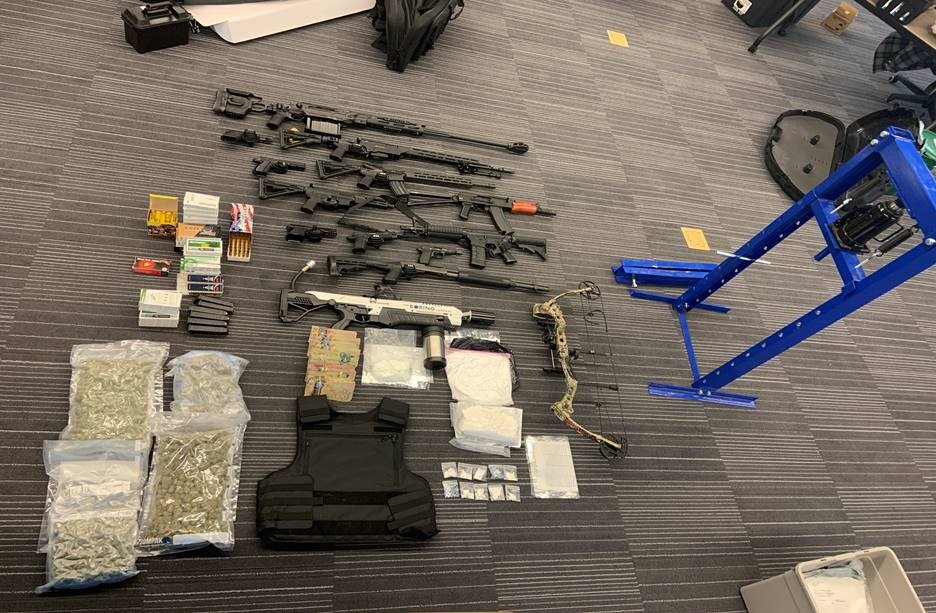
Guelph Police Service lays out items seized including Not a Flamethrower, the novelty item sold by The Boring Company. Image credit: Guelph Police
No company has complete control over what customers do with its products. However, this isn’t the first time a product connected to Musk has been misused.
Tesla, the electric automaker led by Musk, has been criticized for naming its advanced driver assistant system Autopilot and for calling the $10,000 add-on option Full Self-Driving (FSD), even though the driver must remain engaged at all times and is legally liable. A German court has banned the company from using the terms “Autopilot” or “full potential for autonomous driving” on its website or in other marketing materials.
Safety advocates have argued that using terms like Autopilot and FSD misrepresents the capabilities of the system. The name, along with the lack of an in-cabin camera that monitors the driver, has led owners to push well beyond the bounds of the system.
Videos showing Tesla owners misusing Autopilot and FSD abound on YouTube. Some have had run-ins with law enforcement. One Canadian man was charged for sleeping in his Tesla as it drove down the highway.
Eternal flame

Image Credits: Bryce Durbin
John Richardson eventually got his Not a Flamethrower back from the Metropolitan police. He now intends to keep it out of the public eye, at least until it’s worth selling. “I’m happy to sit on it for however long,” he said. “And if there is a zombie apocalypse, at least I’ve got one.”
For now, Craddock remains the only person that TechCrunch can identify as having been incarcerated solely for possessing a Not a Flamethrower. “It was a hair-raising experience,” he said. “I’m in the middle of nowhere in Sardinia, on 24-hour lockdown with an older guy giving off Mafia vibes.”
After nearly a week in prison, Craddock was abruptly handed his belongings (flamethrower aside) and set free. “My lawyer asked the judge, ‘Do you really want to be the guy on international news keeping an American in jail over this toy?’ ” he said. “I think that was the key to getting me out.”
Craddock took the first plane home. He says he now regrets taking the flamethrower abroad, and carrying it in public: “I would have preferred not to have spent that week in an Italian prison, but now I’ve got a hell of a story.”
He also has another flamethrower.
“As soon as I got back, I built myself a new one,” said Craddock. “You can follow YouTube videos with links to all the things you need. It’s pretty simple.”
Source: https://techcrunch.com/2021/01/19/elon-musk-said-it-was-not-a-flamethrower/


