& meet dozens of singles today!
User blogs

A new music platform, Uppbeat, aims to make it easier for YouTubers and other content creators to find quality free music to use in their videos. The system, which is designed to navigate the complexities of copyright claims while also fairly compensating artists, offers an alternative to existing free music platforms, including YouTube’s own Audio Library and Creative Commons’ legal music for videos, for example.
The idea for the startup comes from Lewis Foster and Matt Russell, the U.K.-based co-founders of another music-licensing company, Music Vine, which has been operating for about six years.
Last year, the co-founders realized there was a growing opportunity to address the creator space with a slightly different product.
“We were realizing, more and more, was that the creator space — YouTubers, streamers, podcasters — has become enormous, but there wasn’t a music platform that was doing a nice job for those type of users,” explains Foster. “So we sat down and thought about what the perfect music resource would look like for creators. That led to deciding to build Uppbeat,” he says.
They began developing the Uppbeat website in September 2020 and launched it to the public on Monday.
On the creators’ side, Uppbeat’s key focus is on eliminating headaches over copyright claims, particularly on YouTube.
Currently, if a YouTuber gets a copyright claim over music in their video, it can cause them to lose income. Though YouTube has worked to address this problem over the years with new features and changes to its Content ID match system, it’s still an issue.
“If a YouTuber gets a copyright claim, [YouTube] can de-monetize their video. And if they go through YouTube’s dispute system, it can take as long as 30 days for it to get resolved. It’s a pretty big frustration for YouTubers,” Foster says.
Uppbeat’s music will instead almost instantly clear the claims.
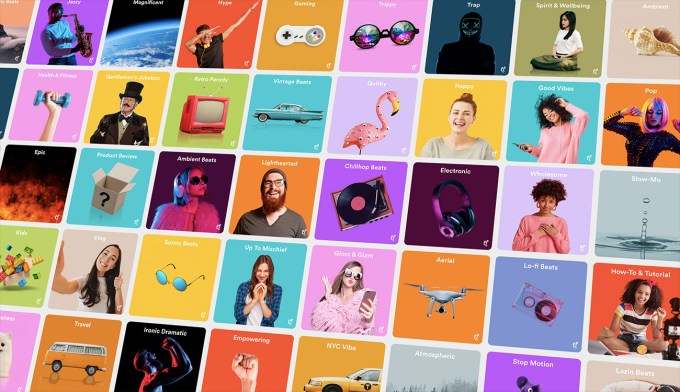
Image Credits: Uppbeat
Similar to Spotify, the Uppbeat website leverages a freemium model, To get started, creators can sign up for a free account that provides access to about 50% of the site’s roughly 1,000-track music catalog and 10 downloads per month. The paid plan offers full catalog access and no download limit.
Free users simply add a credit to their YouTube video description to clear copyright claims, while paid users are added to an approved list, eliminating this extra step.
Because the tracks have to be fingerprinted to fight off unlicensed usage, a copyright claim will still occur. But instead of taking days or weeks to resolve, it will be cleared within about five minutes, the company says. The Uppbeat system clears the claim by checking the video description for the necessary credit and by checking the claim against its list of paid users. This is all automated, too, which helps to speed things up.
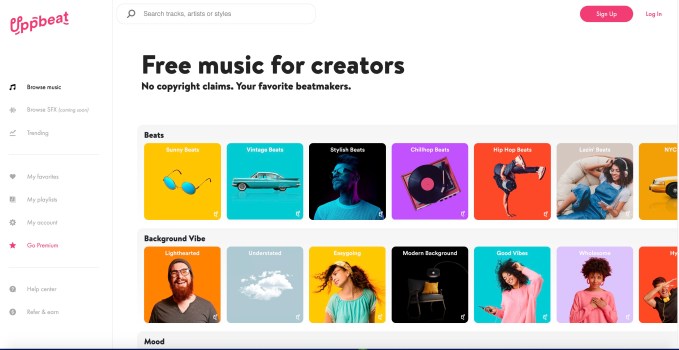
Image Credits: Uppbeat
Meanwhile, on the artists’ side, Uppbeat pays as their music is used — even by the free users.
The revenue from the premium subscriptions, and soon, advertising, is divided between the artists on a monthly basis, in proportion to the number of downloads the artist receives.
“What that means from the artists’ perspective is, on average, they’re going to make the same amount from tracks on the premium side as they do on the free side,” says Lewis. “It means, even for free usage, they will get paid,” he adds.
The site will also monetize through audio ads that play as you browse the tracks and listen to the music. (However, these are just promoting the paid plan for the time being.)
Browsing Uppbeat’s catalog is easy, too. The music is organized by genre, theme and style in colorful rows that aim to introduce all the different types of music and beats a YouTuber may need. For example, there’s music customized for use in the background and other tracks that cater to different moods like inspiring, calm, happy, dramatic and more. A catalog of SFX (sound effects) is expected to be added in a few months, too.
Uppbeat believes its existing music industry connections with producers, composers and songwriters via Music Vine will help them to source higher-quality tracks than other free music services.
At present, the startup is self-funded through revenues from Music Vine, but Foster says they’ve had some VC interest. For now, though, the founders are looking to keep the ownership in-house, for the most part.
However, Uppbeat is experimenting with both a referral program and a profit-sharing scheme. The latter will allow YouTubers who bring Uppbeat new customers, then take the full revenue from those customers for two years’ time.
“We’re taking a massive sacrifice,” Foster admits. “But from from our perspective, the faster we can get Uppbeat out there and well-known in the YouTuber space, then we’re happy to share that [revenue]. We think it’s a cool idea to share that within the YouTuber community, rather than [take] a big private investment,” he notes.
The startup is also considering making shares in the company available to some larger YouTubers, Foster adds.
Today, Uppbeat is a team of eight employees and 12 freelancers, based in Leeds, U.K.
Source: https://techcrunch.com/2021/01/19/uppbeat-launches-a-freemium-music-platform-aimed-at-youtubers/
The European Union is preparing the ground for vaccine passports. A common approach for mutual recognition of vaccination documentation is of the “utmost importance”, the Commission said today, adding that it wants “an appropriate trust framework” to be agreed upon by the end of January — “to allow Member States’ certificates to be rapidly useable in health systems across the EU and beyond”.
“Vaccination certificates allow for a clear record of each individual’s vaccination history, to ensure the right medical follow-up as well as the monitoring of possible adverse effects,” it writes, adding that: “A common EU approach to trusted, reliable and verifiable certificates would allow people to use their records in other Member States. Though it is premature to envisage the use of vaccine certificates for other purposes than health protection, an EU approach may facilitate other cross-border applications of such certificates in the future.”
It’s not clear what form (or forms) these pan-EU coronavirus vaccine certificates will take as yet — but presumably there will be both paper-based and digital formats, to ensure accessibility.
Nor is it clear exactly how EU citizens’ identity and medical data will be protected as checks on vaccination status take place. Or, indeed, who the trusted entities storing and managing sensitive health data will be. All that detail is to come — and may well vary by Member State, depending on how immunity certification verification systems get implemented.
Last week a number of tech companies, including Microsoft, Oracle and Salesforce, announced involvement in a separate, cross-industry effort to establish a universal standard for vaccination status that they said would build on existing standards, such as the SMART Health Cards specification which adheres to HL7 FHIR (Fast Healthcare Interoperability Resources).
That tech-backed effort is pushing for an “encrypted digital copy of [a person’s] immunization credentials to store in a digital wallet of their choice,” with a backup available as a printed QR code that includes W3C-standards verifiable credentials for those not wanting or able to use a smartphone. The PR also talked about a “privacy-preserving health status verification” solution that is at least in part “blockchain-enabled.”
Nothing so specific is being proposed for the common EU approach as yet. And it looks clear that a number of vaccine credential standards will be put forward globally — as a potential universal standard. (The Commission is touting its forthcoming framework on that front too.)
Whatever is devised in the EU must ensure compliance with the region’s data protection framework (which bakes in requirements for security and privacy by design and default when processing people’s information). So it could offer better privacy protection than a private sector-led effort, for example.
The EU’s eHealth Network — a body which includes representatives from relevant Member States’ authorities who are supported by a wider European Joint Action body, called eHAction — will be responsible for defining the minimum dataset needed for vaccination certificates used at the EU level, per the Commission.
It says this must include “a unique identifier and an appropriate trust framework ensuring privacy and security”.
Expect relevant stakeholders such as Europe’s Data Protection Supervisor and Data Protection Board to weigh in with expert advice, as happened last year with coronavirus contacts tracing apps.
“The Commission will continue to work with Member States on vaccination certificates which can be recognised and used in health systems across the EU in full compliance with EU data protection law — and scaled up globally through the certification systems of the World Health Organisation,” EU lawmakers add, saying the forthcoming framework will be presented in the WHO “as a possible universal standard”.
Commenting in the challenges ahead for developing privacy-safe vaccination verification, Lukasz Olejnik, a Europe-based independent cybersecurity and privacy researcher and consultant, told TechCrunch: “It is tricky to follow privacy by design for this particular [use-case]. It is unclear if anyone will be interested in identifying possible innovative privacy-preserving frameworks such as anonymous cryptographic credentials.
“In the end perhaps we will end up with some approach using verifiable credentials, but establishing trust will remain a challenge. What will be the source of trust? Is it possible to prove a particular status without the need to disclose the user identity? These are the core questions.”
“I hope this proposal will be public and transparent,” he added of the EU framework.
It’s worth emphasizing that all this effort is a bit ‘cart before the horse’ at this stage — being as it’s still not confirmed whether any of the currently available COVID-19 vaccinations, which have been developed primarily to protect the recipient from serious illness, also prevent transmission of the disease or not.
Nonetheless, systems for verifying proof of immunization status are fast being spun up — ushering in the possibility of ‘vaccine passport’ checks for travellers within the EU down the road, for example. It’s also not hard to envisage businesses requesting COVID-19 vaccination certification before granting access to a physical facility or service, in a bid to reassure customers they can spend money safety — i.e. once such documentation exists and can be verified in a standardized way.
Standardized frameworks for vaccination credentials could certainly have very broad implications for personal freedoms in the near future, as well as wide ramifications for privacy — depending on how these systems are architected, managed and operated.
Europe’s privacy and security research community mobilized heavily last year as the pandemic triggered early proposals to develop coronavirus contacts tracing apps — contributing to a push for exposure notification apps to be decentralized to ensure privacy of individuals’ social graph. However efforts toward establishing vaccination certification systems don’t appear to have generated the same level of academic engagement as yet.
In an analysis of the implications of immunity certificates, published last month, Privacy International warned that any systems that require proof of vaccination for entry or a service would be unfair “until everyone has access to an effective vaccine” — a bar that remains far off indeed.
European countries, which are among the global leaders on COVID-19 vaccination rollouts, have still only immunized tiny minorities of their national populations so far. (Even as the Commission today urged Member States to set targets to vaccinate a minimum of 80% of health and social care professionals and people over 80 by March 2021; and at least 70% of the total adult population by summer — targets which look like fantastical wishful thinking right now.)
“Governments must find alternatives to delivering vaccination schemes which do not perpetuate and reinforce exclusionary and discriminatory practices,” the rights group further urged, also warning that COVID-19 immunity should not be used as a justification for expanding or instating digital identity schemes.
Source: https://techcrunch.com/2021/01/19/europe-is-working-on-a-common-framework-for-vaccine-passports/
Many VCs historically avoided placing bets on hit-driven mobile gaming content in favor of clearer platform opportunities, but as more success stories pop up, the economics overturned conventional wisdom with new business models. As more accessible infrastructure allowed young studios to become more ambitious, venture money began pouring into the gaming ecosystem.
After tackling topics including how investors are looking at opportunities in social gaming, infrastructure bets and the moonshots of AR/VR, I asked a group of VCs about their approach to mobile content investing and whether new platforms were changing perspectives about opportunities in mobile-first and desktop-first experiences.
While desktop gaming has evolved dramatically in the past few years as new business models and platforms take hold, to some degree, mobile has been hampered. Investors I chatted with openly worried that some of mobile’s opportunities were being hamstrung by Apple’s App Store.
“We are definitely fearful of Apple’s ability to completely disrupt/affect the growth of a game,” Bessemer’s Ethan Kurzweil and Sakib Dadi told TechCrunch. “We do not foresee that changing any time in the near future despite the outcry from companies such as Epic and others.”
All the while, another central focus seems to be the ever-evolving push toward cross-platform gaming, which is getting further bolstered by new technologies. One area of interest for investors: migrating the ambition of desktop titles to mobile and finding ways to build cross-platform experiences that feel fulfilling on devices that are so differently abled performance-wise.
Madrona’s Hope Cochran, who previously served as CFO of Candy Crush maker King, said mobile still has plenty of untapped opportunities. “When you have a AAA game, bringing it to mobile is challenging and yet it opens up an entire universe of scale.”
Responses have been edited for length and clarity. We spoke with:
- Hope Cochran, managing director, Madrona Venture Group
- Daniel Li, partner, Madrona Venture Group
- Ethan Kurzweil, partner, Bessemer Venture Partners
- Sakib Dadi, investor, Bessemer Venture Partners
- Alice Lloyd George, founding partner, Rogue VC
- Gigi Levy-Weiss, general partner, NFX
Hope Cochran and Daniel Li, Madrona Venture Group
Does it ever get any easier to bet on a gaming content play? What do you look for?
Hope Cochran: I feel like there are a couple different sectors in gaming. There’s the actual studios that are developing games and they have several approaches. Are they developing a brand new game, are they reimagining a game from 25 years ago and reskinning it, which is a big trend right now, or are they taking IP that is really trendy right now and trying to create a game around it? There are different ways to predict which ones of those might make it, but then there’s also the infrastructure behind gaming and then there’s also identifying trends and which games or studios are embracing those. Those are some of the ways I try to parse it out and figure out which ones I think are going to rise to the top of the list.
Daniel Li: There’s this single-player narrative versus multiplayer metaverse and I think people are more comfortable on the metaverse stuff because if you’re building a social network and seeing good early traction, those things don’t typically just disappear. Then if you are betting more on individual studios producing games, I think the other thing is we’re seeing more and more VCs pop up that are just totally games-focused or devoting a portion of the portfolio to games. And for them it’s okay to have a hits-driven portfolio.
There seems to be more innovation happening on PC/console in terms of business models and distribution, do you think mobile feels less experimental these days? Why or why not?
Hope Cochran: Mobile is still trying to push the technology forward, the important element of being cross-platform is difficult. When you have a AAA game, bringing it to mobile is challenging and yet it opens up an entire universe of scale. The metrics are also very different for mobile though.
Daniel Li: It seems like the big monetization innovation that has happened over the last couple of years has been the “battle pass” type of subscription where you can unlock more content by playing. Obviously that’s gone over to mobile, but it doesn’t feel like mobile has had some sort of new monetization unlock. The other thing that’s happened on desktop is the success of the “pay $10 or $20 or $20 for this indie game” type of thing, and it feels like that’s not going to happen on mobile because of the price points that people are used to paying.
Alice Lloyd George, Rogue VC
Source: https://techcrunch.com/2021/01/19/6-investors-on-2021s-mobile-gaming-trends-and-opportunities/
Apple today announced a new editorial franchise called Apple Podcasts Spotlight, which aims to highlight rising podcast creators in the U.S. The editorial team at Apple will select new podcast creators to feature every month and then give them prominent screen real estate in the Apple Podcasts app and promote them across social media and elsewhere. This will allow creators to reach a wider audience, similar to how the App Store showcases a selection of recommended apps and games with large banners at the top of its screen.
The first Spotlight creator is Chelsea Devantez, who hosts the podcast Celebrity Book Club. On Fridays, Chelsea and special guests including Emily V. Gordon, Gabourey Sidibe, Ashley Nicole Black and Lydia Popovich will meet to discuss the memoirs of “badass celebrity womxn,” as an announcement describes it.
The idea for the show began a year ago when Devantez was reading Jessica Simpson’s memoir and started recapping it on Instagram. The reaction from her followers prompted her to expand the concept into a podcast.
Upcoming episodes will feature Oscar-nominated writer and producer Emily V. Gordon talking Drew Barrymore’s “Little Girl Lost;” actress Stephanie Beatriz discussing Celine Dion’s memoir “My Story My Dream;” Leighton Meester on Carly Simon’s “Boys in the Trees;” and a special Valentine’s Day episode where Chelsea and TikTok star Rob Anderson read Burt Reynolds’ and Loni Anderson’s competing divorce memoirs.
“Apple Podcasts Spotlight helps listeners find some of the world’s best shows by shining a light on creators with singular voices,” said Ben Cave, Global Head of Business for Apple Podcasts, in a statement about the launch. “Chelsea Devantez has created a fun, vibrant space with Celebrity Book Club for listeners to gain new perspectives on the celebrities we thought we knew. We are delighted to recognize Chelsea and Celebrity Book Club as our first Spotlight selection and look forward to introducing creators like Chelsea to listeners each month,” he added.
Apple says future Spotlight creators will be announced monthly from across a range of podcast genres, formats and locations, and will often focus on independent and underrepresented voices. The content is previewed ahead of selection to ensure quality, but there are no specific requirements about the podcast size and reach.
In general, the new Spotlight creators will debut toward the front of the week, but the specific days are fluid to adapt to holidays, major cultural events, and others. The next Spotlight selection, for example, will launch in mid-February.
The Spotlight creators will be featured at the top of the Browse tab of Apple Podcasts and will be promoted through the Apple Podcasts social media accounts. Some form of in-app featuring will continue throughout the entire month the creators are in the “spotlight.”
Apple says it will also collaborate with the featured creators on their own channels. And, over time, you’ll see promotion via additional Apple-operated channels including outdoor advertising in major U.S. metros.
The news of the new editorial program comes shortly after a report from The Information suggested Apple is working to expand its podcasts platform with the introduction of a podcast subscription service, threatening rivals like Spotify, SiriusXM and Amazon.
Though Apple Podcasts still leads the market, Spotify has been catching up by spending over $800 million on podcast companies, like Anchor, the Ringer, Gimlet Media, and more recently, podcast ad company Megaphone.
SiriusXM, meanwhile, bought podcast management and analytics platform Simplecast, ad tech platform AdsWizz, and podcast app Stitcher. Not to be left out, Amazon just a few weeks ago announced it was acquiring the podcast network Wondery.
Beyond helping the creators grow their audience, Apple says the larger goal with the program is to welcome new audiences to podcasts, in general.
Though podcasts are growing in popularity, the monthly podcast listener base is just 37% in the U.S., according to Edison Research. That means it’s nowhere near being an activity that’s popular among a majority of the U.S. population at this time. Before Apple can effectively monetize podcasts as a subscription service, it needs to help get more people listening to podcasts on a regular basis.
Apple declined to say if the program would expand outside the U.S. at a later date.
Like so many other subjects, the ongoing COVID-19 pandemic has brought concerns about the gig economy and contract workers into sharp focus over the past year which is why we’ll be diving into this topic at TC Sessions: Justice on March 3.
From food delivery services like Seamless to warehouse and fulfillment jobs at places like Amazon, these often low-paid jobs have kept people supplied with essentials during one of the most difficult moments in modern American history.
But why is it that jobs our society has labeled “essential” often carry the least number of protections for those who fulfill them? Is there a way to ensure a safety net for the people who need it the most?
As the pandemic continued to rage, California passed Proposition 22. The law was regarded as a big win for companies like Uber and Lyft (who pumped a collective $200 million into promotions) and a tremendous step back for workers looking for basic employment rights. But the battle between the Prop 22 proponents and the gig workers who oppose it continues. A group of rideshare drivers in California and the Service Employees International Union have filed a lawsuit alleging Proposition 22 violates California’s constitution.
To discuss the gig worker economy and its future in a post-Prop 22 world, we will be joined by Jessica E. Martinez, the co-executive director of the National Council for Occupational Safety and Health, an organization devoted to promoting health and safety conditions for workplaces; Vanessa Bain, a gig worker activist who co-founded the Gig Workers Collective; and Christian Smalls, a former Amazon worker turned activist.
TC Sessions: Justice will be held online on March 3. Get your tickets today!


