& meet dozens of singles today!
User blogs

TikTok has until Friday to respond to an order by Italy’s data protection agency to block users whose age it cannot verify, TechCrunch has learned.
The GPDP made an ‘immediate’ order Friday in response to the death of a 10-year-old girl from Palermo who died of asphyxiation after participating in a ‘blackout challenge’ on the social network, according to reports in local media.
The agency said the ban would remain place until February 15 — suggesting it would make another assessment about any additional action at that point.
At the time of writing it does not appear that TikTok has taken action to comply with the GPDP’s order.
A spokeswoman told us it is reviewing the notification. “We have received and are currently reviewing the notification from Garante,” she said. “Privacy and safety are top priorities for TikTok and we are constantly strengthening our policies, processes and technologies to protect all users, and our younger users in particular.”
The GPDP had already raised concerns about children’s privacy on TikTok, warning in December that its age verification checks are easily circumvented and raising objections over default settings that make users’ content public. On December 22 it also announced it had opened a formal procedure — giving TikTok 30 days to respond.
The order to block users whose age it cannot verify is in addition to that action. If TikTok does not comply with the GPDP’s administrative order it could face enforcement from the Italian agency, drawing on penalty powers set out in the GDPR.
TikTok’s spokeswoman declined to answer additional questions about the order — which prohibits it from further processing user data “for whom there is no absolute certainty of age”, per GPDP’s press release Friday.
The company also did not respond when we asked if it had submitted a response to the agency’s formal procedure.
In a statement last week following the girl’s death the company said: “Our deepest sympathies are with the girl’s family and friends. At TikTok, the safety of our community — in particular our younger users — is our priority, and we do not allow content that encourages, promotes, or glorifies dangerous behaviour that might lead to injury. We offer robust safety controls and resources for teens and families on our platform, and we regularly evolve our policies and protections in our ongoing commitment to our community.”
TikTok has said it has found no evidence of any challenge involving asphyxiation on its platform.
Although, in recent years, there have been a number of previous reports of underage users hanging themselves (or attempting to) after trying to copy things they saw on the platform.
Users frequently create and respond to content challenges, as part of TikTok’s viral appeal — such as (recently) a trend for singing sea shanties.
At the time of writing, a search on the platform for ‘#blackoutchallenge’ returns no user content but displays a warning that the phrase “may be associated with behavior or content that violates our guidelines”.
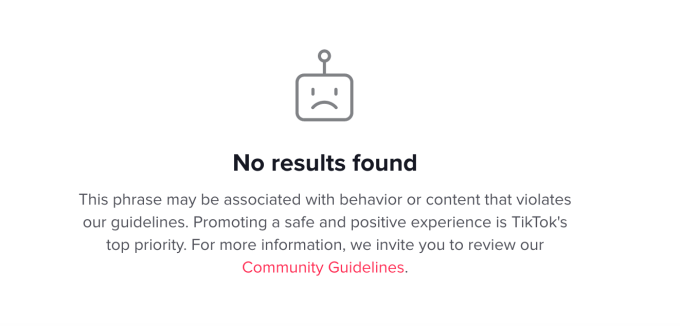
Screengrab of the warning users see if they search for ‘blackout challenge’ (Image credit: TechCrunch)
There have been TikTok challenges related to ‘hanging’ (as in people hanging by parts of their body other than their neck from/off objects) — and a search for #hangingchallenge does still return results (including some users discussing the death of the 10-year-old girl).
Last year a number of users also participated in an event on the platform in which they posted images of black squares — using the hashtag #BlackOutTuesday — which related to Black Lives Matters protests.
So the term ‘blackout’ has similarly been used on TikTok in relation to encouraging others to post content. Though not in that case in relation to asphyxiation.
Ireland’s Data Protection Commission, which has been lined up as TikTok’s lead data supervisor in Europe — following the company’s announcement last year that its Irish entity would take over legal responsibility for processing European users’ data — does not have an open inquiry into the platform “at present”, per a spokesman.
But TikTok is already facing a number of other investigations and legal challenges in Europe, including an investigation into how the app handles users data by France’s watchdog CNIL — announced last summer.
In recent years, France’s CNIL has been responsible for handing out some of the largest penalties for tech giants for infringing EU data protection laws (including fines for Google and Amazon).
In December, it also emerged that a 12-year-old girl in the UK is bringing a legal challenge against TikTok — claiming it uses children’s data unlawfully. A court ruled she can remain anonymous if the case goes ahead.
Last month Ireland’s data protection regulator put out draft guidelines on what it couched as “the Fundamentals for a Child-Oriented Approach to Data Processing” — with the stated aim of driving improvements in standards of data processing related to minors.
While the GDPR typically requires data protection complaints to be funnelled through a lead agency, under the one-stop-shop mechanism, Italy’s GPDP’s order to TikTok to cease processing is possible under powers set out in the regulation (Article 66) that allow for ‘urgency procedures’ to be undertaken by national watchdogs in instances of imperative risk.
Although any such provisional measures can only last for three months — and only apply to the country where the DPA has jurisdiction (Italy in this case). Ireland’s DPC would be the EU agency responsible for leading any resulting investigation.


Wolt, the Helsinki-based online ordering and delivery company that initially focused on restaurants but has since expanded to other verticals, has raised $530 million in new funding. The round was led by Iconiq Growth, with participation from Tiger Global, DST, KKR, Prosus, EQT Growth and Coatue.
Previous backers 83North, Highland Europe, Goldman Sachs Growth Equity, EQT Ventures and Vintage Investment Partners also followed on. The new round takes the total amount of financing Wolt has raised to $856 million. Wolt declined to disclose the company’s latest valuation, although we know from the previous D round that the company is one of Europe’s so-called unicorns.
“We operate in an extremely competitive and well-funded industry, and this round allows us to have a long-term mindset when it comes to doubling down on our different markets,” says co-founder and CEO Miki Kuusi in a statement. “Despite the turbulence of 2020, we’ve remained focused on growth, tripling our revenue to a preliminary $330 against a net loss of just $38 million. Compared to the $670 million in new capital that we’ve raised during this year, this puts us into a strong position for investing in our people, technology, and markets when thinking about the next few years ahead”.
Since launching with 10 restaurants in its home city in 2015, five years on Wolt has expanded to 23 countries and 120 cities, mostly in Europe but also including Japan and Israel. More recently, like others in the restaurant delivery space, Wolt has expanded beyond restaurants and takeout food into the grocery and retail sectors. This, says the company, sees it offer anything from cosmetics to pet food and pharmaceuticals on its platform.
“This was mostly a primary raise,” Kuusi tells me when I ask if the new round includes secondary funding (i.e. shareholders that exited to new investors). “We’re not looking to disclose the valuation at this time, but we’ve previously shared that the Series D round that we raised in early 2020 valued that company at above €1 billion,” he adds.
Kuusi says that the latest funding round is based on the belief that local services in the offline world will gradually be brought online by players “that can execute and maintain a great customer experience”. “We started with an exclusive focus on the restaurant, as it’s the biggest local service with an underlying high-frequency use case,” he says. “We quickly learnt that the magical product market fit for bringing the restaurant online was to offer a quick and predictable delivery experience from restaurants that didn’t use to be available for delivery. We do this by handling the complexity of the delivery on the restaurant’s behalf”.
However, this was especially difficult to do efficiently and sustainably in small and difficult home market in the Nordics. To solve this, Wolt needed to build an “optimization-heavy logistics setup for last-mile delivery” that Kuusi says lets the service operate even in “very small cities with low income disparity, limited population density and high labor costs”.
“This means that we can operate efficiently even with relatively low order volumes, enabling us to grow and expand rapidly with much less financing than some of the other players in the market. We simply had no other choice than to do it this way was we came from such a difficult home market”.
On this foundation, Wolt is expanding into other ordering and local delivery verticals, aiming to be what Kuusi dubs as “the everything app” of goods and services. “Today, Wolt is much more than a restaurant delivery service, you can order groceries, electronics, flowers, clothes and many other things on our platform,” he explains. “We believe that the future of how people buy Nike shoes is a few taps on Wolt and some 30 minutes later you get any pair of shoes brought to your door. This is what we strive to make into a reality with our team at Wolt”. (I’m an Adidas guy myself, steadfastly European.)
Asked what he thinks about all the money being pumped into the dark convenience store model, Kuusi says Wolt is investing into its own dark store operation called Wolt Market. “It’s not surprising to also see a growing amount of financing going into this sector,” he admits. “We’re huge believers in a hybrid model where there will be both offline/online retailers as well as focused online retailers in the mix. Obviously the latter category is only getting started, and we should see a massive amount of growth for the coming years ahead”.
Taboola is the latest company seeking to go public via special purpose acquisition corporation — more commonly known as a SPAC.
To achieve this, it will merge with ION Acquisition Corp, which went public in 2020 with the aim of funding an Israeli tech acquisition (Haaretz reported last month that Taboola was in talks with ION). The transaction is expected to close in the second quarter, and the combined company will trade on the New York Stock Exchange under the ticker symbol TBLA.
Founded in 2007, Taboola powers content recommendation widgets (and advertising on those widgets) across 9,000 websites for publishers including CNBC, NBC News, Business Insider, The Independent and El Mundo. It says it reaches 516 million daily active users while working with more than 13,000 advertisers.
The company had previously planned to merge with competitor Outbrain before the deal was canceled last fall, with sources pointing to the market impact of the COVID-19 pandemic, a “challenging culture fit” and regulatory issues to explain the deal’s end.
Taboola’s founder and CEO Adam Singolda (pictured above) told me that this didn’t lead directly the SPAC deal. But he said, “I always wanted to go public,” which wasn’t possible while the merger was in the works. Once that deal was called off, and with 2020 turning out to be a strong year for Taboola — it’s projecting revenue of $1.2 billion, including $375 million ex-TAC revenue (revenue after paying publishers), with over $100 million in adjusted EBITDA — the time seemed right, and ION seemed like the right partner.
“We believe Taboola is an open web recommendation leader which is well positioned to challenge the walled gardens,” said ION CEO Gilad Shany in a statement. “We were looking to merge with a global technology leader with Israeli DNA and we found that in Taboola. The combination of long-term partnerships built by the company with thousands of open web digital properties, their direct access to advertisers, massive global reach and proven AI technology, allows Taboola to provide significant value to their partners while also achieving attractive unit economics as the company grows.”
The deal will value Taboola at $2.6 billion. Through this transaction, the company plans to raise a total of $545 million, including $285 million in PIPE financing secured from Fidelity Management & Research Company, Baron Capital Group, funds and accounts managed by Hedosophia, the Federated Hermes Kaufmann Funds and others.
Singolda said that the company plans to invest $100 million in R&D this year, and that he hopes to expand the technology into areas like e-commerce and TV advertising, with the goal of moving “beyond the browser.” More broadly, he said he wants Taboola to be be “a strong public company that champions the open web.”
“The open web is a $64 billion advertising market [according to Taboola estimates], but there’s no Google for the open web,” he said.
Yes, Google itself spends plenty of time talking about similar ideas, but Singolda argued that while Google has consumer products like search and YouTube that compete with other publishers for time and attention, “Taboola is not in the consumer business … We serve our partners, and it’s in our identity to drive audience growth, engagement and revenue.”
Source: https://techcrunch.com/2021/01/25/taboola-is-going-public-via-spac/
Google said today it is taking several steps to help with COVID-19 vaccine distribution in the United States, including grants and opening its facilities to vaccination programs. The tech giant is among several other large corporations, including Amazon, Walmart, Starbucks and Microsoft, that have pledged support to local government agencies and medical providers to help increase vaccinations.
Google will pledge ad grants and funding worth a total of $150 million to health organizations and public health agencies to promote vaccine education. It will also provide support for vaccine distribution by making Google facilities available, including buildings and parking lots.
The company said it partnering with One Medical and public health authorities to open vaccination sites in Los Angeles and the San Francisco Bay Area in California; Kirkland, Washington; and New York City, with more sites planned in the U.S. depending on vaccine availability. Its technology, including the Intelligent Vaccine Impact Platform, is being used to help with logistics planning for vaccine distribution.
In terms of funding, about $100 million will be part of Google’s Ad Grants Crisis Relief program, and go to non-profits like the CDC Foundation and the World Health Organization. Another $50 million will be invested “in partnership with public health agencies to reach underserved communities with vaccine-related content and information,” the company said. Google.org has committed about $5 million in grants to organizations focused on access to vaccines among people of color and in rural areas, including the Morehouse School of Medicine’s Satcher Health Leadership Institute and the CDC Foundation.


