& meet dozens of singles today!
User blogs

Automating and controlling devices and energy usage in homes has potentially become a bit easier thanks to an integration between Span, the startup making a digital fusebox replacement, and Amazon’s voice recognition interface, Alexa.
The integration also comes with a $20 million new cash infusion from Amazon’s Alexa Fund and the massive insurance company Munich Re Ventures’ HSB Fund.
Through the Alexa integration, homeowners using Span’s electrical panels can turn on or off any circuit or appliance in their home, monitor which appliances are using power, and determine which electrical source is generating the most power for a home.
Questions like “Alexa, ask Span what is consuming the most power right now?” will get a response. The Alexa integration opens up new opportunities for home owners to integrate their devices and appliances, because of the connection to the home’s wiring, according to Span chief executive, Arch Rao.
Rao sees the Alexa integration as a way for Span to become the home automation hub that tech companies have been promising for a long time. “There are far too many devices in the hoe today… with too many apps,” Rao said. “The advantage we have is, once installed, we’re persistent in the home and connected to everything electric in the home for the next 30 to 40 years.”
In addition to monitoring energy usage and output, Alexa commands could turn off the power for any device or switch that a homeowner has programmed into the system.
“The most material way to state it is, our panel is providing a virtual interface to the home in the build environment,” said Rao. “We’re building a very capable edge device… it becomes sort of a true aggregation point and nerve center to give you real-time visibility and control.”
Going forward, Rao envisions Span integrating with other devices like water sensors, fire alarm sensors, and other equipment to provide other types of controls that could be useful for insurers like Munich Re.
With the $20 million that the company raised, Rao intends to significantly increase sales and marketing efforts working through partners like Munich Re and Amazon to get Span’s devices into as many homes as possible.
The company has significant tailwinds thanks to home automation and energy efficiency upgrade efforts that are now wending their way through Washington, but could mean subsidies for the deployment of technology’s like Span’s electric panels.
Rao also intends to boost headcount at Span. The company currently has 35 employees and Rao would like to see that number double to roughly 70 by the end of the year.
Span’s growth is part of a broad movement in home technologies toward increasingly sustainable options. In many cases that’s the penetration of electrical appliances in things like water heaters and stove tops, but also the integration of electric vehicle charging stations, home energy storage units, and other devices that push energy generation and management to the edge of electricity grids.
“It’s cutting that pipe that’s bringing natural gas to the home and bringing all electric everything… as consumers are continuing to cut the cord on fossils, your existing home system is not efficient. That’s one ecosystem of products where we are starting to see partnership opportunities,” Rao said. “When it comes to applications like monitoring the health of your appliances… and services to the home. Having the data that we provide will be unprecedented.”
5G is the current revolution in wireless technology, and every chip company old and new is trying to burrow their way into this ultra-competitive — but extremely lucrative — market. One of the most interesting new players in the space is EdgeQ, a startup with a strong technical pedigree via Qualcomm that we covered last year after it raised a nearly $40 million Series A.
The company has been quite stealthy about its technology as it works on its design (its website as I write this literally says “Welcome to WordPress. This is your first post. Edit or delete it, then start writing!”), but today, the company revealed more details for the first time (and presumably also updated its website).
The most interesting facet of its system-on-a-chip (SoC) design is that it is based on RISC-V. Unlike processor architectures like x86 and Arm, RISC-V is open-source, and one of the first open architectures to reach any sort of enduring popularity and ecosystem. That’s led to a bunch of new companies building on top of it, including now EdgeQ and also SiFive, which we covered late last year.
Vinay Ravuri, EdgeQ’s founder and CEO, explained that the use of RISC-V allows EdgeQ to offer chips with the flexibility of reprogrammable processors known as FPGAs while also offering a more cohesive and integrated product with better power savings. In his view, that’s been one of the big challenges in the wireless communications market to date with the rollout of 5G.
“When you are in a closed system, it compacts nicely, and everything matches,” he said, pointing to market leaders like Huawei and Ericsson whose vertically-integrated base stations are widely deployed throughout the world. The problem is that customers feel stifled by having all of their equipment come from one, irreplaceable vendor. Meanwhile, with a purely open system based on standards like OpenRAN, “you get a clunky solution” that’s cobbled together from off-the-shelf parts. That leads to increased power consumption since the components in these boxes were never faithfully designed to be used together.
Ravuri says that EdgeQ stands in the middle between open and closed, offering an extensible system that is also integrated and may save, in some instances, up to 50% of the power demand for a wireless base station. The key is combining machine learning into wireless communications through a better SoC and having all the parts work seamlessly together. “The uniqueness of the communications chips is in the algorithms,” he said. “You are not selling sand, you are not connecting gates and saying this is a processor. You are connecting gates and here is an algorithm for the physical layer of communications.”

EdgeQ founder and CEO Vinay Ravuri. Photo via EdgeQ.
Adil Kidwai, who is VP and head of product at EdgeQ, said that “Under the hood, it is hardware instructions that are controlled by software … It’s a ‘soft’ modem with very low power consumption.” Since EdgeQ is based on RISC-V, the existing toolchain available in that ecosystem also applies to the company’s product, allowing engineers to use compilers and debuggers that have been built for RISC-V. Ravuri noted that EdgeQ has added about 50 to 100 of its own vector extensions to the base RISC-V implementation to optimize performance.
With the product’s design more firmly established, he said that the company is looking to sample its system with customers in the first half of this year. “Once we sample, there is a productization cycle that customers take,” he said, and he intends to be starting revenue growth by 2022. The EdgeQ base station is compatible according to the company with OpenRAN option 7.x and option 6.
The company also noted for the first time today that Paul Jacobs, the former CEO of Qualcomm, and Matt Grob, the company’s former CTO, have both joined EdgeQ’s advisory board in an official capacity. The two met Ravuri back when he was at Qualcomm and have been in touch throughout EdgeQ’s development.
Source: https://techcrunch.com/2021/01/26/edgeq-reveals-more-details-behind-its-next-gen-5g-ai-chip/
Many people want to develop better screen-time habits, but don’t have a good set of tools to do so. A new startup, Opal, aims to help. The company, now backed by $4.3 million in seed funding, has developed a digital well-being assistant for iOS that allows you to block distracting websites and apps, set schedules around app usage, lock down apps for stricter and more focused quiet periods, and more.
The service works by way of a VPN system that limits your access to apps and sites. But unlike some VPNs on the market, Opal is committed to not collecting any personal data on its users or their private browsing data. Instead, its business model is based on paid subscriptions, not selling user data, it says.
Timed with its public debut, Opal also today announced its initial financing in a round led by Nicolas Wittenborn at Adjacent, a mobile-focused VC fund. Other investors included Harry Stebbings, Steve Schlafman, Alex Zubillaga, Kevin Carter, Thibaud Elziere, Jean-Charles Samuelian-Werve, Alban Denoyel, Isai, Secocha Ventures, Speedinvest, and others.

Image Credits: Opal, founder Kenneth Schlenker
The idea for Opal comes from Paris-based Kenneth Schlenker, a longtime technologist who previously founded and sold an art marketplace startup ArtList and later led mobility company Bird’s expansion in France.
Schlenker, who grew up in a small, quiet village in the Alps, says he got into technology at a young age.
“I sort of got obsessed, like many of us, by the potential of technology and its amazing power of attraction — making connections, learning new things, all sorts of incredible opportunities,” he explains. “But I’ve then spent the last 10 years and more trying to seek a balance between this need for connection and this need for disconnection.”
In more recent years, Schlenker came to realize that others were having the same problem, including those outside the tech industry. That drove him to build Opal, with the goal of helping people better achieve balance in their lives so they could reconnect with loved ones, spend time in nature or just generally go offline to focus on other areas of their lives.
At a basic level, Opal’s VPN allows users to block themselves from using dozens of distracting apps and sites for certain periods of time, including social media, news, productivity apps and more.
Social media, in particular, has been a huge problem in recent years, Schlenker says.
“In particular, Instagram, Facebook and Twitter — social media is where you feel like you’re learning something, and you feel like you’re connecting with people. So it’s good. But on the other hand, it’s very hard to stay intentional,” he explains. “It’s okay to pick up your phone and go to Instagram, but when you ‘wake up’ 30 minutes later, you usually feel really bad. You feel like, ‘where’s the time gone?’, ‘what did I just do?,’ ” he says.
Opal addresses this problem through a handful of features.
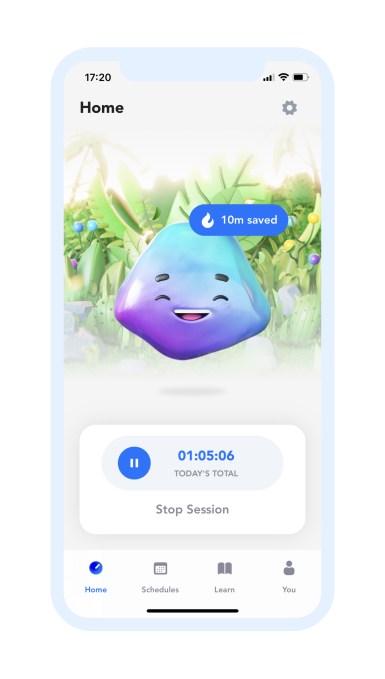
Image Credits: Opal
The free service allows you to block distracting websites and apps and take breaks throughout the day. By upgrading to the paid membership, Opal users can schedule time off from apps to establish recurring downtimes — whether that’s for family dinners or working hours, or anything else. They also can use a more extreme version of this feature called Focus Mode, which locks you out of apps in a way that’s not cancelable.
While the company is using a VPN to make this system work, it’s being transparent and straightforward about its data collection practices.
“There is zero private browsing data that leaves your phone,” Schlenker insists. “Anything you do on your phone outside of Opal’s app stays local on your phone and is never stored on any of our servers or any other servers. That’s very important to us,” he says.
From inside Opal’s app, the company claims it only collects usability and crash information — not browsing data. And the usability data is completely anonymized for another layer of privacy. Opal also doesn’t require an email to begin using the app. It only asks for one if you choose to pay.
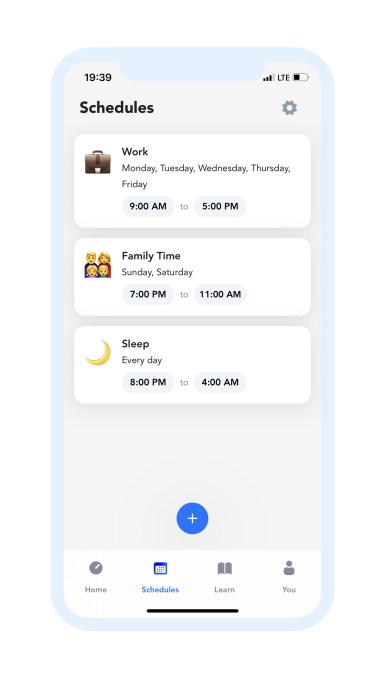
Image Credits: Opal
These core principles are also documented on Opal’s privacy page, and are why Schlenker believes his app won’t face the challenges that other screen-time apps on the App Store have experienced in the past.
As you may recall, Apple cracked down on the screen time app industry a couple of years ago — a move Apple said was focused on protecting user privacy, but has also been raised as a possible example of anticompetitive behavior. Many of the apps at the time had been using techniques Apple claimed put consumers’ privacy and security at risk, as they gave third-parties elevated access to users’ devices. This was particularly concerning because many of the impacted apps were marketed as parental control services — meaning the end users were often children.
Opal, meanwhile, is targeting adults, and perhaps teenagers, who want to develop better screen-time habits. It is not selling this as a parental control system, however.
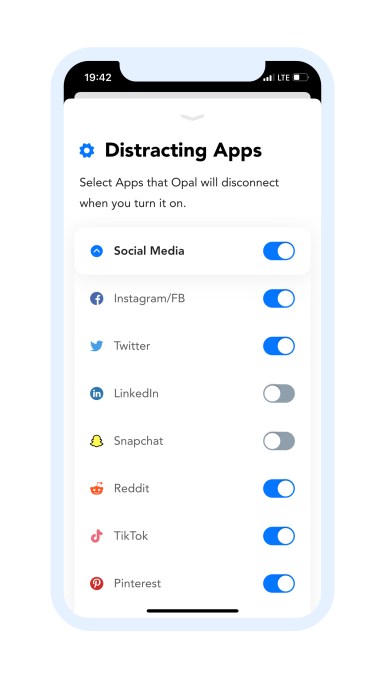
Image Credits: Opal
At launch, Opal can block over 100 apps and sites across several categories, including Facebook, Instagram, Snapchat, TikTok, Reddit, Pinterest, YouTube, Netflix, Twitch, Gmail, Outlook, Slack, Robinhood, WhatsApp, WeChat and others, including those in the news, adult and gambling categories.
Users can choose to block the apps for short breaks — 5, 10 or 60 minutes — throughout the day. You can also set an intention and set a timer before using an app, to help you avoid the issue of losing track of time. And you can set focus timers or scheduled times to automatically shut off app usage.
You can track your progress by viewing the “time saved” and you can share your successes across social media. In time, Schlenker plans to add more of a scoring mechanism to Opal that will help you stay accountable to your original goals.
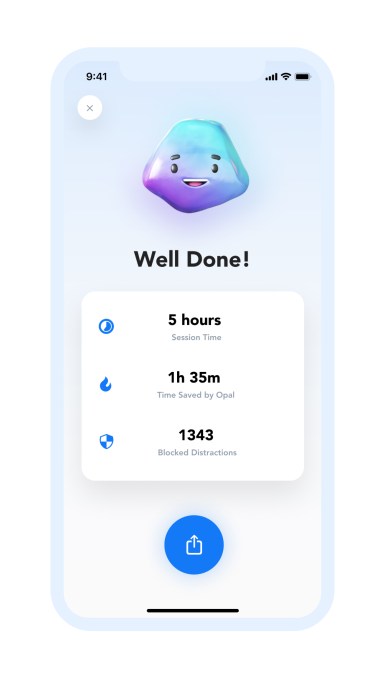
Image Credits: Opal
Though work on the app only began in 2020, Opal began attracting attention as it publicized its plans on Twitter and ran its private beta, which grew from hundreds to thousands of users this year, saving its users an average of two hours per day.
Though Schlenker had connections with many of the angel investors who have since backed Opal, he says the interest from institutional and larger investors was all inbound.
“It was not our intention to raise so much, so early,” Schlenker notes.
The funds will be used to help Opal grow its team, particularly engineering, design as well as product. The company will also soon launch a version of Opal for Chrome and later, Android, and will experiment with more social features around sharing and hosting group sessions.
The app is currently a free download on the App Store with an optional $59.99/year subscription plan.


Twitter is getting into the newsletter business.
The social media company is announcing that it has acquired Revue, a Dutch startup that allows users to publish and monetize email newsletters. While Revue hasn’t driven the same wave of “is this the future of media?” think pieces as Substack, it counts major publishers like Vox Media and The Markup as customers.
Newsletters aren’t the most obvious fit for Twitter’s platform, but in a blog post, Product Lead Kayvon Beykpour and VP of Publisher Products Mike Park suggested that that this is a new way for Twitter to serve writers and publishers who have built a following with their tweets.
“Our goal is to make it easy for them to connect with their subscribers, while also helping readers better discover writers and their content,” Beykpour and Park wrote. “We’re imagining a lot of ways to do this, from allowing people to sign up for newsletters from their favorite follows on Twitter, to new settings for writers to host conversations with their subscribers. It will all work seamlessly within Twitter.”
They also suggested that this will give writers additional ways to make money. Revue already supports paid subscriptions, and Beykpour and Park said that the company will continue developing new monetization features, “whether it’s helping broaden revenue streams or serving as a cornerstone of someone’s business.”
They added that Twitter will continue to operate Revue as a standalone product, with its team remaining “focused on improving the ways writers create their newsletters, build their audience and get paid for their work.” The company is also making the platform’s pro features free for all users and lowering the fee charged on paid newsletters to 5%.
The financial terms of the acquisition were not disclosed. According to Crunchbase, Revue had raised €400,000 from various angel investors.
Source: https://techcrunch.com/2021/01/26/twitter-acquires-revue/


