& meet dozens of singles today!
User blogs

Years ago, Uber had a problem. With millions of users and tens of thousands of drivers scattered across a widening expanse of the globe, the fast-growing mobility startup wanted to display more accurate maps to users about where their ride was coming from and where it was intending to go to reach its destination. The challenge is that geospatial datasets can easily reach into the petabytes, so how do you transmit and visualize such data — particularly on mobile?
“We were tasked with this massive planetary dataset,” Sina Kashuk explained about the purpose of Uber’s data visualization team, and “if money wasn’t an object, how would you architect this so that it would have the best performance?” That was the active problem that confronted a quad of engineers and data scientists tasked with solving the problem. Kashuk, Shan He, Isaac Brodsky and Ib Green collectively spent about 16 years at Uber, and they and their teammates at Uber built up what is today Uber’s extensive geospatial data visualization system. He, Brodsky and Green had joined Uber around 2014 and 2015, while Kashuk joined later in 2017.
Thankfully, the code they developed wasn’t locked inside the Uber app — core elements of their engineering were open-sourced into two libraries: Kepler.gl, a web application that can take geospatial datasets and visualize them, and Deck.gl, which offers an extensible application framework for processing geospatial datasets and preparing them for visualization. According to Kashuk, Green was one of the leaders in the development of Deck.gl, and He developed Kepler.gl a year later using Deck.gl as a base. Both libraries remain in active development on GitHub and through Uber’s Visualization team.
Eventually, the quad realized that they could offer services on top of these libraries to other businesses, given some of the interest they were seeing with the open-source projects. “What we realized is that [these libraries] are all mature and they are ready to go to the market [and] there is opportunity beyond usage at Uber, and we thought that we can take these technologies to the next level,“ Kashuk said. The four departed Uber and eventually came together to create Unfolded.ai in late 2019.
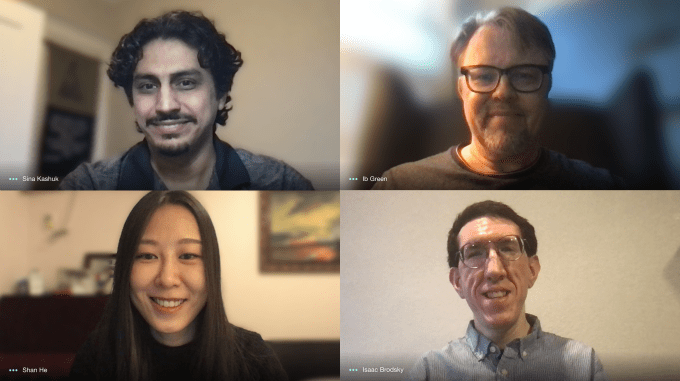
The four founders of Unfolded.ai. Via Unfolded.ai.
The startup’s main product is called Unfolded Studio, which acts as a backend-as-a-service for applications built on top of Kepler.gl (which is only a frontend library itself) handling components like data management and server communications. In particular, the product is designed to bring different geospatial datasets together and allow them all to interact with each other in one unified view.
The team first funded their operations with some consulting projects, including with Google Earth, but now it has raised a seed round to further expand the team and its ambitions. To date according to Kashuk, Unfolded has raised a bit more than $6 million, with a seed round that closed last week led by Shvet Jain at S28 Capital with participation from other firms including Fontinalis Ventures. Auren Hoffman wrote the first personal check into the company, and the first institutional VC was IA Ventures.
Some of the first customers of the Unfolded platform have been in agtech, including a company called Indigo Agriculture, which focuses on helping farmers grow crops and livestock sustainably. Unfolded sees potential in many markets where location data intersects business, but for now, remains mostly heads down building out its platform and readying itself for more customers.
TikTok, UC Browser, UC News, Baidu Map, Xiaomi’s Video and Community and 53 other Chinese apps that India banned in late June won’t be returning to the country anytime soon, the Indian government has decided, a source familiar with the matter told TechCrunch.
Last week New Delhi told the parent firms of these apps that it wasn’t satisfied with the responses they had provided so far to address cybersecurity concerns charged against them, the source said, requesting anonymity as the communication is private.
Citing this reason, New Delhi has said that it will retain the ban on these apps, but it has not completely shut communication channels with the firms, the source said. Indian media reported last week that the country, which is the world’s second largest internet market with over 600 internet users, was making the ban permanent.
Beginning in late June, India banned over 200 apps including PUBG Mobile with links to China last year amid geo-political tension between the two neighboring nations. All these apps engaged in activities that posed threats to “national security and defence of India, which ultimately impinges upon the sovereignty and integrity of India,” the nation’s IT ministry has said.
New Delhi has so far only sent feedback about the responses to the apps that were banned in late June.
TikTok has been the most high-profile app to be banned by India. ByteDance’s crown app had more than 200 million users in India prior to being blocked in the nation. Despite the ban, the company has retained most of its India-based employees so far.
A source told TechCrunch that ByteDance operates several properties in India including a productivity suite called Lark that remains operational in the country and the team continues to develop these apps. This information has not been previously reported. (UC Browser, too, was once very popular in India, though the rising popularity of Google’s Chrome browser put an end to the Chinese app’s dominance in the country.)
Despite the ban, TikTok and several of the blocked Chinese apps still maintain millions of users in the country who are using specialized software such as virtual private networks to access them. TikTok had over 5 million active users (MAU) in India last month, and PUBG Mobile over 15 million, according to mobile insight firm App Annie, data of which an industry executive shared with TechCrunch.
TikTok said it was reviewing New Delhi’s notice. “We continually strive to comply with local laws and regulations and do our best to address any concerns the government may have. Ensuring the privacy and security of all our users remains to be our topmost priority,” a spokesperson said.
The ban — as well as the whole U.S. drama about a potential block — hasn’t made much impact on ByteDance’s financials. The Information reported on Tuesday that ByteDance more than doubled its revenue last year to $37 billion, and increased its operating profit to $7 billion, from $4 billion in 2019.
American and Chinese firms have rushed to India in the past decade in search for their next billion users. But the South Asian nation contributes very little to these firms’ bottom line. Kunal Shah, a serial entrepreneur in India, said at a conference in 2018 that the nation has become an “MAU farm” for many companies.
Regardless, since their ban, TikTok and PUBG Mobile have explored various ways to make a comeback in India. TikTok engaged in early investment talks with Reliance Industries, one of India’s largest conglomerates, and PUBG Mobile cut ties with game publisher Tencent and pledged to invest $100 million in India.
Source: https://techcrunch.com/2021/01/26/india-retains-ban-on-tiktok-uc-browser-and-57-other-chinese-apps/
PepsiCo, the planetary purveyor of sugary drinks, greasy chips, and (weirdly) oatmeal, hummus, and gazpacho(?) is partnering with Beyond Meat, the publicly traded plant-based protein provider, on a poorly named joint venture to hawk new plant-based food and beverages to consumers.
The PLANeT Partnership (which was clearly branded by the same genius behind the comic sans font), will combine Beyond Meat’s skills with protein prestidigitation and PepsiCo’s marketing and manufacturing savvy to flood the global market with new snacks and drinks, the two companies said.
Neither company disclosed any financial terms and other pesky details around who, what, where, and when, except to say that the the joint venture operations will be managed through the newly created PLANeT Partnership.
(If the companies put as much effort into running the business as they did with naming and branding it, Impossible Foods shouldn’t have much to worry about…. The capitalization and branding of this thing is an affront to the English language is all I’m saying.)
“Plant-based proteins represent an exciting growth opportunity for us, a new frontier in our efforts to build a more sustainable food system and be a positive force for people and the planet, while meeting consumer demand for an expanded portfolio of more nutritious products,” said Ram Krishnan, PepsiCo Global Chief Commercial Officer, in a statement.
In the announcement touting the new JV, PepsiCo referred to its storied history of snack innovation including baked LAY’S chips, Sabra Snack Cups, Alvalle ready-to-drink gazpacho, Quaker Breakfast flats and Gatorade Juiced.
The company has also acquired BFY Brands, which makes PopCorners; SodaStream, which makes… well… SodaStreams… and BareSnacks, which makes baked fruit and vegetable chips.
The deal is the latest really really big partnership for Beyond Meat and follows an oddly botched announcement with McDonald’s that the two companies would be collaborating on new menu items.
Remember the app audit Facebook founder Mark Zuckerberg promised to carry out a little under three years ago at the height of the Cambridge Analytica scandal? Actually the tech giant is very keen that you don’t.
The UK’s information commissioner just told a parliamentary subcommittee on online harms and disinformation that a secret arrangement between her office and Facebook prevents her from publicly answering whether or not Facebook contacted the ICO about completing a much-trumpeted ‘app audit’.
“I think I could answer that question with you and the committee in private,” information commissioner Elizabeth Denham told questioner, Kevin Brennan, MP.
Pressed on responding, then and there, on the question of whether Facebook ever notified the regulator about completing the app audit — with Brennan pointing out “after all it was a commitment Mark Zuckerberg gave in the public domain before a US Senate committee” — Denham referred directly to a private arrangement with Facebook which she suggested prevented her from discussing such details in public.
“It’s part of an agreement that we struck with Facebook,” she told the committee. “In terms of our litigation against Facebook. So there is an agreement that’s not in the public domain and that’s why I would prefer to discuss this in private.”
The UK Information Commissioner has previously passed information to FB re: Cambridge Analytica, and has a secret legal settlement w/ them
This will be a worry to anyone who has passed information to them (e.g. whistleblowers)
Long term this practice will have chilling effects https://t.co/an7dgnZADY
— Paul-Olivier Dehaye (@podehaye) January 26, 2021
In October 2019 Facebook settled with the UK’s data protection watchdog — agreeing to pay in full a £500,000 penalty announced by the ICO in 2018 in relation to the Cambridge Analytica breach but which Facebook had been appealing.
When it settled with the ICO Facebook did not admit liability. It had earlier secured a win, from a first-tier legal tribunal that had held June that “procedural fairness and allegations of bias” against the regulator should be considered as part of its appeal, so its litigation against Facebook had got off to a bad start — likely providing the impetus for the ICO to settle with Facebook’s private army of in-house lawyers.
In a statement at the time, covering the bare bones of the settlement, the ICO said Denham considered the agreement “best serves the interests of all UK data subjects who are Facebook users”.
There was no mention of any ‘gagging clauses’ in that disclosure. But the regulator did note that the terms of the agreement gave Facebook permission to “retain documents disclosed by the ICO during the appeal for other purposes, including furthering its own investigation into issues around Cambridge Analytica”.
So — at a stroke — Facebook gained control of a whole lot of strategically important information.
The settlement looks to have been extremely convenient for Facebook. Not only was it fantastically cheap (Facebook paid $5BN to settle with the FTC in the wake of the Cambridge Analytica scandal just a short while later); and not only did it provide Facebook with a trove of ICO-obtained data to do its own digging into Cambridge Analytica safely out of the public eye; but it also ensured the UK regulator would be restricted in what it could say publicly.
To the point where the information commissioner has refused to say anything about Facebook’s post-Cambridge Analytica app audit in public.
The ICO seized a massive trove of data from the disgraced (and since defunct) company which had become such a thorn in Facebook’s side, after raidingCambridge Analytica’s UK offices in early 2018. How much of that data ended up with Facebook via the ICO settlement is unclear.
Interestingly, the ICO also never produced a final report on its Cambridge Analytica investigation.
Instead it sent a letter to the DCMS committee last year — in which it set out a number of conclusions, confirming its view that the umbrella of companies of which CA was a part had been aggregating datasets from commercial sources to try to “make predictions on personal data for political alliance purposes”, as it put it; also confirming the improperly obtained Facebook data had been incorporated into a pre-existing database containing “voter file, demographic and consumer data for US individuals”.
The ICO also said then that its investigation did not find evidence of the Facebook data that had been sold to Cambridge Analytica had been used for political campaigning associated with the UK’s Brexit Referendum. But there was no overarching report detailing the underlying workings via which the regulator got to its conclusions.
So, again from Facebook’s perspective, a pretty convenient outcome.
Asked today by the DCMS committee why the regulator had not produced the expected final report on Cambridge Analytica, Denham pointed to a number of other reports it put out over the course of the multi-year probe, such as audits of UK political parties and an investigation into credit reporting agencies.
“The letter was extensive,” she also argued. “My office produced three reports on the investigation into the misuse of data in political campaigning. So we had a policy report and we had two enforcement reports. So we had looked at the entire ecosystem of data sharing and campaigning… and the strands of that investigation are reported out sufficiently, in my view, in all of our work.”
“Taken together the letter, which was our final line on the report, with the policy and the enforcement actions, prosecutions, fines, stop processing orders, we had done a lot of work in this space — and what’s important here is that we have really pulled back the curtain on the use of data in democracy which has been taken up by… many organizations and parliamentarians around the world,” she added.
Denham also confirmed to the committee that the ICO has retained data related to the Cambridge Analytica investigation — which could be of potential use to other investigations still ongoing around the world. But she denied that her office had been asked by the US Senate Intelligence Committee to provide it with information obtained from Cambridge Analytica — seemingly contradicting an earlier report by the US committee that suggested it had been unable to obtain sought for information. (We’ve contacted the committee to ask about this.)
Denham did say evidence obtained from Cambridge Analytica was shared with the FTC, SEC and with states attorneys general, though.
We’ve also reached out to Facebook about its private arrangement with the ICO, and to ask again about the status of its post-Cambridge Analytica ‘app audit’. (And will update this report with any response.)
The company has produced periodic updates about the audit’s progress, saying in May 2018 that around 200 apps had been suspended as a result of the internal probe, for example.
Then in August 2019 Facebook also claimed to the DCMS committee that the app audit was “ongoing”.
In its original audit pledge — in March 2018 — Zuckerberg promised a root and branch investigation into any other ‘sketchy’ apps operating on Facebook’s platform, responding in a ‘crisis’ length Facebook post to the revelations that a third party had illicitly obtained data on millions of users with the aim of building psychographic profiles for voter targeting. It later turned out that an app developer, operating freely on Facebook’s platform under existing developer policies, had sold user data to Cambridge Analytica.
“We will investigate all apps that had access to large amounts of information before we changed our platform to dramatically reduce data access in 2014, and we will conduct a full audit of any app with suspicious activity,” Zuckerberg wrote at the time. “We will ban any developer from our platform that does not agree to a thorough audit. And if we find developers that misused personally identifiable information, we will ban them and tell everyone affected by those apps. That includes people whose data [Aleksandr] Kogan misused here as well.”
It’s notable that the Facebook founder did not promise to transparently and publicly report audit findings. This is of course what ‘self regulation’ looks like. Invisible final ‘audit’ reports.
An ‘audit’ that’s entirely controlled by an entity deeply implicated in core elements of what’s being scrutinized obviously isn’t worth the paper it’s (not) written on. But, in Facebook’s case, this opened-but-never-closed ‘app audit’ appears to have served its crisis PR purpose.
TiVo devices are getting new voice recognition capabilities thanks to a partnership with the Atlanta-based startup Pindrop, which is now offering its voice recognition and personalization technologies for consumer devices.
The new voice recognition capabilities replace TiVo’s discontinued use of the Alexa voice recognition service, which happened with little fanfare last year.
TiVo made a big push with its Alexa integration a little over two years ago, but the switch to Pindrop’s services shows that there’s a robust market for voice-enabled services and providers are moving from different markets to compete on Amazon and Google’s home turf.
Through the integration with Pindrop’s services, TiVo homeowners will now be able to search for shows and control their devices using their voice. But Pindrop’s tech, which was developed initially as an anti-fraud technology for financial services firms and big business customers, goes beyond basic voice recognition.
Pindrop’s tech can tell the difference between different speakers, setting up opportunities for the personalization of programming with each user being able to call up their individual account for Netflix, Amazon or other services with simple voice commands.
“Beyond just understanding what was said, we want to understand the context of the situation to drive intelligent system behavior in the moment,” said Jon Heim, Senior Director of Product & Conversation Services at TiVo. “The ability to distinguish between different members of a household based on their voice is an example of this contextual awareness, enabling us to provide an unprecedented level of personalization through an experience tailored to that specific person.”
It’s cool.
When different users say the “What should I watch?” prompt, TiVo devices can now pull up personalized content they are most likely to want to watch. If another member of the household says the same command, the device will display different results.
The technology requires user opt-in, and while Pindrop’s tech can differentiate between speakers, the identity of the speaker is anonymized.
It’s a service that Pindrop has already rolled out to eight of the ten largest banks in the U.S., according to Pindrop co-founder and chief executive Vijay Balasubramanian. And the foray into consumer devices through the TiVo partnership is just the beginning.
The company has also integrated with SEI Robotics devices, the white label manufacturer of Android devices.
Pindrop has plenty of cash in the bank to finance its push into the world of consumer devices. The company’s profitable and is looking at an annual run rate just shy of $100 million, according to Balasubramanian.
For its next trick, the company intends to roll out its voice recognition service in cars and other networked consumer devices, according to Balasubramanian.
“[We’re] working with OEMS for auto… they’re in the proof of concept phase,” he said.


