& meet dozens of singles today!
User blogs

As I write this Elon Musk has joined Clubhouse for his first-ever in-person session and the boundaries of the app have already been tested. Only 5,000 people are in the room, BUT… the session is being live-streamed from here or here.
I am dusting off my creaky live-blogging skillz to cover the session… and will update this post as we go (apologies for appalling typos in the interim).
Musk initially talked about going gong to Mars and said it was likely to be a “hard” for the early pioneers, but that it would be a matter of keeping the “candle of civilization alive in the dark”.
Asked if he believed in aliens, he said there wasn’t a single piece of conclusive evidence for the existence of aliens, although it’s “quite possible” there is such a thing as Alien tech, at least at a “7/11” level, and a joked that they evidence so far suggests they might be at the “500 Megapixel camera” or “at least iPhone 6 level”.
He said his kids were not quite into the idea of going to Mars.
Asked about memes online he quipped: “He who controls the memes controls the universe” and it’s about what influences the zeitgeist. Memes are a complex form of communication – unlike pictures, memes are “10,000 words not 1,000 words”. They are aspirationally funny. “I love memes, they can be very insightful”
Does he try to sound crazy on Twitter? “I started crazy on Twitter,” he joked.
I don’t follow them, but some “are sent by “meme dealers” who are friends.
He posted about Neurolink but said Tesla had one of the strongest AI teams in the world.
With AI, it’s about “how to we stay relevant” and at least “stay along for the ride” in the good scenario” and couple to AI.
“People are already a cyborg.” We already have a tertiary layer in the form of smartphones. The bit-rate of us typing into a phone is 100 bits. So it’s like trying to talk to a tree, for our smartphones. So with a direct neural interface, we increase it with a huge magnitude. And also spend longer with a higher magnitude.
You can decide if you want to be a robot of a person. But when you wake in the morning you wouldn’t have to be the same as you were yesterday. It’s analogous to a video game, not unlike the “Altered Carbon” Netflix series.
There are primitive versions s the Neurolink idea, with tiny wires into your brain.
He said they will be releasing new videos in a month or so, such as of a monkey playing videos with their mind.
The value of the early implant will be enormous and outright the risks.
Question: What should we educate a 5-year-old about in this world?
Musk talked about how video games engage children, but explaining “the why” was important. “We are programmed to forget the low “probability of things” if they aren’t relevant.
Such as, taking apart an engine and putting them together. We will need tools, so we understand the relevance. It’s better than having a “course of wrenches”
He was asked “why are there not more Elon Musks”? “If you need encouraging words, don’t do a startup”.
A friend sent him a slice of cake in 2013. So “I should have bought it 8 years ago” “At this point Bitcoin is a good thing. I am a supporter. I am late to the party, but I am a supporter.”
He said it was clear Bitcoin was getting broader acceptance by the finance world. “I don’t have a strong opinion on other currencies.”
Dogecoin is a made aa joke to make fun of cryptocurrencies, but “fate lives irony”.
“The most entertaining outcome is the most likely.” The most ironic outcome would be dogecoin becoming the currency of the future.
He made a joke about bitcoin and his account got locked.
TESLA: They want to make 20 million cars and trucks per year as a target.
Autonomous driving could reach a significant amount of time you would rely on it in a week, so autonomous cars would do a third of the hours in a weeks, so 60 hours instead of 12.
Making sense of objects with technologies like Lidar would effectively make cars “superhuman”.
Working remotely on zoom has been tricky for him, but remote working has not been perfect. “Fear is not the mind-killer, context switching the mind-killer” he said.
Would he start another company? It joked that he pretty much has his hands with Tesla, Space X, The Boring Company and others to date.
He talked about the huge advances in vaccine technology, such as the MRNA tech which made the Covid-19 vaccine possible. He seems very bullish about the vaccine.
“There is going to be an avalanche of vaccine” coming, “I guarantee you ‘it’ will be thrown away this year.” He said ‘CureVac’ vaccine will be approved soon.
He mentioned, “The Tesla machine can make a bazillion doses super fast.”
He made his poison clear on vaccines: “I am not an anti-vaxxer I am a pro-vaxxer.”
Joining Silicon Valley in the early days he had to ask himself ‘I watch the internet being built in front of me or do I get involved.’
Too shy to speak to anyone in the lobby of Netscape.
Then he tried to code. He wrote the first maps and directions on the internet. The Web site only worked during the night as he was using the server during the day.
Marc Andressen quipped that we would get a job the next time he hangs out in the lobby.
He’s been watching The Last King for is historical accuracy and Cobra Kai. The Expanse’s plot lines sometimes seem too fantastical to him.
He was recommended Devs and Mythic Quest and Ravens Baquet.
Tenet was “pretty good”. Did he understand it “If you think too hard about it, it’s not going to make complete sense, but it’s a good movie”
His knowledge of the Hitch Hikers guide to the Galaxy, remains intact
“Vlad The Stock Impaler” was brought into the Clubhouse room to talk about the Game Stop phenomenon. It turned out this was the actual CEO fo CEO of Robinhood.
“Vlad” (or rather Vlad Tenev, CEO of Robinhood) made a rambling attempt to explain what happened last week but was interrogated by Musk (things getting slightly surreal at this point).
Musk then turned interviewer:
“All right, tell is what really happened. Give us the inside scoop,” he said
“This has been a very surreal weekend and week for me,” said Vlad.
Vlad said “one of the really great things is all the people “coming out of the woodwork” to offer support for the company to offer advice.
He said this was his first time using Clubhouse. He then made a jokey remark about an adherent to the “simulation hypothosis”.
Musk brought him back: “The people demand an answer and they want to know the truth.”
Vlad said: “So there’s an introducing broker dealer called Robin Hood Financial, and that basically is the app that you know and love, it processes trades. You’re a customer of Robin Hood Financial. Then there’s a clearing broker dealer, Robin Hood Securities, that clears and settles the trades. And then we have Robin Hood Crypto, which is our Crypto business… All of these are different entities that are differently operated. So, basically Wednesday of last week. We just had, you know, unprecedented volume, unprecedented load on the system. A lot of these, you know, so-called meme stocks were, you know, going viral on social media, and people were people are joining Robin Hood and there was a lot of net buy activity on them.”
He said Robin Hood became number one on the iOS App Store and pretty close if not number one on Google Play store.
“Thursday morning I’m sleeping. At 3:30am Pacific, our operations team receives a file from the NSCC, which is the National Securities Clearing Corporation. So, basically as a broker as a clearing broker. And this is where Robin Hood securities comes in. We have to put up money to the NSCC based on some factors including things like the volatility of the trading activity into certain securities. And this is is the equities business so it’s based on, stock trading and not options trading or anything else.
So, they give us a file with the deposit and the request was around $3 billion, which is, you know, about an order of magnitude more than what it typically is.”
MUSK: This is not an unprecedented increase in demand for capital. What formula that they use to calculate that”
Vlad: Just to give context, Robin Hood up until that point has raised around $2 billion in total venture capital. Up until now, so it’s a big number, like $3 billion is is a large number, right. So, basically, the details are, we don’t have the full details, it’s a little bit of an opaque formula, but there’s a component called the VAR of it, which is value at risk. And that’s based on kind of some fairly quantitative things although it’s not it’s not fully transparent. So, there are ways to reverse engineer it, but it’s not kind of publicly shared.
And then there’s a special component, which is discretionary. So that kind of acts as a multiplier, and basically
MUSK: Discretionary meaning like it’s just their opinion”
VLAD: There’s definitely more, more than just their opinion.
MUSK: Everyone wants to know did something shady go down here? It seems weird that you get a sudden $3 billion demand, you know, at 3.30am in the morning. Just suddenly out of nowhere.
VLAD: I wouldn’t impute shadiness to it or anything like that and actually you know the NSPCC was reasonable.
Speaking is one of the hardest parts of learning a new language, especially if you don’t have someone to practice with regularly. ELSA is an app that helps by using speech recognition technology to correct pronunciation. Based in San Francisco and Ho Chi Minh City, ELSA announced today it has raised a $15 million Series B, led by VI (Vietnam Investments) Group and SIG. Other participants included returning investors Google’s AI-focused fund Gradient Ventures, SOSV and Monk’s Hill Ventures, along with Endeavor Catalyst and Globant Ventures.
The capital will be used to expand ELSA’s operations in Latin America and build a scalable B2B platform, allowing companies and educational organizations to offers the app’s coaching services to employees or students. Founded in 2015, ELSA, which stands for English Language Speech Assistant, now claims more than 13 million users. Its last round of funding was a $7 million Series A announced in 2019.
In addition to Latin America, ELSA will also focus on expanding in Vietnam, India and Japan, where it saw high demand last year. The company recently formed a partnership with IDP and British Council, which owns the widely-used IELTS English language test and now recommends ELSA to for test preparation. ELSA is also working with language schools in Vietnam like IMAP and Speak Up, online learning platform YOLA and corporate clients including Kimberly Clark, Intel and ATAD.
ELSA co-founder and chief executive officer Vu Van told TechCrunch that many users want to improve their English speaking proficiency for job opportunities and to increase their earning potential. In Vietnam, India and Brazil, people with higher English speaking proficiency can earn about two to three times more than their colleagues, she said.
“This motivation drives a lot of demand for our English learner community in Vietnam, India and Brazil, especially during COVID-19 when we’ve seen enormous interest from the LatAm region as well,” Van added.
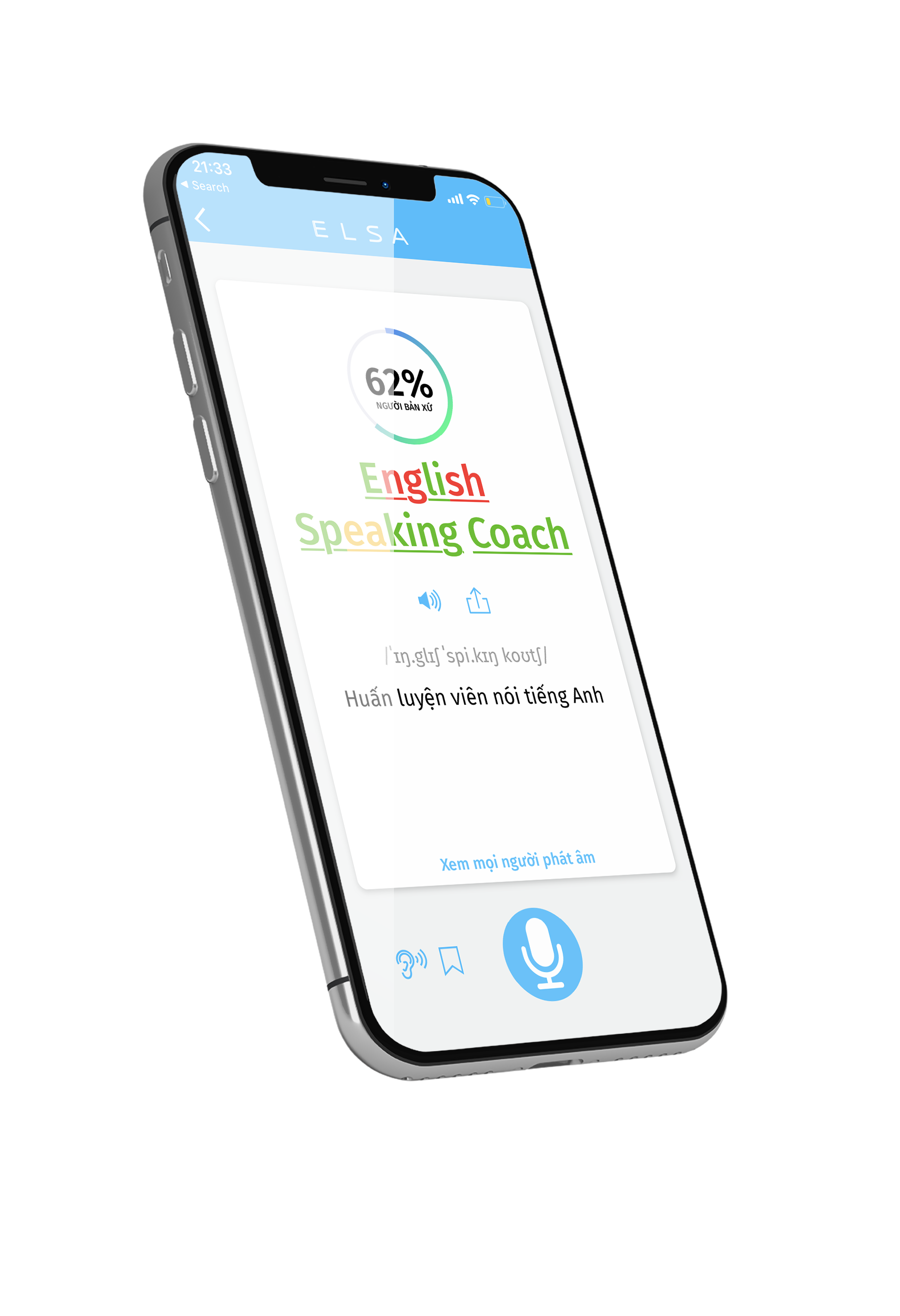
ELSA’s English pronunciation feedback
In Vietnam, where Van is from, English learners spend a lot of their disposable income on online or offline English training. “However, the majority of English learners still struggle to improve their speaking skill because other people don’t understand them or they’re afraid to speak it,” she said. ELSA was designed to give them an accessible resource to help improve their pronunciation and confidence when speaking English.
Other apps focused on English pronunciation include FluentU and Say It. Van said one of ELSA’s main advantages is its proprietary voice recognition AI tech.
“What’s unique about our AI is that we’ve collected the largest amount of accented English voice data from millions of users that we have used to train our AI model over the last few years, which gives us a higher accuracy in recognizing and understanding non-native English speakers around the world,” she said. “The other existing voice recognition technologies available, by comparison, might understand native speakers well but have a hard time understanding non-native accented English learner communities.”
Instead of providing feedback about individual words, ELSA’s app also corrects individual sounds and gives users detailed information on how to improve their pronunciation, including “very advanced prosodic speaking features like intonation, rhythm and fluency to help them speak English more naturally, something that our competitors don’t offer,” Van added.
Ben, a London-based employee benefits and rewards platform, has raised $2.5 million in funding. The seed round is led by Cherry Ventures, and Seedcamp.
A number of angel investors with backgrounds in fintech and HR tech also participated. They include Paul Forster (founder of Indeed), Taavet Hinrikus (founder of TransferWise), Carlos Gonzalez-Cadenas (previously an exec at GoCardless but now a partner at Index Ventures), Philip Reynolds (VP of Engineering at Workday), and Matt Robinson (founder of Nested).
Part fintech, part HR play, Ben has built an employee benefits platform to enable SMEs to offer much more personalised and flexible benefits to employees. The U.K. startup does this via a SaaS for managing benefits, including a benefits marketplace, combined with per-employee debit cards powered by Mastercard.
The idea is to give employees more individual choice around which benefits they choose, while making it easy to on-board additional providers. This can be via the marketplace or through whitelisting merchant or merchant categories via the employer issued Mastercards, such as food and drink or travel and mobility, or a specific co-working space etc.
“While most companies offer benefits in order to attract and engage team members, and ultimately drive productivity, most solutions don’t deliver the desired outcomes,” Ben co-founder and CEO Sebastian Fallert tells me. “To have impact, offerings need to work for the individual employees; after all, a ‘benefit’ that’s relevant for somebody working from home in their mid-40s could be next to useless for a new starter in their 20s”.
Fallert says that providing the required level of personalised benefits has been impossible for most small to medium-sized companies due to the “high cost and complexity” of creating and administering personalised programmes. This has seen only large enterprises able to offer flexible benefit programmes where employees get to pick from a range of options. Ben aims to remedy this.
“The Ben software platform allows companies to load funds and set individual spend rules on how these can be used,” explains Fallert. “Employees are then able to choose from group benefits, such as private medical insurance, mental wellbeing services, or dental plans, while a real per-employee Mastercard opens the door to pretty much any product or service in a tax-efficient and compliant way”.
The result is a “win-win,” says the Ben CEO. “Employees get tailored benefits, and companies only pay for what’s used, take advantage of tax exemptions and preferred pricing, while streamlining the administration”.
The Ben platform is currently used by smaller and mid-market companies, especially those with a distributed team. “It’s these firms in particular that have to deal with the growing complexity of their programmes to keep up with a more diverse and increasingly remote/distributed workforce,” says Fallert.
Meanwhile, Ben has three revenue streams: a SaaS fee; interchange revenue every time its cards get used; and, of course, affiliate revenue from its marketplace.
Adds the Ben CEO: “One of our core hypotheses is that there are so many amazing services out there that simply can’t get through to companies as they’re often not relevant for all employees, such as debt consolidation or fertility treatment. With Ben, they get easy distribution on standard commercial terms while companies get to offer an additional benefit without any additional overhead”.
Despite China’s history of stringent media control, an industry of uninstitutionalized, individual publishers has managed to flourish on social media platforms like Tencent’s WeChat and ByteDance’s Toutiao. These self-publishers are called “We Media” in the Chinese internet lexicon, denoting the independent power of citizen journalists and content creators.
Meanwhile, self-publishers have always had to tread carefully on what they post or risk being targeted by censors who deem them illegal or inappropriate.
The topics they cover are myriad, ranging from fashion and food to politics and current affairs. WeChat, a major destination for self-publishers, hinted last July it had 20 million “public accounts”, platforms for individuals to broadcast content and in businesses’ case, reach customers. In 2020, 360 million users read articles published on WeChat public accounts, WeChat founder Allen Zhang disclosed recently.
Sina Weibo, China’s answer to Twitter, has long attracted citizen journalists. In the early days of COVID-19, millions of Chinese users rushed to Weibo seeking facts from accounts like that of Fang Fang, an author who chronicled what she had witnessed in Wuhan.
Now, a new development in China’s internet regulation is about to further restrict China’s tens of millions of self-publishers.
Public accounts that “provide online news service to the public shall obtain the Internet News Information Permit and other relevant media accreditation,” according to a new regulation (translation here) published January 22 by the Cyberspace Administration of China, the country’s internet watchdog.
In the following days, WeChat, Baidu, Sohu and other online information services began notifying publishers of the new rule. “If your account lacks relevant accreditation, you are advised not to edit, report, publish or comment on news about politics, the economy, military, foreign affairs or other major current events,” according to the notice sent by WeChat.
“The WeChat Public Account Platform always commits to providing a green, healthy online environment to users,” the message adds.
The requirement of news accreditation will likely be a death knell for independent social media publishers that have taken on journalistic roles, particularly those covering politics. “It’s not something you can obtain easily unless you’re an official news outlet or an organization with unmatched resources and background,” a WeChat account publisher told TechCrunch.
China’s control on news reaches into every corner of the internet, and regulations are always playing catchup with the pace at which new media, such as microblogs and live streaming, flourishes.
From 2017 to 2018, the cyberspace authority granted news permits to a total of 761 “internet news services,” which together operated 743 websites, 563 apps, 119 forums, 23 blogs, 3 microblogs, 2285 public accounts, one instant messenger, and 13 live streaming services. In other words, hard news is off limits for internet services of these categories that operate without a news license. It remains to see how platform operators like WeChat and Sina Weibo work to enforce the rules.
Heightening oversight on online information could have merit when it comes to battling misinformation. The new regulation also calls on operators to set up mechanisms like a creator blacklist to root out fake news. But the regulation overall could have an adverse impact on freedom of expression in China, the International Federation of Journalists warned.
“The vaguely defined new rule comes at a time when ‘self-media’ has gained huge popularity in China and journalists have begun using such platforms to publish work which was axed by their organisations,” the IFJ said in a statement published on January 28.
Source: https://techcrunch.com/2021/01/31/china-crack-down-self-publishing/
Access to the internet in Myanmar dropped sharply after the military detained leaders of ruling party National League for Democracy, including Aung San Suu Kyi, and declared a state of emergency. The NLD won a wide majority of parliamentary seats in November’s general election, which the military alleges was the result of election fraud. In a statement on military-owned television, the army said a year-long state of emergency would be declared in Myanmar and power handed to military chief Min Aung Hlaing.
According to NetBlocks, a non-governmental organization that monitors digital rights, cybersecurity and internet governance around the world, internet disruptions began around 3AM Monday morning local time, with national connectivity falling to 75% of ordinary levels, and then reaching about 50% around 8AM. Data shows that the cuts affected several network operators, including the state-owned Myanma Posts and Telecommunications (MPT) and Telenor. NetBlocks said “preliminary findings [indicate] a centrally ordered mechanism of disruption targeting cellular and some fixed-line services, progressing over time as operators comply.”
Update: Internet connectivity in #Myanmar has fallen to 50% of ordinary levels as of 8:00 a.m. local time amid an apparent military coup and the detention of civilian leaders; pattern of disruption indicates centrally issued telecoms blackout order
https://t.co/Jgc20OBk27 pic.twitter.com/71fHI3sRv3
— NetBlocks (@netblocks) February 1, 2021

The United States Embassy’s American Citizen Services said on Twitter that internet and phone connectivity are both limited throughout Yangon and Nay Pyi Taw.
Update: We are aware that internet and phone connectivity is limited throughout Yangon and Nay Pyi Taw.
— American Citizen Services – Burma (Myanmar) (@ACSRangoon) February 1, 2021
Aye Min Thant, a former correspondent for Reuters who is now the Tech for Peace program manager at Phandeeyar, a tech accelerator in Yangon, tweeted that she had been logged out of Signal and Telegram overnight, and can’t log in again because cell service is shut down, preventing her from getting verification codes.
The detainment of Suu Kyi and other National League for Democracy leaders comes days after Myanmar’s military attempted to downplay concerns about a coup by stating it would protect the country’s constitution, despite its allegations of vote fraud in November’s election.
Myanmar came under direct military rule after a 1962 coup replaced the civilian government. In 1990, free elections were held and the NLD won, but the military refused to give up power, placing Suu Kyi under house arrest. After 2011, a transition to democratic rule gradually began, but the military still controlled much of the government.
The NLD has also been accused of being complicit in the military’s ethnic cleansing campaign against Rohingya Muslims and disenfranchising opponents.
While Myanmar’s government does not practice direct censorship of internet content, Freedom House gave the country a score of only 36 out of 100 in 2019, citing manipulation of online content by both the military and NLD, and prosecution that forces individuals to self-censor. In June 2019, the government banned the internet in parts of Rakhine and Chin State, the sites of ongoing fighting between the Myanmar military and Arakan Army. Human rights observers including the Human Rights Watch have said that the internet ban prevents people in those areas from communicating with their families, getting information about COVID-19 or accessing aid.


