& meet dozens of singles today!
User blogs

Alibaba Cloud, the cloud computing arm of Chinese e-commerce giant Alibaba, became profitable for the first time in the December quarter, the company announced in its earnings report.
The firm’s cloud unit achieved positive adjusted EBITA (earnings before interest, taxes, and amortization) during the quarter, after being in business since 2009. The milestone is in part a result of the “realization of economies of scale,” Alibaba said.
Alibaba Cloud, which incorporates everything from database, storage, big data analytics, security, machine learning to IoT services, has dominated China’s cloud infrastructure market for the past few years and its market share worldwide continues to grow. As of 2019, the cloud behemoth was the third-largest public cloud company (providing infrastructure-as-a-service) in the world with a 9% market, trailing behind Amazon and Microsoft, according to Gartner.
COVID-19 has been a boon to cloud and digital adoption around the world as the virus forces offline activities online. For instance, Alibaba notes in its earnings that demand for digitalization in the restaurant and service industry remains strong in the post-COVID period in China, a trend that benefits its food delivery and on-demand services app, Ele.me. The firm’s cloud revenue grew to $2.47 billion in the December quarter, primarily driven by “robust growth in revenue from customers in the internet and retail industries and the public sector.”
Commerce remained Alibaba’s largest revenue driver in the quarter accounting for nearly 70% of revenue, while cloud contributed 7%.
Tencent’s cloud segment is Alibaba Cloud’s closest rival. As of 2019, it had a 2.8% market globally, according to Gartner. The industry in China still has ample room for growth, as Alibaba executive vice-chairman Joe Tsai pointed out in an analyst call from last August.
“Based on the third-party studies that we’ve seen, the China cloud market is going to be somewhere in the $15 billion to $20 billion total size range, and the U.S. market is about eight times that. So the China market is still at a very early stage,” said Tsai.
“We feel very good, very comfortable to be in the China market and just being an environment of faster digitization and faster growth of usage of cloud from enterprises because we’re growing from such a smaller base, about one-eighth the base of that of the U.S. market.”
A key strategy to grow Alibaba Cloud is the integration of cloud into Alibaba’s enterprise chat app Dingtalk, which the company hopes can drive industries across the board onto cloud services. It’s a relationship that echoes that between Microsoft 365 and Azure, as president of Alibaba Cloud, Zhang Jianfeng, previously suggested in an interview.
“We don’t want to just provide cloud in terms of infrastructure services,” said Alibaba CEO Daniel Zhang in the August earnings call. “If we just do it as an infrastructure service, as SaaS services, then price competition is inevitable, and then all the cloud service is more like a commodity business. Today, Alibaba’s cloud is cloud plus intelligence services, and it’s about cloud plus the power of the data usage.”
Source: https://techcrunch.com/2021/02/03/alibaba-cloud-turns-profitable-after-11-years/
Time is critical for healthcare providers, especially in the middle of the pandemic. Singapore-based Bot MD helps save time with an AI-based chatbot that lets doctors look up important information from their smartphones, instead of needing to call a hospital operator or access its intranet. The startup announced today it has raised a $5 million Series A led by Monk’s Hill Venture.
Other backers include SeaX, XA Network and SG Innovate, and angel investors Yoh-Chie Lu, Jean-Luc Butel and Steve Blank. Bot MD was also part of Y Combinator’s summer 2018 batch.
The funding will be used to expand in the Asia-Pacific region, including Indonesia, the Philippines, Malaysia and Indonesia, and to add new features in response to demand from hospitals and healthcare organizations during COVID-19. Bot MD’s AI assistant currently supports English, with plans to release Bahasa Indonesian and Spanish later this year. It is currently used by about 13,000 doctors at organizations including Changi General Hospital, National University Health System, National University Cancer Institute of Singapore, Tan Tock Seng Hospital, Singapore General Hospital, Parkway Radiology and the National Kidney Transplant Institute.
Co-founder and chief executive officer Dorothea Koh told TechCrunch that Bot MD integrates hospital information usually stored in multiple systems and makes it easier to access.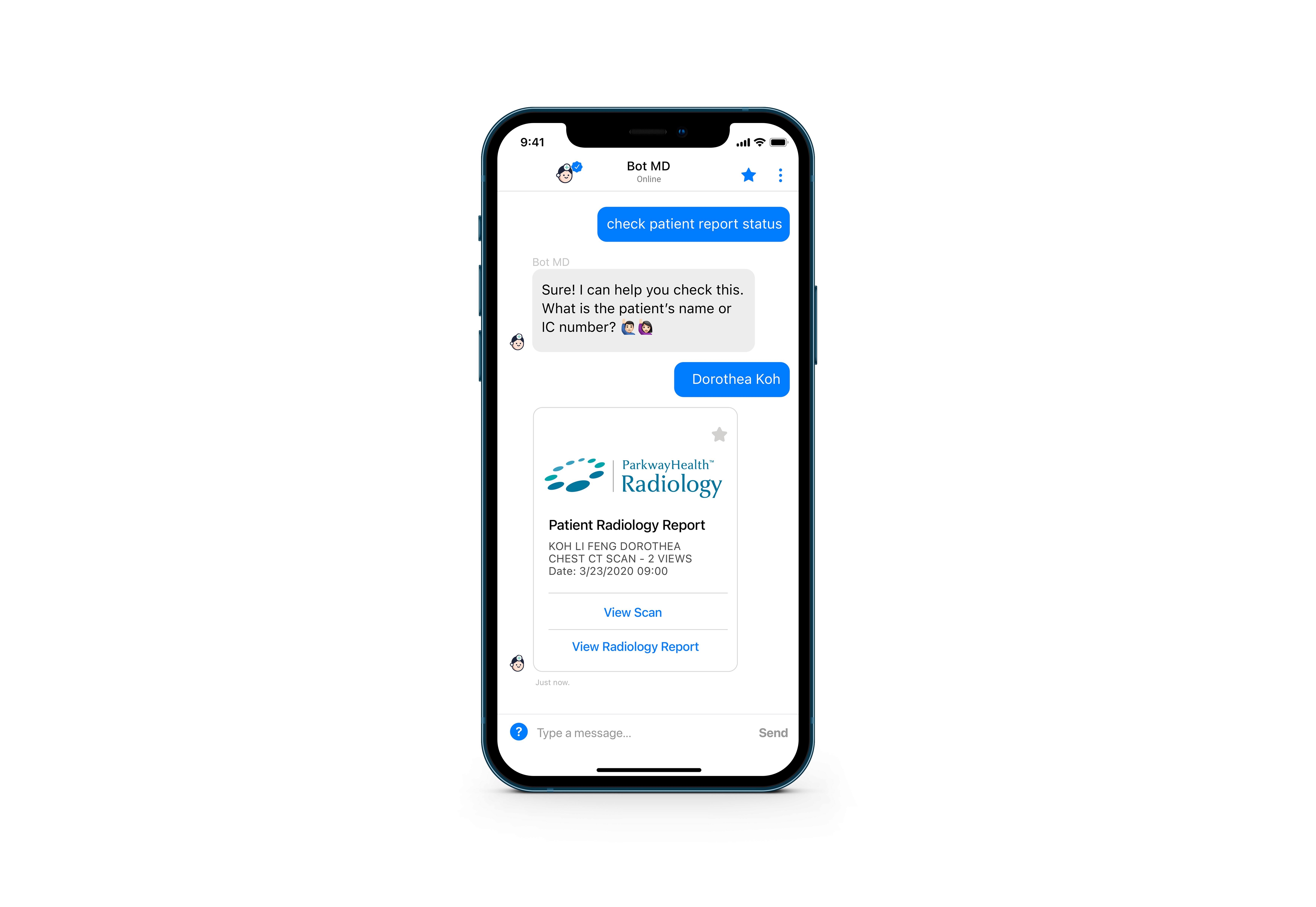
Image Credits: Bot MDWithout Bot MD, doctors may need to dial a hospital operator to find which staffers are on call and get their contact information. If they want drug information, that means another call to the pharmacy. If they need to see updated guidelines and clinical protocols, that often entails finding a computer that is connected to the hospital’s intranet.
“A lot of what Bot MD does is to integrate the content that they need into a single interface that is searchable 24/7,” said Koh.
For example, during COVID-19, Bot MD introduced a new feature that takes healthcare providers to a form pre-filled with their information when they type “record temperature” into the chatbot. Many were accessing their organization’s intranet twice a day to log their temperature and Koh said being able to use the form through Bot MD has significantly improved compliance.
The time it takes to onboard Bot MD varies depending on the information systems and amount of content it needs to integrate, but Koh said its proprietary natural language processing chat engine makes training its AI relatively quick. For example, Changi General Hospital, a recent client, was onboarded in less than 10 days.
Bot MD plans to add new clinical apps to its platform, including ones for electronic medical records (EMR), billing and scheduling integrations, clinical alerts and chronic disease monitoring.
When you want to buy a refrigerator or a television, you can walk to the nearby electronics store or visit an e-commerce website like Amazon. But where do you go when you’re looking for parts of a crane, a door or chassis of different machines?
For several businesses globally, the answer to that question is increasingly Zetwerk, a Bangalore-based startup.
The three-year-old startup runs a business-to-business marketplace for manufacturing items that connects OEMs (original equipment manufacturers) and EPC (engineering procurement construction) customers with manufacturing small-businesses and enterprises.
All the products it sells today are custom-made. “Nobody has a stock of such inventories. You get the order, you find manufacturers and workshops that make them,” explained Amrit Acharya, co-founder and chief executive of Zetwerk, in an interview with TechCrunch.
Its customers — there are over 250 of them, up from 100 a year ago — operate across two-dozen industries (including process plants, oil & gas, steel, aerospace, medical devices, apparel and luxury goods) in the infrastructure space, and approach Zetwerk with digital designs they wish to be translated into physical products.
Customers aren’t alone in seeing value in Zetwerk. On Wednesday, the Indian startup said it has raised $120 million in a Series D financing round led by existing investors Greenoaks Capital and Lightspeed Venture Partners. Existing investors Sequoia Capital and Kae Capital also participated in the Series D round.
The new round, which brings Zetwerk’s to-date raise to $193 million, gives the firm a post-money valuation of somewhere between $600 million to $700 million, a person familiar with the matter told TechCrunch. (A quick side note: Zetwerk announced a $21 million Series C round last year, but ended up raising $31 million in that round.)
Zetwerk was co-founded by Acharya, Srinath Ramakkrushnan, Rahul Sharma and Vishal Chaudhary. Long before Acharya and Ramakkrushnan joined forces to tackle this space, they had been contemplating this idea.
Both of them studied at IIT Madras, went to the same exchange program in Singapore, and were colleagues at Kolkata-headquartered conglomerate ITC. While working there, they realized that part of a product manager’s job at the firm was dealing with gazillions of suppliers and the manufacturing items they offered.
The process was archaic: There were no databases, and people couldn’t track shipments.
The early version of Zetwerk, which was a database of suppliers, was a direct response to this. But after listening to requests from customers, the startup saw a bigger opportunity and transformed itself into a full-fledged marketplace with integrations with third-party vendors. Once a firm has placed an order, Zetwerk allows them to keep tabs on the progress of manufacturing and then the shipping. There are also quality checks in place.
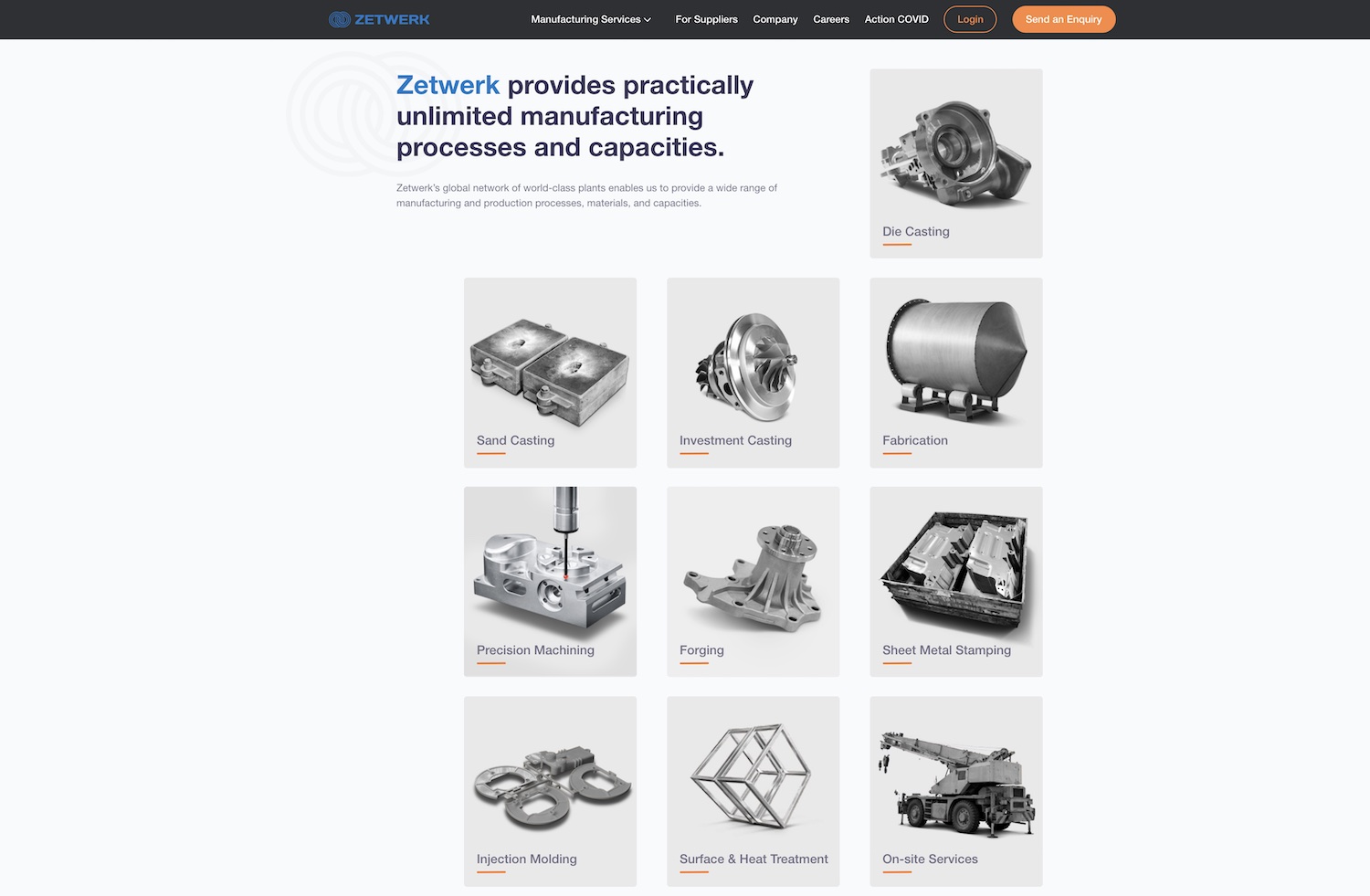
Zetwerk website
Zetwerk operates in such a unique space today — Shailesh Lakhani, managing director at Sequoia India, says the startup has defined a new category of marketplace — that by and large it’s not competing with any other firm in India — or South Asia. (The startup competes with domain project consultants in the offline world.)
The opportunity in India itself is gigantic. According to industry reports, manufacturing today accounts for 14% of India’s GDP. Vaibhav Agarwal, a partner at Lightspeed, estimates that the market is as large as $40 billion to $60 billion in India and global trade-tailwinds that creates opportunity to serve international demand.
As more and more companies expand or shift their manufacturing to India — in part due to import duties imposed by India and geo-political tension with China, the global hub for manufacturing — this opportunity has only grown bigger in recent years.
“India has a lot of depth in manufacturing, but much of it has not been tapped well,” said Acharya.
Zetwerk — which grew 3X last year and reported revenue of $43.9 million in the financial year that ended in March, a 20X growth from the year prior — plans to deploy the new capital to expand to more areas of categories, and broaden its technology stack. Consumer goods (which covers items such as mixer grinders and TVs) is an area Zetwerk expanded to last year, and said it accounts for 15% of the revenue it generated in the last six months.
Currently 25 of its customers are in the U.S., Canada, Europe and other international markets. Acharya said the startup plans to open offices overseas this year as it scouts for more international customers.
“We are excited to partner with Zetwerk on the next leg of their journey, as they expand their value proposition globally. Zetwerk’s operating system for manufacturing has digitized multiple supply chains end-to-end, ensuring on-time delivery and high quality standards. This has led to rapid growth in India and internationally, with the potential to quickly become one of the most important manufacturing platforms globally,” said Neil Shah, partner at Greenoaks Capital, in a statement.
BukuWarung, an Indonesian startup focused on digitizing the country’s 60 million small businesses, announced today it has raised new funding from Rocketship.vc and an Indonesian retail conglomerate.
The amount was undisclosed, but sources say it brings BukuWarung’s total funding so far to $20 million. The company’s last round, announced in September 2020, was between $10 million to $15 million. Launched in 2019, BukuWarung was founded by Chinmay Chauhan and Abhinay Peddisetty and took part in Y Combinator last year.
Indonesian fintech startup BukuWarung gets new funding to add financial services for small merchants
Rocketship.vc is also an investor in Indian startup Khatabook, which reached a valuation between $275 million to $300 million in its last funding round. Like Khatabook, BukuWarung helps small businesses, like neigborhood stores called warung, that previously relied on paper ledgers transition to digital bookkeeping and online payments. BukuWarung recently launched Tokoko, a Shopify-like tool that lets merchants create online stores through an app, and says Tokoko has been used by 500,000 merchants so far.
Chuahan, BukuWarung’s president, said it has started making revenue through its payments solution. In total, BukuWarung now claims more than 3.5 million registered merchants in 750 Indonesian towns and cities, and says it is recording over $15 billion worth of transactions across its platform and processing over $500 million in terms of volume.
SMEs contribute about 60% to Indonesia’s gross domestic product and employ 97% of its domestic workforce, but many have difficulty accessing financial services that can help them grow. By digitizing their financial records, companies like BukuWarung can make it easier for them to access lines of credit, working capital loans and other services. Other companies serving SMEs in Indonesia, Southeast Asia’s largest economy, include BukuKas and CrediBook.
BukuWarung will use its new funding to grow its tech and product teams in Indonesia, India and Singapore. It plans to launch more monetization products, including credit, and grow its payments solution this year.
The Bezos era is ending, Uber acquires Drizly and Tesla recalls 135,000 vehicles. This is your Daily Crunch for February 2, 2021.
The big story: Jeff Bezos will step down as Amazon CEO
Amazon announced today that founder Jeff Bezos will be transitioning from CEO to executive chair in the third quarter of this year. Andy Jassy, currently the CEO of Amazon Web Services, will be taking over as chief executive for the entire company.
In an email to employees, Bezos said that this will allow him to devote more time to “Day 1 Fund, the Bezos Earth Fund, Blue Origin, The Washington Post, and [his] other passions.” Jassy, meanwhile, had previously been identified as a likely successor.
The tech giants
Uber is buying alcohol delivery service Drizly for $1.1B — The plan is to build Drizly’s marketplace directly into the Uber Eats app, though Uber says it will maintain Drizly as a standalone app as well.
Tesla recalls 135,000 vehicles over touchscreen failures — According to the National Highway Traffic Safety Administration, the touchscreen in Model S and Model X vehicles can fail when a memory chip runs out of storage capacity.
Amazon to pay $61.7M to settle FTC complaint over stolen Amazon Flex driver tips — According to the complaint against Amazon and its subsidiary Amazon Logistics, the company had advertised that it paid 100% of tips to drivers, but in reality, Amazon used the customer tips to cover the difference after it lowered the hourly rate.
Startups, funding and venture capital
Divvy Homes secures $110M Series C to help renters become homeowners — Over the course of 2020, Divvy expanded operations from eight to 16 total markets and financed five times as many homes as it had in pre-pandemic times.
Kindred Ventures just closed its second fund with $100M in capital commitments — Kindred is a San Francisco-based pre-seed and seed-stage venture fund founded by Steve Jang and Kanyi Maqubela.
Omnispace raises $60M to fuse satellites and 5G into one ubiquitous network — Omnispace wants to offer ubiquitous 5G-compliant connectivity for enterprise users using a hybrid of wireless ground technology and satellites.
Advice and analysis from Extra Crunch
Udemy’s new president discusses the reskilling company’s future — “We blew through $100M ARR.”
The future of SaaS is on-demand: Use experts to drive growth and engagement — For SaaS companies, not having a gig economy strategy as we start 2021 is like missing the internet trend in 1990.
Save 25% with Extra Crunch Group Membership — This new feature allows you to easily manage seats and payments for your team through a self-service interface.
(Extra Crunch is our membership program, which helps founders and startup teams get ahead. You can sign up here.)
Everything else
Eight Miami-area investors assess America’s southernmost tech ecosystem — We’re seeing a “moment” in Miami, but many are hoping to turn it into a movement.
Welcome Tage Kene-Okafor, Mary Ann Azevedo, Sophie Burkholder and a guy named Drew — Hooray for new team members!
The Daily Crunch is TechCrunch’s roundup of our biggest and most important stories. If you’d like to get this delivered to your inbox every day at around 3pm Pacific, you can subscribe here.

Source: https://techcrunch.com/2021/02/02/daily-crunch-jeff-bezos-will-step-down-as-amazon-ceo/


