& meet dozens of singles today!
User blogs

Elon Musk notified the world that he would be donating $100 million to pursue new technologies for carbon capture, methods through which carbon dioxide can be actively extracted from the atmosphere as a means to help stave off climate change. As TechCrunch reported in January when he made the tweet, Musk’s sizeable pool of monetary incentive would be going to the Xprize foundation, a non-profit that has organized similar ambitious technology competitions aimed at developing world-changing tech. Now, Xprize and Musk have released new details of the competition.
The entire $100 million prize pool is up for grabs with this competition, which will seek solutions that can “pull carbon dioxide directly from the atmosphere or oceans and lock it away permanently in an environmentally benign way.” That’s an ambitious goal, and one that seeks methods for carbon extraction which have a net negative effect on the overall global balance of the element’s presence. Xprize aims to award up to 15 finalists $1 million each, along with three top winners, with $50 million to the Grand Prize victor, and $20 million and $10 million respectively for second and third place. 25 student scholarships valued at $250,000 each will also be up for grabs specifically for student team entrants.
To qualify for victory, solutions must be able to extract 1 ton of CO2 per day, and be viable in a scaled, validated model at time of presentation, with the ability to scale it to “gigaton levels” in commercially viable ways in future. Those are big goals for new technologies, but the competition’s stakes are high: Musk has frequently referred to climate change as an existential threat to humanity, and carbon capture is one key means to combat it.
Carbon capture methods exist, and some are at the center of new startups and emerging businesses, like Canadian company Carggon Engineering which uses CO2 extracted from the atmosphere to create new types of fuel, or Air Vodka, a carbon negative vodka distilled using C02 removed from the atmosphere. Though there are a handful of companies pursuing this, the problem is that it’s typically very expensive to remove carbon in a way that is both safe and that has no subsequent impact on the environment from its resulting byproducts.
The new Xprize competition hopes to spur the development of a wide range of emerging companies in a way similar to how the the 2004 $10 million private spaceflight Ansari Xprize led the development of a whole new era in the space industry. The competition will officially begin on April 22, 2021, at which time full guidelines will be made available and registration will open. Applicants will have up to four years to submit their solution, with the competition closing on Earth Day 2025 and the initial $1 million awards distributed after 18 months following that. That will provide the funding necessary for teams to build out their full-scale demos to claim the top prizes.
VerSe Innovation, the parent firm of popular news and entertainment app Dailyhunt and short video app Josh, said on Monday it has raised over $100 million as part of a Series H financing round from Qatar Investment Authority and Glade Brook Capital Partners.
The announcement follows another $100 million+ investment the startup secured from Google, AlphaWave, and Microsoft in December last year. That investment, also part of Series H, had turned Dailyhunt into a unicorn (giving it a valuation of $1 billion or higher). The startup has to-date raised about $430 million.
Dailyhunt, co-run by Virendra Gupta and former Facebook India head Umang Bedi, is a popular news and entertainment app that serves more than 285 million users each day in 14 local languages in India. Its reach in India, the world’s second largest internet market, would explain why Twitter last month partnered with the Indian firm to bring Moments to Dailyhunt.
VerSe Innovation expanded to short form videos last year, with Josh, after New Delhi banned TikTok and created a theoretical void for snacking content in the country. Scores of large giants and startups — including MX Player and ShareChat — have attempted to try their hand at short form videos in the recent quarters.
Facebook launched Instagram Reels in India last year, and YouTube launched Shorts, which is already garnering over 3.5 billion daily views in India, it said last month. (With over 450 million users in India, YouTube is closing in on WhatsApp’s market lead in India.)
Josh appears to have emerged as one of the leading players: The startup says Josh has amassed over 85 million monthly active users — 40 million of whom check the app each day — and the app sees more than 1.5 billion video plays everyday.
India’s internet economy is expected to be worth $639 billion by 2030, analysts at Citi wrote in a report to clients late last month. The coronavirus pandemic accelerated digital adoption and users’ appetite to transact online, a report from analysts at UBS said last week.
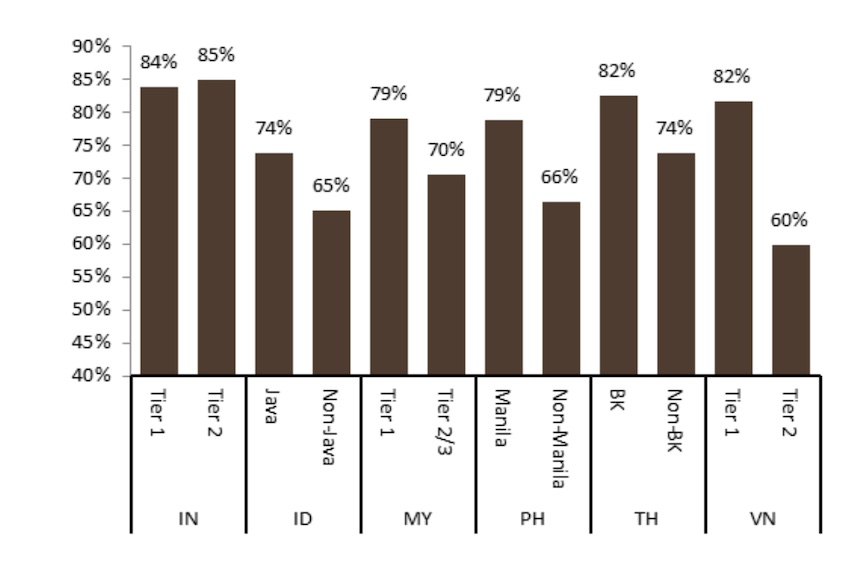
India leads with Tier 2 cities comparable to Tier 1. Biggest catch up opportunity in Philippines and Vietnam (UBS)
“Josh represents a confluence of India’s top 200+ best creators, the 10 biggest music labels, 15+ million UGC creators, best in class content creation tools, the hottest entertainment formats, and formidable user demographics. Josh has been consistently rated as the leading Indian short-video app in India on the Play store,” the startup said in a statement.
The startup said it will deploy the fresh capital to broaden its local languages content offering, and expand its creators ecosystem and AI and ML tech stacks.
Source: https://techcrunch.com/2021/02/07/dailyhunt-and-joshs-parent-firm-raises-over-100-million/
ByteDance is bringing its battle with archrival Tencent to the court at a time when the Chinese government moves to curve the power of the country’s internet behemoths.
The Beijing Intellectual Property Court has permitted a ByteDance lawsuit brought against Tencent to proceed, a ByteDance spokesperson confirmed with TechCrunch. Upstart new media company ByteDance alleged that Tencent’s restrictions on Douyin, the Chinese version of TikTok, are in violation of China’s anti-monopoly draft rules. Douyin is headquartered in Beijing while Tencent’s base is in Shenzhen.
For three years, Tencent has blocked Douyin from its flagship networking apps WeChat and QQ, which bans users from viewing or sharing content from the short video app. Tencent’s behavior “no doubt” constitutes “monopolistic behavior achieved by abusing market domination to exclude and limit competition,” which the proposed anti-monopoly law prohibits, Douyin, said.
“We believe that competition is better for consumers and promotes innovation. We have filed this lawsuit to protect our rights and those of our users.”
Tencent said in response the accusation is false and malicious defamation. It further asserted that Douyin, which is used by 600 million users every day, uses illegal and anti-competitive methods to access WeChat’s user data, and it’s planning to sue ByteDance for harming its platform ecosystem and user rights.
ByteDance and Tencent each covet the other’s turf. ByteDance debuted a chat app to take on Tencent’s dominance in social networking, while Tencent countered Douyin’s popularity by introducing a slew of short video apps. Neither has managed to threaten the other’s dominance in their respective field.
Early signs show that the Chinese government is increasingly willing to rein in monopolistic behavior on the Chinese internet following two decades of relatively lax regulations.
In November, the country’s top market regulator unveiled the draft version of its first anti-monopoly law, opening a floodgate to lawsuits and investigations. In December, regulators launched an antitrust probe into Alibaba for forcing vendors to sell exclusively on its platform. Just this month, a court in Beijing imposed a 3 million yuan ($464,000) fine on fashion e-commerce site Vipshop over anti-competitive behavior. It won’t be surprising to see more Chinese internet giants getting hit by anti-trust actions in the upcoming months.
Source: https://techcrunch.com/2021/02/07/bytedance-tencent-lawsuit/
VerSe Innovation, the parent firm of popular news and entertainment app DailyHunt and short video app Josh, said on Monday the startup has raised over $100 million as part of its Series H financing round from Qatar Investment Authority and Glade Brook Capital Partners.
The announcement follows another $100 million or so the startup secured from Google, AlphaWave, and Microsoft in December last year.
This is a developing story. More to follow…
Source: https://techcrunch.com/2021/02/07/dailyhunt-and-joshs-parent-firm-raises-over-100-million/
ByteDance is bringing its battle with archrival Tencent to the court at a time when the Chinese government moves to curve the power of the country’s internet behemoths.
The Beijing Intellectual Property Court has permitted a ByteDance lawsuit brought against Tencent to proceed, a ByteDance spokesperson confirmed with TechCrunch. Upstart new media company ByteDance alleged that Tencent’s restrictions on Douyin, the Chinese version of TikTok, are in violation of China’s anti-monopoly draft rules. Douyin is headquartered in Beijing while Tencent’s base is in Shenzhen.
For three years, Tencent has blocked Douyin from its flagship networking apps WeChat and QQ, which bans users from viewing or sharing content from the short video app. Tencent’s behavior “no doubt” constitutes “monopolistic behavior achieved by abusing market domination to exclude and limit competition,” which the proposed anti-monopoly law prohibits, Douyin, said.
“We believe that competition is better for consumers and promotes innovation. We have filed this lawsuit to protect our rights and those of our users.”
Tencent said in response the accusation is false and malicious defamation. It further asserted that Douyin, which is used by 600 million users every day, uses illegal and anti-competitive methods to access WeChat’s user data, and it’s planning to sue ByteDance for harming its platform ecosystem and user rights.
ByteDance and Tencent each covet the other’s turf. ByteDance debuted a chat app to take on Tencent’s dominance in social networking, while Tencent countered Douyin’s popularity by introducing a slew of short video apps. Neither has managed to threaten the other’s dominance in their respective field.
Early signs show that the Chinese government is increasingly willing to rein in monopolistic behavior on the Chinese internet following two decades of relatively lax regulations.
In November, the country’s top market regulator unveiled the draft version of its first anti-monopoly law, opening a floodgate to lawsuits and investigations. In December, regulators launched an antitrust probe into Alibaba for forcing vendors to sell exclusively on its platform. Just this month, a court in Beijing imposed a 3 million yuan ($464,000) fine on fashion e-commerce site Vipshop over anti-competitive behavior. It won’t be surprising to see more Chinese internet giants getting hit by anti-trust actions in the upcoming months.
Source: https://techcrunch.com/2021/02/07/bytedance-tencent-lawsuit/


