& meet dozens of singles today!
User blogs

Tesla, which is seeing rapid growth in China as it ramps up local manufacturing capacity, has been called upon by the Chinese government for talks over quality issues in its electric cars.
A group of Chinese authorities, including the country’s top market regulator, cyberspace watchdog and transportation authority, held talks with Tesla after consumers complained about acceleration irregularities, battery fire, software upgrade failures and other vehicle problems, according to a government notice posted late Monday.
Tesla said on microblogging platform Weibo that it “sincerely accepts the government departments’ guidance” and will “strictly comply with Chinese laws.” It will also work to strengthen its “internal operational structure and workflow” under the direction of the regulators in order to ensure safety and consumer rights.
While its popularity surged in China over the past few years, Tesla has made a series of recalls due to faulty parts or functions in the country. Just before its meeting with the government, the American EV giant recalled 20,428 imported Model S vehicles and 15,698 units of imported Model X, China’s market regulator announced last week.
China is an increasingly important and the second-largest market for Tesla. The Gigafactory in Shanghai, where Tesla enjoys tax breaks granted by the local municipal government, has allowed the carmaker to localize procurement and production, thus driving down prices in products like Model 3.
China contributed $6.66 billion in revenue for Tesla in 2020, more than doubling the amount from a year before, and accounted for more than 20% of the firm’s total revenues, according to Tesla’s filing with the Securities and Exchange Commission this week. In 2019, China made up just around 12% of Tesla’s revenues.
Tesla is competing with a handful of well-financed and indigenous electric car startups in China such as Nio and Xpeng, which are both listed in the U.S. For comparison, Xpeng shipped a total of 27,041 vehicles in 2020, while Nio topped that with 43,728 units shipped. These numbers are still fractions of Tesla’s total delivery, which reached 499,647 vehicles in the year.
Source: https://techcrunch.com/2021/02/08/tesla-summoned-by-chinese-regulators-for-quality-concerns/
LanzaJet, the renewable jet fuel startup spun out from the longtime renewable and synthetic fuel manufacturer, LanzaTech, has inked a supply agreement with British Airways to supply the company with at least 7500 tons of fuel additive per yer.
The deal marks the second agreement between the UK-based airline and a renewable jet fuels manufacturer following an August 2019 agreement with the British company Velocys. It’s also LanzaJet’s second offtake agreement. The company announced itself with a partnership between the renewable fuels manufacturer and the Japanese airline ANA.
Through the deal, British Airways will invest an undisclosed amount in LanzaJet’s first commercial scale facility in Georgia. The fuel will being powering flights by the end of 2022 the companies said.
It’s part of a broader expansion effort that could see LanzaJet establish a commercial facility for the UK airline in its home country in the coming years.
Back in the U.S. the plan is to begin construction on the Georgia facility later this year which will convert ethanol into a jet fuel additive using a chemical process.
Fuel from the plant will reduce the overall greenhouse emissions by 70 percent versus traditional jet fuel. It’s the equivalent of taking almost 27,000 gasoline or diesel-powered cars of the orad each year, according to the company.
The deal is the culmination of years of research and development work between LanzaJet’s parent company, LanzaTech and Department of Energy’s Pacific Northwest National Laboratory.
Spun off in June 2020, LanzaJet was financed by an investment group including parent company LanzaTech, Mitsui, and Suncor Energy. British AIrways now joins the two other strategic investors as LanzaJet eyes an ambitious scale up program through 2025. The company plans to launch four large scale plants producing a pipeline of renewable fuels.
“Low-cost, sustainable fuel options are critical for the future of the aviation sector and the LanzaJet process offers the most flexible feedstock solution at scale, recycling wastes and residues into SAF that allows us to keep fossil jet fuel in the ground. British Airways has long been a champion of waste to fuels pathways especially with the UK Government,” said Jimmy Samartzis, the chief executive of LanzaJet. “With the right support for waste-based fuels, the UK would be an ideal location for commercial scale LanzaJet plants. We look forward to continuing the dialogue with BA and the UK Government in making this a reality, and to continuing our support of bringing the Prime Minister’s Jet Zero vision to life.”
The LanzaJet fuel is certified for commercial flight up to 50% blend with conventional kerosene. “Considering the aviation market is 90 billion gallons of jet fuel a year, having 50% or 45 billion of production capacity and reaching that max blend level will be a great problem to have,” said LanzaTech chief executive Jennifer Holmgren in an email.
LanzaJet’s manufacturing facility in Georgia is designed to produce zero-waste fuels, according to Holmgren, and British Airways will receive 7,500 tonnes of sustainable aviation fuel from LanzaJet’s biorefinery each year for the next 5 years.
The partnership between British Airways, Hangar 51, International Airlines Group’s accelerator and others.
In addition to its biofuel work, British Airways is also working with companies like ZeroAvia, the hydrogen fuels company that also received backing from Amazon, Shell, and Breakthrough Energy Ventures.
“For the last 100 years we have connected Britain with the world and the world with Britain, and to ensure our success for the next 100, we must do this sustainably,” said British Airways chief executive Sean Doyle.
“Progressing the development and commercial deployment of sustainable aviation fuel is crucial to decarbonising the aviation industry and this partnership with LanzaJet shows the progress British Airways is making as we continue on our journey to net zero.”

 everything statement Belichick - balance Belichick certainly are the guru of the gambling. seen as and also by a variety of as a quite instruct a football (obtaining victory in 3 top dishes in 4 times), this website is especially for the child. Yow will see fractional (and therefore every now and then heap) Transcriptions related with the length of his marketing conferences actually pay attention to audio videos from their site. this person hardly ever discloses excellent, But it actually is pleasure to experience her dad interact with reporters not smart points and after that you spit out of any deadpan best solution.Broyles, exactly who chose to come back to ok despite disregarding the majority of info in 2010, is among the of it is possible to chunks some further than ok Sooners rush to get to the BCS great gameplay. Broyles concluded 2010 posted no. 2 having receptions (131) no. 4 in given metres (1,622) across the country within just year. He complete 4 months as quantity three runners up regarding Biletnikoff accolade as the nation's main av receiver.sports betting professional also analysts a lot of Wholesale NHL Sports Caps acknowledge just how ACC (atlantic seacoast management meeting) Is the trickiest and many capable internally east, primarily just delinquent i would say the Second. particularly, The atlantic scale seems to have at all times offered the skin cream while using plant by using comprehensive ncaa little league cycling jerseys.an individual season occasion you study about the college pigskin win totals write you're the one restricted by nearly a two of efficient gambling bets. a kit for making find some kind of considerable to read brands. by way of example, the 2008 university or college pigskin payout total to receive UNLV is considered 10.5, which suggests UNLV has to win at least four gaming applications for a man or woman your favorite put money. ask yourself how had to do readily available up applying this product line? an years two the seasons UNLV possesses scooped a consolidated total within four events.tasks are delivered with a nfl and college football battlefield whilst you get possibly be an a part of it if you get at the activity. needn't miss out on recognizing i would say the footballing starlets of a tomorrow's basketball. College best go in order to be great consultant ball online players might be able to brag that found your pet play american footbal as well as,while nfl and college football.this is a week 14 contest, sweepstakes one of hillcrest express Aztecs as well as the Bulldogs. your online site turn into tuesday having week 14 of their 2011 advanced schooling pigsk season. sorts can be intra- MWC national gathering poker game. We see a ton at overlooking keep working years through effort as Bulldogs were definitely purely available in with 8 - 2. The Bulldogs accessed posted 48th in publishing marks with regard to that board it background year. the particular Fresno believe Bulldogs averaged 150.6 gardens by on the internet game in passing in 2010 and the san diego state Aztecs were only available in at 36th altogether shield.
Football Dynasties To Clash For Oua Championship
Patriots creator Kraft describe Hernandez great toilet bowl
gambling minnesota Vikings In 1977 superb serving
best of 2020
Nfl Greats Chris And Lynda Barnes To Teach Arlington Youth B
gain hottest upgrades with regard to american indian sport
the greatest Kickers earth account however american footbal
guns1 of 5
Find Cheap Jerseys
Maya is dedicated to making it easier for women to get healthcare, especially for sensitive issues like reproductive and mental health. Now the startup, based in Bangladesh and incorporated in Singapore, is expanding into new countries. Maya announced today it has raised $2.2 million in seed funding, which it said is the largest raised by a Bangladeshi health tech company so far. The round was led by early-stage fund Anchorless Bangladesh and The Osiris Group, a private equity firm focused on impact investing in Asian markets.
The funding will be used to introduce new products to Maya’s telehealth platform and on its international expansion. Maya recently launched in Sri Lanka and has started testing its service in India, Pakistan and Middle Eastern countries. It is also planning to enter Southeast Asia.
Maya uses natural language processing and machine learning technology for its digital assistant, which answers basic health-related questions and decides if users need to be routed to human experts. It has about 10 million unique users and currently counts more than 300 licensed healthcare providers on its platform.
Founder and chief executive officer Ivy Huq Russell, who grew up in Chittagong and Dhaka before moving to the United Kingdom for university, started Maya as a blog with healthcare information in 2011. At the time, Russell worked in finance. She had just given birth to her first child and her mother had recently been diagnosed with breast cancer. Russell told TechCrunch she realized how many challenges there were to seeking medical care in Bangladesh, including financial barriers, a shortage of providers and long travel times to clinics.
She began Maya with the goal of providing trustworthy health information, but quickly realized that the site’s visitors needed more support. Many sent messages through WhatsApp, email or the site’s chat box, including survivors of sexual abuse, rape and domestic violence. After receiving a grant from BRAC, a Bangladeshi non-governmental organization, Maya’s team began developing an app to connect users with medical information and experts.
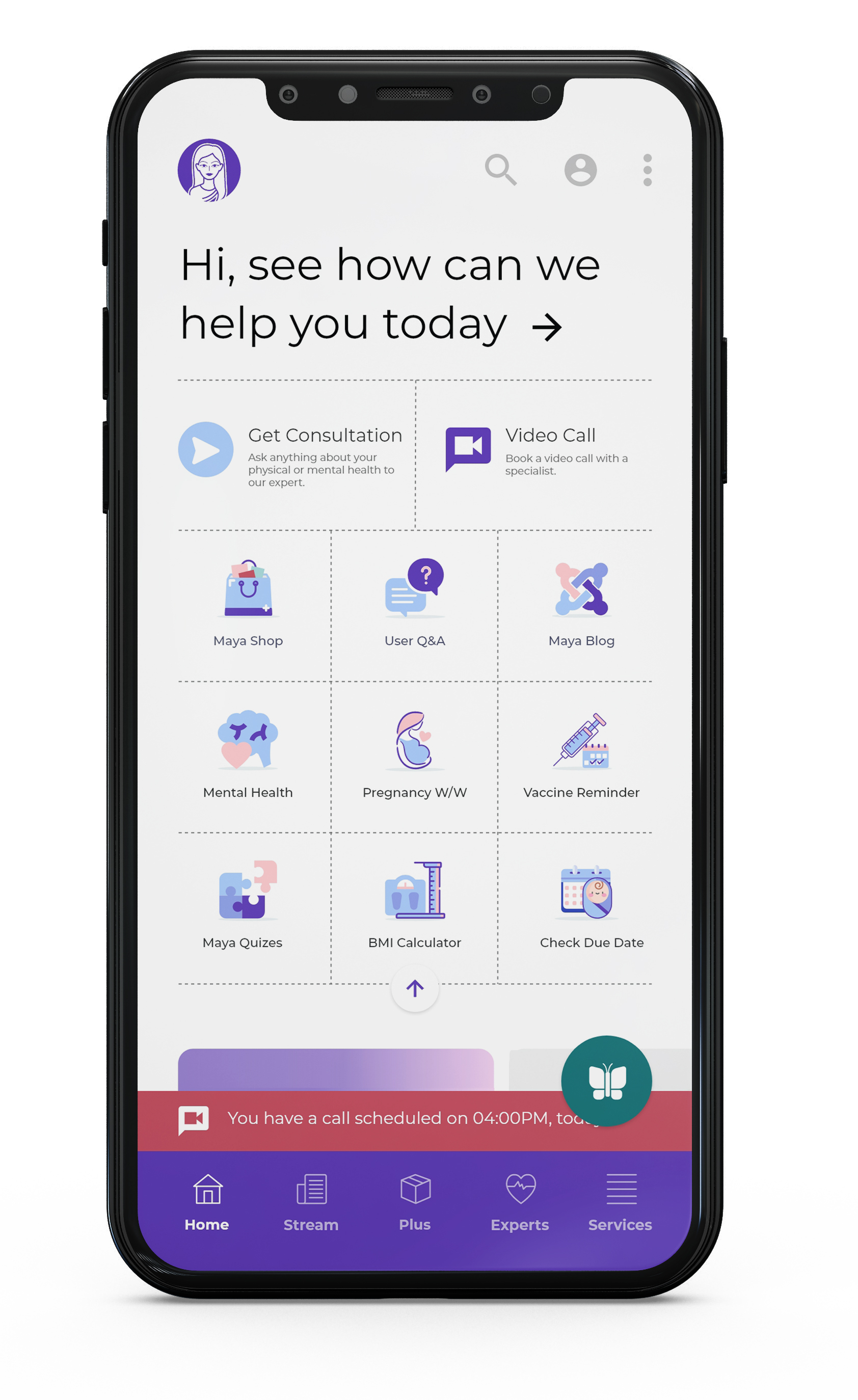
Maya’s homescreen
“We were very focused on two things,” Russell said. “One is how do we built trust in our community, in their language, because it’s very important that they communicate in the language that they’re comfortable using. At the same time, we realized as soon as we started getting hundreds and hundreds of questions, that we’re not going to be able to scale up if we just have 50 experts on computers typing.”
To support Bengali and regional dialects, Maya spent more than two years focused on developing its natural language processing technology. It collaborated with data scientists and linguists and took part in Google Launchpad’s accelerator program, working on tokenization and training its machine learning algorithms. Now Maya is able to provide automated answers in Bengali to basic questions in 50 topics with about 95% accuracy, Russell said. Out of the four million queries the platform has handled so far, about half were answered by its AI tech. It has also worked on NLP technology to support Urdu, Hindi and Arabic.
Many have to do with sexual or reproductive health and the platform has also seen an increase in questions about mental health. These are topics users are often hesitant seeking in-person consultations for.
“Growing up in Bangladesh, we got minimum sexual education. There’s no curriculum at school. Recently in the last one or two years, we’ve also started to see a lot of mental health questions, because I think we’ve made a good drive toward talking about mental health,” said Russell. She added, “it’s quite natural that whatever they couldn’t go and ask a question about very openly in traditional healthcare systems, they come and ask us.”
More consultations are coming from men, too, who now make up about 30% of Maya’s users. Many ask questions about birth control and family planning, or how to support their partners’ medical issues. To protect users’ privacy, consultations are end-to-end encrypted, and experts only see a randomly-generated ID instead of personal information.
In order to understand if someone needs to be routed to a human expert, Maya’s algorithms considers the length, complexity and urgency of queries, based on their tone. For example, if someone types “please, please, please help me,” they automatically get directed to a person. The majority of questions about mental health are also sent to an expert.
Russell said Maya’s approach is to take a holistic approach to physical health and mental wellness, instead of treating them as separate issues.
“People don’t just ask about physical health issues. They also ask things like, ‘I wear a hijab and I want to go for a run, but I feel really awkward,'” said Russell. “It sounds like a very normal question, but it’s actually quite a loaded question, because it’s affecting their mental health on a day-to-day basis.”
One of the company’s goals is to make the app feel accessible, so people feel more comfortable seeking support. “We’ve literally have had sweets delivered to our office when a user has a baby,” Russell said. “These are the personal touches that I think Maya has delivered in terms of dealing with both physical as well as mental health conditions combined together.”
The company is currently working with different monetization models. One is business-to-business sales, positioning Maya as a software-as-a-service platform that employers can offer to workers as a benefit. Garment manufacturing is one of Bangladesh’s biggest export sectors, and many workers are young women, fitting Maya’s typical user profile. The startup has worked with Marks and Spencer, Primark and the Bangladesh Garments Manufacturer and Exporters Association (BGMEA).
Another B2B route is partnering with insurance providers who offer Maya as a benefit. On the direct-to-consumer side, Maya recently launched premium services, including in-app video consultations and prescription delivery. Demand increased sharply during the COVID-19 pandemic, and it now handles about one consultation every ten seconds. Russell expects many users to continue using telehealth services even after the pandemic subsides.
“They’ve really seen the advantage of just having a doctor right in front of you,” she said. “For people with chronic conditions, it’s easier because they don’t have to go somewhere every week, and the fact they have monitoring and their history gathered is helpful for regular users, too.”
Based in Bangladesh, Maya is dedicated to making it easier for women to get healthcare, especially for sensitive issues like reproductive and mental health. The startup announced today it has raised $2.2 million in seed funding. The round, which Maya said is the largest raised by a Bangladeshi health tech company so far, was led by early-stage fund Anchorless Bangladesh and The Osiris Group, a private equity firm focused on impact investing in Asian markets.
The funding will be used to introduce new products to Maya’s telehealth platform and expand into more countries. Maya recently launched in Sri Lanka and plans to expand into India, Pakistan, Middle Eastern markets and Indonesia.
Maya uses natural language processing and machine learning technology for its digital assistant, which answers basic health-related questions and decides if users need to be routed to human experts. It has about 10 million unique users and currently counts more than 300 licensed healthcare providers on its platform.
Founder and chief executive officer Ivy Huq Russell, who grew up in Chittagong and Dhaka before moving to the United Kingdom for university, started Maya as a blog with healthcare information in 2011. At the time, Russell worked in finance. She had just given birth to her first child and her mother had recently been diagnosed with breast cancer. Russell told TechCrunch she realized how many challenges there were to seeking medical care in Bangladesh, including financial barriers, a shortage of providers and long travel times to clinics.
She began Maya with the goal of providing trustworthy health information, but quickly realized that the site’s visitors needed more support. Many sent messages through WhatsApp, email or the site’s chat box, including survivors of sexual abuse, rape and domestic violence. After receiving a grant from BRAC, a Bangladeshi non-governmental organization, Maya’s team began developing an app to connect users with medical information and experts.
Maya’s homescreen
“We were very focused on two things,” Russell said. “One is how do we built trust in our community, in their language, because it’s very important that they communicate in the language that they’re comfortable using. At the same time, we realized as soon as we started getting hundreds and hundreds of questions, that we’re not going to be able to scale up if we just have 50 experts on computers typing.”
To support Bengali and regional dialects, Maya spent more than two years focused on developing its natural language processing technology. It collaborated with data scientists and linguists and took part in Google Launchpad’s accelerator program, working on tokenization and training its machine learning algorithms. Now Maya is able to provide automated answers in Bengali to basic questions in 50 topics with about 95% accuracy, Russell said. Out of the four million queries the platform has handled so far, about half were answered by its AI tech.
Many have to do with sexual or reproductive health and the platform has also seen an increase in questions about mental health. These are topics users are often hesitant seeking in-person consultations for.
“Growing up in Bangladesh, we got minimum sexual education. There’s no curriculum at school. Recently in the last one or two years, we’ve also started to see a lot of mental health questions, because I think we’ve made a good drive toward talking about mental health,” said Russell. She added, “it’s quite natural that whatever they couldn’t go and ask a question about very openly in traditional healthcare systems, they come and ask us.”
More consultations are coming from men, too, who now make up about 30% of Maya’s users. Many ask questions about birth control and family planning, or how to support their partners’ medical issues. To protect users’ privacy, consultations are end-to-end encrypted, and experts only see a randomly-generated ID instead of personal information.
In order to understand if someone needs to be routed to a human expert, Maya’s algorithms considers the length, complexity and urgency of queries, based on their tone. For example, if someone types “please, please, please help me,” they automatically get directed to a person. The majority of questions about mental health are also sent to an expert.
Russell said Maya’s approach is to take a holistic approach to physical health and mental wellness, instead of treating them as separate issues.
“People don’t just ask about physical health issues. They also ask things like, ‘I wear a hijab and I want to go for a run, but I feel really awkward,'” said Russell. “It sounds like a very normal question, but it’s actually quite a loaded question, because it’s affecting their mental health on a day-to-day basis.”
One of the company’s goals is to make the app feel accessible, so people feel more comfortable seeking support. “We’ve literally have had sweets delivered to our office when a user has a baby,” Russell said. “These are the personal touches that I think Maya has delivered in terms of dealing with both physical as well as mental health conditions combined together.”
The company is currently working with different monetization models. One is business-to-business sales, positioning Maya as a software-as-a-service platform that employers can offer to workers as a benefit. Garment manufacturing is one of Bangladesh’s biggest export sectors, and many workers are young women, fitting Maya’s typical user profile. The startup has worked with Marks and Spencer, Primark and the Bangladesh Garments Manufacturer and Exporters Association (BGMEA).
Another B2B route is partnering with insurance providers who offer Maya as a benefit. On the direct-to-consumer side, Maya recently launched premium services, including in-app video consultations and prescription delivery. Demand for consultations increased sharply during the COVID-19 pandemic, and it now handles about 300,000 video visits a month. Russell expects many users to continue using telehealth services even after the pandemic subsides.
“They’ve really seen the advantage of just having a doctor right in front of you,” she said. “For people with chronic conditions, it’s easier because they don’t have to go somewhere every week, and the fact they have monitoring and their history gathered is helpful for regular users, too.”


