& meet dozens of singles today!
User blogs

Shell’s plan to roll out 500,000 electric charging station in just four years is the latest sign of an EV charging infrastructure boom that has prompted investors to pour cash into the industry and inspired a few companies to become public companies in search of the capital needed to meet demand.
Since the beginning of the year, three companies have been acquired by special purpose acquisition vehicles and are on a path to go public, while a third has raised tens of millions from some of the biggest names in private equity investing for its own path to commercial viability.
The SPAC attack began in September when an electric vehicle charging network ChargePoint struck a deal to merge with special-purpose acquisition company Switchback Energy Acquisition Corporation, with a market valuation of $2.4 billion. The company’s public listing will debut February 16 on the New York Stock Exchange.
In January, EVgo, an owner and operator of electric vehicle charging infrastructure, agreed to merge with the SPAC Climate Change Crisis Real Impact I Acquisition for a valuation of $2.6 billion— a huge win for the company’s privately held owner, the power development and investment company LS Power. LS Power and EVgo management, which today own 100% of the company will be rolling all of its equity into the transaction. Once the transaction closes in the second quarter, LS Power and EVgo will hold a 74% stake in the newly combined company.
One more deal soon followed. Volta Industries agreed to merge this month with Tortoise Acquisition II, a tie-up that would give the charging company named after battery inventor Alessandro Volta a $1.4 billion valuation. The deal sent shares of the SPAC company, trading under the ticker SNPR, rocketing up 31.9% in trading earlier this week to $17.01. The stock is currently trading around $15 per-share.
Not to be outdone, private equity firms are also getting into the game. Riverstone Holdings, one of the biggest names in private equity energy investment, placed its own bet on the charging space with an investment in FreeWire. That company raised $50 million in new round of funding earlier this year.
“The writing is on the wall and the investors have to take the time. There’s been a flight out of the traditional investment opportunities in markets,” said FreeWire chief executive, Arcady Sosinov, in an interview. “There’s been a flight out fo the oil and gas companies and out fo the traditional utilities. You have to look at other opportunities… This is going to be the largest growth opportunity of the next ten years.”
FreeWire deploys its infrastructure with BP currently, but the company’s charging technology can be rolled out to fast food companies, post offices, grocery stores, or anywhere where people go and spend somewhere between 20 minutes and an hour. With the Biden Administration’s plan to boost EV adoption in federal fleets, post offices actually represent another big opportunity for charging networks, Sosinov said.
“One of the reasons we find electrification of mobility so attractive is because it’s not if or how, it’s when,” said Robert Tichio, a partner at Riverstone in charge of the firm’s ESG efforts. “Penetration rates are incredibly low… compare that to Norway or Northern Europe. They have already achieved double digit percentages.”
A recent Super Bowl commercial from GM featuring Will Farrell showed just how far ahead Norway is when it comes to electric vehicle adoption.
“The demands onc capital in the electrification of transport will begin to approach three quarters of a trillion annually,” Tichio said. “The short answer to your question is that the needs for capital now that we have collectively, politically, socially economically come to a consensus in terms of where we’re going and we couldn’t say that 18 months ago is going to be at a tipping point.”
Shell already has electric vehicle charging infrastructure that it has deployed in some markets. Back in 2019 the company acquired the Los Angeles-based company Greenlots, an EV charging developer. And earlier this year Shell made another move into electric vehicle charging with the acquisition of Ubitricity in the UK.
“As our customers’ needs evolve, we will increasingly offer a range of alternative energy sources, supported by digital technologies, to give people choice and the flexibility, wherever they need to go and whatever they drive,” said Mark Gainsborough, Executive Vice President, New Energies for Shell, in a statement at the time of the Greenlots acquisition. “This latest investment in meeting the low-carbon energy needs of US drivers today is part of our wider efforts to make a better tomorrow. It is a step towards making EV charging more accessible and more attractive to utilities, businesses and communities.”
Maisonette, a four-year-old, New York-based company has aimed from the outset to become a one-stop curated shop for everything a family might need for their young children.
That plan appears to be working. Today, the company — which launched with preppy young children’s apparel and has steadily built out categories that include home decor, home furniture, toys, gear, and accessories — says it doubled its number of customers last year and tripled its revenue. Indeed, even as COVID could have crimped its style — sale of children’s dress-up clothes slowed for a time — its DIY and STEM toy sales shot up 1,400%.
Though the company keeps its sales numbers private, its growth is interesting, particularly given the unabated growth of Amazon, which became the nation’s leading apparel retailer somewhere around the end of 2018.
Seemingly, much of Maisonette’s traction owes to the trust it has built with customers, who see its offerings as high-end yet accessible relative to the many high-end fashion brands that are also increasingly focused on the children’s market, like Gucci and Burberry.
Specifically, the 75-person company has a merchandising team that prides itself on working with independent brands and surfacing items that are hard to find elsewhere.
Maisonette also launched its own apparel line roughly 30 months ago called Maison Me. Focused around “elevated basics” at a more reasonable price point, the line, made in China, is seeing brisk sales to families who buy items time and again as their kids outgrow or wear holes in them, says the company.
It helps that Maisonette’s founders have an eye for what’s chic. Cofounder Sylvana Ward Durrett and Luisana Mendoza Roccia met at Vogue magazine, where Durrett spent 15 years, joining the staff straight from Princeton and becoming its director of events (work that earned her a high profile in fashion circles). Roccia joined straight from Georgetown the same year, 2003, and left as the magazine’s accessories editor in 2008.
For those who might be curious, their former boss, Anna Wintour, is a champion of theirs. Yet they also have some other powerful advocates, including NEA investor Tony Florence, a kind of e-commerce whisperer who has also led previous investments on behalf of his firm in Jet, Goop, and Casper.
NEA is an investor in Maisonette, as is Thrive Capital and the growth-stage venture firm G Squared, which just today announced it led a $30 million round in the company that brings its total funding to $50 million.
Another ally is Marissa Mayer, who first met Durrett back in 2009 when Mayer was still known as Google’s first female engineer its most fashionable executive. Not only has their friendship endured — Mayer says she named one of her twin daughters Sylvana because she adored the name — but Mayer is on the board of Maisonette, where she has presumably helped refine its data strategy, including around an inherent advantage that the company enjoys: its very young customers.
“One of the things that’s really helpful when it comes to data and e-commerce is when you can capture people at a particular life stage,” Mayer explains. “It’s why people liked wedding registries. You get married, then you have children and [the retailer] can follow the children’s ages and start anticipating that customer’s needs and what they’re going to want two years from now.”
In terms of “predictable supply chain, for inventory selection, for just being able to meet that moment, having insight into those stages is really important and helpful,” she says. It can also be very lucrative for Maisonette as it continues to build out its business, notes Mayer,
Certainly, much is working in the company’s favor already. To Mayer’s point, Roccia says that more than half of Maisonette’s sales last year came from repeat customers. More, it already has an audience of more than 800,000 people who either receive emails from the company or follow its social media channels. (Maisonette also features a healthy dose of content at its site.)
Unlike some e-commerce businesses, Maisonette is asset-lite, too. Though it has opened a handful of pop-up stores previously and was contemplating a bigger move into retail (“that’s now on pause,” says Durrett), the company doesn’t have warehouses to manage. Instead, items are shipped directly to customers from the various retailers featured at its site.
Perhaps most meaningful of all, the company is competing in what is a massive and growing market. In the U.S. alone, the children’s apparel market is estimated to be $34 billion. Meanwhile, the children’s market is $630 billion globally. While Maisonette is selling to U.S. customers alone right now, it plans to use some of that new funding to move into international markets, says Roccia, who has been living in Milan with her own four children during the pandemic, while Durrett began working out Maisonette’s mostly empty Brooklyn headquarters in January to create a bit of space from her three.
Indeed, on a Zoom call from their far-flung locations, they talk at length about parents needing to create new space to work from home right now, as well as to update rooms for kids attending virtual school. While no one asked for a global shutdown, home decor is a “category that has picked up due to the Covid effect,” notes Roccia.
Asked what other trends the two are tracking — for example, Maisonette features the mommy-and-me clothing pairings that have become big business in recent years — Roccia says that even with the world shut down, it remains a “huge” trend. “It started with holiday pajamas — that was kind of the catalyst to this whole movement — and now swimwear and just casual dressing has become a pretty big piece of the business, too.”
As for what Durrett has noticed, she laughs. “Llamas are big. We sell a llama music player that we had to bring back on the site several times over the holidays.” Also “rainbows and unicorns. As cliche as it sounds, we literally can’t keep them in stock.”
Unicorns, she adds, “are a thing.”
The team at Reduct.Video is hoping to dramatically increase the amount of videos created by businesses.
The startup’s technology is already used by customers including Intuit, Autodesk, Facebook, Dell, Spotify, Indeed, Superhuman and IDEO. And today, Reduct is announcing that it has raised a $4 million round led by Greylock and South Park Commons, with participation from Figma CEO Dylan Field, Hopin Chief Business Officer Armando Mann and former Twitter exec Elad Gil.
Reduct was founded by CEO Pabhas Pokharel and CTO Robert Ochshorn (both pictured above). Pokharel argued that despite the proliferation of streaming video platforms and social media apps on the consumer side, video remains “underutilized” in a business context, because it simply takes so much time to sort through video footage, much less edit it down into something watchable.
As Pokharel demonstrated for me, Reduct uses artificial intelligence, natural language processing and other technologies to simplify the process by automatically transcribing video footage (users can also pay for professional transcription), then tying that transcript to the video.
“The magic starts there: Once the transcription has been made, every single word is connected to the [corresponding] moment in the video,” he said.
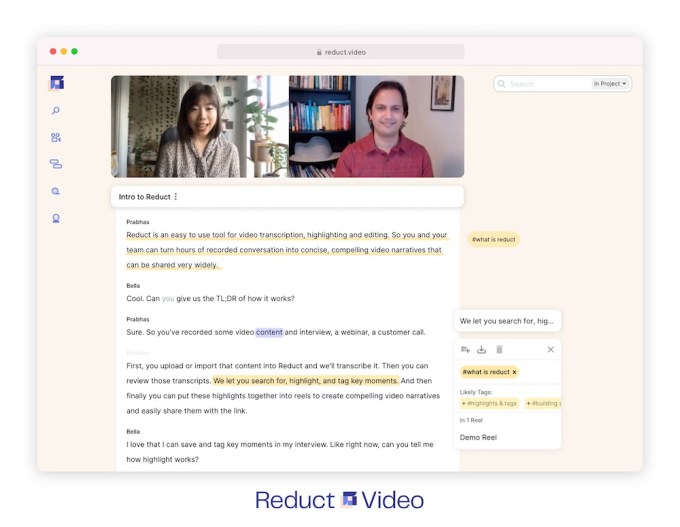
Image Credits: Reduct.Video
That means editing a video is as simple as editing text. (I’ve taken advantage of a similar linkage between text and media in Otter, but Otter is focused on audio and I’ve treated it more as a transcription tool.) It also means you can search through hours of footage for every time a topic is mentioned, then organize, tag and share it.
Prabhas said that AI allows Reduct to simplify parts of the sorting and editing process, like understanding how different search terms might be related. But he doesn’t think the editing process will become fully automated — instead, he compared the product to an “Iron Man suit,” which makes a human editor more powerful.
He also suggested that this approach changes businesses’ perspective on video, and not just by making the editing process easier.
“Users on Reduct emphasize authenticity over polish, where it’s much more the content of the video that matters,” Prabhas said. He added that Reduct has been “learning from our customers” about what they can do with the product — user research teams can now easily organize and share hundreds of hours of user footage, while marketers can turn customer testimonials and webinars into short, shareable videos.
“Video has been so supply constrained, it’s crazy,” he continued. “There are all these use cases for asynchronous video that [companies] haven’t even bothered with.”
For example, he recalled one customer who said that she used to insist that team members attend a meeting even if there was only two minutes of it that they needed to hear. With Reduct, she can “give them that time back” and just share the parts they need.
Source: https://techcrunch.com/2021/02/11/reduct-video-funding/
Human Interest, a 401(k) provider for small and medium-sized businesses (SMBs), announced Thursday that it has tacked on another $55 million to its Series C.
The news is notable for a couple of reasons. For one, the San Francisco-based company had already raised $50 million across two tranches in 2020. Secondly, the majority of its existing backers (about 40 of 55) joined one new investor — NEA spinout NewView Capital (NVC) — in pumping more capital into Human Interest.
And last but definitely not least, the latest extension — which closed in December but is only now being publicly announced — effectively doubles Human Interest’s valuation from its financing a few months prior.
CEO Jeff Schneble would not disclose the company’s current valuation, but he did say Human Interest “is now in the position of becoming a unicorn” the next time it raises, if that round “follows the same step-ups as the last couple” of financings.
With this latest extension, Human Interest has now raised a total of $136.7 million since its 2015 inception.
Human Interest’s growth has been impressive. It’s gone from adding about $100,000 a month in net new revenue in early 2019 to now adding more than $1 million a month in net new revenue, according to Schneble. The startup’s goal is to get to over $2 million a month by year’s end.
“We’ve grown about 10 times in the past 18 months or so, and we’re not going to stop here,” he told TechCrunch. “Our goal is to get to $100 million-plus ARR [annual recurring revenue] in the next three years so that we can go public in the next three to four years.”
Since its launch, Human Interest says it has helped nearly 3,000 businesses across America to offer retirement accounts to their more than 80,000 employees.
The COVID-19 pandemic was challenging, but led to an interesting shift in the company’s business. Pre-2020, about 85% of its customers were first-time 401(k) users. Last year, that number dropped to about 50%. This means that more companies moved from existing plans to Human Interest.
“Given there was a recession and a lot of uncertainty, it was a much easier pitch, considering we could offer a more affordable product,” Schneble said.
Human Interest says it works with “every kind of SMB” — from tech startups to law offices, from dentists to dog walkers, manufacturing firms and social justice nonprofits. Customers include a San Francisco Bay Area electrician company, a Denver-based pizza chain and a Seattle-based chain of gas stations and convenience stores.
Despite being just a few years old, Schneble said the company doesn’t view itself as a startup.
“We want to build a really big company that will be around for decades, and can go public,” he said. “If we were trying to sell the company, we might be doing this differently.”
Currently, Human Interest has about 300 employees, up from a little over 100 a year ago. It plans to double the size of its engineering team this year.
Looking ahead, Schneble said the company is simply out “to do more of the same.”
“We don’t need new products,” he told TechCrunch. “There’s so much runway just doing what we’re doing, and that’s taking market share from others.”
It also plans to focus on improving the technology on its platform, which it moved from a third-party provider to in-house in 2020. The move led the company to double its margins over the past six months while eliminating transaction fees for plan administrators and participants, according to Schneble.
“Often financial services products get worse as you go,” he said. “We want to be the opposite, and this year are focused on making our platform as awesome as it can be.”
Human Interest says it also launched new offerings, Complete and Concierge, last year in an effort to simplify retirement plan administration and “make retirement savings accessible to people in all lines of work.”
“The big incumbents haven’t figured out how to make plans affordable and accessible for smaller companies,” Schneble said. “We knew that to make a permanent dent in this country’s retirement crisis, we had to do something different.”
The 401(k) space is indeed a growing one. Last July San Mateo-based Guideline — which is also focused on SMBs — announced an $85 million Series D round co-led by Al Gore’s Generation Investment Management and Greyhound Capital. It was later revealed that American Express Ventures had joined the financing as an investor.
With more than $2 billion in assets under management, new investor NewView Capital (NVC) — which also backed Plaid — aims to match late-stage funding with “significant operational support.”
NewView founder and Managing Partner Ravi Viswanathan said he was impressed by how the company simplifies the process and administration for SMBs to offer 401(k)s and “is able to do so at lower fees through software and automation.”
The NewView team was also drawn to the company’s desire to make offering a 401(k) accessible for more employers. In a blog post, Ankit Sud and Christina Fa wrote:
“Traditional 401(k) providers like Vanguard and Fidelity designed and priced their plans for large businesses. The administrative burden and high fees make it unaffordable for small business owners. In fact, only 10% of small to mid-sized businesses (SMBs) offer 401(k) plans to their workforce, despite employing one-third of the working population…Human Interest brings simple, affordable 401(k) plans to the 90% of small businesses that do not offer retirement plans today. “
Source: https://techcrunch.com/2021/02/11/401k-provider-human-interest-doubles-valuation-with-55m-fundraise/
TikTok has crafted a number of policies over the years to distance itself from the often-messy political fray, but its users continue to have other agendas in mind.
In Russia, a tug-of-war has emerged on the social network.
On one side are young people using the app to create videos in support of free speech, rallying the public against the government and its treatment of Alexander Navalny, the anti-Putin, anti-corruption politician and activist.
On the other is a government that has quickly versed itself in the art of video messaging — tapping and allegedly paying influencers to dissuade the masses from joining them.
Navalny’s long-term battle with Putin’s government has included political run-ins, imprisonments and a poisoning (with an evacuation to Germany to heal), followed by a return to Russia, subsequent arrest and conviction for violating a previous parole.
Through all of that, Navalny has taken on the mantle of anti-authoritarian hero. With many already unhappy about how the government is handling a weak economy and COVID-19 — a situation that has shaken (but, apparently, not completely toppled) government approval ratings — Navalny’s call for mass protests has been met with a strong response.
And as those protests unfold, TikTok is shaping up to be the scrappy social media analogue of that activity — not unlike the prominent role that Twitter took on during the Arab Spring.
“Political content is not typical for Russian TikTok,’’ said food blogger Egor Khodasevich, whose @kushat_hochu account has 1.2 million followers on the app. “Before Navalny’s return, Russian TikTok was all about dancing, pranks and post-Soviet trash aesthetics. All of a sudden, political videos have started to appear across all categories — humour, beauty, sport.’’
Now, in a significant turnaround, Russian content on the app is being flooded with catchy videos of teenagers cutting their passports in half and throwing them away, pupils taking down portraits of Putin and swapping them with those of Navalny, and others creating how-to’s for would-be protestors — advising them to wear warm clothes, to equip themselves with water and power banks and, if arrested, to pretend they are foreign.
@almorozova#навальный #свободунавальному быть против власти – не значит быть против Родины♬ оригинальный звук – новый год кончился…
These are pooling around hashtags like #23января (January 23, the date of one of the biggest protests so far) and #занавального (“For Navalny”).
The wave of videos even got shout-outs from Navalny himself — fittingly, not on TikTok, but Instagram, where he praised the TikTok activists for helping get the word and the crowds out.
“Respect to the schoolchildren who, according to my lawyer, caused a frenzy on TikTok,” he noted on one post. Later he poked fun at how the TikTok protest videos were described as “fakes” planted by dastardly Americans.
Russia as a country has a small but fast-growing and vocal group of TikTok users.
Figures provided to us from SensorTower estimate that of the more than 2.66 billion times to date globally that TikTok has been downloaded (a figure that includes its Chinese version Douyin), it has been installed about 93.6 million times in Russia (figures that don’t count third-party Android stores, direct downloads or sideloads).
A report in the Moscow Times from the end of December estimates that there are around 20 million active users in the country, more than double the 8 million it had at the end of 2019. TikTok itself does not disclose current MAUs in Russia or globally, but analysts have projected that the company is on track to pass 1 billion MAUs sometime in the early part of this year.
Even with those sub-100 million numbers, videos with the Navalny hashtag have passed 1 billion views on the platform (as of the time of publishing, the number of views has passed 1.6 billion).
The Empire Strikes Back…
But Russia is nothing if not persistent when it comes to being ahead of the game in tech, and it has been harnessing the media world in a couple of ways in aid of its own ends.
State television and other state media outlets strongly encouraged people to stay away from protests, citing issues like public safety, the spread of Covid-19, and the threat of arrest (one they followed through on: authorities have carried out controversial mass arrests of hundreds of people at these gatherings).
At the same time, attention turned to social media, and in particular TikTok.
Roskomnadzor first confirmed that it would fine all major social media platforms up to 4 million rubles ($54,000) over protest-related content, citing that “these Internet platforms failed to remove a total of 170 illegal appeals in a timely manner.”
It then followed that up with an order to the management teams of TikTok, Facebook, Telegram and Vkontakte to appear at the regulators’ offices to explain why they have not yet removed offending videos, reminding them that failure to comply will mean that fines will be increased to 10% of a company’s annual revenues, dangling the threat that non-compliance could mean services get blocked.
With TikTokers claiming they were being called in by the police after their videos were taken down, TikTok more directly started to get threatened with fines by the regulator in the wake of all this.
As with previous moves to censor online platforms, investigators explained their actions as a response to societal impact. In this case, regulators described protest videos as a coordinated criminal attempt to get minors to commit illegal acts that could endanger their safety.
In addition to all that, the state appeared to take on a guerilla approach, too.
Small accounts, newly created accounts and popular bloggers slowly all started posting videos persuading people away from the protests. These videos, in Russian, warn of the dangers of protesting.
It turns out that at least some of the people posting videos were quietly getting paid. Sums ranged from 2,000 rubles, or about $25, through to 5,000 rubles, according to one TikToker who declined the offer and posted the proposal on TikTok instead.
(Those figures may not sound very high, but they can still be welcome sums for young people in a country where the average salary as of 2019 is around $718 per month.)
It hasn’t taken long for the situation to get unmasked. Several videos criticizing protests have been removed in the last week. It’s unclear whether TikTok — which declined to comment for this article — or the original creators removed them.
But in one case, a TikToker who goes by the name @golyakov_ (741,000 followers) initially posted a stream of reasons why protesting was dangerous. He then later admitted to getting paid but claimed to believe in what he was saying (perhaps one reason why the video has stayed up?).
Startok, one of the agencies that represents social media influencers, confirmed to us that it has cut ties with two of the creators who had taken payments to make videos in support of the state.
TikTok’s immediate connection and current popularity with younger adults has made it unique in the social media pantheon. However, it wasn’t the only social media platform seeing anti-Navalny activity — both in terms of messaging, and entities soliciting posts for payments.
A Navalny assistant posted this thread on Twitter of Stories from Instagram casting doubt on Navalny’s decision to return to Russia as a publicity stunt, knowing he would be arrested.
Meanwhile, Boris Kantorovich, a sales director of social media agency Avtorskiye Media who has used Twitter to post about people getting detained, noted that he also came across briefs on Telegram chat ADvizer.me, as well as in a Facebook group that required bloggers to create a video with one or two talking points. He said included “protesters provoked the police at the rally,” “we are tired of Navalny” and “we want peace and quiet.”
When Kantorovich posed as one of the TikTokers that he represents, he received a brief for a 15-second video. “After a quick negotiation I hiked the price up from 2,000 rubles to 3,500 rubles,” he said.
Further creative briefs came with the guidance that they needed to condemn protests on 31 January and 2 February, the second being the date of Navalny’s trial.
“Bloggers should say that ‘Navalny will go to jail 100%’, he is ‘funded from the West’ and ‘his recent imprisonment is legal,” Kantorovich said.
Kantorovich added that authorities didn’t reach out to his agency Avtorskiye Media to advertise with the bloggers it works with: “We clearly mark all ads but authorities don’t like it, because they are trying to create an illusion of a public opinion,” he said.
Similar information was shared by Anatoly Kapustin with the “Picture” advertising agency.
Kapustin, speaking in an interview on non-State-owned Russian TV station Rain, named the “public organization for youth affairs” as an advertiser.
“Talking points on offer were: ‘criminal charges could be brought against protesters,’ ‘you might end up in jail and then not find well-paid jobs,’ and ‘Navalny’s children are studying in America,’” he said in the interview.
In some cases, the virality tricks that TikTok is known for have been used by protestors to turn some of those pro-government campaigns around.
After a wave of people created videos based on the same clip of music that repeats in a deep voice that TikTok is not a place for politics, it’s a place for [fill in a fun and non-political activity/video here] — the audio and hashtag were hijacked by protestors seeking to encourage people to embrace free speech and not silence their voices.
TikTok declined to comment for this story, but in general the company has made it a policy not to wade into partisan politics, or to make a space for political advertising, turning its platform into a commercial opportunity to get political points across.
It declined to comment on whether it was taking down videos that might be reported as possible paid advertising by viewers, nor would it comment on whether it had responded to any government requests to remove videos. It periodically publishes transparency reports where some of that detail, and its subsequent actions, can be found, after the fact. (It judges each request individually.)
One thing that the Navalny situation has exposed is that there is a strong appetite among younger people to be more politically engaged, and for the moment, TikTok is emerging as their preferred place to do that.
Khodasevich, the food blogger, thinks TikTok can replace Twitter as a platform of choice for the opposition in Russia.
“Thanks to its clever algorithms, TikTok can show your video to a bigger audience than YouTube or Instagram, even if you don’t pay for promotion,” he said in an interview. “TikTok representatives told me political videos without direct calls for protests will not get banned.’’
It means that, with a bit of creativity — and a very heavy dose of opportunism and cynicism — both sides might still be able push forward with their political agenda. Boris Kantorovitch agrees.
“Authorities will change their strategy and become more subtle,” he said. “They acted in haste. Probably they thought of TikTok as a good breeding ground for loyalists. Now, the only way to stop people talking about politics on TikTok is by banning access to this platform.’’
Or, if you can’t beat them, join them? The last few days have seen government organizations the Ministry of Foreign Affairs and the Ministry of Emergency Situations joining the platform to give the public a glimpse into how they, too, can roll with it.
@mchs.russiaВы только посмотрите, что могут наши сотрудники! Отправляйте свою реакцию в комментариях!Спасибо за предоставленное видео @@anatoly.doletsky♬ оригинальный звук – МЧС России
Some of the content is not exactly subtle — the Foreign Affairs almost immediately used its new account to post a TikTok discrediting Navaly — but more generally, these are signs that the government is all too aware of the impact the platform is having to galvanize people against it, and it’s trying various things to fight that.
So did TikTok really manage to bring a considerable number of young people to rallies? Are we witnessing a birth of a new protest movement or yet another example of one click activism?
According to a poll conducted on 23 January by TV Rain in Moscow, 44% percent of protesters took to the streets for the first time ever. Only 10% of respondents were under the age of 18, with an average age of protesters hovering around 31 years old, showing an overlap with the audience using TikTok in the country.
Other major movements (such as last year’s run of BLM activism) point to 18-34 being the biggest age demographic among protestors (albeit, worth noting strong participation among other ages, too).
With that in mind, it seems that both authorities and opposition in Russia will try to use the social media platforms most popular among that age group to recruit their new foot soldiers.
Social media might even take on a bigger role in coming months, as the wave of physical, outdoor protests have died down amid the Russian winter weather and the police response, giving people a moment to regroup.
In the meantime, Navalny supporters are planning to stand outside their homes on Sunday evening, February 14, from 8.00 – 8.15 pm, holding up their telephone flashlights, taking photos and uploading them to social media using a new hashtag: #ЛюбовьСильнееСтраха (Love is Stronger than Fear).
Of course, as with everything on social media, it’s sometimes hard to figure out everyone’s actual agenda. As Khodasevich said, some political posts are genuine, some could be attributed to “news jacking.” But ultimately, they are sparking a lot of attention that the government is now mobilizing to counteract.
And with another critical Navalny hearing coming up on February 15th, as well as the September 2021 state Duma elections being only months away, the stakes are high for whatever political battles come next.


