& meet dozens of singles today!
User blogs

In an earlier article, I wrote about how and when to build go-to-market teams at deep tech companies. There, I noted that it is more important for growth hires at deep tech companies to have functional expertise than industry expertise.
But how do deep tech companies connect and cultivate strong relationships with talented nontechnical growth people outside of their industry? In this article, I answer this question, articulating exactly how to:
- Write role descriptions that entice talented growth people.
- Create company marketing materials that brands your startup well to talent.
- Craft thoughtful end-to-end candidate experiences for growth talent.
- Close top growth candidates.
Incredible growth people are independent and creative and are drawn to environments that explicitly value these traits.
Write a job description that explains how you operate
Underscore the autonomy. Incredible growth people are independent and creative and are drawn to environments that explicitly value these traits. Growth talent wants to know that they have room to experiment, fail and iterate with the support and trust of their company. Highlight the creative agency you give to your growth team. Paint the role as one of managing a subset of the startup and its initiatives.
Show you are ready for a growth marketer. Do not expect your growth person to be a panacea for the company. Growth people work cross-functionally, but there are boundaries where the growth role starts and ends. Growth people cannot sell a product that is not ready. Growth people cannot fix product bugs. Growth people cannot replace excellent customer service. Ensure your role description is clear on what the growth person would do and what they would lean on other teams for. Demonstrate that you have a team structure in place where a growth marketer could fit in and thrive.
Articulate your talent needs. Growth is a broad category. Some growth marketers are more creative. Others are more quantitative. Some have more industry experience. Others have more functional experience. Be clear on what type of growth marketer you need and how this person’s talents would complement those of the existing team.
Use marketing to share your history and chart the future
Generate excitement and establish credibility. People can naturally be skeptical about new technologies and younger companies. Do anything you can to ameliorate these concerns. Link to relevant news articles from well-known publications and thought leaders in your industry. Incorporate customer testimonials that speak to the transformative impact your product creates. Name drop well-known advisors, investors and team members.
Dick Costolo and Adam Bain, renowned early Twitter execs who served as company’s CEO and its chief operating officer, respectively, have quietly closed a second venture fund just one-and-a-half years after disclosing they’d secured $135 million for a debut fund under their firm, 01 Advisors.
According to an SEC filing, they wrapped up their second fund late last week with $325 million in capital commitments from 81 investors.
We’ve reached out to the firm and hope to share more soon. In the meantime, its strategy appears to center around more concentrated bets in both the consumer and enterprise spheres — with checks going out both early and sometimes later in a startup’s trajectory.
Among these recipients is Literati, a nearly five-year-old, Austin, Tex.-based book club subscription service that raised $40 million in Series B funding in January led by Felicis Ventures; Tipalti, a 10-year-old, Israel-based company that develops automation software for global payments and raised $150 million in Series E funding at a $2 billion valuation back in October (01 Advisors joined as a follow-on investor); and SpotOn Transact, a payments software startup that raised $50 million in Series B funding last year led by 01 Advisors. (Worth noting: the company raised a $60 million Series C round just six months later. DST Global led that next round, with participation from 01 Advisors and others.)
In fact, numerous of the outfit’s investments have hit the gas during the pandemic, including the San Francisco-based mental health and wellness platform Modern Health, which last week announced $74 million in Series D funding just a few months after announcing $51 million Series C funding. The startup, reportedly now valued at $1.17 billion, has raised roughly $170 million to date; 01 Advisors has joined the last two rounds.
01 Advisors has itself largely remained the same size since it publicly launched in August 2019, years after Costolo and Bain had begun investing in startups on an individual and joint basis.
In addition to Costolo and Bain and Dave Rivinus, who spent four years in corporate development and finance at Twitter and is also a founding partner of the firm, Kelly Kovacs is a partner at the firm. Kovacs was Costolo’s chief of staff at Twitter before joining Color Genomics in a similar capacity, then founding her own startup meant to empower executive assistants. She joined 01 Advisors full time in 2018.
Jenny Pater is meanwhile the firm’s operations manager.
01 Advisors did recently list a position for a senior associate.
Costolo, who great up in Troy, Michigan, found himself in the headlines in October when he fired off an incendiary tweet about the decision of Coinbase founder and CEO Brian Armstrong to publicly discourage employee activism and political discussions at work, a stance that drove at least 60 employees to take a severance package offered to them afterward.
While some business leaders were quick to praise Armstrong, Costolo wasn’t shy about hiding his disgust over Armstrong’s position. “Me-first capitalists who think you can separate society from business are going to be the first people lined up against the wall and shot in the revolution,” he tweeted. “I’ll happily provide video commentary.”
Bain, a long-suffering Browns fan (like all native Clevelanders), has meanwhile been busy, too. In addition to scouting for startups, he now sits on the public company boards of both the real estate tech outfit Opendoor and the space tourism company Virgin Galactic.
01 Advisors served as a co-sponsor of the SPAC that took Opendoor public, along with investor Chamath Palihapitiya. Palihapitiya also spun up the blank-check company that took public Virgin Galactic and the company invited Bain to be a director as that merger was coming together.
Earlier bets by the pair — as angel investors — include the corporate travel site TripActions and the connected fitness startup Tonal.
Nature’s Fynd, the food technology company with a new food offering cultivated from fungus found in the wilds of Yellowstone National Park, is releasing its first products for pre-order.
Pitching both a non-dairy cream cheese and meatless breakfast patties, Nature’s Fynd had managed to attract some serious investors including Al Gore’s Generation Investment Management and the Bill Gates-backed investment fund, Breakthrough Energy Ventures. The company most recently raised $80 million in its last round of funding.
The company is part of a wave of innovative products using a range of bacteria, fungi, and plants to create meat alternatives. Last year, companies developing meat alternatives raised well over $1 billion in financing and investors show no sign of slowing down in their commitments to the industry.
The commercial launch of the Fy Breakfast Bundle, vegan and non-GMO alternatives to traditional breakfast products will be the first commercial test for Nature’s Fynd as it looks to go to market.
These limited release bundles are available for $14,99 plus shipping, according to the company, and the products will be available across the 48 contiguous U.S. states.
The company’s product is grown using fermentation technology to cultivate the bacteria that Nature’s Fynd’s chief scientists discovered during their research into organisms around Yellowstone National Park.
Nature’s Fynd touts the resilience and efficiency of the microbe it discovered, leading to a more sustainable production process that uses a fraction of the land, water, and energy resources that traditional animal husbandry requires, the company said.
“We choose optimism so that we can find a way to do more with less. Using our novel liquid-air surface fermentation technology, we’re creating a range of sustainable foods that nourish our bodies and nurture our planet for generations to come. We’re really excited to be at the beginning of this journey with the launch of our first-ever limited release of Fy Breakfast Bundles,” said Nature’s Fynd CEO Thomas Jonas. “We’ve deeply studied our consumers and we know that Fy’s unique versatility, which delivers great tasting meat and dairy alternatives for every occasion, is highly appealing.”

Nature’s Fynd chief executive, Thomas Jonas. Image Credit: Nature’s Fynd
Earlier this year, 15 top U.S. universities joined forces to launch a one-stop shop where corporations and startups can discover and license patents.
Working in concert, Brown, Caltech, Columbia, Cornell, Harvard, the University of Illinois, Michigan, Northwestern, Penn, Princeton, SUNY Binghamton, UC Berkeley, UCLA, the University of Southern California and Yale formed The University Technology Licensing Program LLC (UTLP) to create a centralized pool of licensable IP.
The UTLP arrives as more higher education institutions are beefing up their investment in the entrepreneurial pipeline to help more students launch startups after graduation. In some instances, schools serve as accelerators, providing students with resources and helping them connect with VCs to find seed funding.
To get a better look at the new program and more insight into the university-to-startup pipeline, we spoke to:
- Jennifer Dyer, executive director, USC Stevens Center for Innovation
- Orin Herskowitz, senior vice president of Intellectual Property and Tech Transfer, Columbia University
- Marc De Leeuw, partner, Sullivan & Cromwell LLP
The UTLP initiative seems to be more focused on licensing IP to existing companies, rather than accelerating university startups.
Orin Herskowitz: The UTLP effort is really much more about licensing to the somewhat broken interface between universities and very large companies in the tech space when it comes to licensing intellectual property. But I know USC and Columbia and many of our peers, especially over the last three to seven years, have pivoted in a massive way to helping our faculty students fulfill their entrepreneurial dreams and launch startups around this exciting university technology.
The word “broken” jumped out at me. Historically, what has the problem been?
Orin Herskowitz: Universities have traditionally been a source of amazing, life-saving and life-improving inventions, for decades. There’s been a ton of new drugs and medical devices, cybersecurity improvements, and search engines, like Google, that have come out of universities over the years, that were federally funded and developed in the labs, and then licensed to either a startup or the industry. And that’s been great. At least over the last couple of decades, that interface has worked really, really well in some fields, but less well in others. So, in the life sciences, in energy, in advanced materials, in those industries, a lot of the time, these innovations that end up having a huge impact on society are based really on one or two or three core eureka moments. There’s like one or two patents that underlie an enormous new cancer drug, for instance.
In the tech space though, it’s a very different dynamic because, a lot of the time, these inventions are incredibly important and they do launch a whole new generation of products and services, but the problem is that a new device, like an iPhone, or a piece of software, might rely on dozens or even hundreds of innovations from across many different universities, as opposed to just one or two.
Obviously not every breakthrough necessitates the launch of a startup. I assume that the vast majority of these things that are coming would make the most sense to work with existing companies.
Jennifer Dyer: We’ve all had this renewed focus on innovation within the university and really helping our students and faculty that want to start companies, launch those companies. If you look at the space, helping educate our students that launching a company in a high-tech space may mean that they have to go out and acquire 100 different licenses, so maybe it doesn’t make sense. We’re going to be doing nonexclusive licensing, and it doesn’t preclude anyone from moving forward with this technology. This is probably the first pool for nonstandard essential patents in the high-tech space, which makes it somewhat unique. Because if you look back, most of the pools have been around standard essential patents.
The question of exclusivity is an interesting one. You wouldn’t grant exclusive rights for the right fee?
Trafi, the Lithuanian startup that created a platform that lets users plan, book and pay for various modes of transportation within a city, is expanding beyond the European market where it got its start to tackle one of the most congested urban areas in the world.
The company said it has reached an agreement to provide its mobility-as-a-service platform in Bogota, Colombia.
Trafi’s platform is a white label product. But underneath the name — whether it’s Yuomov in Zurich, Jelbi in Berlin or MVG in Munich — is the same underlying technology. The company, which operates in seven European cities, is able to capture transportation data to provide real-time route planning for users. It also handles the payment system, which helps it stand apart from some of its competitors.
Trafi doesn’t just work with cities, however. The company’s tech is also used by Google, Lyft, Dott and nextbike — to name a few.
In Bogota, the platform will pull together all the forms of public transit, including buses and trams, as well as local taxis and e-bikes. Users can use the single-payment system to book and pay for the various modes of transportation. The app includes real-time departure information, a “nearby function” that will show the user all mobility options available within their location and “intermodal routing,” which proposes combinations of up to three different modes such as taking an e-bike to the bus stop.
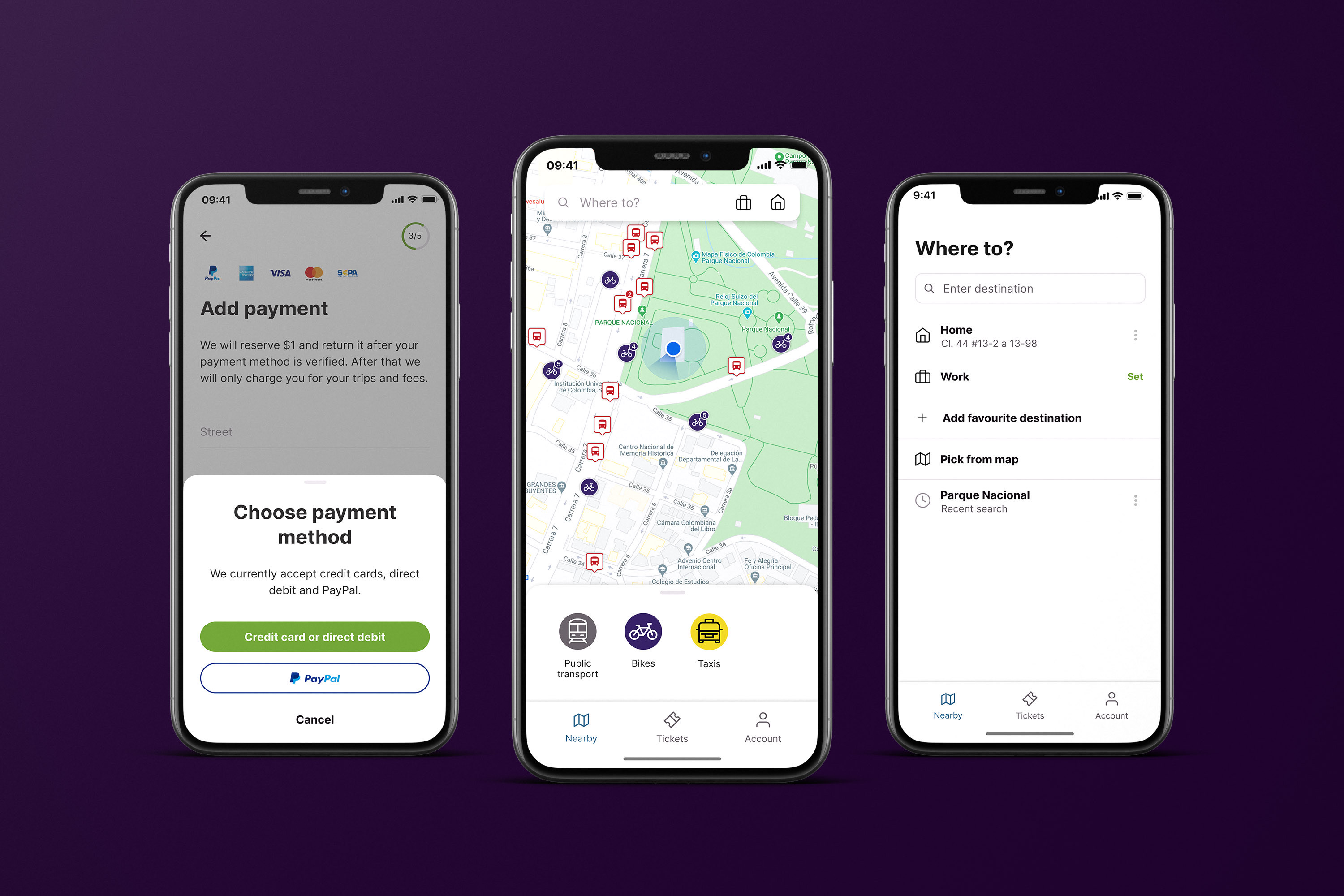
Image Credits: Trafi
Bogota is just the start. Trafi co-founder and CEO Martynas Gudonavičius told TechCrunch that the company plans to expand to other LatAm cities. The company will target capital cities in other LatAm countries first, places like São Paulo in Brazil. Gudonavičius said Trafi will seek out contracts with smaller and medium-sized cities in the region as well. Any city with digital ticketing and various modes of transportation, including scooter and bicycles, buses and ride-hailing, is a good fit for the company, he added.
“Latin America is a superb example where mobility-as-a-service can really strive,” Gudonavičius said. “This is why we’re in Bogota, it’s this young, dynamic, fast-growing population. And we are here to help them do the big transition from transportation patterns and behavior they have at the moment, to a mobility-as-a service concept.”
Trafi is hiring for a director in the region and plans to hire more people in all departments this year. It’s also eyeing an expansion into Asia in the second half of 2021. Gudonavičius wouldn’t provide specific details, but said the company had a short list of cities it wanted to enter. He specifically noted that Trafi planned to expand to a city in Japan.


