& meet dozens of singles today!
User blogs

Metropolis is a new Los Angeles-based startup that’s looking to compete with BMW-owned ParkMobile for a slice of the automated parking lot management market.
Upgrading ParkMobile’s license plate-based service with a computer vision based system that recognizes cars as they enter and leave garages has been Metropolis’ mission since founder and chief executive Alex Israel first formed the business back in 2017.
Israel, a serial entrepreneur, has spent decades thinking about parking. His last company, ParkMe, was sold to Inrix back in 2015. And it was with those earnings and experience that Israel went back to the drawing board to develop a new kind of parking payment and management service.
Now, the company is ready for its closeup, announcing not only its launch, but $41 million in financing the company raised from investors including the real estate managers Starwood and RXR Realty; Dick Costolo’s 01 Advisors; Dragoneer; former Facebook employees Sam Lessin and Kevin Colleran’s Slow Ventures; Dan Doctoroff, the head of Alphabet’s Sidewalk Labs initiative; and NBA All star and early stage investor, Baron Davis.
According to Alex Israel, the parking payment application is the foundation for a bigger business empire that hopes to reimagine parking spaces as hubs for a broad array of urban mobility services.
In this, the company’s goals aren’t dissimilar from the Florida-based startup, REEF, which has its own spin on what to do with the existing infrastructure and footprint created by urban parking spaces. And REEF’s $700 million round of funding from last year shows there’s a lot of money to be made — or at least spent — in a parking lot.
Unlike REEF, Metropolis will remain focused on mobility, according to Israel. “How does parking change over the next 20 years as mobility shifts?” he asked. And he’s hoping that Metropolis will provide an answer.
The company is hoping to use its latest funding to expand its footprint to over 600 locations over the course of the next year. In all, Metropolis has raised $60 million since it was formed back in 2017.
While the computer vision and machine learning technology will serve as the company’s beachhead into parking lots, services like cleaning, charging, storage and logistics could all be part and parcel of the Metropolis offering going forward, Israel said. “We become the integrator [and] we also in some cases become the direct service provider,” Israel said.
The company already has 10,000 parking spots that it’s managing for big real estate owners, and Israel expects more property managers to flood to its service.
“[Big property owners] are not thinking about the infrastructure requirements that allow for the seamless access to these facilities,” Israel said. His technology can allow buildings to capture more value through other services like dynamic pricing and yield optimization as well.
“Metropolis is finding the highest and best use whether that be scooter charging, scooter storage, fleet storage, fleet logistics, or sorting,” Israel said.
One of the new space startups with the loftiest near-term goals has raised $130 million in a Series B round that demonstrates investor confidence in the scope of its ambitions: Axiom Space, which has been tapped by NASA to add privately-developed space station modules to the ISS, announced the new funding led by C5 Capital on Tuesday.
This is the latest in a string of high-profile announcements for Axiom, which was founded in 2016 by a team including space professionals with a history of demonstrated expertise working on the International Space Station. Eventually, Axiom hopes to go from adding the first private commercial modules to the existing station, to creating their own, wholly private on-orbital platforms – for research, space tourism and more.
Axiom announced the people who will take part it it first ever private astronaut launch to the ISS, which is set to fly next January using a SpaceX Dragon spacecraft and Falcon 9 rocket. Axiom is the service provider for the mission, brokering the deal for the private spacefarers and setting up training and mission profile. That should be the first time we see a crew made up entirely of private individuals (ie., not astronauts selected, trained and employed by their respective national government) make its way to the station.
The company was also in discussions with Tom Cruise about filming at least part of an upcoming film aboard the ISS, and it’s in development with a production company on a forthcoming competition reality show that will see contestants vie for a spot on a private flight to the station.
Axiom is emerging as the leading linkage between private human spaceflight and the existing infrastructure and industry, covering both public sector partners like NASA, and the ‘rails’ of the bourgeoning industry – SpaceX and its ilk. It’s been focused on this unique opportunity longer than most in the private market, and it has all the relationships and in-house expertise to make it work.
Contestants will compete for a SpaceX trip to the International Space Station in new reality TV show
This new, significant injection of capital will help the company hire, as well as boost its ability to construct the pieces of its forthcoming private space station modules, as well as its eventual station itself. The Houston-based company aims to put its ISS modules on the station by 2024, and it has raised $150 million to date.
Knoq (formerly known as Polis) was a startup that recruited representatives to go door-to-door in their neighborhoods, talking up client products and services. So for obvious reasons, it faced challenges in 2020.
“We stopped knocking on doors in February, and this summer, we were trying to figure out what the path forward was,” founder and CEO Kendall Tucker told me.
The company has already pivoted once, shifting focus from political work to commercial marketing. But Tucker said Knoq also had some attractive assets, namely its “unique, huge consumer models” designed to predict whether someone would be interested in a given product, as well as “the experience of building out these teams of neighborhood representatives.”
So after what she described as a competitive bidding prices, Knoq was acquired by Ad Practitioners, a digital media company that owns properties like Money.com and ConsumersAdvocate.org.
As part of Ad Practitioners, Tucker said the Knoq team will be able to interact with visitors to those properties and help “pair consumers with the right product,” whether that’s auto insurance or software. After all, she noted that there plenty of consumers already reaching out to Ad Practitioners via chat bots and phone calls: “These are people already asking for help … we’re really just connecting the dots.”
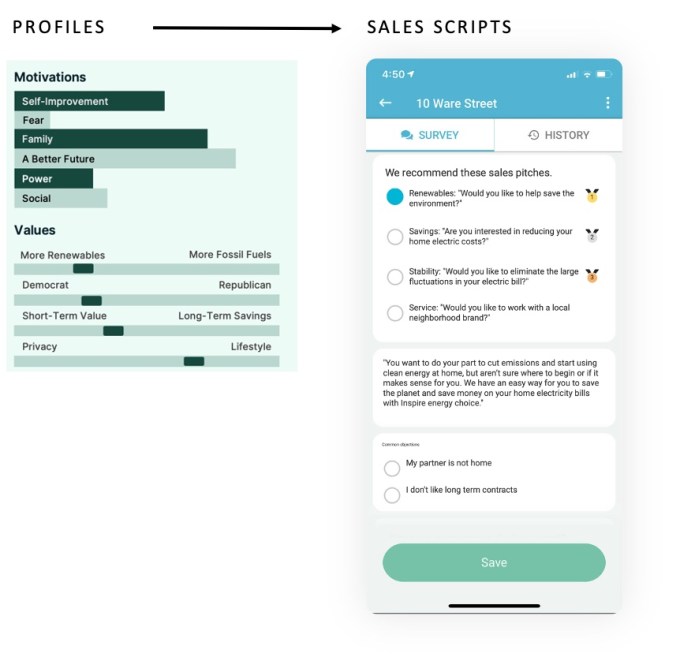
Image Credits: Knoq
In the acquisition announcement, Ad Practitioners CEO Greg Powel made a similar point, saying that the deal represents “a shared vision of helping people make decisions through conversations driven by data and technology while educating people about products and services that matter.”
“The Money and ConsumersAdvocate.org brands are already trusted by millions of highly-engaged users,” Powel continued. “Together, we foresee a world where consumers come to our sites for great content [and] reviews and to speak with representatives who can help them find the personal information they need.”
The Knoq leadership team has already moved to join Ad Practitioners in Puerto Rico, with the rest of the Knoq team set to move later this year.
You might think a startup would be inclined to stay put in its current location (in Knoq’s case, Boston), at least for the duration of the pandemic, but Tucker said she’s a big believer in seeing your team in person. In fact, the Knoq team had socially distanced outdoor meetups over the summer, “to brainstorm or just hang out and make sure people are okay.” Plus, she’s excited about the possibility of “hiring the amazing people on this island.”
The financial terms of the acquisition were not disclosed. Knoq had most recently raised $2.5 million from Initialized Capital and Haystack.vc, and Tucker said it was crucial that the acquisition provided a good outcome not just for her team and herself, but also her investors.
“We’re so excited for Kendall and her team on their successful exit to Ad Practitioners,” said Initialized General Partner Alda Leu Dennis in a statement. “It’s been a pleasure partnering with Knoq over the last few years. The Knoq team will bring a tech-forward approach to sales outreach and customer analytics. And, Kendall’s skills as a brilliant builder, operator and strategic thinker will be a huge asset for Ad Practitioners.”
Source: https://techcrunch.com/2021/02/16/ad-practitioners-acquies-knoq/
The hodl-crew are having quite the moment as bitcoin passed the $50,000 mark earlier today for the first time. Data pegs the peak at just over $50,500.
The price of bitcoin, the world’s best-known cryptocurrency, has historically proven a reasonable proxy for consumer interest in the cryptocurrency space, and for trading activity amongst blockchain-based assets. Bitcoin’s price has retreated since the milestone, and is now worth just over $49,000.
Bitcoin has been on a tear this year, rising from around the $30,000 mark at the start of 2021 to its recent $50,000 milestone, a gain or around 66%. Looking back a year and the gains are even more impressive, with the price of bitcoin rising from around $10,000 a year ago to its current price, a gain of 400%.
Luckily for investors and believers in other decentralized tokens, it’s not just bitcoin that is enjoying a valuation updraft. Cardano, one of the most highly-valued blockchain assets, is up around 28% in the last week according to CoinMarketCap. Its total value is nearing the $8 billion mark.
Companies built atop the burgeoning cryptocurrency space could be enjoying a boom as the price of bitcoin advances; as trading activity and consumer interest tend to rise along with the price of bitcoin, and companies like Coinbase make money from trading activity and consumer use, 2021 is starting off strongly.
Coinbase has filed to go public, and intends to pursue a direct listing in short order.
What’s driving the price of bitcoin and its sister-tokens up in the short-term? In a market melt-up its hard to point fingers with any accuracy. But broadly speaking if it feels that nearly every asset class is setting new all-time records, so why not bitcoin as well?
Pex, a startup aiming to giving rightsholders more control over how their content is used and reused online, has raised $57 million in new funding.
The round comes from existing investors including Susa Ventures and Illuminate Ventures, as well as Tencent, Tencent Music Entertainment, the CueBall Group, NexGen Ventures Partners, Amaranthine and others.
Founded in 2014, Pex had previously raised $7 million, and it acquired music rights startup Dubset last year. Founder and CEO Rasty Turek told me that while the product has evolved from what he described as “a Google-like search engine for rightsholders to find copyright infringement” into a broader platform, the vision of creating a better system of managing copyright and payments online has remained the same.
The startup describes its Attribution Engine as the “licensing infrastructure for the Internet,” bringing together the individuals and companies who own content rights, creators who might want to license and remix that content, the big digital platforms where content gets shared and the law enforcement agencies that want to monitor all of this.
The product includes six modules — an asset registry, a system for identifying those assets when they’re used in new content, a licensing system, a dispute resolution system, a payment system and data and reporting to see how your content is being used.
Turek said that while Pex is being used by “most of the largest rightsholders in the world,” the system was built to be accessible to “a struggling musician out on the streets of Los Angeles” who doesn’t have the resources to “police all of this content” online.

Pex CEO Rasty Turek
He also suggested that the broader regulatory environment is calling for a solution like Pex, with the European Union passing a new copyright directive that’s set to take effect this year, and new copyright legislation also on the table in the United States. The EU bill was criticized for potentially prompting larger platforms to preemptively block broad swaths of content, but Turek argued, “There’s so much content out there in search of an audience that this is going to be the opposite of overblocking.”
Not that Pex is taking is relying entirely on regulators. Turek also said the platform is structured to balance the needs of the different groups using it — and that it has an incentive to strike that balance because its revenue comes from licensing deals, so it’s focused on “really being the Switzerland, really being the neutral party.”
“We designed all of our business around the idea that if we try to abuse the system, we lose, too,” he said. “We don’t make money [when someone] abuses the system, we only make money when everybody plays nice.”
Turek also claimed that public domain and Creative Commons licenses are “first class citizens” on the platform, and that many of the rightsholders using the Attribution Engine don’t necessarily want monetary compensation: “A lot of people are happy to do this for recognition. We are social animals.” (Plus, recognition can lead to moneymaking opportunities.)
Pex says the new funding will allow it to continue scaling the Attribution Engine.
“I don’t believe investments are valdation,” Turek added. “I believe they’re more obligation than validation, but they do prove you are directionally correct.”
Source: https://techcrunch.com/2021/02/16/pex-tencent-funding/


