& meet dozens of singles today!
User blogs

New York Attorney General Letitia James has filed a lawsuit alleging that Amazon failed to provide adequate safety health and safety measures in two New York facilities, and that it unlawfully disciplined and fired employees who complained.
James opened an investigation into Amazon in March of last year, which her office says initially focused on conditions at a fulfillment center in Staten Island and a distribution center in Queens — collectively employing more than 5,000 people — before expanding to look at the firing and disciplining of employees as well.
In a statement, James said:
While Amazon and its CEO made billions during this crisis, hardworking employees were forced to endure unsafe conditions and were retaliated against for rightfully voicing these concerns. Since the pandemic began, it is clear that Amazon has valued profit over people and has failed to ensure the health and safety of its workers. The workers who have powered this country and kept it going during the pandemic are the very workers who continue to be treated the worst. As we seek to hold Amazon accountable for its actions, my office remains dedicated to protecting New York workers from exploitation and unfair treatment in all forms.
Last week, Amazon preemptively sued James, arguing that workplace safety is a federal matter and that she did not have authority to bring her suit.
“We care deeply about the health and safety of our employees, as demonstrated in our filing last week, and we don’t believe the Attorney General’s filing presents an accurate picture of Amazon’s industry-leading response to the pandemic,” said Amazon spokesperson Kelly Nantel in a statement.
Among other things, the suit alleges that Amazon violated state laws around cleaning and disinfection protocols, as well as contact tracing, and that it failed to alter its productivity policies to allow employees “to take the time necessary to engage in hygiene, sanitation, social-distancing, and necessary cleaning practices.”
The suit also points to the firing of Christian Smalls (who has filed his own lawsuit against the company) and its warnings to Derrick Palmer as “swift retaliatory action against workers’ complaints.”
James’ office says that it’s seeking changes in Amazon’s policies, backpay/damages and reinstatement for Smalls, damages for Palmer and “requiring Amazon to give up the profits it made as a result of its illegal acts.”
Source: https://techcrunch.com/2021/02/17/amazon-ny-ag-lawsuit/
There will be one more robot on Mars tomorrow afternoon. The Perseverance rover will touch down just before 1:00 Pacific, beginning a major new expedition to the planet and kicking off a number of experiments — from a search for traces of life to the long-awaited Martian helicopter. Here’s what you can expect from Perseverance tomorrow and over the next few years.
It’s a big, complex mission — and like the Artemis program, is as much about preparing for the future, in which people will visit the Red Planet, as it is about learning more about it in the present. Perseverance is ambitious even among missions to Mars.
If you want to follow along live, NASA TV’s broadcast of the landing starts at 11:15 AM Pacific, providing context and interviews as the craft makes its final approach:
Until then, however, you might want to brush up on what Perseverance will be getting up to.
Seven months of anticipation and seven minutes of terror

Image Credits: NASA/JPL-Caltech
First, the car-sized rover has to get to the surface safely. It’s been traveling for seven months to arrive at the Red Planet, its arrival heralded by new orbiters from the UAE and China, which both arrived last week.
Perseverance isn’t looking to stick around in orbit, however, and will plunge directly into the thin atmosphere of Mars. The spacecraft carrying the rover has made small adjustments to its trajectory to be sure that it enters at the right time and angle to put Perseverance above its target, the Jezero crater.
The process of deceleration and landing will take about seven minutes once the craft enters the atmosphere. The landing process is the most complex and ambitious ever undertaken by an interplanetary mission, and goes as follows.
After slowing down in the atmosphere like a meteor to a leisurely 940 MPH or so, the parachute will deploy, slowing the descender over the next minute or two to a quarter of that speed. At the same time, the heat shield will separate, exposing the instruments on the underside of the craft.
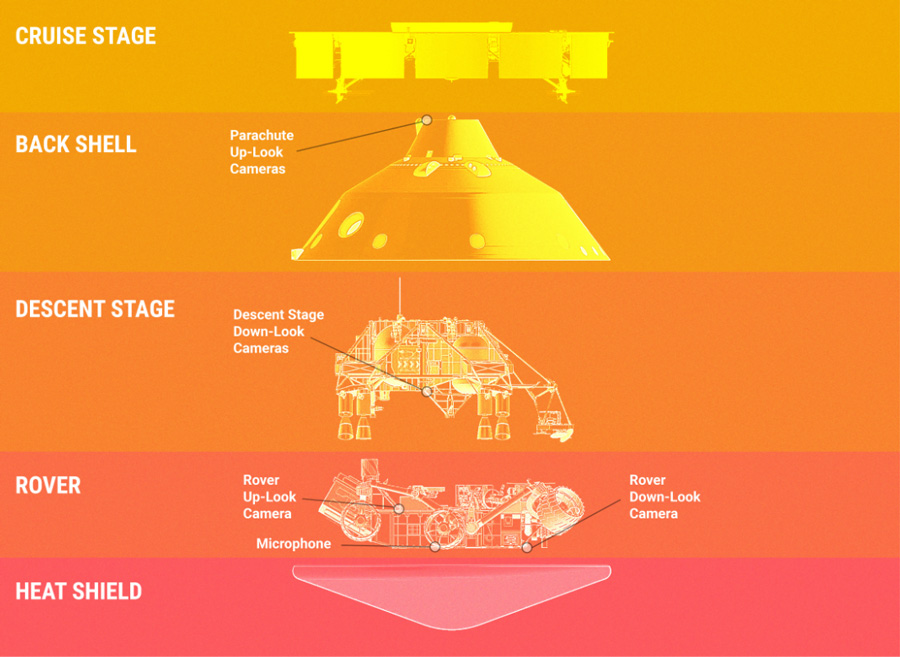
Image Credits: NASA/JPL-Caltech
This is a crucial moment, as the craft will then autonomously — there’s no time to send the data to Earth — scan the area below it with radar and other instruments and find what it believes to be an optimal landing location.
Once it does so, from more than a mile up, the parachute will detach and the rover will continue downwards in a “powered descent” using a sort of jetpack that will take it down to just 70 feet above the surface. At this point the rover detaches, suspended at the end of a 21-foot “Sky Crane,” and as the jetpack descends the cable extends; once it touches down, the jetpack boosts itself away, Sky Crane and all, to crash somewhere safely distant.
All that takes place in about 410 seconds, during which time the team will be sweating madly and chewing their pencils. It’s all right here in this diagram for quick reference:
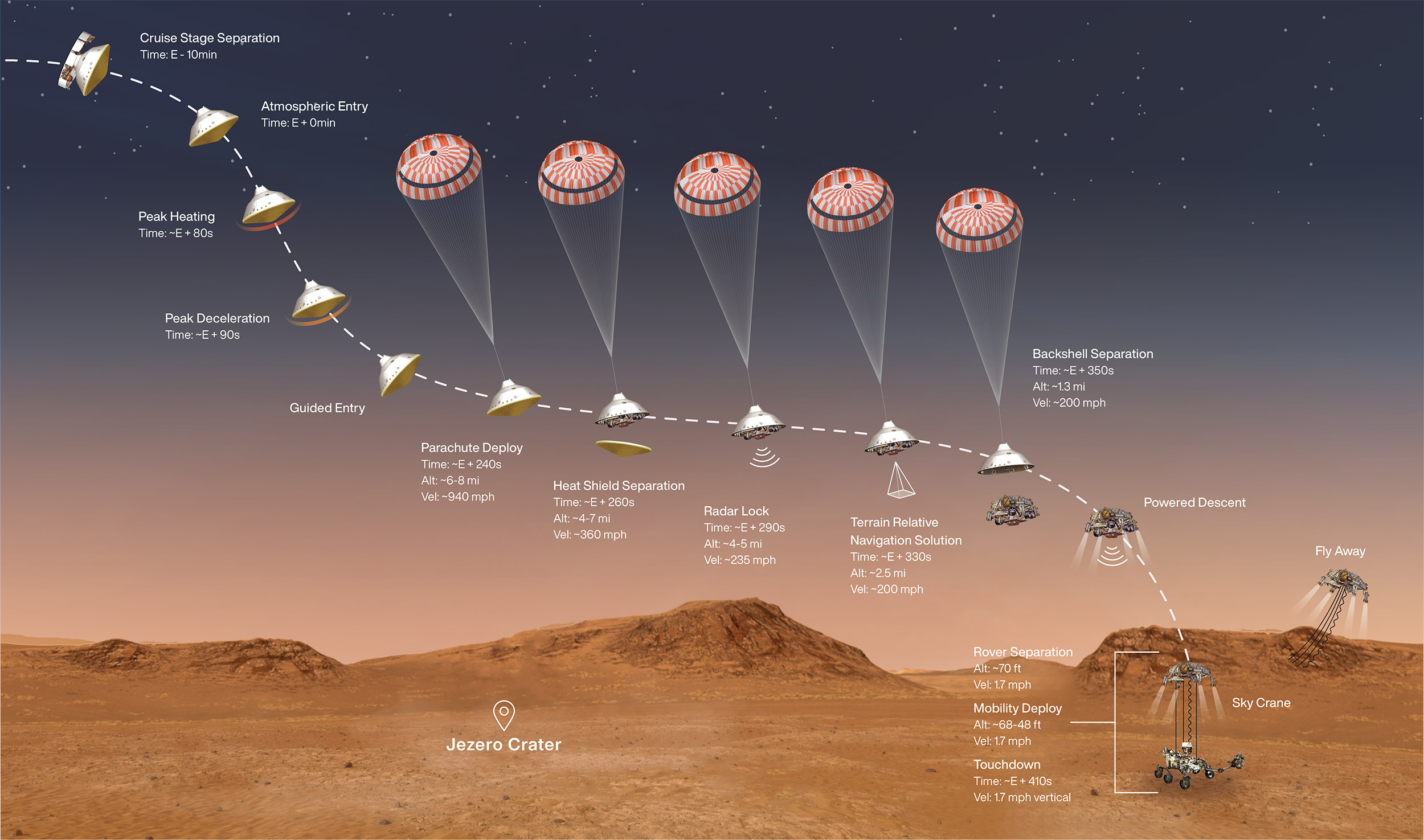
Image Credits: NASA/JPL-Caltech
And for the space geeks who want a little more detail, check out this awesome real-time simulation of the whole process. You can speed up, slow down, check the theoretical nominal velocities and forces, and so on.
Rocking the crater

Image Credits: NASA/JPL-Caltech
Other rovers and orbiters have been turning up promising signs of life on Mars for years: the Mars Express Orbiter discovered liquid water under the surface in 2018; Curiosity found gaseous hints of life in 2019; Spirit and Opportunity found tons of signs that life could have been supported during their incredibly long missions.
Jezero Crater was chosen as a region rich in possibilities for finding evidence of life, but also a good venue for many other scientific endeavors.
The most similar to previous missions are the geology and astrobiology goals. Jezero was “home to an ancient delta, flooded with water.” Tons of materials coalesce in deltas that not only foster life, but record its presence. Perseverance will undertake a detailed survey of the area in which it lands to help characterize the former climate of Mars.
Part of that investigation will specifically test for evidence of life, such as deposits of certain minerals in patterns likely to have resulted from colonies of microbes rather than geological processes. It’s not expected that the rover will stumble across any living creatures, but you know the team all secretly hope this astronomically unlikely possibility will occur.
One of the more future-embracing science goals is to collect and sequester samples from the environment in a central storage facility, which can then be sent back to Earth — though they’re still figuring out how to handle that last detail. The samples themselves will be carefully cut from the rock rather than drilled or chipped out, leaving them in pristine condition for analysis later.
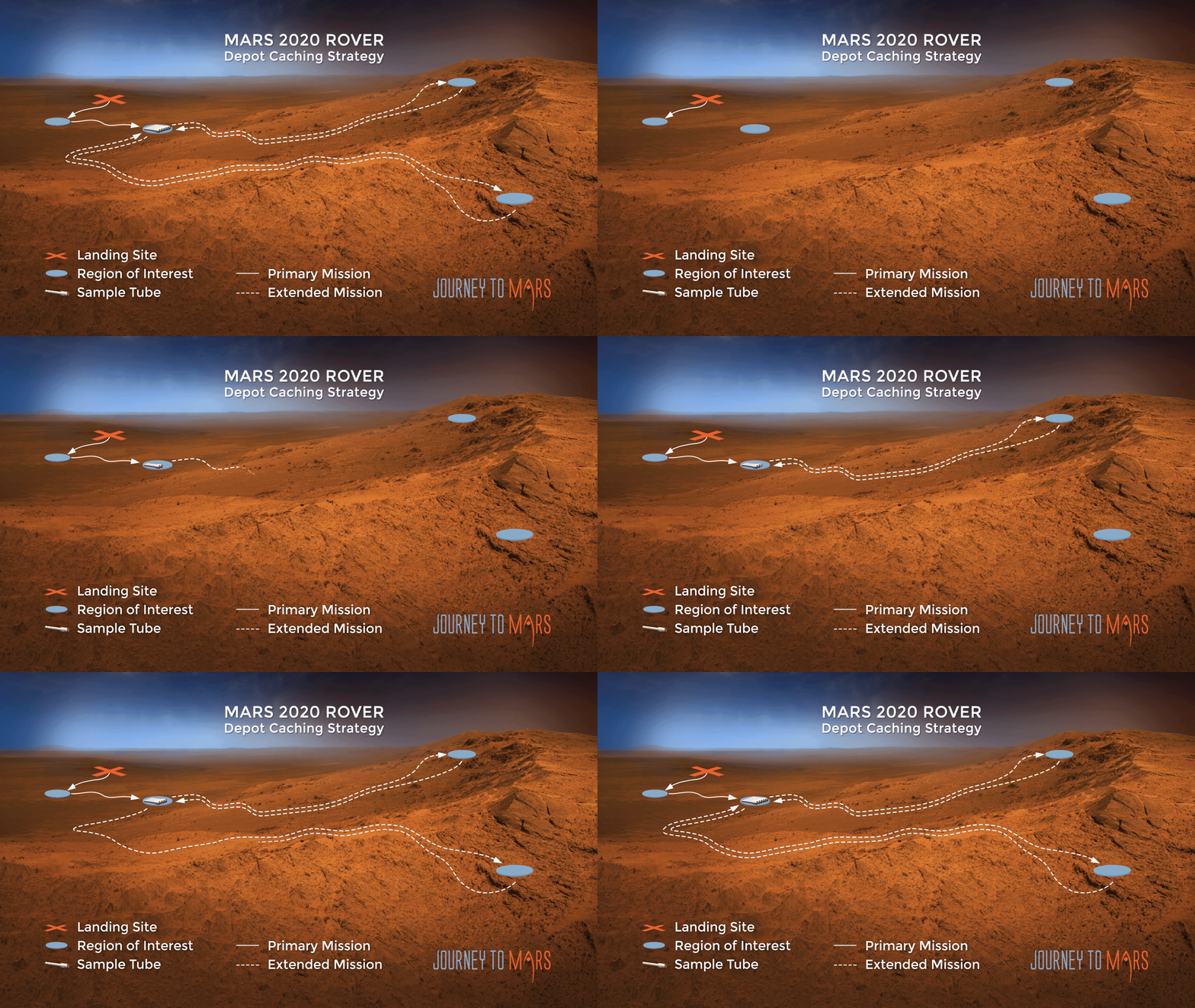
Image Credits: NASA/JPL-Caltech
Perseverance will spend some time doubling back on its path to place as many as 30 capsules full of sampled material in a central depot, which will be kept sealed until such a time as they can be harvested and returned to Earth.
The whole time the rover will be acting as a mobile science laboratory, taking all kinds of readings as it goes. Some of the signs of life it’s looking for only result from detailed analysis of the soil, for instance, so sophisticating imaging and spectroscopy instruments are on board, PIXL and SHERLOC. It also carries a ground-penetrating radar (RIMFAX) to observe the fine structure of the landscape beneath it. And MEDA will continuously take measurements of temperature, wind, pressure, dust characteristics, and so on.
Of course the crowd-pleasing landscapes and “selfies” NASA’s rovers have become famous for will also be beamed back to Earth regularly. It has 19 cameras, though mostly they’ll be used for navigation and science purposes.
Exploring takes a little MOXIE and Ingenuity
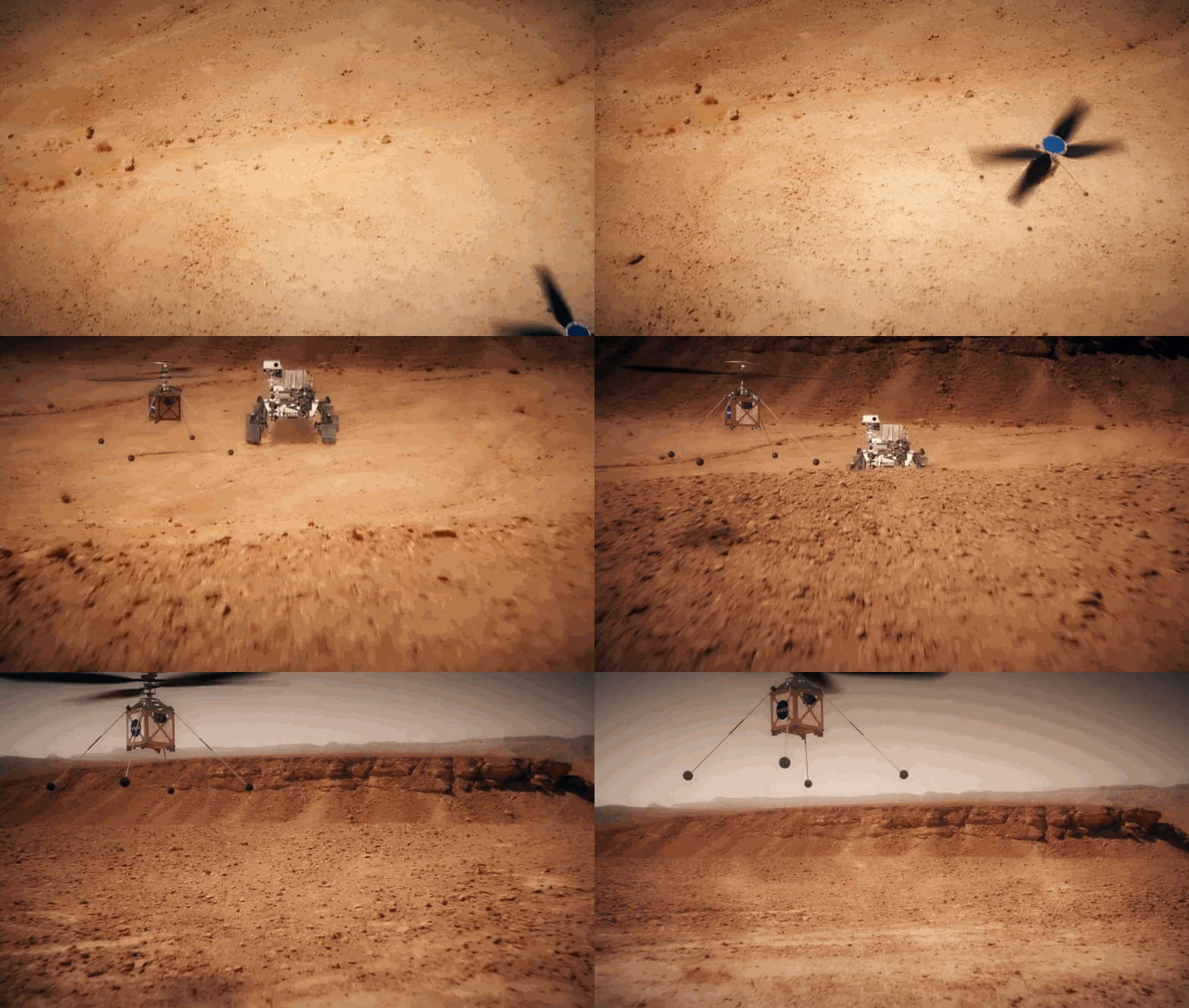
Image Credits: NASA/JPL-Caltech
Perseverance is part of NASA’s long-term plan to visit the Red Planet in person, and it carries a handful of tech experiments that could contribute to that mission.
The most popular one, and for good reason, is the Ingenuity Mars Helicopter. This little solar-powered two-rotor craft will be the first ever demonstration of powered flight on another planet (the jetpack Perseverance rode in on doesn’t count).
The goals are modest: the main one is simply to take off and hover in the thin air a few feet off the ground for 20 to 30 seconds, then land safely. This will provide crucial real-world data about how a craft like this will perform on Mars, how much dust it kicks up, and all kinds of other metrics that future aerial craft will take into account. If the first flight goes well, the team plans additional ones that may look like the GIF above.
Being able to fly around on another planet would be huge for science and exploration, and eventually for industry and safety when people are there. Drones are have already become crucial tools for all kinds of surveying, rescue operations, and other tasks here on Earth — why wouldn’t it be the same case on Mars? Plus it’ll get some great shots from its onboard cameras.
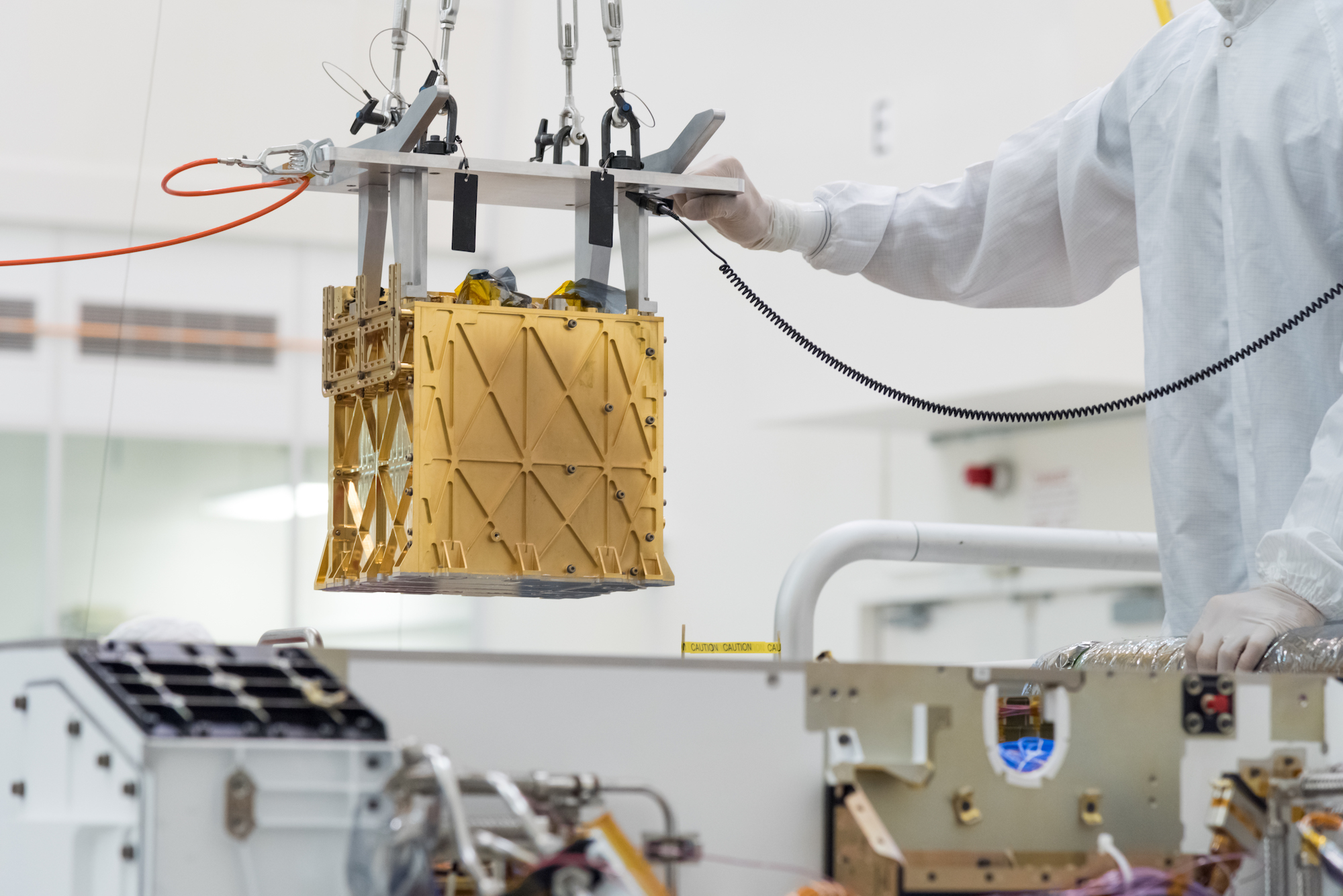
MOXIE is the other forward-looking experiment, and could be even more important (though less flashy) than the helicopter. It stands for Mars Oxygen In-Situ Resource Utilization Experiment, and it’s all about trying to make breathable oxygen from the planet’s thin, mostly carbon dioxide atmosphere.
This isn’t about making oxygen to breathe, though it could be used for that too. MOXIE is about making oxygen at scales large enough that it could be used to provide rocket fuel for future takeoffs. Though if habitats like these ever end up getting built, it will be good to have plenty of O2 on hand just in case.
For a round trip to Mars, sourcing fuel from the there rather than trucking all the way from Earth to burn on the way back is an immense improvement in many ways. The 30-50 tons of liquid oxygen that would normally be brought over in the tanks could instead be functional payloads, and that kind of tonnage goes a long way when you’re talking about freeze-dried food, electronics, and other supplies.
MOXIE will be attempting, at a small scale (it’s about the size of a car battery, and future oxygen generators would be a hundred times bigger), to isolate oxygen from the CO2 surrounding it. The team is expecting about 10 grams per hour, but it will only be on intermittently so as not to draw too much power. With luck it’ll be enough of a success that this method can be pursued more seriously in the near future.
Self-roving technology

Image Credits: NASA/JPL-Caltech
One of the big challenges for previous rovers is that they have essentially been remote controlled with a 30-mintue delay — scientists on Earth examine the surroundings, send instructions like go forward 40 centimeters, turn front wheels 5 degrees to the right, go 75 centimeters, etc. This not only means a lot of work for the team but a huge delay as the rover makes moves, waits half an hour for more instructions to arrive, then repeats the process over and over.
Perseverance breaks with its forbears with a totally new autonomous navigation system. It has high resolution, wide-angle color cameras and a dedicated processing unit for turning images into terrain maps and choosing paths through them, much like a self-driving car.
Being able to go farther on its own means the rover can cover far more ground. The longest drive ever recorded in a single Martian day was 702 feet by Opportunity (RIP). Perseverance will aim to cover about that distance on average, and with far less human input. Chances are it’ll set a new record pretty quickly once it’s done tiptoeing around for the first few days.
In fact the first 30 sols after the terrifying landing will be mostly checks, double checks, instrument deployments, more checks, and rather unimpressive-looking short rolls around the immediate area. But remember, if all goes well, this thing could still be rolling around Mars in 10 or 15 years when people start showing up. This is just the very beginning of a long, long mission.
ExOne this week announced that the U.S. Department of Defense has granted it $1.6 million. It’s one of the Pennsylvania-based metal 3D printing company’s largest government contracts, in service of building a portable 3D printing factory for the front line – essentially a method for troops to fabricate broken and missing parts where the need them the most.
“Over the last two years, we’ve really focused on providing our technology into government-type applications: DoD, NASA, DoE,” CEO John Hartner tells TechCrunch. “Sometimes people talk about disrupting the supply chain and getting decentralized manufacturing. This is decentralized and forward deployed, if you will. Be it an emergency, humanitarian mission or frontlines for a war fighter.”
The money from the grant will specifically go toward R&D and building the first unit.
ExOne is proud to have been awarded a $1.6M U.S. Department of Defense contract to develop a portable self-contained 3D printing “factory” housed in a shipping container. The pod will help reduce inventory and simplify the supply chain. #metal3Dprintinghttps://t.co/jSCef5HuB6 pic.twitter.com/awXhMGrKFp
— ExOne (@ExOneCo) February 16, 2021
The system combines a series of machines with a software layer designed to lower the barrier of entry for use. While some training will be required, the hope is that people will be able to operate the system in the field.
“We’ve ruggedized the products that are going inside,” says Hartner. “There’s an element of software that makes the whole thing easier to use together. You start with scanning. So, there’s a possibility that you print from a cloud-based repository, but that may not be available for whatever reason, so you may have a broken part that you can scan and do some digital repair to the file and print.”
The devices rely on binder jet printing, the core tech behind ExOne’s machines. The system essentially composites powder, layer by layer to build up an object. ExOne expects to deliver the first system by Q3 2022. If all goes well, the parties will discuss further partnerships going forward.
The day before Robinhood goes under the the Congressional hammer, domestic rival Public.com announced this morning that it has closed a $220 million funding round at a $1.2 billion valuation. News of the round was first broken by TechCrunch. Further reporting colored in the lines concerning the investment’s size and valuation range.
Confirming the funding news today, Public added a fresh metric to the mix, namely that it has reached one million members – over the course of just 18 months post-launch, the company was quick to point out.
That means that Public’s backers – its latest round was put together by prior investors, including Greycroft, Accel, Tiger Global, Inspired Capital and others – values the company at around $1,200 per current “member.” Whether or not that feels rich, we leave to you to decide.
But with rising interest in the savings and investing space – some data here — and Robinhood’s revenues growing to a run rate of more than $800 million in Q4 2020 and looking even better at the start of 2021, it’s not hard to see why investors are backing Public. It’s even easier if you believe that Robinhood’s brand has undergone material harm from its woes during the GameStop saga.
The pair, along with a host of other fintech services that offer savings and investing products, have been buoyed by a secular shift in banking away from the physical world (in-person shopping, bank branches, plastic cards) to the digital (neo-banks, ecommerce, virtual cards). Robinhood shook up the trading world with zero-cost investing, fitting neatly into the mobile and virtual banking future that is being built. And Public has taken that model a step further by dropping payment for order flow (PFOF), a method revenue generation in which companies like Robinhood get a small fee for sending their users’ trades to one particular market maker or another.
TechCrunch recently joked that it seems like “there is infinite money for stock-trading startups,” in light of the anticipated Public round, which has now has arrived. Let’s see who is next to take home a big check.
This morning Ally.io, a software startup with a focus on the OKR (objectives and key results, in case you’ve somehow avoided being exposed) goal-setting technique, announced that it has closed $50 million in new capital. The Series C round was led by Green Oaks Capital, Madrona Capital, and its Series B lead, Tiger Global.
Ally raised an $8 million Series A in August, 2019 and a $15 million Series B in October of the same year. The Series C is more than its A and B rounds put together – and doubled.
That Ally raised such a large round really wasn’t too big a surprise. OKR-software rival Gtmhub raised a $30 million Series B earlier this year, and companies in this particular software niche reported rapid-fire growth last year. TechCrunch collected growth metrics from a host of companies competing in the OKR and corporate goal-setting market, including Ally. In 2020, Gtmhub, Perdoo, WorkBoard, and Ally.io all grew in the triple digits.
In a blog post that TechCrunch saw before publication, Madrona investor and Ally backer S. Somasegar noted that “nearly $300 million” has been invested into OKR startups in the last two years. Such rapid growth from so many players in such a competitive space could signal a huge market.
Ally’s latest round makes it clear that investors expect similar growth from the cohort in 2021.
For flavor, we got new growth numbers from Ally.io. Previously the startup had shared growth of 3.3x in 2020. Its CEO Vetri Vellore told TechCrunch in an email that Ally.io’s “revenue has increased by 5x and [has] added over 600 customers” since its Series B, which came around 15 months prior. That’s quick.
It’s the sort of growth that venture investors want to own a piece of. So, even though Vellore told TechCrunch that his company has “most of [its] Series B money in the bank,” it decided to take on more capital “to accelerate further,” to which we’d add because it could.
Ally did not have to twist arms to raise more. Vellore described the round as “extremely competitive” in an email, noting that he had “started the [fundraising] process in early January.” It’s just over mid-February, so the round came together quickly: “Within two weeks of starting the process, we were able to wrap it up,” the CEO wrote, adding that the investment “was heavily oversubscribed due to strong interest from both existing investors and our new investors.”
The market for OKR software, and corporate goal-setting software in general, is proving to be large, and lucrative. Let’s see which rival player is the next to raise.


