& meet dozens of singles today!
User blogs

In recent years, the U.S. has seen more renters than at any point since at least 1965, according to a Pew Research Center analysis of Census Bureau housing data.
Competition for renters is fierce and property managers are turning to technology to get a leg up.
To meet that demand, Seattle-based Knock – one startup that has developed tools to give property management companies a competitive edge – has raised $20 million in a growth funding round led by Fifth Wall Ventures.
Existing backers Madrona Venture Group, Lead Edge Capital, Second Avenue Partners and Seven Peaks Ventures also participated in the financing, which brings the company’s total capital raised to $47 million.
Demetri Themelis and Tom Petry co-founded Knock in 2014 after renting “in super competitive markets” such as New York City, San Francisco and Seattle.
“After meeting with property management companies, it was eye-opening to learn about the total gap across their tech stacks,” Themelis recalled.
Knock’s goal is to provide CRM tools to modernize front office operations for these companies so they can do things like offer virtual tours and communicate with renters via text, email or social media from “a single conversation screen.” For renters, it offers an easier way to communicate and engage with landlords.
“Apartment buildings, like almost every customer-driven business, compete with each other by attracting, converting and retaining customers,” Themelis said. “For property management companies, these customers are renters.”
The startup — which operates as a SaaS business — has seen an uptick in growth, quadrupling its revenue over the past two years. Its software is used by hundreds of the largest property management companies across the United States and Canada and has more than 1.5 million apartment units using the platform. Starwood Capital Group, ZRS, FPI and Cushman & Wakefield (formerly Pinnacle) are among its users.
As Petry explains it, Knock serves as the sales inbox (chat, SMS, phone, email), sales calendar and CRM systems, all in one.
“We also automate certain sales tasks like outreach and appointment scheduling, while also surfacing which sales opportunities need the most attention at any given time, for both new leases as well as renewals,” he said.

Image Credit: Knock
The company, Themelis said, was well-prepared for the impact of the COVID-19 pandemic.
“Our software supports property management companies, which operate high-density apartment buildings that people live and work in,” he told TechCrunch. “You can’t just ‘shut them down,’ which has made multifamily resilient and even grow in comparison to retail and industrial real estate.”
For example, when lockdowns went into effect, in-person property tours declined by an estimated 80% in a matter of weeks.
Knock did things like help property managers transition to a centralized and remote leasing model so remote agents could work across a large portfolio of properties rather than in a single on-site leasing office, noted Petry.
It also helped them adopt self-guided, virtual and live video-based leasing tools, so prospective renters could tour properties in person on their own or virtually.
“This transformation and modernization became a huge tailwind for our business in 2020,” Petry said. “Not only did we have a record year in terms of new customers, revenue growth and revenue retention, but our customers outperformed market averages for occupancy and rent growth as well.”
Looking ahead, the company says it will be using its new capital to (naturally!) hire across product, engineering, sales, marketing, customer success, finance and human resources divisions. It expects to grow headcount by 40% to 50% before year-end. It also plans to expand its product portfolio to include AI communications, fraud prevention, applicant screening and leasing, and intelligent forecasting.
Fifth Wall partner Vik Chawla, who is joining Knock’s board of directors, pointed out that the macroeconomic environment is driving institutional capital into multifamily real estate at an accelerated pace. This makes Knock’s offering even more timely in its importance, in the firm’s view.
The startup, he believes, outshines its competitors in terms of quality of product, technical prowess and functionality.
“The Knock team has accomplished so much in just a short period of time by attracting very high quality product design and engineering talent to ameliorate a nuanced pain point in the tenant acquisition process,” Chawla told TechCrunch.
In terms of fitting with its investment thesis, Chawla said companies like Knock can both benefit from Fifth Wall’s global corporate strategic partners “and simultaneously serve as a key offering which we can share with real estate industry leaders in different countries as a potential solution for their local markets.”
Calendars. They are at the core of how we organize our workdays and meetings, but despite regular attempts to modernize the overall calendar experience, the calendar experience you see today in Outlook or G Suite Google Workspace hasn’t really changed at its core. And for the most part, the area that startups like Calendly or ReclaimAI have focused on in recent years is scheduling.
Magical is a Tel Aviv-based startup that wants to reinvent the calendar experience from the ground up and turn it into more of a team collaboration tool than simply a personal time-management service. The company today announced that it has raised a $3.3 million seed round led by Resolute Ventures, with additional backing from Ibex Investors, Aviv Growth Partners, ORR Partners, Homeward Ventures and Fusion LA, as well as several angel investors in the productivity space.
The idea for the service came from discussions on Supertools, a large workplace-productivity community, which was also founded by Magical founder and CEO Tommy Barav.

Image Credits: Magical
Based on the feedback from the community — and his own consulting work with large Fortune 500 multinationals — Barav realized that time management remains an unsolved business problem. “The time management space is so highly fragmented,” he told me. “There are so many micro tools and frameworks to manage time, but they’re not built inside of your calendar, which is the main workflow.”
Traditional calendars are add-ons to bigger product bundles and find themselves trapped under those, he argues. “The calendar in Outlook is an email sidekick, but it’s actually the center of your day. So there is an unmet need to use the calendar as a time management hub,” he said.
Magical, which is still in private beta, aims to integrate many of the features we’re seeing from current scheduling and calendaring startups, including AI-scheduling and automation tools. But Magical’s ambition is larger than that.
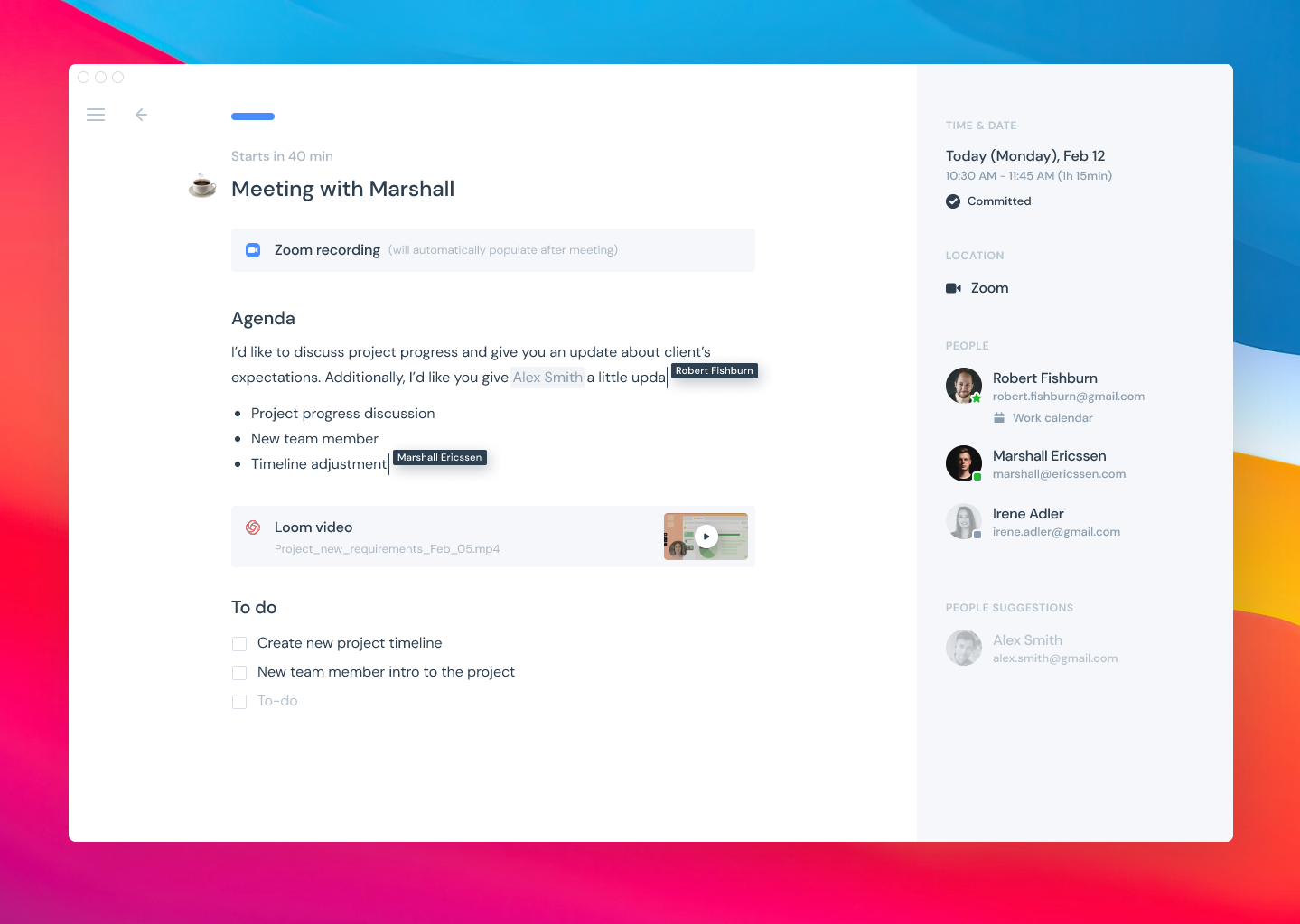
Image Credits: Magical
“We want to redefine how you use a calendar in the first place,” Barav said. “Many of the innovations that we’ve seen are associated with scheduling: how you schedule your time, letting you streamline the way you schedule meetings, how you see your calendar. […] But we’re talking about redefining time management by giving you a better calendar, by bringing these workflows — scheduling, coordinating and utilizing — into your calendar. We’re redefining the use of the calendar in the modern workspace.”
Since Magical is still in its early days, the team is still working out some of the details, but the general idea is to, for example, turn the calendar into the central repository for meeting notes — and Magical will feature tools to collaborate on these notes and share them. Team members will also be able to follow those meeting notes without having to participate in the actual meeting (or get copied on the emails about that meeting).
“We’ll help teams reduce pointless meetings,” Barav noted. To do this, the team is also integrating other service into the calendar experience, including the usual suspects like Zoom and Slack, but also Salesforce and Notion, for example.
“It’s rare that you find an entrepreneur who has so clearly validated its market opportunity,” said Mike Hirshland, a founding partner of Magical investor Resolute Ventures. “Tommy and his team have been talking to thousands of users for three years, they’ve validated the opportunity, and they’ve designed a product from the ground-up that meets the needs of the market. Now it’s ‘go time’ and I’m thrilled to be part of the journey ahead.”
Source: https://techcrunch.com/2021/02/18/magical-raises-3-3m-to-modernize-calendars/
Application performance monitoring startup Sentry announced today that it has reached unicorn status, raising a $60 million Series D with a post-funding valuation of $1 billion. The round was led by Accel and New Enterprise Associates, both returning investors, and Bond.
Accel led Sentry’s seed funding in 2015, and has invested in each of its rounds since then. The startup, which serves 68,000 organizations, has now raised a total of $127 million. Its clients include Disney, Cloudflare, Peloton, Slack, Eventbrite, Supercell and Rockstar Games.
Sentry’s software monitors apps for potential issues, helping developers catch bugs before they result in outages, downtime and frustrated users. Its Series D will be used on product development, like adding support for more languages and frameworks, and hiring for its offices in San Francisco, Toronto and Vienna.
While Sentry’s products are used by a wide range of sectors, it is seeing continued growth in gaming and streaming media, and new demand in industries that are digitizing more of their infrastructure and services, including finance, commerce and healthcare.
In July, Sentry announced the launch of frontend monitoring software for Python and Javascript. At the time, Sentry’s chief executive officer Milin Desai told TechCrunch that its customers in all verticals were relying more heavily on the platform as the COVID-19 pandemic increased the usage of work, education and e-commerce apps.
In a press statement, Accel partner Dan Levine said, “With nearly all companies moving to digital-first ways of working and engaging with customers, application health has become a business-critical initiative, and as a result, Sentry is poised for explosive growth.”
Some more internal emails Facebook really doesn’t want you to see: Turns out in 2017 COO Sheryl Sandberg had already known for years there were problems with a free ad planning tool the company offers to marketeers to display estimates of how many people campaigns running on its platform may reach, per newly unsealed court documents.
The filing also reveals that a Facebook product manager for the ‘potential reach’ tool warned the company was making revenue it “should never have” off of “wrong data”.
The unsealed documents pertain to a US class action lawsuit, filed in 2018, which alleges that Facebook deceived advertisers by knowingly including fake and duplicate accounts in ‘potential reach’ metric.
Facebook denies the claim but has acknowledged accuracy issues with the ‘potential reach’ metric as far back as 2016 — and also changed how it worked in 2019.
While the litigants have continued to accuse Facebook of continuing to misrepresent the ad reach estimate in updates to their 2018 complaint.
Redacted documents from the lawsuit, reported by the WSJ last year, included the awkward detail that a Facebook employee had asked “how long can we get away with the reach overestimation?”
But sections of the filing pertaining to Sandberg and other Facebook executives were redacted.
Newly unsealed documents from the suit — which we’ve reviewed — now reveal that in fall 2017 Sandberg “acknowledged in an internal email she had known about problems with Potential Reach for years”.
They also show Facebook repeatedly rejected internal proposals to fix the issue of fake and duplicate accounts inflating the estimates its platform showed to advertisers of the number of people who could see their ads — citing impact on revenue as a reason not to act.
In early 2018 Facebook estimated that removing duplicate accounts would cause a 10% drop in potential reach, per the unsealed filing. While Facebook management rejected an employee’s suggestion to change the language the tool showed to advertisers, declining to swap out the words “people” and “reach” for the (more accurate) term “accounts” — on the grounds that “people-based marketing was core to Facebook’s value proposition”.
The filing also reveals that a product manager for ‘potential reach’, Yaron Fidler, proposed a fix for the tool that would have decreased its numbers. His proposal was rejected by Facebook’s metrics leadership on the grounds that it would have a “significant” impact on the company’s revenue — to which Fidler responded: “It’s revenue we should have never made given the fact it’s based on wrong data.”
Always interesting to go back and see what Facebook worked for years to keep sealed. "trade secrets"….lol 2/4 pic.twitter.com/vISCzezjKH
— Jason Kint (@jason_kint) February 18, 2021
In 2016, when Facebook published an update on metrics — a few weeks after publicly disclosing it had been over-inflating average video view times, as it sought to regain advertiser trust in its reporting tools — the tech giant also announced a new channel for “regular information on metrics enhancements”, called Metrics FYI.
This is where it made the aforementioned fuzzy disclosure of accuracy issues with ‘potential reach’ — writing then that it was “improving our methodology for sampling and extrapolating potential audience sizes” to “help to provide a more accurate estimate for a given target audience and to better account for audiences across multiple platforms (Facebook, Instagram and Audience Network)”.
“In most cases, advertisers should expect to see less than a 10% change (increase or decrease) in the audience sizes shown in the tool,” it added at the time.
However the December 2016 blog post did not go into any detail about the nature of the accuracy problems Facebook thought needed improving — reading more like another classic slice of Facebook crisis PR.
The class action suit, meanwhile, alleges that rather than accepting internal proposals to fix the accuracy problems of ‘potential reach’, Facebook instead “developed talking points to deflect from the truth”.
The tech giant did announce some changes to the ad tool in March 2019 — when it said an advertiser’s campaign’s estimated potential reach “is now based on how many people have been shown an ad on a Facebook Product in the past 30 days who match your desired audience and placement criteria” (vs the estimates being previously based on “people who were active users in the past 30 days”).
But the litigants argue that the changes to the tool which displays an estimate to advertisers as they are beginning to create a campaign — and therefore when they’re deciding/considering whether/how much money to spend with Facebook — do not fully fix the issue of the metric not corresponding to the potential audience of people who could see the ad on Facebook.
An analyst report back in 2017 showed that Facebook’s ad platform claimed to reach millions more users among specific age groups in the U.S. than official census data indicated reside in the country.
At the time the company said the audience reach estimates “are based on a number of factors, including Facebook user behaviors, user demographics, location data from devices, and other factors”, per the WSJ, and claimed they are “not designed to match population or census estimates”. Facebook added then that it is “always working to improve our estimates”.
Asked about the latest batch of unsealed court documents pertaining to the lawsuit — including the revelation that Facebook’s COO had told staff she knew about “problems” with the ad tool “for years” as far back as fall 2017 — Facebook sent us this statement, attributed to a spokesperson: “These allegations are without merit and we will defend ourselves vigorously.”
Problems with self-reporting ad metrics have been a recurring theme for Facebook.
Last year the tech giant disclosed yet another issue on this front — saying its ‘conversion lift’ ad tool had a code error that meant it had miscalculated the number of sales derived from ad impressions for a number of advertisers.
That ‘technical problem’ with Facebook’s internal calculation of the efficacy of third parties’ ad campaigns meant advertisers saw skewed data which they may have used to determine how much to spend on its platform.
Yext Answers allows businesses to provide a better search experience on their own websites — but as the name implies, the goal is really to make sure consumers get the answers they’re looking for.
“If we deliver a link [in response to a search query], we consider it a failure on our side,” Chief Strategy Officer Marc Ferrentino told me.
Ferrentino said the company will be able to do an even better job of that starting on March 17, with the launch of the “Orion” update to its search algorithm.
Yext will then be able to pull answers directly from unstructured pages on a business’ website. The key, he said, is that Yext can “extract structured information” from an unstructured document — whether that’s a webpage, a blog post or a help document — rather than just searching for keywords. So instead simply presenting a link or a “blob of text,” it will offer a “rich snippet” that actually answers your question.
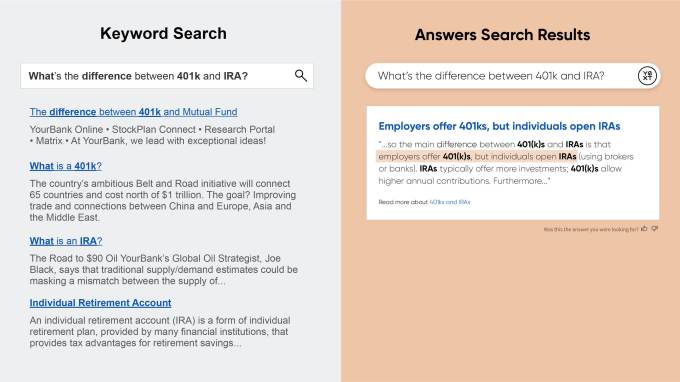
Image Credits: Yext
There’s a good chance that you’re familiar with something similar from Google’s consumer search experience, where the results often include a widget with questions and answers. Ferrentino welcomed the comparison, saying this will allow Yext customers to close the “experience gap” between Google’s search experience and their own.
To demonstrate the technology, Ferrentino showed me how Yext Answers could crawl pages about presidential history and then return the correct answer when asked, “Who was the only U.S. president to be impeached twice?”
Or for a more commercial (albeit slightly meta) example, he showed me how it could answer questions about Yext’s technology. As another example, Yext says it could search a bank’s website to answer a question about the difference between a 401(k) and Roth IRA.
And Yext co-founder and President Jon Brod noted that this change won’t just improve things for business and their customers, but also Yext’s non-profit clients, including the World Health Organization, which is using Yext to provide pandemic-related answers online.
Source: https://techcrunch.com/2021/02/18/yext-answers-orion/


