& meet dozens of singles today!
User blogs

Zomato has raised $250 million, two months after closing a $660 million Series J financing round, as the Indian food delivery startup builds a war-chest ahead of its IPO later this year.
Kora (which contributed $115 million), Fidelity ($55 million), Tiger Global ($50 million), Bow Wave ($20 million), and Dragoneer ($10 million) pumped the new capital into the 12-year-old Gurgaon-headquartered startup, Info Edge, a publicly listed investor in Zomato, disclosed in a filing (PDF) to a local stock exchange. The new investment gives Zomato a post-money valuation of $5.4 billion, up from $3.9 billion in December last year, said Info Edge, which owns 18.4% stake in the Indian startup.
The new investment reinforces the strong confidence investors have in Zomato, which struggled to raise money for much of last year. Zomato, which acquired the Indian food delivery business of Uber early last year, competes with Prosus Ventures-backed Swiggy (valued at about $3.6 billion) in India. Together they work with over 440,000 delivery partners, a larger workforce than that employed by Indian Department of Posts.
A third player, Amazon, also entered the food delivery market in India last year, though its operations are still limited to parts of Bangalore.
At stake is India’s food delivery market, which analysts at Bernstein expect to balloon to be worth $12 billion by 2022, they wrote in a report to clients. With about 50% of the market share, Zomato is the current leader among the three, Bernstein analysts wrote.
“We find the food-tech industry in India to be well positioned to sustained growth with improving unit economics. Take-rates are one of the highest in India at 20-25% and consumer traction is increasing. Market is largely a duopoly between Zomato and Swiggy with 80%+ share,” wrote analysts at Bank of America in a recent report, reviewed by TechCrunch.
Zomato and Swiggy have improved their finances in recent years, which is especially impressive because making money with food delivery is very even more challenging in India. Unlike Western markets such as the U.S., where the value of each delivery item is about $33, in India, a similar item carries the price tag of $3 to $4, according to research firms.
Both the startups eliminated hundreds of jobs last year as coronavirus pandemic hit their businesses. Zomato co-founder and chief executive Deepinder Goyal said in December that the food delivery market was “rapidly coming out of COVID-19 shadows.”
“December 2020 is expected to be the highest ever GMV month in our history. We are now clocking ~25% higher GMV than our previous peaks in February 2020. I am supremely excited about what lies ahead and the impact that we will create for our customers, delivery partners, and restaurant partners,” he said.
In an email to employees in September last year, Goyal said Zomato was working on its IPO for “sometime in the first half” of 2021 and was raising money to build a war-chest for “future M&A, and fighting off any mischief or price wars from our competition in various areas of our business.”
The FCC has taken a major step towards offering financial support for people struggling to pay broadband bills during the pandemic. If approved, the Emergency Broadband Benefit Program could provide $50 per month to millions of households, and more in tribal lands.
The EBBP was created in the budget passed by Congress earlier this year, which earmarked $3.2 billion to offset the cost of broadband in households already struggling to make ends meet.
“From work to healthcare to education, this crisis has made it clear that without an internet connection too many households are locked out of modern life,” said acting FCC Chairwoman Jessica Rosenworcel in a statement. “It’s more apparent than ever that broadband is no longer nice-to-have. It’s need-to-have. But too many of us are struggling to afford this critical service.”
The general shape of the EBBP was already known, but since Congress first proposed it last year it has been up to the FCC to decide what it would actually look like. The rules for the program Rosenworcel circulated at the agency today are an important step in taking it from idea to reality.
The important bit is spelling out exactly who qualifies for the benefit — to wit, anyone who:
- Qualifies for the FCC’s existing Lifeline connectivity subsidy program
- Receives free and reduce-price school lunch or breakfast benefits
- Received a Pell Grant
- Meets other eligibility requirements for internet providers’ existing low-income or pandemic-related programs
- “Experienced a substantial loss of income since February 29, 2020”
That last one is a bit vague, and I’ve asked the FCC for more details (the proposed rules are not yet public). It may involve something like qualifying for unemployment benefits or showing a given percentage reduction in income. Depending on exactly what is specified it could greatly increase the scope of the program. I’ve asked the FCC for more details.
Most qualifying households would get $50 per month, and those living on tribal lands would get $75 per month. There’s also the possibility of a one-time $100 to help cover the cost of a device purchased from certain providers.
Unfortunately there are plenty more steps before anyone is likely to get these discounts. The FCC will have to approve and vote on the rules, which even at the fastest pace may take a couple months. And then there is a period of considering requests from providers, which could take up further time. All told it could take as few as three months if everything goes at maximum speed, or much more than that if they get bogged down in red tape.
Now that the rules are at least set down, though, it is likely only a matter of time — a small comfort to those having trouble making ends meet, but it’s something to look forward to.
Amber Group has fixed a second security lapse that exposed private keys and passwords for the government’s JamCOVID app and website.
A security researcher told TechCrunch on Sunday that the Amber Group left a file on the JamCOVID website by mistake, which contained passwords that would have granted access to the backend systems, storage, and databases running the JamCOVID site and app. The researcher asked not to be named for fears of legal repercussions from the Jamaican government.
This file, known as an environment variables (.env) file, is often used to store private keys and passwords for third-party services that are necessary for cloud applications to run. But these files are sometimes inadvertently exposed or uploaded by mistake, but can be abused to gain access to data or services that the cloud application relies on if found by a malicious actor.
The exposed environmental variables file was found in an open directory on the JamCOVID website. Although the JamCOVID domain appears to be on the Ministry of Health’s website, Amber Group controls and maintains the JamCOVID dashboard, app, and website.
The exposed file contained secret credentials for the Amazon Web Services databases and storage servers for JamCOVID. The file also contained a username and password to the SMS gateway used by JamCOVID to send text messages, and credentials for its email-sending server. (TechCrunch did not test or use any of the passwords or keys as doing so would be unlawful.)
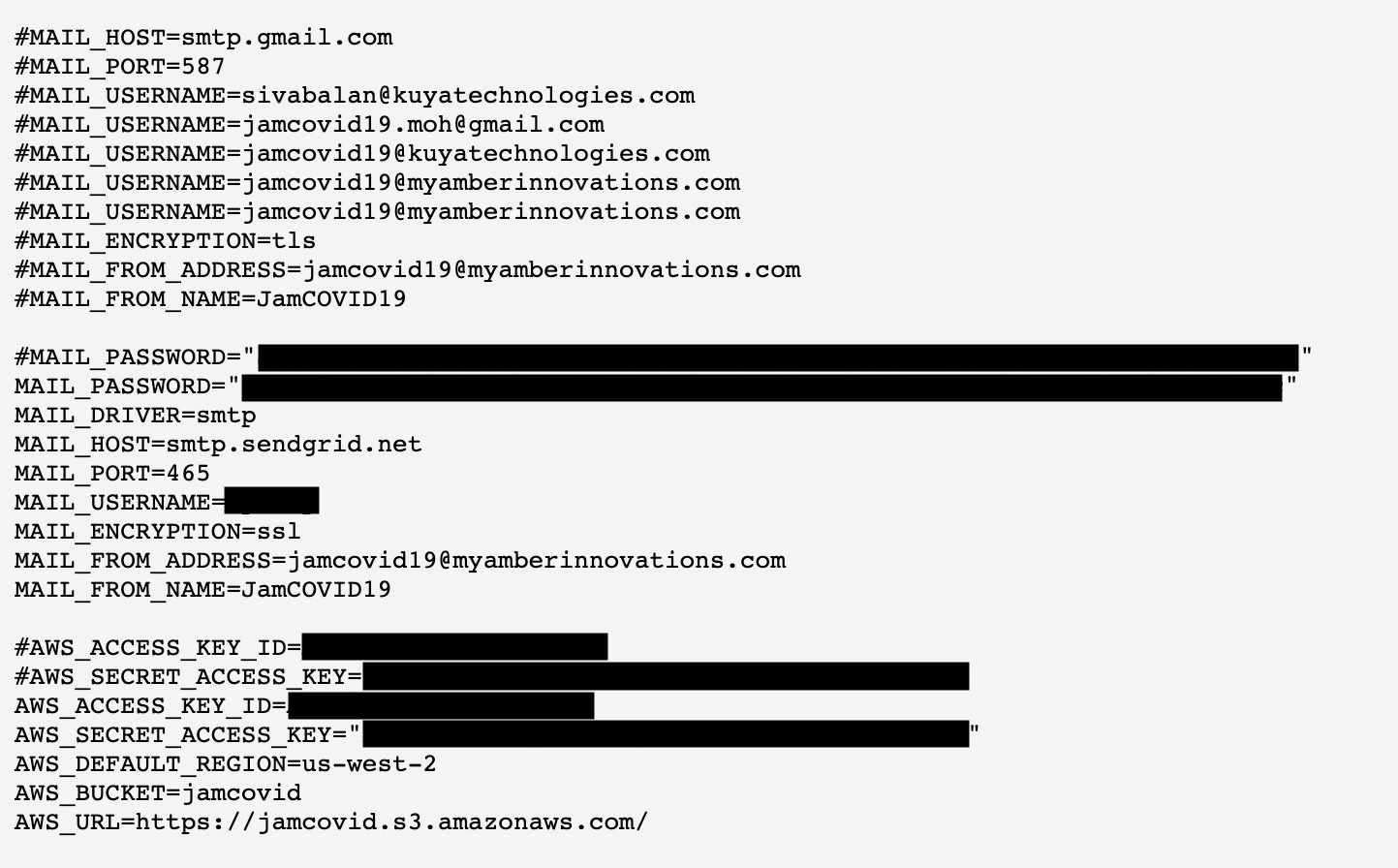
A portion of the exposed credentials found on the JamCOVID website, controlled and maintained by Amber Group. (Image: TechCrunch)
TechCrunch contacted Amber Group’s chief executive Dushyant Savadia to alert the company to the security lapse, who pulled the exposed file offline a short time later. We also asked Savadia, who did not comment, to revoke and replace the keys.
Matthew Samuda, a minister in Jamaica’s Ministry of National Security, did not respond to a request for comment or our questions — including if the Jamaican government plans to continue its contract or relationship with Amber Group, and what — if any — security requirements were agreed upon by both the Amber Group and the Jamaican government for the JamCOVID app and website?
Details of the exposure comes just days after Escala 24×7, a cybersecurity firm based in the Caribbean, claimed that it had found no vulnerabilities in the JamCOVID service following the initial security lapse.
Escala’s chief executive Alejandro Planas declined to say if his company was aware of the second security lapse prior to its comments last week, saying only that his company was under a non-disclosure agreement and “is not able to provide any additional information.”
This latest security incident comes less than a week after Amber Group secured a passwordless cloud server hosting immigration records and negative COVID-19 test results for hundreds of thousands of travelers who visited the island over the past year. Travelers visiting the island are required to upload their COVID-19 test results in order to obtain a travel authorization before their flights. Many of the victims whose information was exposed on the server are Americans.
One news report recently quoted Amber’s Savadia as saying that the company developed JamCOVID19 “within three days.”
Neither the Amber Group nor the Jamaican government have commented to TechCrunch, but Samada told local radio that it has launched a criminal investigation into the security lapse.
Send tips securely over Signal and WhatsApp to +1 646-755-8849. You can also send files or documents using our SecureDrop. Learn more.
Source: https://techcrunch.com/2021/02/22/jamaica-amber-group-jamcovid-security-lapse/
During its live-streamed event today, Spotify officially confirmed its plans to launch paid podcast subscriptions on its platform. As a first step, the company will this spring begin beta testing a new feature in its Anchor podcast creation tool that will allow U.S. creators to publish paid podcast content aimed at their “most dedicated fans.” It also opened up signups for this and other new features, starting today.
Spotify had hinted at its plans for paid podcast content during its fourth-quarter earnings call earlier this month, when it said it was exploring ideas like paid podcast subscriptions and à la carte payments. But it didn’t detail when these new options would go live or how they would work.
At its online event today, Spotify more formally announced its plans to enter the market of paid podcasts, initially with a new service that would allow Anchor creators the ability to offer paid podcast subscriptions supported by their listeners.
This sort of idea is not new, to be clear. Already, some podcasters offer paid access to bonus material — for example, through a service like Stitcher Premium, which promises both an ad-free experience and bonus episodes. Some creators may even independently offer paid feeds through their own platforms.
But until now, a similar option was not available to Spotify creators.
Anchor co-founder Michael Mignano said the company believes paid bonus material can work well as a means of podcast monetization, in addition to ads.
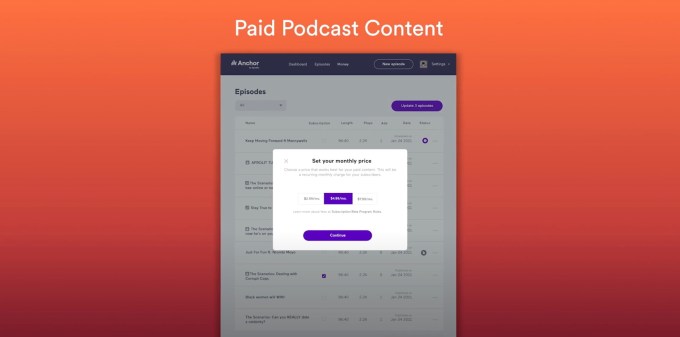
Image Credits: Spotify
“We have found that, through our research, it seems to work especially well for creators who have really engaged and dedicated audiences — regardless of the audience size,” he told TechCrunch in an interview following Spotify’s event. “We’ve also found that podcast listeners do tend to be open to financially supporting the shows they love,” he added.
The company was hesitant to detail some of the specifics of how paid subscriptions would work at launch, but did say that the model would involve a revenue share between creators and Anchor, where creators keep the majority of the earnings. Anchor will also allow creators to determine what price to charge their listeners for the paid experience and what that experience would include — like bonus episodes or interviews, or even ad-free content, if they prefer.
It will then use its understanding of what creators actually do with paid subscriptions to inform its product product launch and its “best practices” recommendations in the future.
We also understand the offering will be limited to those who use Anchor to record and publish across podcast platforms. However, it will more immediately benefit creators with a strong Spotify presence and a loyal listenership.
But Mignano points out that creators may be able to grow their paid subscriber base thanks to Spotify’s tools for podcast discovery.
“The problem is the system for doing this type of paid subscription so far in podcasts has been really disjointed,” he explained. “It hasn’t been a really seamless experience for the listener, and it hasn’t really been a great experience for the creator. We feel like that’s really held this model back and hindered creators’ reach and ability to gain paid subscribers,” he said.
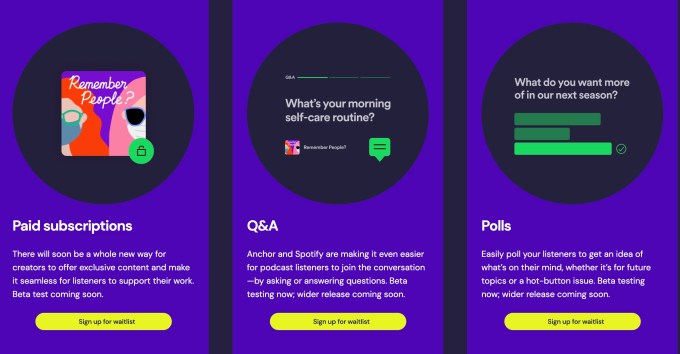
Image Credits: Spotify/Anchor
In other words, users may be open to the idea of paid bonus material, but they don’t necessarily want to switch between apps to gain access, nor do they want to figure out how to get paid RSS feeds into some third-party podcast listening app.
Spotify, meanwhile, will try to make discovery easier. It will highlight the paid content alongside the free material on the podcast’s main page, for example. Plus, in the same way that Spotify today helps users discover new podcasts they may like to try, it will also point to paid subscription-based podcasts in the future as the new model rolls out further.
Anchor says it will initially open up the beta test in the U.S. to a small number of creators, but aims to expand access to more creators as soon as reasonably possible. The test, for the time being, will only focus on paid subscriptions, but Mignano told us the company may explore the à la carte model in the future.
Paid podcasts were only one of several new features Anchor announced today at the Spotify event.
The company also announced the launch of a WordPress partnership that makes it easier for bloggers to turn their posts into posts, either by reading the blog posts themselves or leveraging third-party text-to-speech technology Anchor provides.
Anchor will also expand beta testing of video podcasts, which so far have been tested by only a handful of creators, including Higher Learning from The Ringer.
And it will begin beta testing new, interactive features, like polls and Q&A, with a small number of creators in the months ahead.
These features could potentially overlap with paid subscriptions. For example, some podcast creators may choose to make their videos a paid feature, or perhaps other interactive features. It remains to be seen how they’re put to use.
But more broadly, features like polls and Q&As could help Spotify better differentiate an interactive podcast from a live audio program, like those popularized by the buzzy new app Clubhouse. The advantage of the latter is that it allows for audience participation in the “show,” rather than being a one-way street where hosts control the experience. But on the flip side, Clubhouse rooms can also have folks who drone on and on, or they can become boring, when not carefully managed.
Anchor says it doesn’t intend to charge creators for access to its tools, beyond taking a rev share on subscriptions.
“I think our vision with Anchor and Spotify has always been to really empower creators. In the Anchor suite of tools, we’ve never charged creators for any features because we believe that charging creators can often represent friction that stands in the way of them trying to actually make something and getting it out into the world,” Mignano said. “We want to enable creators to do whatever they want, as far as expressing themselves through these new tools,” he added.
Over the next few days, Spotify will be launching its service in 85 new markets, and will also roll out 36 new languages on the platform. The news was announced at its online event, “Stream On” today.
The expansion includes markets across Africa, Asia, Europe, Latin America and the Caribbean. Combined, these markets include more than a billion people. With these launches, Spotify says “sounds and stories that once remained local will have access to a global audience of fans across nearly 180 markets.” And as part of its ongoing commitment to building a truly borderless audio ecosystem— connecting creators, listeners, and content — this move represents the company’s broadest market expansion to date.
According to the company, it will be working closely with local creators and partners in each market to deliver a tailored experience that meets their unique needs, with scaled language translations and specialized payment formats. In addition, Spotify’s expansion will likely accelerate the discovery of more genres like Afrobeats, Amapiano, K-Pop, Reggaeton, and Amapiano that have earned a place in the global music scene.
“The existing rich music cultures in each of these markets will now be able to reach Spotify’s global audience. All this untapped music energy and access to our innovative creator tools will help propel artists to new heights and empower them to turn their passion into a profession,” an excerpt in the company’s statement read.
Working with local creators and partners, here’s a holistic approach to how Spotify plans to roll out its music offerings in each region.
First off, its free and premium plans will be available across all the markets. It will also offer individual, family, duo, and student plan options but in select markets which Spotify doesn’t specify. Also in each of these new markets, Spotify will offer its full global catalog. The company adds that it will continuously work with local rights holders and partners to expand its catalog to include more local offerings globally.
Full podcast catalogs of the global streaming giant will be launched in the majority of these markets. For the other markets, Spotify will work closely with local partners to introduce more podcasts from its catalog, as well as Spotify’s proprietary creator platform, Anchor.
Other offerings include providing a personalized experience to users through its home screen, and browse and search features. Upon launch in these markets, Spotify will be available on mobile and desktop web players while the company works with local partners to introduce Spotify on more platforms, including TV, speakers, wearables, and cars in the coming months.
“Having more listeners on our platform creates more opportunities for artists and podcasters to make a living from their work. And more creators means more audio content for our users to discover,” said Alex Norström, Spotify chief freemium business officer. “This creates an essential flywheel between creators and listeners that is the foundation of our business — and in the end, it is what will propel the audio industry forward.”
The new markets include Angola, Antigua and Barbuda, Armenia, Azerbaijan, Bahamas, Bangladesh, Barbados, Belize, Benin, Bhutan, Botswana, Brunei Darussalam, Burkina Faso, Burundi, Cabo Verde, Cambodia, Cameroon, Chad, Comoros, Côte d’Ivoire, Curaçao, Djibouti, Dominica, Equatorial Guinea, Eswatini, Fiji, Gabon, Gambia, Georgia, Ghana, Grenada, Guinea, Guinea-Bissau, Guyana, Haiti, Jamaica, Kenya, Kiribati, Kyrgyzstan, Lao People’s Democratic Republic, Lesotho, Liberia, Macau, Madagascar, Malawi, Maldives, Mali, Marshall Islands, Mauritania, Mauritius, Micronesia, Mongolia, Mozambique, Namibia, Nauru, Nepal, Niger, Nigeria, Pakistan, Palau, Papua New Guinea, Rwanda, Samoa, San Marino, Sao Tome and Principe, Senegal, Seychelles, Sierra Leone, Solomon Islands, Sri Lanka, St. Kitts and Nevis, St. Lucia, St. Vincent and the Grenadines, Suriname, Tanzania, Timor-Leste, Togo, Tonga, Trinidad and Tobago, Tuvalu, Uganda, Uzbekistan, Vanuatu, Zambia, and Zimbabwe.
The expansion news follows a thread of announcements Spotify made today where it also rolled out Spotify HiFi in select global markets and launched a new tool “Discovery Mode” in beta.
Source: https://techcrunch.com/2021/02/22/spotify-to-expand-international-footprint-across-85-new-markets/


