& meet dozens of singles today!
User blogs

ConstellR, a SpaceTech startup with a technology that can monitors land surface temperatures from space, has raised a €1m pre-seed round led by FTTF, with the participation of strategic investor OHB Venture Capital, Baden-Württemberg’s state bank L-Bank and an undisclosed investor. The first system is due to go into orbit in December 2021. The company was a finalist for Hottest Ag/FoodTech Startup at the prestigious Europas Awards 2020.
The Freiburg, Germany-based startup monitors the land via a constellation of 30 CubeSats with thermal infrared payloads. The data generated is used by farmers to reduce water and fertilizer usage, and could help them reduce existing monitoring costs by 97%, says the company. ConstellR has a patent-pending miniaturization architecture with ‘free-form optics’ and claims to be able to make it much cheaper to monitor the infrared part of the spectrum than traditional satellite systems.
Dr. Max Gulde, CEO, ConstellR, said: “Our mission is to monitor every single field on the planet every single day of the year and provide precision farming companies with highly accurate temperature data to safeguard the world’s food supply. With our strong financial and technology partners on board, I am looking forward to a time of quantum leaps in our constellation development to change agriculture on the global planetary scale.”
Tobias Schwind, Managing Partner at FTTF, Fraunhofer’s Technology Transfer Fund, said: “ConstellR’s unique technology and business case as well as its passionate team convinced us to make this exciting pre-seed investment.”
The onset of the pandemic has led to increased demand across customer income groups around the world for digital banking options. We’ve seen how digital banks like Zolve and Nubank have raised money in recent months to fill this need. This time, a startup from Africa has joined the party.
TymeBank, a South African digital bank, announced today that it has secured an R1.6 billion (~$109 million) investment from new investors in the UK and Philippines. The company made this known via a statement. This investment will be used to bolster TymeBank’s growth and drive its commercial expansion across the country.
However, this investment will come in two tranches. According to the company, R500 million ($34 million) has already been invested in the business, while the rest — R1.1 billion ($75 million) — will be invested over the next 12 to 15 months.
TymeBank offers a transactional bank account with zero or low monthly fees and a savings product. Most of its customers are onboarded via physical kiosks, usually in Pick n Pay and Boxer stores around the country. Since launching in February 2019, TymeBank has grown rapidly and now has about 2.8 million customers. The company says that it’s on track to reach 3 million by the end of next month.
The investors for this unnamed round include Apis Growth Fund II, a private equity fund managed by Apis Partners, and Gokongwei-owned JG Summit Holdings, one of the largest conglomerates in the Philippines. Both these investors are experienced in financial services in emerging markets; Apis, for instance, is a private equity asset manager that supports growth-stage financial services and financial infrastructure businesses.
It is noteworthy that this is one of the largest raises, if not the largest, for a digital bank on the continent. Tauriq Keraan, the CEO of TymeBank, considers this to be largely due to more investors buying into the importance of digital banking and also the company’s value propositions — the first which is improving access to underbanked and underserviced customers in South Africa, and the other, satisfying customer demand for low and transparent bank fees which is generally viewed as both costly and difficult to understand across the country.
“The establishments of digital banks in South Africa is in its infancy. Growth in this particular segment of financial services is only possible with investments from partners who understand and support the growth trajectory of digital banks,” he said.
With already existing shareholders like African Rainbow Capital (founded by South African billionaire Patrice Motsepe), TymeBank says these new investors will grow the company into a top tier retail bank in South Africa. The investment will also help the company expand its range of banking products and grow its lending portfolio. Diversification of offerings is key as well as TymeBank seeks to enhance its propositions in insurance and credit cards to its customers.
“As the controlling shareholder in TymeBank, African Rainbow Capital is delighted to have our new co-investors onboard. Equally important, Apis and the Gokongwei family invest in TymeBank at a time when significant uncertainty reigns globally and in South Africa as a result of the COVID-19 pandemic,” said Dr Patrice Motsepe, the majority owner of TymeBank and chairman of African Rainbow Capital. “The invested amount of R1.6 billion is no small feat both in terms of drawing investment into South Africa’s financial services sector as well as investing into a fledgling part of the sector in our country.”
TymeBank claims to onboard an average of 110,000 new customers per month. This makes it globally recognized for digital banking in emerging markets, and the plan is to reach 4 million customers next year. In terms of growth, TymeBank currently outpaces its competitors in Africa and can be argued to be one of the fastest-growing digital banks in the world at the moment. The company is the first bank in South Africa to be fully operated off a cloud-based infrastructure network and the first to be granted a commercial banking license in the country since 1999.
TymeBank isn’t indigenously South African though. It is a member of the Tyme group of companies headquartered in Singapore. The holding company, Tyme, focuses on designing, building, and operating digital banks for emerging markets. With its success in South Africa, Tyme is planning to launch operations in Asia and has entered into an agreement to launch a digital bank in the Philippines in the coming months.
Better Origin is a startup that converts waste food into essential nutrients using insects fed to chickens inside a standard shipping container. It’s now raised a Seed Series $3 million funding round led by Fly Ventures and solar entrepreneur Nick Boyle, while previous investor Metavallon VC is also participating. Its competitors include Protix, Agriprotein, InnovaFeed, Enterra, Entocycle.
Better Origin’s product is an “autonomous insect mini-farm.” Its X1insect mini-farm is dropped on site. A farmer adds food waste – gathered from nearby factories or from the farm – into a hopper to feed the larvae of black soldier flies.
Two weeks later, the insects are fed directly to the chickens as an alternative to the soy feed they normally get. To add to the ease of use, everything inside the container is automated and remotely controlled by Better Origin’s engineers in Cambridge.
This process has a double effect. Not only does it take care of the food waste product as a by-product of farming practices, but it also drives down the use of soy, the growth of which is contributing to deforestation and habitat loss in countries like Brazil.
Plus, given the pandemic has exposed the fragility of the global food supply chain, the company says its solution is way of decentralizing food and feed production, thus safeguarding the food supply chain and food security.
Better Origin says it is tackling a real problem, and it’s a fair assessment. Western economies waste around a third of all food produced annually, but, on average, the demands of a growing population means food production will need to increase by 70%. Food waste is also the third-largest emitter of Green House Gas (GHG) after the US and China.
Founder Fotis Fotiadis was working in the Oil & Gas industry when he decided he’d rather work in a sustainable, non-polluting. After studying Sustainable Engineering at Cambridge University, and meeting cofounder Miha Pipan, the two set out to work on a sustainable startup.
The company was launched in May 2020, now has five commercial contracts, and plans to expand across the UK.
Better Origin says its differentiation with competitors is the nature of its ‘decentralized’ approach to insect farming, as a result of the way its units are, effectively, ‘Drag-and-drop’ into a farm. In some sense, it’s not dissimilar to adding a server to a server farm.
The business model will be to either lease or sell systems to farms, likely with a subscription model.
When people ask me which robotics categories are poised for the biggest growth, I often point to agriculture. The technology already has a strong foothold in places like warehouse and logistics, but it’s impossible to look at the American – and global – farming community and not see a lot of potential for human-assisted automation.
The category still seems fairly wide open — but not for lack of interest. There are a number of companies both large and small carving out niches in the category. For now, at least, it seems there’s room for a number of different players. After all, needs vary greatly from farm to farm and crop to crop.
Santa Monica-based Future Acres is launching today, with plans to tackle grape picking. An outgrowth of Wavemaker Partners — the same firm that gave the world burger-flipping Miso Robotics — the startup is also announce its first robot, Carry.

Image Credits: Future Acres
“We see Carry as a kind of harvesting sidekick for workers. It’s an autonomous harvesting companion,” CEO Suma Reddy tells TechCrunch. “What it can do in the real world is transport up to 500 lbs. of crops in all terrain and all weather. It can increase production efficiency by up to 80%, which means it pays for itself in only 80 days.”
Carry relies on AI to transport hand-picked crops, working alongside humans rather than attempting to replace the delicate picking process outright. The company is expecting that farms will purchase multiple machines that can work in tandem to speed up their process and help reduce the human strain of moving the crops around manually.
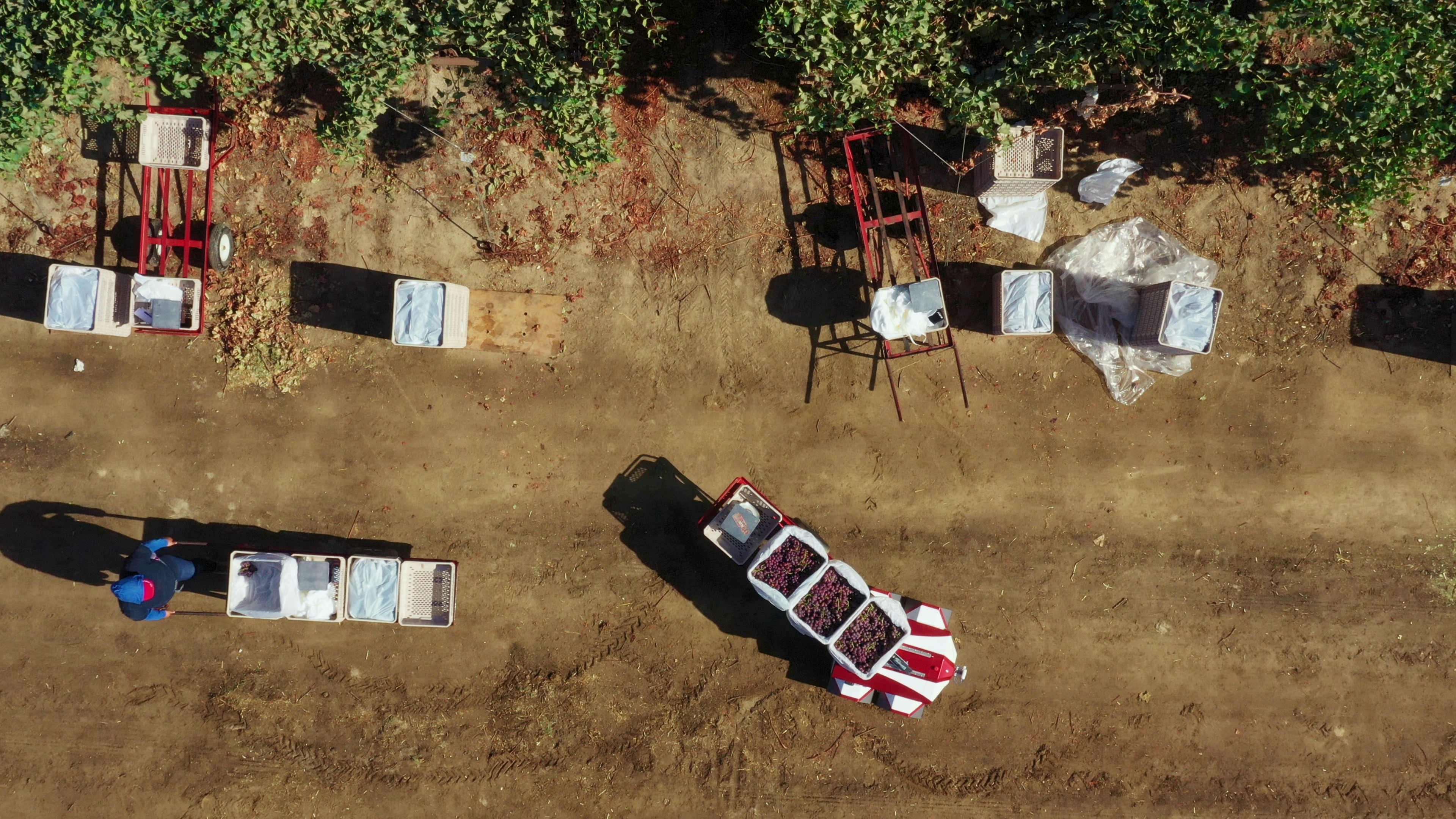
Image Credits: Future Acres
The company is still in early stages, having developed a prototype of Carry. It’s also exploring some partnerships for development. The systems would run $10,000-$15,000 up front, though the company says it’s looking at a RaaS (robotics as a service) model, as a way to defer that cost.
Interest in agricultural robotics has only increased during the pandemic, amid health concerns and labor issues. The company is building on that interest by launching a campaign on SeedInvest, in hopes of raising $3 million, in addition to funding already provided by Wavemaker.
A new VC fund, “2150“, is launching with the first close of a €200m ($240m) fund which will back technologies aimed largely at reducing the carbon footprint of cities. For example, startups that inject carbon into concrete, or monitor the energy of buildings. The final close is anticipated by mid-2021.
The advisory board for 2150 comprises the former chief sustainability officer in the Obama administration and renowned urbanist and academic, Richard Florida. 2150 is based around the idea that half of the world’s population lives in cities, and this will increase to two-thirds by 2050, creating a growing environmental impact that the world can ill-afford, given the climate crisis.
Based across London, Copenhagen and Berlin, the fund’s Limited Partners include a mix of institutional capital and family offices including Chr. Augustinus Fabrikker, Denmark’s Green Future Fund and Novo Holdings. 2150 says it has other LP partners who are building or managing “over 16 million square meters of real estate”, who will come in handy, kicking the tires on the efficacy of 2150 investments. The anchor funding has come from NREP, a sustainable real estate fund manager with a large Northern European footprint and platform.
The founding partners include Mikkel Bülow-Lehnsby, Chairman and co-founder of large real estate logistics company NREP; Jacob Bro, former Chief Product Officer at Rocket Internet; Christian Jølck, the founder and former Chairman of industry climate advocacy group SYNERGI; Christian Hernandez, former Facebook executive and VC; Nicole LeBlanc, formerly with Alphabet’s urban product incubator Sidewalk Labs; Rahul Parekh, founder of VC-backed foodtech startup EatFirst and former executive director at Goldman Sachs; and Alexandra Perez, who incubated and launched urban tech startups at Tech City Ventures.
2150 will focus on startups that can make cities more resilient, efficient and sustainable, investing in tech associated with the urban environment, materials, automation, and sensor-based monitoring to improve the health, safety, and productivity of building occupants. It says it will only invest where sustainability impact can be measured, aiming for a first portfolio of around 20 companies. Ticket sizes will be €4-5m series A for startups, but it will also invest in existing companies that want to expand.
Its first investment is in CarbonCure Technologies – a Canadian company lowering the CO2 footprint of concrete – in which 2150 participated in a funding round for last year, investing alongside Amazon’s Climate Pledge Fund, Bill Gates-backed Breakthrough Energy Ventures, and Microsoft’s Climate Innovation Fund. At present, concrete accounts for 8% of all global CO2 emissions
Speaking to TechCrunch, Hernandez said 2150 was particularly interested in what’s coming to be known as “ESG Analytics” or “Carbon Accounting”. In other words, platforms that can analyze the impact of developments for an ESG and CO2 perspective.
The other background data which inspired the creation of the fund includes the fact that two billion new homes will need to be built over the next 80 years ; cities consume over two-thirds of the world’s energy and account for more than 70% of global CO2 emissions; 13% of global GDP is spent on construction, but the industry is slow to adopt new technology; and the UN has said ground-breaking innovation is needed in cities, where the battle for sustainable development will be “won or lost”.
Mikkel Bülow-Lehnsby, Partner at 2150 and Chairman and co-founder of NREP, said: “With NREP we have been on a 15-year mission of making real estate and cities more efficient, customer-centric and sustainable. With 2150 we are leveraging all of NREP’s learnings and ambitions and partnering with our industry peers to identify and accelerate technology that can help us support our purpose of making real estate better. I am convinced that 2150’s mission-aligned team will play an important role in designing a future in which the convergence of entrepreneurship, technology and sustainability will reverse the built environment’s negative impact on the planet.”
Christian Hernandez, Partner at 2150, said: “Cities are complex living systems that are constantly expanding, evolving and adapting, with half the world’s population now living in urban environments and rising. Cities, while vehicles for the betterment of humanity, currently emit 70% of the world’s greenhouse gases and generate the vast majority of the planet’s waste. We see a huge opportunity to make a serious impact on the way cities are developed and the way our citizens live, work and are cared for by completely reimagining and reshaping the urban environment for good.”
The advisory board for 2150 includes technologists, scientists and designers including well-known architect, Bjarke Ingels, the Director of Princeton’s Andlinger Center for Energy and the Environment; Dr. Lynn Loo, Unity’s head of AI; Danny Lange, the former Chief Sustainability Officer in the Obama Administration; Christine Harada, the founder of sustainable developer EDGE Technologies; and Coen van Oostrom.


