& meet dozens of singles today!
User blogs

The sustainability focused shoe maker Allbirds has taken another step to green its supply chain with a small $2 million investment in a new company called Natural Fiber Welding.
Announced this morning, the investment in Natural Fiber Welding will see Allbirds bring a vegan leather replacement option to customers by December 2021. It’s a natural addition for a company that has always billed itself as focused on environmental impact in other aspects of its apparel manufacturing.
Allbirds these days is far more than a shoe company and Natural Fiber Weldings suite of products that include both a purportedly tougher cotton fiber made using the company’s proprietary processing technology and a plant-based leather substitute.
Those materials could find their way into Allbirds array of socks, shoes, tshirts, underwear, sweaters, jackets, and face masks. Natural Fiber Welding already touts a relationship with Porsche on its website, so Allbirds isn’t the only company that’s warmed to the Peoria, Ill.-based startup’s new materials.
With the addition of Allbirds Natural Fiber Welding has raised roughly $15 million, according to data from Pitchbook. Other investors in the company include Central Illinois Angels, Prairie Crest Capital, Ralph Lauren Corp. and Capital V, an investment firm focused on backing vegan products.
Allbirds is far from the only clothier to make the jump to plant-based materials in the past year. The buzzy clothing company Pangaia invested $2 million into a company called Kintra which is making a bio-based polyester substitute in December.
By the far the biggest startup name in the sustainable fashion space is a company like Bolt Threads, which has inked deals with companies including Stella McCartney, Adidas, and the owner of the Balenciaga fashion house (among others).
Other startups that have raised significant capital for plant-based fabrics and materials are companies like Mycoworks, which raised $45 million last year from backers include John Legend, Natalie Portman along with more traditional investors like WTT Investment Ltd. (Taipei, Taiwan), DCVC Bio, Valor Equity Partners, Humboldt Fund, Gruss & Co., Novo Holdings, 8VC, SOSV, AgFunder, Wireframe Ventures and Tony Fadell.
With Natural Fiber Welding’s products Allbirds is boasting about a significantly reduced environmental footprint for its leather-like material. Natural Fiber Welding claims its material reduce the associated carbon footprint by 40 times and uses 17 times less carbon in its manufacturing than synthetic leather made from plastic.
The company does say that the plant leather will use natural rubber, an industry with its own history of human rights abuses, that’s also trying to clean up its act.
“For too long, fashion companies have relied on dirty synthetics and unsustainable leather, prioritizing speed and cost over the environment,” says Joey Zwillinger, co-founder and co-CEO of Allbirds, in a statement. “Natural Fiber Welding is creating scalable, sustainable antidotes to leather, and doing so with the potential for a game-changing 98% reduction in carbon emissions. Our partnership with NFW and planned introduction of Plant Leather based on their technology is an exciting step on our journey to eradicate petroleum from the fashion industry.”
TechCrunch has reached out to Allbirds for additional comment, but had not received a reply at the time of publication.
Pet tech company Fi today announced that it has raised a $30 million Series B. The round, led by Chuck Murphy of Longview Asset Management, follows a $7 million Series A raised back in 2019. The round values the startup at north of $200 million.
The New York-based startup specializes in connected dog collars, releasing its Series 2 device late last year. The second-gen version of the product brings some key hardware improvements to the pet tracking device, including battery optimization that gives up to three months of life on a charge (with an average of around 1.5, according to the company).
The device relies on Wi-Fi and Bluetooth, sending users a notification when a dog has traveled outside an AI-determined geofenced area.
The company has experienced solid growth since launching in March 2019, and says demand for its product continued to grow in spite of the COVID-19 pandemic. It’s still a fairly small operation, but Fi is working on growing its availability in the U.S. The product was made available on the mega-pet online retailer Chewy in Q4 of last year.
“There’s such a huge market in the U.S. that we’re just scratching the surface,” founder and CEO Jonathan Bensamoun tells TechCrunch. “We want to stay focused here. And really make this a household product. The number one limitation to growth is that people just don’t know we exist or that the category exists.”
The company says discussions with large brick and mortar pet retailers are currently “up in the air.” In addition to research, the funding round will go toward marketing and exploring additional retail partnerships to help grow the product’s footprint.
“We’ve been tracking Jonathan and the team at Fi for over a year now and have been incredibly impressed with their execution and rapid growth rate,” AVP partner Courtney Robinson says in a statement offered to TechCrunch. They have established themselves as the clear leader in the emerging category of connected collars, with a device that blows away the competition in terms of design, battery life, and accuracy.”
Source: https://techcrunch.com/2021/02/25/connected-pet-collar-company-fi-raises-a-30m-series-b/
Doubtnut, an Indian startup that helps students learn and master concepts from math and science using short videos, has raised $31 million in a new financing round, months after it rejected an acquisition offer from India’s largest edtech firm Byju’s.
The three-year-old Gurgaon-headquartered startup said SIG and James Murdoch’s Lupa Systems led the $31 million Series B funding round. Existing investors Sequoia Capital India, Omidyar Network India and Waterbridge Ventures also participated in the round, which brings the startup’s to-date raise to about $50 million to date.
The Doubtnut app allows students to take a picture of a problem, and uses machine learning and image recognition to deliver their answers through short-videos. These videos offer students step-by-step instructions to solve a problem.
The app supports multiple languages, and has amassed over 2.5 million daily active users who spend 600 million minutes a month on the app, the startup said. More than half of the users have come online for the first time in last 12 months, the startup said.
The startup said it has developed a bank of over 65 million questions in nine languages for students from sixth grade to high-school. Unlike several other popular edtech firms, Doubtnut said its app reaches students in smaller towns and cities. “85% of the current base comes from outside of the top 15 Indian cities, and 60% users study in state boards where typical medium of instruction is the local vernacular language,” the startup said.
TechCrunch reported last year that Byju’s was in talks to acquire Doubtnut for as much as $150 million. Byju’s later lowered its deal offer, after which the two firms ended their talks.
James Murdoch last month announced he was reuniting with Uday Shankar, an executive who helped him build the Murdoch family’s Star business in India, which was later sold to Disney. Shankar will work with Murdoch to “accelerate” Lupa’s efforts in India, Murdoch said last month. Lupa has backed nearly a dozen startups so far, including Indian news aggregator and social app DailyHunt.
“Doubtnut has been built with a vision to improve learning outcomes for all students, especially those outside the major Indian cities. We specialize in developing content in vernacular languages and use technology to create affordable solutions for people in this large target segment,” said Tanushree Nagori, co-founder and CEO of Doubtnut, adding,
“We are pleased to welcome onboard SIG and Lupa; SIG brings in strong experience of investing in ed-tech companies globally and Lupa Systems brings unparalleled experience of building world-class businesses and harnessing high-impact technologies,” she added.
The startup said it will deploy the fresh capital to add support for more language and broaden the scope of subjects it covers today. Doubtnut is also planning to introduce paid courses.
TechCrunch is embarking on a major project to survey the venture capital investors of Europe, and their cities.
Our survey of VCs in the Czech Republic and Prague will capture how the country is faring, and what changes are being wrought amongst investors by the coronavirus pandemic.
We’d like to know how the Prague, and the broader Czech, startup scene is evolving, how the tech sector is being impacted by COVID-19, and, generally, how your thinking will evolve from here.
Our survey will only be about investors, and only the contributions of VC investors will be included. More than one partner is welcome to fill out the survey. (Please note, if you have filled the survey out already, there is no need to do it again).
The shortlist of questions will require only brief responses, but the more you can add, the better.
You can fill out the survey here.
Obviously, investors who contribute will be featured in the final surveys, with links to their companies and profiles.
What kinds of things do we want to know? Questions include: Which trends are you most excited by? What startup do you wish someone would create? Where are the overlooked opportunities? What are you looking for in your next investment, in general? How is your local ecosystem going? And how has COVID-19 impacted your investment strategy?
This survey is part of a broader series of surveys we’re doing to help founders find the right investors.
https://techcrunch.com/extra-crunch/investor-surveys/
For example, here is the recent survey of London.
You are not in the Czech Republic, but would like to take part? That’s fine! Any European VC investor can STILL fill out the survey, as we probably will be putting a call out to your country next anyway! And we will use the data for future surveys on vertical topics.
The survey is covering almost every country on in the Union for the Mediterranean, so just look for your country and city on the survey and please participate (if you’re a venture capital investor).
Thank you for participating. If you have questions you can email mike@techcrunch.com
(Please note: Filling out the survey is not a guarantee of inclusion in the final published piece).
India announced sweeping changes to its guidelines for social media, on-demand video streaming services, and digital news outlets on Thursday, joining several other nations in posing new challenges for giants such as Facebook and Google that count the nation as its biggest market by users.
Ravi Shankar Prasad, India’s IT, Law, and Justice minister, said in a press conference that social media companies will be required to acknowledge takedown requests of unlawful content within 24 hours and deliver a complete redressal in within 15 days. In sensitive cases that surround rape or other similar criminal cases, firms will be required to take down the objectionable content within 24 hours.
These firms will also be required to appoint a chief compliance officer, a nodal contact officer, who shall be reachable round the clock, and a resident grievance officer. They will also have to set up a local office in India.
Prasad said social media firms will have to disclose the originator of objectionable content. “We don’t want to know the content, but firms need to be able to tell who was the first person who began spreading misinformation and other objectionable content,” he said. WhatsApp has previously said that it can’t comply with such traceability requests without compromising end-to-end encryption security for every user.
Firms will also be required to publish a monthly compliance report to disclose the number of requests they received and what actions they took. They will also be required to offer a voluntary option to users who wish to verify their accounts.
The guidelines, which replace the law from 2011, go into effect for small firms effective immediately, but bigger services will be provided three months to comply, said Prasad.
New Delhi has put together these guidelines because citizens in India have long requested a “mechanism to address grievances,” said Prasad. India has been working on a law aimed at intermediaries since 2018. You can read the final version of the draft here, courtesy of New Delhi-based advocacy group Internet Freedom Foundation.
“India is the world’s largest open Internet society and the Government welcomes social media companies to operate in India, do business and also earn profits. However, they will have to be accountable to the Constitution and laws of India,” he said, adding that WhatsApp had amassed 530 million users, YouTube, 448 million users, Facebook’s marquee service 410 million users, Instagram 210 million users, and Twitter, 175 million users in the country.
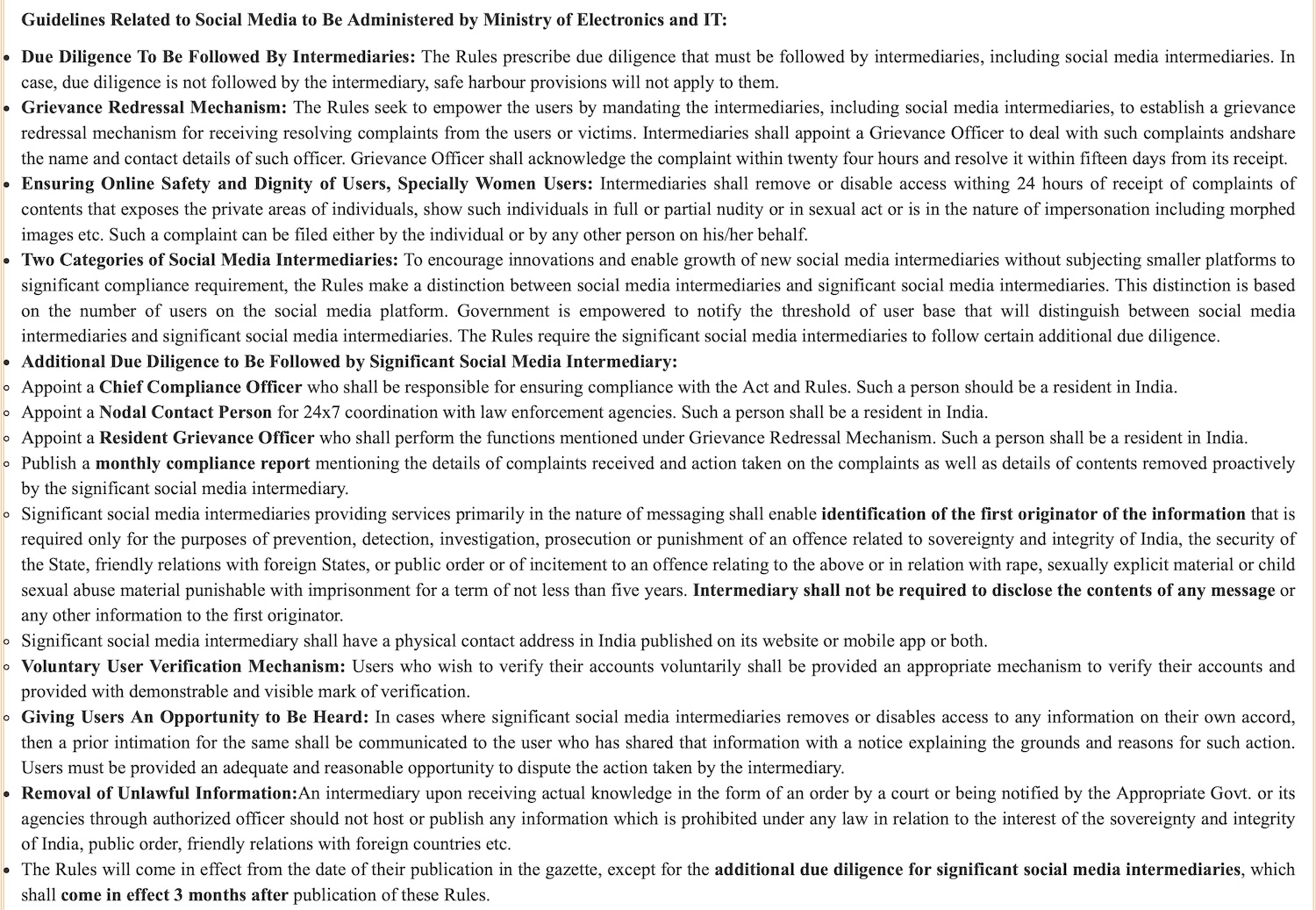
Full guidelines for social media firms and other intermediaries. (Source: Indian government.)
For streaming platforms, the rules have outlined a three-tier structure for “observance and adherence to the code.” Until now, on-demand services such as Netflix, Disney+ Hotstar, and MX Player have operated in India with little to no censorship.
New Delhi last year said India’s broadcasting ministry, which regulates content on TV, will also be overseeing digital streaming platforms. 17 popular streaming firms including international giants had banded together to devise a self-regulation code. Prakash Javedkar, Minister of Information and Broadcasting, said in the conference that the proposed solution from the industry wasn’t adequate and there will be an oversight mechanism from the government to ensure full compliance with the code.
Streaming services will also have to attach a content ratings to their titles. “The OTT platforms, called as the publishers of online curated content in the rules, would self-classify the content into five age based categories- U (Universal), U/A 7+, U/A 13+, U/A 16+, and A (Adult). Platforms would be required to implement parental locks for content classified as U/A 13+ or higher, and reliable age verification mechanisms for content classified as “A”,” the Indian government said.
“The publisher of online curated content shall prominently display the classification rating specific to each content or programme together with a content descriptor informing the user about the nature of the content, and advising on viewer description (if applicable) at the beginning of every programme enabling the user to make an informed decision, prior to watching the programme.”
The new rules will also force digital news outlets to disclose the size of their reach and structure of their ownership.
Industry executives have expressed concerns over the new proposed regulation, saying New Delhi hasn’t consulted them for these changes. IAMAI, a powerful industry body that represents nearly all on-demand streaming services, said it was “dismayed” by the guidelines, and hoped to have a dialogue with the government.
Javedkar and Prasad were asked if there will be any consultation with the industry before these guidelines become law. The ministers said that they had already received enough inputs from the industry.
This is a developing story. Check back for more information…


