& meet dozens of singles today!
User blogs

Antibiotic resistance is one of the biggest potential threats to global health today. But Locus Biosciences is hoping that their crPhage technology might provide a new solution.
Based in North Carolina’s Research Triangle, the startup recently announced promising phase 1b clinical trial results for their use of CRISPR-Cas3-enhanced bacteriophages as a treatment for urinary tract infections caused by escherichia coli. Led in part by former Patheon executive and current Locus CEO Paul Garofolo, the startup launched in 2015 with the goal of using a less popular application of CRISPR technology to address growing antimicrobial resistance.
CRISPR-Cas3 technology has notably different mechanisms from its more well-known CRISPR-Cas9 counterpart. Where the Cas9 enzyme has the ability to cleanly cut through a piece of DNA like a pair of scissors, Garofolo describes Cas3 more like a Pac-Man, shredding the DNA as it moves along a strand.
“You wouldn’t be able to use it for most of the editing platforms people were after,” he said, noting that meant there wouldn’t be as much competition around Cas3. “So I knew it would be protected for some time, and that we could keep it quiet.”
Garofolo and his team wanted to use CRISPR-Cas3 not to edit harmful bacteria found in the body, but to destroy it. To do this, they took the DNA-shredding mechanism of Cas3 and used it to enhance bacteriophages—viruses that can attack and kill different species of bacteria. Together, co-founder and Chief Scientific Officer Dave Ousterout—who has a Ph.D. in biomedical engineering from Duke—thinks this technology offers an extremely direct and targeted way of killing bacteria.
“We armed the phages with this Cas3 system that attacks E. coli, and that sort of dual mechanism of action is what comes together, essentially, as a really potent way to remove just E. coli,” he said in an interview.
That specificity is something that antibiotics lack. Rather than targeting only harmful bacteria in the body, antibiotics typically wipe out all bacteria they come across. “Every time we take antibiotics, we’re not thinking about all the other parts of us that are impacted by the bacteria that do good things,” said Garofolo. But the precision of Locus Biosciences’ crPhage technology means that only the targeted bacteria would be wiped out, leaving those necessary to the body’s normal function intact.
Beyond offering this more specific approach to treatment of pathogens, or any bacteria-based disease, Garofolo and his team also suspect that their approach will also be extremely safe. Though deadly to bacteria, bacteriophages are typically harmless to humans. The safety of CRISPR in humans is well-established, too.
“That’s our secret sauce,” said Garofolo. “We can build drugs that are more powerful than the antibiotics they’re trying to replace, and they use phage, which is probably one of the world’s safest ways to deliver something into the human body.”
While this new technology could certainly help treat pathogens and infectious diseases, Garofolo hopes that indications in immunology, oncology, and neurology might benefit from it too. “We’re starting to figure out that some bacteria might promote cancer, or inflammation in your gut,” he said. If researchers can identify the bacteria at the root cause of those conditions, Garofolo and Ousterout think the crPhage technology might prove to be an effective treatment.
“If we’re right about that, it’s not just about infections or antimicrobial resistance, but helping people overcome cancer or delay the onset of dementia,” Garofolo said. “It’s changing the way we think about how bacteria really help us live.”
Early Stage is the premier ‘how-to’ event for startup entrepreneurs and investors. You’ll hear first-hand how some of the most successful founders and VCs build their businesses, raise money and manage their portfolios. We’ll cover every aspect of company-building: Fundraising, recruiting, sales, product market fit, PR, marketing and brand building. Each session also has audience participation built-in – there’s ample time included for audience questions and discussion.


Planted, a startup pursuing a unique method of creating a vegetarian chicken alternative, has raised an $18M (CHF 17M) Series A to expand its product offerings and international footprint. With new kebabs and pulled-style faux meats available and steak-like cuts in the (literal) pipeline, Planted has begun to set its sights outside central Europe.
The company was a spinout from ETH Zurich and made its debut in 2019, but has not rested on the success of its plain chicken recipe. Its approach, which relied on using pea protein and pea fiber extruded to recreate the fibrous structure of chicken for nearly 1:1 replacement in recipes, has proven to be adaptable for different styles and ingredients as well.
“We aim to use different proteins, so that there is diversity, both in terms of agriculture and dietary aspects,” said co-founder Christoph Jenny.

Image Credits: Planted
“For example our newly launched planted.pulled consists of sunflower, oat and yellow pea proteins, changing both structure and taste to resemble pulled pork rather than chicken. The great thing about the sunflower proteins, they are upcycled from sunflower oil production. Hence, we are establishing a circular economy approach.”
When I first wrote about Planted, its products were only being distributed through a handful of restaurants and grocery stores. Now the company has a presence in more than 3,000 retail locations across Switzerland, Germany, and Austria, and works with restaurant and food service partners as well. No doubt this strong organic (so to speak) growth, and the growth of the meat alternative market in general, made raising money less of a chore.
The cash will be directed, as you might expect for a company at this stage, towards R&D and further expansion.
“The funding will be used to expand our tech stack, to commercialize our prime cuts that are currently produced at lab scale,” said Jenny. “On the manufacturing side we look to significantly increase our current capacity of half a ton per hour to serve the increasing demand coming from international markets, first in neighboring countries and then further into Europe and overseas.”
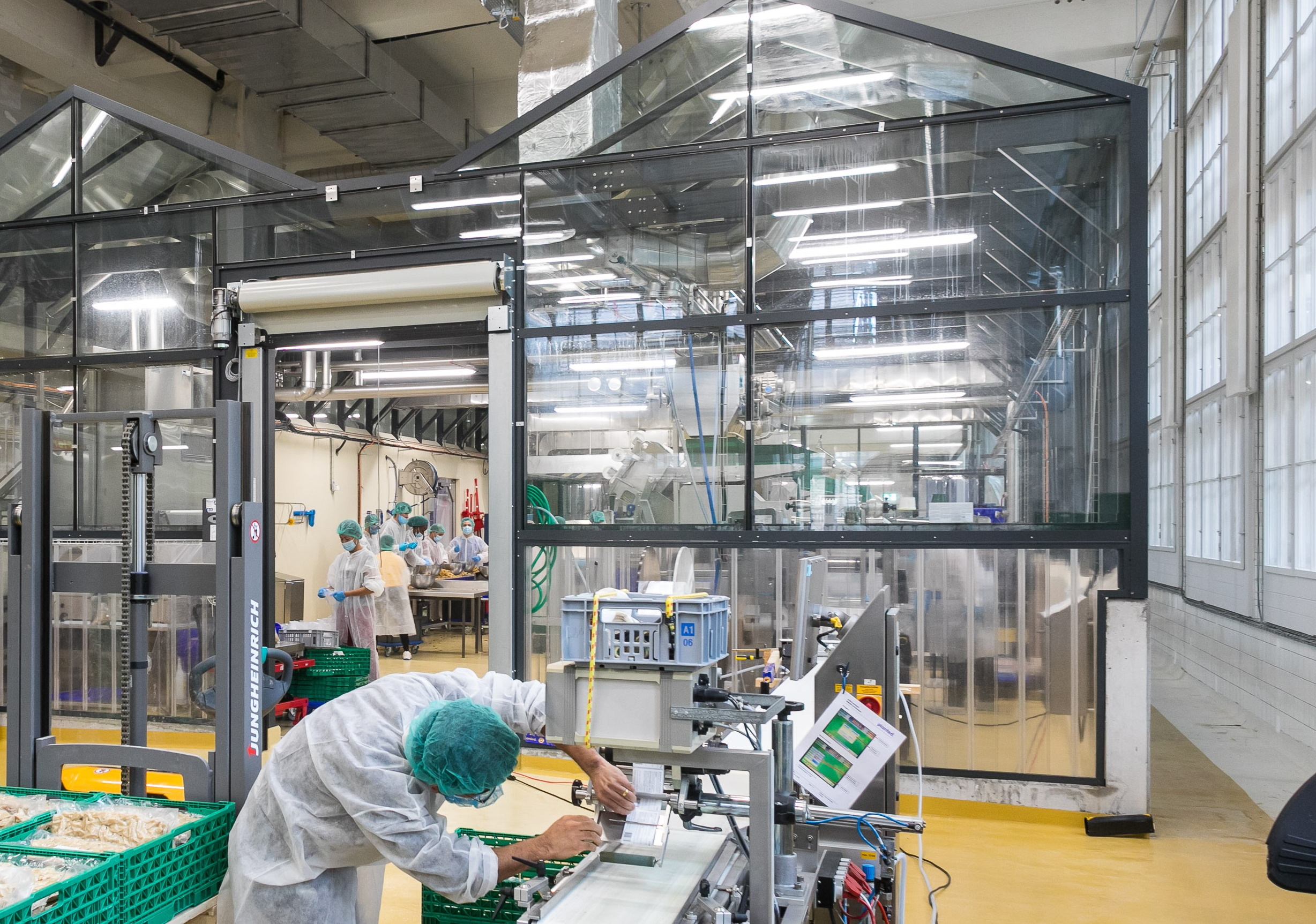
Image Credits: Planted
“We will further invest in our structuring and fermentation platforms. Combining structuring technologies with the biochemical toolboxes of natural microorganisms will allow us to create ultimately new products with transformative character – all clean, natural, healthy and tasty,” said co-founder Lukas Böni in a press release.
No doubt this all will also help lower the price, a goal from the beginning but only possible by scaling up.
As other companies in this space also raise money (incidentally, rather large amounts of it) and expand to other markets, competition will be fierce — but Planted seems to be specializing in a few food types that aren’t as commonly found, at least in the U.S., where sausages, ground “beef,” and “chicken” nuggets have been the leading forms of meat alternatives.
No word on when Planted products will make it to American tables, but Jenny’s “overseas” suggests it is at least a possibility fairly soon.
The funding round was co-led by Vorwerk Ventures and Blue Horizon Ventures, with participation from Swiss football (soccer) player Yann Sommer and several previous investors.
The clock has officially started ticking on Deliveroo’s plans to go public in April. After announcing last week that it planned to list on the London Stock Exchange, today the on-demand food delivery company backed by Amazon and others published selected updated financials for the previous fiscal year, along with its Expected Intention to Float (EITF) — a more formal document that marks the two-week period until the company publishes its prospectus and, at the start of April, embarks on its subsequent IPO.
The bottom line is that Deliveroo is still unprofitable. It posted a 2020 underlying loss of £223.7 million ($309 million), but that figure was down by nearly £100 million from 2019, when it chalked up a loss of £317 million ($438 million). It did not disclose revenues (sometimes called turnover) in today’s statement.
The company said that it now serves some 6 million customers, with its three-sided marketplace also including more than 115,000 restaurants, takeaways and grocery stores, and 100,000 riders in 800 locations among 12 markets.
At the same time, Deliveroo showed some clear momentum in a year where many restaurants had to close their doors and shift operations to take-away models because of Covid-19.
It notes that it has been profitable on an “Adjusted EBITDA basis” over two quarters, with underlying gross profit up by 89.5% to £358 million ($495 million) compared to £189 million in 2019.
Its gross transaction volume (total amount spent by consumers ordering food) grew by 64% to £4.1 billion ($5.67 billion) with the run-rate in Q4 surging to £5 billion. This figure is unsurprising when you consider that Q4 represented the holiday period, and additionally the UK market (Deliveroo’s primary market and its home) went through not one but two different periods of being locked down in that quarter (the second of these is still in place).
It also notes that gross profit margin as a percentage of GTV has grown from 5.8% in 2018 to 8.8% in 2020, with some markets getting to 12%.
“The company remains focused on investing in driving growth in a nascent online food market,” it noted in the EITF, although I’m not sure nascent is exactly the word I’d use. Its drivers are easily the most visible of the many delivery services that exist in London. Deliveroo estimates that the restaurant and grocery sectors represent an addressable market of £1.2 trillion ($1.66 trillion) across the 12 regions where it offers services. In that figure, it says that just 3% of sales are estimated to be online, “equivalent to less than 1 out of the 21 weekly meal occasions being online.”
The company was valued at over $7 billion in it last fundraising, a $180 million round from Durable, Fidelity and others, as recently as January of this year.
It’s a huge leap that is the stuff that tech myths are made of (with untold hours of blood, sweat and tears, and a lot of luck too). I met Will Shu, the CEO and founder, when he was just really getting started at Deliveroo, and he seemed somewhat bewildered by how fast the startup was growing and where it was leading him. It’s interesting that he himself hasn’t forgotten those early days, either, which surely help keep the company focused at a time when there are a lot of opportunities, and therefore a lot of potential for focus unravelling.
“I never set out to be a founder or a CEO. I was never into start-ups, I didn’t read TechCrunch. I’m not one of those Silicon Valley types with a million ideas,” he noted in his letter published in the EITF. “I had one idea. One idea born out of personal frustration. An idea that I was fanatically obsessed with: I wanted to get great food delivered from amazing London restaurants.”
The prospectus will tell us how much the company intends to raise in its IPO so we’ll know those numbers soon. In the meantime, Deliveroo said that it plans to “invest in its long-term proposition by developing its core marketplace, enhancing its superior consumer experience, providing restaurant and grocery partners with unique tools to help them grow their businesses, and providing riders with the flexible work they value alongside security.”
It’s also going to continue building out “dark kitchens” (which it brands Editions); Signature, a white-label service for restaurants to offer delivery via their own online channels; Plus, a Prime-style loyalty subscription service; and on-demand grocery — which is also shaping up to be a huge market in Europe and the rest of the world.
Rimac Automobili, the Croatian company known for its electric hypercars and battery and powertrain development, has gained yet another investment from Porsche AG.
Porsche said Monday it has invested 70 million euros ($83.3 miilion) into Rimac, a move that increases its stake from 15% to 24%.
This is the third time Porsche has invested into Rimac. The German automaker made its first investment into Rimac in 2018. Porsche increased its equity stake into Rimac in September 2019. A few months earlier, Hyundai Motor Company and Kia Motors jointly invested €80 million ($90 million at the time) into Rimac.
Rimac was founded by Mate Rimac in 2009 and is perhaps best known for its electric hypercars, such as the two-seater C Two that it debuted in 2018 at the Geneva International Motor Show. The vehicle produces an eye-popping 1,914 horsepower, has a top speed of 256 miles per hour and can accelerate from 0 to 60 mph in 1.85 seconds. Rimac plans to unveil C Two in its final form in 2021.
However, Rimac does more than produce hypercars. The company, which employs 1,000 people, also focuses on battery technology within the high-voltage segment, engineers and manufactures electric powertrains and develops digital interfaces between humans and machines.
Porsche is most interested in Rimac’s development of components, according to comments made by Lutz Meschke, the deputy chairman of Porsche AG’s executive board. Meschke noted that Rimac is “excellently positioned in prototype solutions and small series” and “is well on its way to becoming a Tier 1 supplier for Porsche and other manufacturers in the high-tech segment.”
Porsche has already placed its first orders with Rimac for the development of highly innovative series components, according to Meschke.
Despite its continued investments, Porsche said it doesn’t have a controlling stake in Rimac.


