& meet dozens of singles today!
User blogs



The popularity of video and other streamed content like podcasts is continuing to grow at a breakneck speed, and today a startup called Epidemic Sound, a marketplace to source the background music for that media, is announcing a huge round of funding to scale along with it. The Stockholm-based startup has raised $450 million from Blackstone Group and EQT Growth, an equity round that values Epidemic Sound at $1.4 billion.
Epidemic currently features some 32,000 music tracks and 60,000 sound effects, and the plan will be to continue building out the technology on its platform to provide better tools to creators for matching music to media, to expand that catalogue, to grow its customer base, and to take the service global with more localized offerings.
$450 million may sound like a lot of money for a company that — if you’ll excuse the pun — hasn’t made a lot of noise up to now. But the funding is underpinned with some big ambitions and significant metrics.
“It ties into the size of the vision,” co-founder and CEO Oscar Höglund said in an interview. “We are trying to soundtrack the internet. That’s what it comes down to.”
For an idea of how the startup is growing, when we last covered funding for Epidemic Sound in 2019 (a more modest $20 million at a $370 million valuation), it saw its tracks playing for an average of 250 million hours each month on YouTube alone.
Since then, that figure has grown by more than 400% and is now well over 1 billion hours each month. Höglund says that in terms of streams, YouTube videos using music from Epidemic Sound artists are played 1.5 billion times each day. And that’s before you consider the traffic for Epidemic music used across TikTok, Facebook and Instagram, Snapchat and other platforms.
“The macro trend is exploding,” Höglund said. Counting composers and other creators, there are around 150,000 people using its platform today.
But considering that there are around 37 million YouTube channels, and that’s not counting the many other places like Twitch, TikTok, Instagram, Snapchat and elsewhere that you might find people, there is a lot of room to grow.
“We look for huge open-ended markets, and [in this market] Epidemic is growing into an industry leader,” Jon Korngold, the global head of Blackstone Growth who led on its investment, said in an interview.
Two-sided music marketplace
Epidemic Sound, positions itself as a marketplace, where musicians can upload their recorded tracks, and those who want to use them can come with some ideas in mind of what they’d like to find — music is searchable by genre, mood, instruments, tempo, track length and popularity — and then purchase them with pricing based on where they will be used, not how often they will be heard.
It also offers subscriptions for unlimited use based on personal use ($15/month) or commercial use ($49/month). It’s a formula that helped the startup tip into profitability, although at the moment it’s focused more on growth and is back in red.
Founded back in 2009, Epidemic was started by Höglund and Jan Zachrisson to address a specific gap in the market: their aim was to make it easier, and less legally risky, to add music to digital media. It’s funny to think of it, but 11 years ago, the digital music market was still mostly about downloads, and most of them (95%) were illegal. This report from the IFPI at the time didn’t even seem to mention streaming as a concept.
And to Epidemic’s opportunity, there were also no clear, easy to use marketplaces in existence to make music available, and to buy it under easy licensing terms.
“At the core, Epidemic was and is about the restriction free experience for creators,” said Victor Englesson, a partner and investment advisor at EQT Partners. “That was one of the big pain points for user-generated content, and that has been true since its inception. Epidemic Sound controls 100% of the rights in its library.”
Fast forward to today, and the opportunity is less about offering easy licensing, which now seems to be table stakes, but more directly addressing a huge demand.
In a world where video has proven to be a hugely popular with consumers — Cisco previously estimated that video accounted for some 80% of all internet traffic in 2020, but with those numbers dating from pre-pandemic, I wouldn’t be surprised if it was more — it has also proliferated as a medium for creators. Unsurprisingly, a lot of companies have emerged to provide tools for creators to produce and distribute their video content, and that has included providing them with music.
That has led to a pretty crowded market for soundtracking platforms. Others in the same area include the likes of Artlist (which also provides a catalogue of stills and video; it also raised money last year), Upbeat, and Comma.
Platforms themselves also provide music tools to creators, casual and otherwise, and that has extended far beyond YouTube.
On TikTok, tracks themselves go viral and become earworms overnight. And it’s interesting that Snap last year made a move that points to how it might leverage a role for itself in the music creation and dissemination marketplace. Last year, it quietly acquired an app called Voisy, which lets people overlay and edit their own tunes and vocals over a selection of beats, and then share those creations.
Within all that, Epidemic is more than just a simple platform for exchange, however.
In addition to operating its own platform, Epidemic also partners with other platforms where people are creating content, such as Adobe, Canva, Getty and Lightricks, which offer Epidemic’s music streams as part of their one-stop shops.
And there is also the “brain” behind what Epidemic has built. It tracks which music is used the most, and then how that music plays with audiences, it has been building a gradual picture of the music tastes of the global market — a music graph, as it were — information that it in turn uses to help sort music, match it up better with those looking for it, and to help encourage composers to create further tracks to meet demand.
“Because we collect data and because music leaves a footprint, we can see when there is a huge ask for metal lullabies, for example,” said Höglund. “We can then commission more of that kind of track, and it will get picked up.”
The growth of Spotify, and the massive investments made by Apple, Google, Facebook and others into music streaming, tells a story of how the physical music business has declined but music listening very much has not, a trend only accentuated in the last year, where concerts were cancelled and virtual streaming took their place.
Epidemic is an interesting counterpoint to all of these, focusing not on deals with labels and the Billie’s and Beyonce’s of the world, but a very long tail of creators who may have no deals of the sort in their sights.
While companies like Spotify have turned their attention to building out brands as monetization platforms for artists, that was a part of the equation for the start for Epidemic.
Music creatives receive an upfront payment for each track Epidemic buys, with payment varying depending on the track. It also splits the revenue from streaming platforms where the music might later get played.
The company says that on average musicians can make tens of thousands of dollars year, with a select few making hundreds of thousands of dollars per year. “It’s massive distribution and reach,” he said.
And some grow in their own right, not just as anonymous partners to video creators. Ooyy, Kospy and Loving Caliber are three that have crossed over into their own stardom, so the gap between what Epidemic Sound is doing for musicians and what a platform like, say, Spotify or YouTube might do is not as wide as you might think. (That also also points to some very obvious and formidable competitors — or acquirers or partners — down the line.)
Combined with its size and growth, it’s this engine that has helped Epidemic Sound grow in what has become a pretty crowded market.
“This is, at the end of the day, a data business,” said Korngold at Blackstone Growth.
Roblox went public yesterday after seeing tremendous growth in 2020, and that’s not just good news for the company’s employees and investors — there are also startups like Gamefam hoping to take advantage of the platform’s success.
Roblox has a whole ecosystem of millions of developers and creators building on its game platform, and some are banding together to create their own teams and studios. (We profiled several of those teams earlier this year in an article about the company’s creator accelerator.) But Gamefam founder and CEO Joe Ferencz said his startup is “the first and only fully-dedicated, professional game publishing company on Roblox.”
Founded in 2019, Gamefan currently has 37 full-time employees and eight live games, including Ultimate Driving and Hot Wheels Open World, and Ferencz said there are another 10 in development. Collectively, those games are seeing 48 million monthly visitors and generating six figures in monthly revenue.
Ferencz described the team as “gaming industry professionals working hand-in-hand with the top up-and-coming Roblox creators.” For example, Ultimate Driving creator TwentyTwoPilots also serves as Gamefam’s creative director.
Ferencz himself has worked as a manager Ubisoft and Mattel, where he worked on franchises including Hot Wheels, and where he recalled seeing the emergence free-to-play mobile gaming: “I said to myself, ‘The next time there’s this big platform shift, I want to be a part of this.'” The rise of Roblox and user-created games provided him with that opportunity.
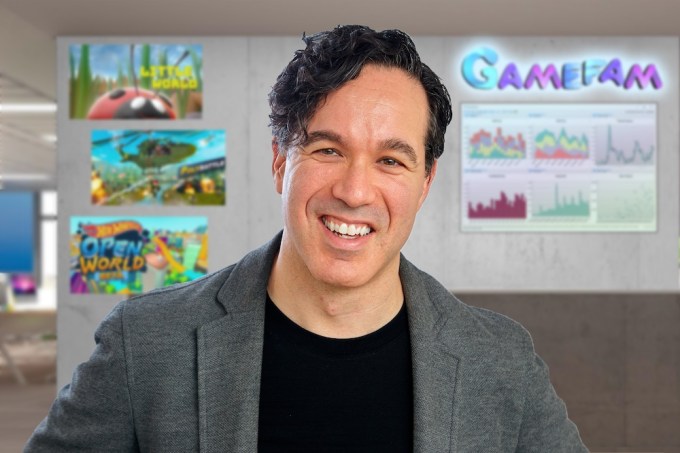
Image Credits: Gamefam
At the same time, Ferencz said he was excited about the opportunities that Roblox provides to escape from the “orthodoxies” of free-to-play gaming, where the economics often drive game design decisions.
“Roblox truly is the metaverse for this younger generation,” he argued. “What they are finding here is something that transcends gaming, it’s human co-experience. What that means is that each game needs to have a very distinctive and attractive immersion to it in way that mobile free-to-play doesn’t.”
Of course, part of Roblox’s appeal is the fact that individual creators don’t need to work with large teams or publishers, but Ferencz said, “Superstar developers and creators are thinking about bigger and bigger games, the sophistication is really evolving at a rapid pace.” That, in turn, means bigger teams, and “when you have bigger teams, you have more process, you need to know how to structure high-performing teams and drive positive teamwork between people.”
“As the business gets bigger, you need people focused on the business opportunities, dedicated marketing functions, a dedicated live operations team,” he continued. “That’s what we offer.”
Ferencz and Gamefan’s business team have been involved in the Roblox platform for several years now, but he admitted, “Although we get it, we don’t get it exactly the way people who have been playing on it since they were 10 and developing for it since 15 get it … We respect that and lean into that.”
So one of the key elements to the Gamefam approach, he said, is to make sure the creators are driving the game development process.
“We believe that there needs to be a visionary or a team of visionaries on each project, and that they need to decide what is right,” Ferencz said. “There will then be a team around them that is part of a consensus process, that the visionaries are responsible for bringing along for a ride.”
And as he thinks about Gamefam’s future, Ferencz said the company could eventually publish games on other platforms. Don’t expect it to happen anytime soon, though.
“Our focus is UGC gaming, and Roblox is the only place that matters in UGC gaming today,” he said. “We plan to build a huge brand and media business hand-in-hand with the Roblox platform. In the long term, if other platforms become relevant, then course we will be looking to evaluate and expand on those platforms —but the truth is, right now we couldn’t be more all about Roblox.”
In just a few hours, we’re going to (virtually) meet up in the Magic City, Miami. Since we first let you know about our new Spotlight series, we’ve gotten a ton of registrations and some amazing submissions for our pitch-off.
The small event features three segments: networking, a pitch-off, and a fireside chat with Rebecca Danta, Managing Director of Miami Angels, and Brian Brackeen, General Partner of Lightship Capital. Everyone is welcome to attend today’s event, but it’s specifically programmed to help and highlight those in the Miami region.
Meet Our TechCrunch City Spotlight: Miami Pitch-Off Companies and Judges
We had to go through some fantastic submissions to get the five that will pitch their companies to our judges today. We think you’ll agree that Miami’s best have come out in full force.
First, let’s meet the companies:
- Evan Leaphart will be presenting his unique approach to helping kids learn how real-life actions lead to financial consequences with Kiddie Kredit
- Lacey Kaelani has been a casting pro for years. How are things still done through Craigslist ads and hacked together databases? No idea. Casting Depot aims to solve that problem.
- Samella Watson, founder of Sebiya, will remind us that when travelling where you stay is more than just a place to sleep.
- Dan Saltman has seen people from all walks of life try to handle the footprint that social media leaves in their wake. Sometimes, you want to start over. Redact is the tool to do it with.
- D Marie Thompson has a very personal story when it comes to nursing and she founded MyRa to solve a problem that affected her and her colleagues.
The three judges that have the difficult task of picking a winner and runner-up are:
- Alexis Alston, Senior Associate at Lightship Capital
- Patty Wexler, Managing Director at Starlight Ventures,
- Laura González-Estéfani, Founder and CEO of TheVentureCity
Each company will get four minutes to present and then the judges will have a few minutes to ask questions. After all of the companies have pitched, the judges will get five minutes to decide who takes the crown of first-ever TechCrunch City Spotlight Pitch-Off champion.
Not in Miami? Don’t worry. TechCrunch is bringing this series of free events to other cities across the United States and abroad. In the coming weeks, we’ll have similar events in Pittsburgh, Detroit, and others as TechCrunch digs deep into growing tech scenes outside of Silicon Valley.

Warehouse automation company Nimble Robotics today announced that it has raised a $50 million Series A. Led by DNS Capital and GSR Ventures and featuring Accel and Reinvent Capital, the round will go toward helping the company essentially double its headcount this year.
Founded by former Stanford PhD student Simon Kalouche, the system utilizes deep imitation learning – a popular concept in robotics research that helps systems map and improve through imitation.
“Instead of letting it sit in a lab for five years and creating this robotic application before it’s finally ready to deploy to the real world, we deployed it today,” says Kalouche. “It’s not fully autonomous – it’s autonomous maybe 90, 95% of the time. The other 5-10% is assisted by remote human operators, but it’s reliable on day one, and it’s reliable on day 10,000.”
Nimble is one in a long list of robotics companies to get a boast from Covid-19. The pandemic has driven both explosive growth in ecommerce and interest in automation, contributing to a significant excitement around the warehouse fulfillment tech. Nimble has also benefited from the rapid deployment of its systems.
“We’re not the first robotic pick, place and pack company that’s out there. We’ve grown really fast and have a lot of robots deployed in production,” Kalouche tells TechCrunch. “A lot of people have robots in the corner of a warehouse. Right now, we have heaps of robots deployed, and we’re growing really quickly. These are robots that are in production and picking tens of thousands of real orders every single day for each of our customers.”
In addition to the large funding round, the company is also adding two impressive names to its Board of Directors: Sequoia Professor of Computer Science at Stanford University, Fei-Fei Li and Kitty Hawk/Udacity’s Sebastian Thrun.
“Nimble addresses both reliability and integration concerns,” Li, who’s also a seed investor, said in a release tied to the news. “Their robots have been picking reliably in production, at scale for over a year for some of the world’s largest retailers. They’ve developed an AI-powered product that makes integration fast and frictionless for their retail customers.”


