& meet dozens of singles today!
User blogs

When it comes to building a data science team, many companies fail at the first step — creating a job posting. These mistakes have been amplified in the age of COVID-19.
The increasing demand for AI and data science experts, driven in part by the pandemic’s economic impact, is showing no sign of abating. Many employers are failing to identify viable job candidates, much less interviewing or hiring them.
What’s the biggest obstacle holding them back? In our experience, it is often a poorly drafted job posting. And with the pandemic completely stopping all in-person recruiting events, hiring success hinges on an effective job rec. Previously tolerable mistakes are now fatal.
At The Data Incubator, a data science training and placement firm, we’ve helped hundreds of companies successfully hire data science teams. Honestly, it pains me to see amazing companies undersell themselves in this area.
When it comes to building a data science team, many companies fail at the first step — creating a job posting.
Companies inevitably gravitate toward the same generic buzzwords, promoting themselves as “cutting edge,” “creative,” “collaborative,” “data driven,” “passionate” or “insightful” (just peruse Indeed for examples of these lackluster postings). Or they delve into industry jargon, which may be lost on candidates who are not familiar with the industry.
To streamline the writing process, we recommend that clients break down their competitive advantage into three buckets: compensation, mission and tech. Only by understanding where their strength lies can they successfully market their job openings.
Compensation
Compensation is an important component of making a position competitive. Managers certainly need to fight to ensure their remuneration range is appropriate for their data science roles. However, budget constraints are difficult to overcome, especially given the ability of tech and finance to pay top dollar for these sought-after skills. How to combat this when you don’t have the same budget? Consider listing compensation in job ads.
If you’re one of (the majority of) employers who cannot afford to compete on salary, this will help job seekers understand what to expect. Neither you, nor a potential candidate, wants to spend hours interviewing just to discover that it would have never worked out because of compensation. Save yourself the time and frustration by listing remuneration upfront.
What if you are one of the few employers able to pay major-league salaries? Congratulations, but don’t throw away your hard-won budget! Companies develop reputations for compensation. Unless you are one of the select firms with a reputation for paying top dollar, you will need to signal that to top talent. Otherwise, strong candidates may assume the remuneration is low and not apply, defeating the purpose of paying a high salary in the first place.
Obviously, listing salaries is controversial and there are plenty of reasons why employers are weary of listing salary ranges. However, a recent survey by SHRM found that 70% of professionals want to hear about salary upfront and Glassdoor.com reports that salary is the No. 1 consideration for 67% of job seekers. With all these benefits, employers should seriously consider being more upfront and transparent about what they are able to pay, if only to save themselves time and frustration.
Mission
In the COVID-19 workplace, employees are finding themselves increasingly isolated. With work from home poised to stay even after the virus has dissipated, the risk of isolation will continue. Companies need to double down on articulating their mission and galvanizing employees around that. This doesn’t just start with employment but the very first step of the hiring process: the job posting. Emphasizing mission in the job posting will attract employees.
BMW plans to have 25 electrified cars in its lineup by 2025 and it’s taking a few more steps in this direction this year with the launch of the all-electric iX SUV and the i4 sedan. Today, for the first time, the German automaker shared a few more details of what we can expect from the i4, its first fully-electric sedan, in addition to sharing the first exterior shots of the new model.
At the top end, the i4 will have a power output of 390kW / 530HP. Going from zero to 100km/h will take four seconds.
BMW promises up to a 300 miles range, according to its own preliminary tests based on the EPA’s test procedures. Enough to go from L.A. to Las Vegas. That’s the same range as the iX will be able to cover on a single charge and a slight increase in horsepower compared to BMW’s new SUV. And while that range is less than what Tesla and some other competitors can offer, it’s still more than what’s possible with comparable all-electric Porsche and Audi models like the eTaycan and e-tron GT, which are in the lower 200s.
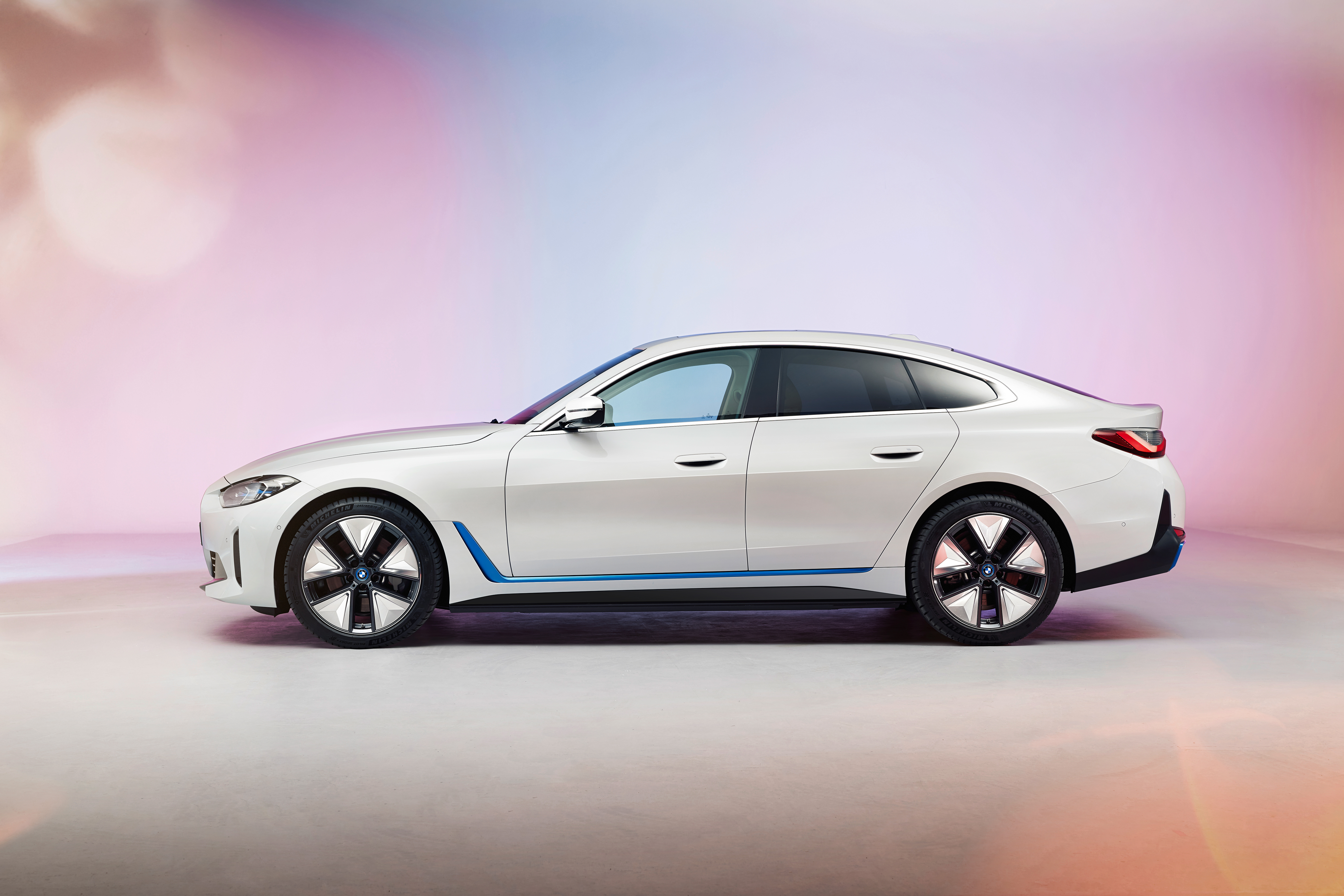
Image Credits: BMW
“With its sporty looks, best in class driving dynamics and zero local emissions, the BMW i4 is a true BMW. It makes the heart of the BMW brand now beat fully electric,” said Pieter Nota, member of the Board of Management of BMW AG responsible for Customer, Brands, Sales.
For now, we don’t have any pricing details or additional specs for the i4. It will become available later this year, so we’ll likely see more details in the summer.
“The iX is purpose-built, it’s spectacular and it’s a completely new BMW X product,” Frank Weber, BMW’s head of development, said at a press event earlier this week. “But what people are longing for is to see that we have a sport sedan that is fully electric. […] And the i4 has everything it takes to have a real sporty sedan from BMW that is fully electric.”
And indeed, unlike the somewhat quirky i3, BMW’s first all-electric car, the i4 is a standard, four-door sedan (with real passenger doors, unlike the i3) — something that buyers in the market for a sporty yet roomy electric car from BMW in the spirit of the existing 4-series will likely appreciate.
Earlier this week, BMW also announced version 8 of its iDrive operating system, which will feature a new dashboard layout and visual design, with two curved screens. It will make its debut in the i4 and iX.
Amazon is apparently pleased with how its Amazon Care pilot in Seattle has gone, since it announced this morning that it will be expanding the offering across the U.S. this summer, and opening it up to companies of all sizes, in addition to its own employees. The Amazon Care model combines on-demand and in-person care, and is meant as a solution from the search giant to address shortfalls in current offering for employer-sponsored healthcare offerings.
In a blog post announcing the expansion, Amazon touted the speed of access to care made possible for its employees and their families via the remote, chat and video-based features of Amazon Care. These are facilitated via a dedicated Amazon Care app, which provides direct, live chats via a nurse or doctor. Issues that then require in-person care is then handled via a house call, so a medical professional is actually sent to your home to take care of things like administering blood tests or doing a chest exam, and prescriptions are delivered to your door as well.
The expansion is being handled differently across both in-person and remote variants of care; remote services will be available starting this summer to both Amazon’s own employees, as well as other companies who sign on as customers, starting this summer. The in-person side will be rolling out more slowly, starting with availability in Washington, D.C., Baltimore, and “other cities in the coming months” according to the company.
As of today, Amazon Care is expanding in its home state of Washington to begin serving other companies. The idea is that others will sing on to make Amazon Care part of its overall benefits package for employees. Amazon is touting the speed advantages of testing services, including results delivery, for things including COVID-19 as a major strength of the service.
The Amazon Care model has a surprisingly Amazon twist, too – when using the in-person care option, the app will provide an updating ETA for when to expect your physician or medical technician, which is eerily similar to how its primary app treats package delivery.
While the Amazon Care pilot in Washington only launched a year-and-a-half ago, the company has had its collective mind set on upending the corporate healthcare industry for some time now. It announced a partnership with Berkshire Hathaway and JPMorgan back at the very beginning of 2018 to form a joint venture specifically to address the gaps they saw in the private corporate healthcare provider market.
That deep pocketed all-star team ended up officially disbanding at the outset of this year, after having done a whole lot of not very much in the three years in between. One of the stated reasons that Amazon and its partners gave for unpartnering was that each had made a lot of progress on its own in addressing the problems it had faced anyway. While Berkshire Hathaway and JPMorgan’s work in that regard might be less obvious, Amazon was clearly referring to Amazon Care.
It’s not unusual for large tech companies with lots of cash on the balance sheet and a need to attract and retain top-flight talent to spin up their own healthcare benefits for their workforces. Apple and Google both have their own on-campus wellness centers staffed by medical professionals, for instance. But Amazon’s ambitious have clearly exceeded those of its peers, and it looks intent on making a business line out of the work it did to improve its own employee care services — a strategy that isn’t too dissimilar from what happened with AWS, by the way.
Diem, a London, UK-based fintech start-up has raised a seed round of $5.5 million led by Fasanara Capital, and Angel investor Chris Adelsbach, founder of Outrun Ventures. Additional investors include Andrea Molteni (early investor in Farfetch), Ben Demiri (co-chairman at fashion tech PlatformE) and Nicholas Kirkwood (founder of the eponymous brand).
Diem is a debit card with an app affording instant cash access, traditional banking service benefits (debit card, domestic and international bank transfers), but also allowing consumers to dispose of goods for eventual resale. The idea here is that this feeds into the so-called circular economy, making Diem attractive from an environmental point of view. Some estimates put the amount of worth of goods disposed of in the last 15 years at $6.9Tn.
Here’s how it works: You have an old time of clothing, phone, book or bag, for instance. You load the item it into the app. The app makes you an offer for what the item is worth. If you accept, cash is loaded into your account and there’s a facility to spend in the item, which is then resold. The incentive, therefore, is not to throw away the object and add to landfill, because you have now turned it into cash. Think “neo bank meets people who sell your stuff on eBay”
Geri Cupi said in a statement: “Diem’s mission is to empower consumers to value, unlock, and enjoy wealth they never knew they had. All of this while fuelling the circular economy and supporting the commitment to sustainability as our key value proposition. DIEM makes it possible for capitalism and sustainability to co-exist.”
Lead Investor and CEO at Fasanara Capital, Francesco Filia, said: “Fasanara is excited to announce our partnership with DIEM and Geri Cupi… [it’s] a new generation fintech powered by principles of circular economy and look forward to support its growth.”
Riva, founded by scientist Tuhin Sinha and Siri co-founder Dag Kittlaus, wants to help people measure their blood pressure in a clinically-approved way. Blood pressure can help indicate at-risk patients before they are actually at risk, showing early signs of heart disease. And while other hardware solutions on the market promise the same end-goal, Riva wants to be a purely software solution that integrates with hardware that it thinks its end-user has anyways: their smartphone.
The company, launching out of stealth today, has raised $15.5 million in seed funding in a round led by Menlo Ventures, with participation from True Ventures. UC Health and University of Colorado Innovation Fund accounted for $5 million of the round, with other angels including GoHealth’s Brandon Cruz and Madison Industries Larry Gies. Greg Yap of Menlo, who talked to Sinha for three years before investing, will be joining the board.
Kittlaus, who also founded AI-assistant Viv, says that he began thinking about how to make a difference in digital health after undergoing his own severe health issues. Kittlaus was diagnosed with pancreatic neuroendocrine cancer in 2016, the same type of cancer that late Apple CEO Steve Jobs died from.
“I spend time researching ideas on it, but I was missing the thing that I’ve had in both my previous companies, which was some amazing technical innovation that could form a wedge that you can move the world with,” he said.
Kittlaus mentioned this internal conversation with his friend, who was the first investor in Siri, this past summer. The friend introduced him to Tuhin Sinha, the scientist who spent years developing the technology that is used to power Riva.
To use Riva, all a person needs to do is open the app on their phone and tap ‘Go’, which triggers the camera flash on the back of the phone. The app will then guide the user to place their finger over the right camera, and help them adjust positioning until it locks into place. After that, Riva will use the light to track blood pressure change and create a rendering of it on screen.
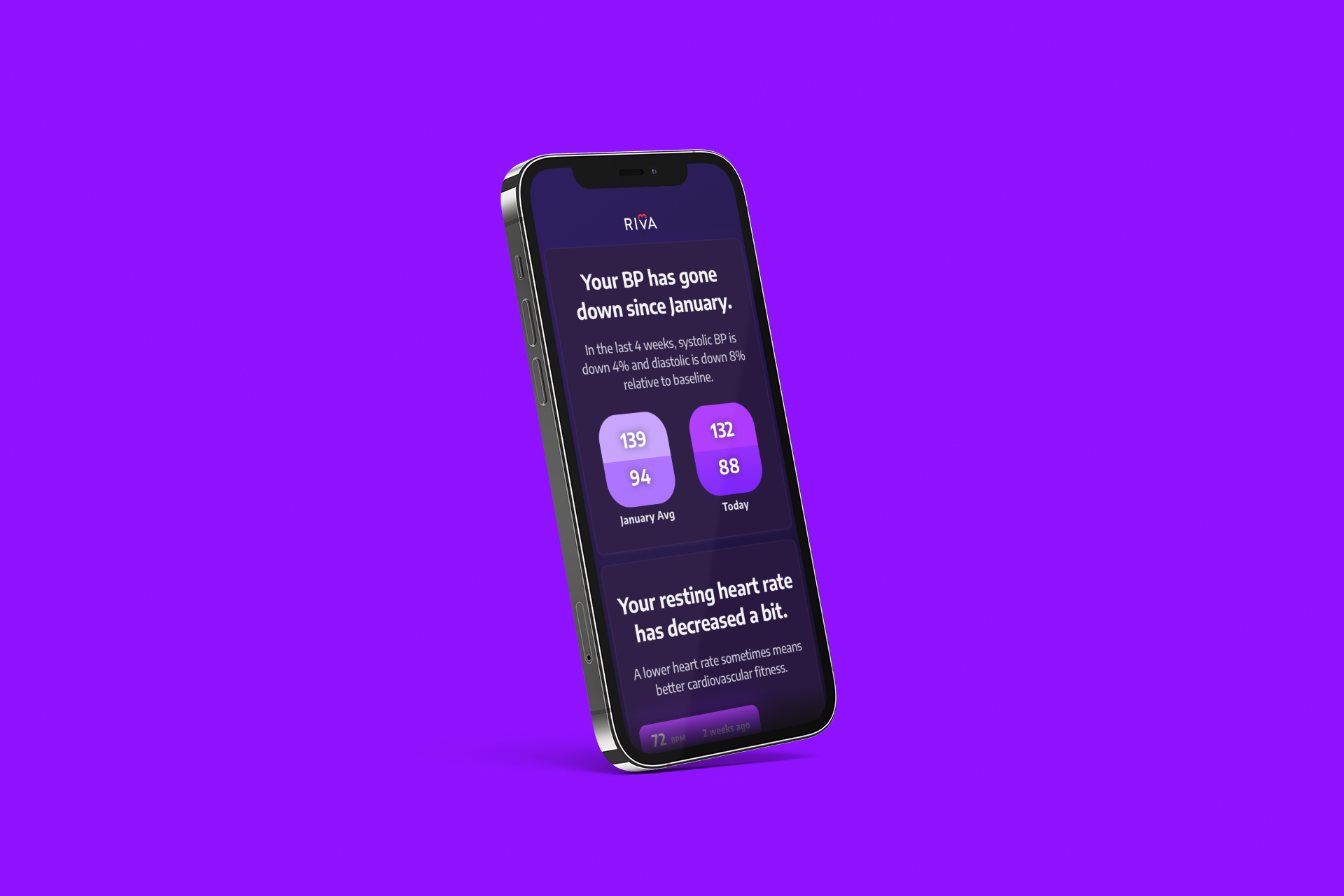
Riva Health planned design, subject to change.
“The well-known part of this technology is shining a light on a blood vessel and getting a wave out of it,” Sinha said. “The novelty is the shape of the wave, how it relates to blood pressure, and our secret sauce is looking at those waveshape changes and validating them in a rigorous and comprehensive way.” Sinha declined to share how they are validating exactly, but said that it is key that a startup has to measure blood pressure in a variety of different scenarios – think standing or sitting – to see if it is effective.
Once Riva tracks five to seven heartbeats worth of data, it has a comprehensive understanding of someone’s blood pressure at that moment.
The data, which is HIPAA compliant, can then be sent to a family physician or doctor’s office to be analyzed if a risk is present, starting with hypertension.
“Moving to a platform like the smartphone is mobilizing the measurement and management of [health and disease management],” Sinha said. Riva Health is a purely software solution.
The company is currently in the process of verifying its software with Android phones, but Kittalus says that “any modern phone should be able to acquire the signal needed” to work.
A big hurdle for any health tech company, and especially Riva, is whether it can get FDA approval for clinical usage. The company is currently engaged in that process with the FDA, and will ask users who pilot its free app, coming out this summer, to participate in the trial and data-gathering to bolster its approval process.
Right now, Riva is using its technology to track the changes in blood pressure in a clinical setting, and the second-half will be in a home setting. By tracking the use of its system in the real world, it can prove that it works in a laboratory and home set-up, helping it prove that its disease management technology is effective.
“There are a lot of gizmos and gadgets that will claim to do blood pressure reading,” Kiittlaus said. “I call it blood pressure as a novelty where it gives you blood pressure reading but not a clinic.” For example, a Fitbit does track blood pressure but consistently underestimates the number, a study says. Other solutions like the Apple Watch or cuffless wearables measure blood pressure for non-clinical usage, which means that it isn’t super accurate and only notifies obvious blood pressure problems.
Riva wants to be daily and precise enough to be relied on by doctors, which is part of its overall route to make money. While the team wouldn’t share any published research or proof about its scientific method, Dr. Richard Zane, the chief innovation officer of UCHealth said that it is “bulletproof” technology. Over 700 companies in the past three years have tried to work with Zane’s team, and Riva is one of the few that met the bar.
“When our team tested it, it actually worked out of the box the first time, which basically never happens,” Zane said. He added that one of the biggest barriers to entry is that people have needed devices in the past, and Riva brings “a novel technology that actually works that will be embedded in something that patients already carry around with them and allow them to manage their heart disease or hypertension.”
“The core product of the company is healthcare outcomes,” Sinha said. The company is part of the wave of startups that believe outcome-based healthcare is the future, a model where doctors are paid for results instead of the number of visits they complete in a day. With this vision, Riva plans to monetize by selling outcomes to hospital systems and providers: if it can provide a tool to help doctors keep people out of surgery and indicate issues earlier than before, it can make a solid argument as to why systems should adopt it.
Only 20% of healthcare works on the value-based model, so this will be a hurdle even with the right sentiment. In the meantime, Kittlaus says that it is working with insurers to pay for its service. Riva would get reimbursed for treating and managing hypertension.
“We want to keep it free for the consumer, free for the doctor, and insurance will cover it,” he said.
If and when the FDA clears this technology, Kittlaus says that doctors and medics “will still be skeptical about it” but will ultimately be convinced of the outcomes being more accurate, and ongoing, than the cuff.
“You’re prescribing an app,” he said. “Instead of medicine.”
The app, pending FDA approval, will be available for public late this year or early next year. The next few months for Riva will be key in determining its success and validity – and Sinha, the chief scientist, say it will be rigorous, but fast. He has a personal tie to the company’s success.
Sinha has lost five brothers, one sister, and his father before the age of 59 to heart disease. Now, his app has the ability to track the condition that made him lose these family members in the first place.
“I feel like I have a ticking time bomb in my chest,” he said. “And if anything, I’m going to do this for myself.”


