& meet dozens of singles today!
User blogs



The coming wave of electric vehicles will require more than thousands of charging stations. In addition to being installed, they also need to work — and today, that isn’t happening.
If a station doesn’t send out an error or a driver doesn’t report it network providers might never know there’s even a problem. Kameale C. Terry, who co-founded ChargerHelp!, an on-demand repair app for electric vehicle charging stations, has seen these issues firsthand.
One customer assumed that poor usage rates at a particular station was due to a lack of EVs in the area, Terry recalled in a recent interview. That wasn’t the problem.
“There was an abandoned vehicle parked there and the station was surrounded by mud,” said Terry who is CEO and co-founded the company with Evette Ellis.
Demand for ChargerHelp’s service has attracted customers and investors. The company said it has raised $2.75 million from investors Trucks VC, Kapor Capital, JFF, Energy Impact Partners, and The Fund. This round values the startup, which was founded in January 2020, at $11 million post-money.
The funds will be used to build out its platform, hire beyond its 27-person workforce and expand its service area. ChargerHelp works directly with the charging manufacturers and network providers.
“Today when a station goes down there’s really no troubleshooting guidance,” said Terry, noting that it takes getting someone out into the field to run diagnostics on the station to understand the specific problem. After an onsite visit, a technician then typically shares data with the customer, and then steps are taken to order the correct and specific part — a practice that often doesn’t happen today.
While ChargerHelp is couched as an on-demand repair app, it is also acts as a preventative maintenance service for its customers.
Powering up
The idea for ChargerHelp came from Terry’s experience working at EV Connect, where she held a number of roles including head of customer experience and director of programs. During her time there, she worked with 12 different manufacturers, which gave her knowledge into inner workings and common problems with the chargers.
It was here that she spotted a gap in the EV charging market.
“When the stations went down we really couldn’t get anyone on site because most of the issues were communication issues, vandalism, firmware updates or swapping out a part — all things that were not electrical,” Terry said.
And yet, the general practice was to use electrical contractors to fix issues at the charging stations. Terry said it could take as long as 30 days to get an electrical contractor on site to repair these non-electrical problems.
Terry often took matters in her own hands if issues arose with stations located in Los Angeles, where she is based.
“If there was a part that needed to be swapped out, I would just go do it myself,” Terry said, adding she didn’t have a background in software or repairs. “I thought, if I can figure this stuff out, then anyone can.”
In January 2020, Terry quit her job and started ChargerHelp. The newly minted founder joined the Los Angeles Cleantech Incubator, where she developed a curriculum to teach people how to repair EV chargers. It was here that she met Ellis, a career coach at LACI who also worked at the Long Beach Job Corp Center. Ellis is now the chief workforce officer at ChargerHelp.
Since then, Terry and Ellis were accepted into Elemental Excelerator’s startup incubator, raised about $400,000 in grant money, launched a pilot program with Tellus Power focused on preventative maintenance, landed contracts with EV charging networks and manufacturers such as EV Connect, ABB and Sparkcharge. Terry said they have also hired their core team of seven employees and trained their first tranche of technicians.
Hiring approach

Image Credits: ChargerHelp
ChargerHelp takes a workforce-development approach to finding employees. The company only hires in cohorts, or groups, of employees.
The company received more than 1,600 applications in its first recruitment round for electric vehicle service technicians, according to Terry. Of those, 20 were picked to go through training and 18 were ultimately hired to service contracts across six states, including California, Oregon, Washington, New York and Texas. Everyone who is picked to go through training are paid a stipend and earn two safety licenses.
The startup will begin its second recruitment round in April. All workers are full-time with a guaranteed wage of $30 an hour and are being given shares in the startup, Terry said. The company is working directly with workforce development centers in the areas where ChargerHelp needs technicians.
The U.S. government has cut trade ties to Myanmar, two months after the country’s military staged a coup overthrowing the country’s president and also its de-facto leader, Aung San Suu Kyi, and killed at least 200 protesters resulting from its offensive.
In a statement, U.S. Trade Representative Katherine Tai said the trade suspension would be “effective immediately” and will remain in place “until the return of a democratically elected government.”
“The United States supports the people of Burma in their efforts to restore a democratically elected government, which has been the foundation of Burma’s economic growth and reform,” said Tai. “The United States strongly condemns the Burmese security forces’ brutal violence against civilians. The killing of peaceful protestors, students, workers, labor leaders, medics, and children has shocked the conscience of the international community. These actions are a direct assault on the country’s transition to democracy and the efforts of the Burmese people to achieve a peaceful and prosperous future,” the statement read.
Myanmar (also known as Burma) and the U.S. began trading in 2013 following the easing of U.S. sanctions a year earlier after elections saw Suu Kyi’s party win by a landslide.
The trade suspension is designed to target the ruling military junta, but leaves millions of internet users across Myanmar in uncertainty as U.S. cloud and internet companies wrangle with the U.S. government order, at a time where protesters are struggling to stay online amid government-ordered internet shutdowns across the country.
Myanmar already blocked Facebook, Twitter, and Instagram “until further notice.”
Sanctions are designed to prevent the shipping of goods, money and certain services to other countries. Companies operating in the U.S. have to follow U.S. sanctions or face heavy financial penalties. ZTE pleaded guilty in 2017 to violating U.S. sanctions against Iran by knowingly shipping products to the country, and agreed to pay a near-$1 billion fine.
But cloud companies fall into a gray area and have different interpretations of the rules. Quartz reported in 2016 that internet users across Syria, Cuba, and Iran — all subject to U.S. trade sanctions — couldn’t access sites hosted by IBM, because the U.S. cloud host blocked visitors from those countries from accessing its services. Rackspace and Linode, two other large cloud providers, do not block internet traffic to users in embargoed countries but instead prevented users from those countries from signing up for their service.
Myamnar has about 17 million internet users, some 30% of the wider population. A spokesperson for the Office of the U.S. Trade Representative did not immediately return a request for comment.
Hello and welcome back to Equity, TechCrunch’s venture capital-focused podcast where we unpack the numbers behind the headlines.
This is Equity Monday, our weekly kickoff that tracks the latest private market news, talks about the coming week, digs into some recent funding rounds and mulls over a larger theme or narrative from the private markets. You can follow the show on Twitter here and myself here.
This morning was a fun mix of news, including some early-stage and late-stage startups entries, along with the latest from the public markets and the great IPO game. Here’s the rundown:
- ServiceTitan’s vertical SaaS success was enshrined in its recent funding round and valuation. Both of which were predicated on its revenue growth. The software market is just gigantic. It’s kinda crazy.
- Deliveroo’s IPO has hit market chop as it looks to price. Governance and how it treats workers were among the concerns that investors have raised.
- And then Chinese company BiliBili struggled during its Hong Kong IPO, while Chinese company Zhihu fell after debuting in the United States — could the public markets bet ratcheting back their interest in tech stocks?
- On the funding round side of things, Ajaib extended its Series A, Singular announced its fund, and Cazoo is going public via a SPAC.
It was a lot, but when have we started the week anything less than fully behind? Chat Wednesday!
Equity drops every Monday at 7:00 a.m. PST, Wednesday, and Friday at 6:00 AM PST, so subscribe to us on Apple Podcasts, Overcast, Spotify and all the casts!
IBM today announced the launch of its first developer certification for programming quantum computers.
While quantum computing may still be in its infancy, most pundits in the industry will tell you that now is the time to learn the basic concepts. And while there is little that’s immediately intuitive on the hardware side of quantum computing, the actual software tools that most players in the industry are developing today should feel somewhat familiar to virtually any developer.
Unsurprisingly, the ‘IBM Quantum Developer Certification,’ as it’s officially called, focuses on IBM’s own software tools and especially Qiskit, its SDK for working with quantum computers. Qiskit has already proven quite popular, with more than 600,000 installs and when IBM Quantum and the Qiskit team hosted a quantum summer school last year, almost 5,000 developers participated.
But on top of knowing their way around the basics of Qiskit (think defining and executing quantum circuits) developers also need to learn some of the basics of quantum computing itself. Once you know your way around Bloch spheres, Pauli matrices and Bell states, you’ll probably be in good shape for taking the certification exam, which will be administered on the Pearson VUE platform.
Abe Asfaw, the global lead for Quantum Education and Open Science at IBM, told me that this is just the first of a series of planned quantum certifications.
“What we’ve built is a multi-tiered developer certification,” he told me. “The first tier is what we’re releasing in this announcement and that tier gets developers introduced to how to work with quantum circuits. How do you use Qiskit […] and how do you run it on a quantum computer? And once you run it on a quantum computer, how do you look at the results and how do you interpret the results? This sets the stage for the next series of certifications that we’re developing, which are then going to be attached to use cases that are being explored in optimization, chemistry and finance. All of these can now be sort of integrated into the developer workflow once we have enabled someone to show that they can work with quantum circuits.”
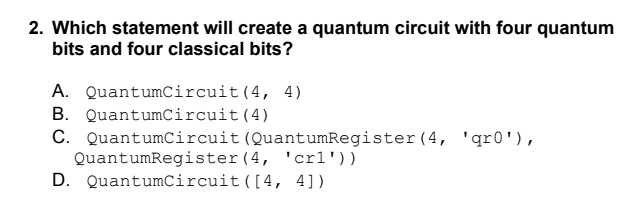
Image Credits: IBM
Asfaw stressed that IBM has focused on education developers about quantum computing for quite a while now, in part because it takes some time to develop the skills and intuition to build quantum circuits. He also noted that the open-source Qiskit project has integrated a lot of the tools that developers need to work at both the circuit level — which is a bit closer to writing in C or maybe even assembly in the classical computing world — and at the application level, where a lot of that is abstracted away.
“The idea is to make it easy for someone who is currently developing, whether it’s in the cloud, whether it’s using Python, to be able to run these tools and integrate quantum computing into their workflow,” Asfaw said. “I think the hardest part, to be very honest, is just giving someone the comfort to know that quantum computing is real today and that you can work with quantum computers. It’s as easy as opening up a Jupyter notebook and writing some code in Python.”


