& meet dozens of singles today!
User blogs

The coronavirus pandemic has increased our collective screen time, and that’s particularly true on mobile devices. According to a new report from mobile data and analytics firm App Annie, global consumers are now spending an average of 4.2 hours per day using apps on our smartphones, an increase of 30% from just two years prior. In some markets, the average is even higher — more than five hours.
In the first quarter of 2021, the daily time spent in apps surpassed four hours in the U.S., Turkey, Mexico and India for the first time, the report notes. Of those, India saw the biggest jump as consumers there spent 80% more time in smartphone apps in the Q1 2021 versus the first quarter of 2019.
To put this in perspective in the American market, Nielsen had last year reported consumers were spending around 4 and half hours watching live or time-shifted TV, but only 3 hours, 46 minutes using smartphone apps.
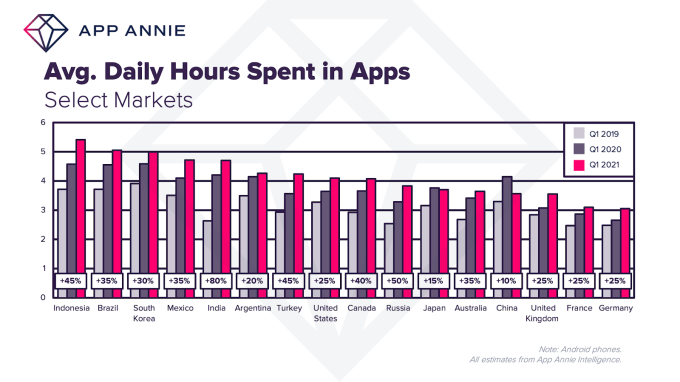
Image Credits: App Annie
However, we should point out that Nielsen and App Annie’s analysis can’t necessarily be compared directly, because App Annie only measured time spent on Android devices — and many Americans use iPhones. Nielsen, meanwhile, relies on panels to achieve a representative sampling. Nevertheless, the broad strokes here are that mobile apps seem to be a more popular means of entertainment than the good ol’ American pastime of watching TV.
The new report also notes that three markets — Brazil, South Korea, and Indonesia — saw the average daily time spent in apps jump to over five hours this past quarter.
It can be difficult to determine which apps are driving these changes as the most downloaded apps tend to remain the same quarter after quarter. The top charts are dominated by the usual names like TikTok, YouTube and Facebook, for example. That’s why App Annie now tracks what it calls “breakout apps,” which are those that saw spikes in quarter-over-quarter downloads across both iOS and Android.
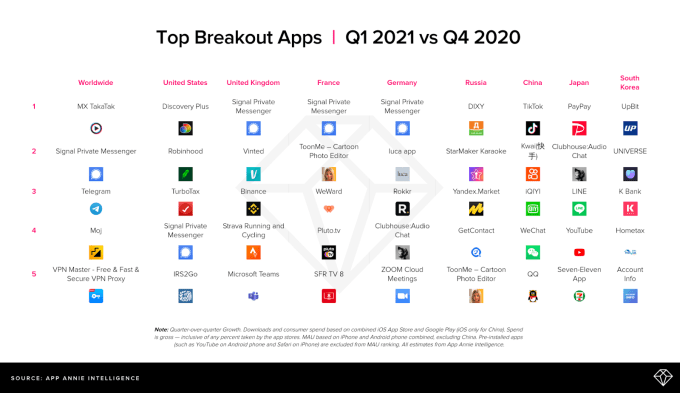
Image Credits: App Annie
In Q1 2021, Western markets saw a sharp rise in secure messaging apps, Signal and Telegram. Signal, for instance, placed first in the U.K., Germany, and France, and fourth in the U.S. as a “breakout app” for the quarter. Telegram was No. 9 in the U.K. No. 5 in France, and No. 7 in the U.S.
Investment and trading apps were also popular in the quarter, with Coinbase’s crypto app at No. 6 in the U.S. and U.K. on this list, while Binance was No. 7 in France. Crypto trading app Upbit, meanwhile, was No. 1 in South Korea. The payment app, PayPay was the No. 1 breakout app in Japan. And Robinhood was No. 2 in the U.S.
Clubhouse also made a showing on the “breakout” charts, as it gained ground in non-U.S. markets like Germany and Japan, where it ranked No. 4 and No. 3, respectively.
China’s breakout chart was different, with a focus on video apps like TikTok, Kwai, CapCut and iQIYI.
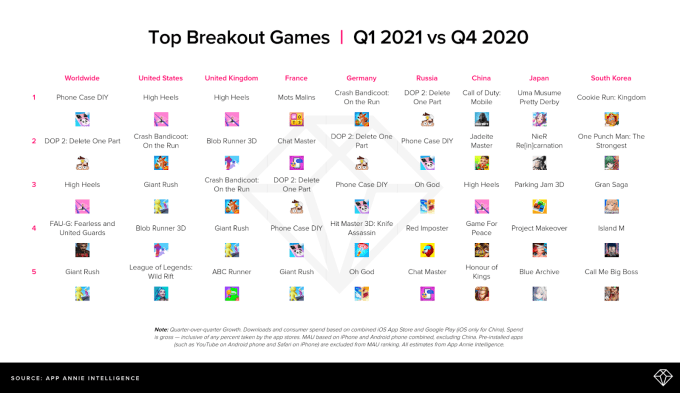
Image Credits: App Annie
TikTok’s influence on games was also apparent in the quarter. The game High Heels from Istanbul-based Rollic (now owned by Zynga), was heavily advertised on TikTok, sending the title to No. 1 in the U.S. and U.K.’s “breakout” games charts, as well as No. 3 in China, No. 7 in Germany, and No. 6 in Russia.
Other hyper-casual games did well, too, including Project Makeover, DOP 2: Delete One Part, and Phone Case DIY.
Crash Bandicoot: On the Run also broke out in the quarter. Despite launching on March 25, the game saw 21 million downloads in four days, becoming the top breakout app in Germany, No. 2 in the U.S., No. 3 in the U.K, and No. 9 in France.
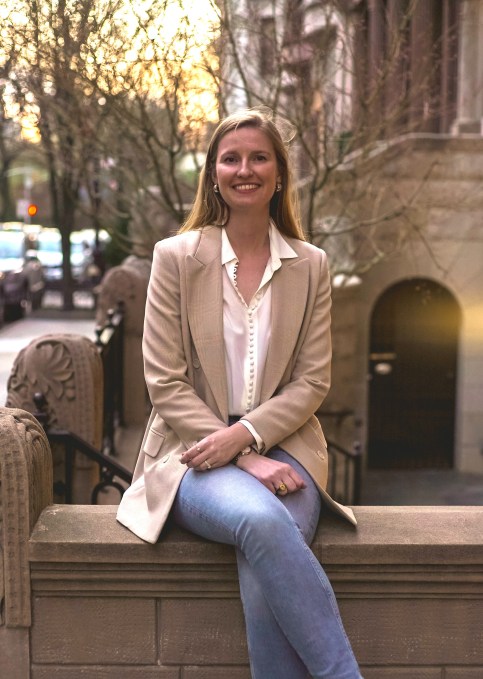
Realworld has a big vision — founder and CEO Genevieve Ryan Bellaire told me her goal is “simplifying adulthood.” And the New York startup has raised $3.4 million in seed funding to make it happen.
Apparently that’s something Ballaire struggled with herself in her early twenties. Despite being a lawyer with an MBA, she said she found herself “just totally unprepared for all these real world things,” whether that was figuring out housing or heath insurance — something I can definitely relate to.
“There’s tons of content out there out there that can tell you to fill out this form to sign up for a credit card, but you don’t know what you don’t know,” she said. “There’s not one place that defines adulthood.”
At the same time, there are online services that can make aspects of adulthood easier — whether that’s Lemonade for insurance, Betterment for investing or Zocdoc for doctor’s appointments. But again, finding these services and just knowing that you should use them can be a challenge, so Bellaire said Realworld is meant to serve as the “single point of entry.”
To do that, the startup has created more than 90 step-by-step playbooks, covering everything from budgeting to moving to salary negotiation. Bellaire said these are designed for members of Gen Z who are just leaving college and entering the workforce.
Realworld CEO Genevieve Ryan Bellaire
Of course, even if you focus on a specific age group, different twentysomethings will have different backgrounds, income levels and challenges. Bellaire said the playbooks will customize their instructions based on a user’s specific goals and circumstances, but she also argued that Realworld’s “starter pack” of 15 playbooks covers things that every adult will need to deal with in some form, such as creating budgets, finding an apartment and understanding income taxes.
The startup plans to release its first mobile app next month, and its goal is to become into Bellaire described as a “platform, marketplace and community.” The playbooks are a big piece of the platform, and eventually, Realworld could also include a marketplace for services that will help you accomplish those adulthood goals, as well as a community where users share their knowledge and advice.
Realworld initially charged for access to its playbooks, but they’re now available for free. Instead, Bellaire said the company could charge a subscription fee for additional features and for “concierge-oriented support.”
“This is one of those problems where if get it right, you can make a huge impact, but you can also have huge financial success,” she added.
It sounds like investors agree. Realworld had previously raised $1.1 million, and this new seed round was led by Fitz Gate Ventures, with participation from Bezos Expeditions (Jeff Bezos’ personal investment firm), Knightsgate Ventures, The Helm, Great Oaks VC, Copper Wire Ventures, AmplifyHer Ventures, Underdog Labs, Human Ventures and Techstars.
Amplifyher Partner Meghan Cross Breeden noted that Realworld could “corner the market on life milestones,” not just for Gen Z right now, but for “every future milestone … in the long-haul of adulthood, from buying a home to caring for a parent.”
Rocket Lab is preparing for its next launch, currently set to take place in May from its launch facility in New Zealand. The payload for the flight are two satellites to join BlackSky’s Earth observation constellation, but Rocket Lab has a secondary goal crucial to its aim of adding reusability to its Electron launch vehicle: Recovering the booster stage after its return from space.
This isn’t the first time Rocket Lab has done a booster recovery; last December, it fished one out of the sea following its aptly-named ‘Return to Sender’ mission. For this flight, dubbed ‘Running Out of Toes,’ the goal is roughly the same, but the Electron vehicle has some upgrades and modifications that will help Rocket Lab gather even more data, and make progress towards actually fully reusing one of these boosters once they get it back.
“We were very, very pleased with the condition of the [first] booster we got back with basically no modifications to any of the thermal protection systems,” Rocket Lab CEO and founder Peter Beck explained in an interview. “The way that we enter with the booster is obviously engines-first and propagate a big shockwave forward. This next flight is the next iteration where we’ve upgraded the heat shield to be able to actually carry those loads, because we know those loads now.”
Flight one provided plenty of valuable data about what the actual stresses were on the Electron booster during re-entry — information that engineers on the ground could make educated guesses about, but couldn’t actually really know without a real-world test. The data collected by sensors onboard the rocket during that December flight provided Rocket Lab the ability to redesign Electron’s heat shield for a “major increase in performance and strength,” according to Beck.
This second flight will test the efficacy of those improvements, and provide even more data to the Rocket Lab team, which will be used to inform the design of the third and final planned recovery test. That will focus on adjusting the re-entry procedure so that the Electron booster sheds even more of its speed while coming back into the atmosphere, which makes Rocket Lab’s final recovery steps — a parachute-assisted slowdown and a mid-air helicopter capture — more viable.
“There’ll be one other design iteration after this, where we will look to scrub even more velocity in the air for more heat off the stage, to get us to that point where it really is worth introducing the other elements of the helicopter to go and pick up a stage that we feel like we could go and re-fly,” Beck said.
That third and final splashdown test should happen sometime later this year, if all goes to plan. And while Rocket Lab doesn’t aim to actually re-fly any of the boosters from these three development tests, Beck told me that certain components from the first booster they got back have been re-integrated into this second test vehicle, and the plan is to recover and re-use even more parts for test #3.
Beck said that bringing the booster back to the Rocket Lab factory and essentially cutting it into tiny pieces is actually the best way for the company’s engineers to learn about what happens during re-entry, and what parts of the rocket are affected most.
“There’s nothing like putting a stage back in the factory to really understand,” he explained. “You can have all the instrumentation you want, but we brought that stage back here and the first thing we did is, we cut it up. We cut all the heat-affected areas, all of the areas that are in the shadow of flow, and then start doing tensile polls on them to understand the material properties.”
All of this work drives towards the end goal of re-flying a recovered Electron booster — which will be a major accomplishment not only because it should help Rocket Lab increase its launch pace, but also because the vehicle was never designed for reusability to begin with. I asked Beck whether that first re-flight of a recovered Electron will be a commercial mission, or just a test without a customer payload.
“I would imagine it would be a commercial mission, simply because we’re not going to put anything on the pad that we don’t have really high confidence in anyway,” he said. “I suspect the first reused vehicles will have quite a lot of refurbishment on them, because if you look at the only other company that has demonstrated reusability [SpaceX], it’s been many, many years of learning and understanding. You don’t just kind of grab a launch vehicle, say it looks good, put it back on the pad and fly again. It’s a very iterative process of building confidence and assurance.”
While introducing reusability to Electron has benefits in its own right for that launch vehicle, the process of developing that capability has also been invaluable for Rocket Lab’s efforts to build out its next spacecraft, the higher-capacity Neutron launch system, according to Beck. Neutron is designed to launch and land propulsively, and to include a lot more usability by design from the very start.
“Electron was designed to be the world’s most manufacturable launch vehicle — Neutron is designed to be the most reusable launch vehicle,” Beck said. “They’re very different paradigms, but unusually we now have experience in both. For Neutron, the innovation really is around reusability, and there’ll be some interesting bits shortly, when we we reveal a little bit more about the vehicle architecture, that will make it very obvious to what degree we’re going to make this a reusable launch vehicle.”
Samsung’s Galaxy SmartTag+, the company’s competitor to Apple’s forthcoming lost-item finder known as AirTags, has now arrived. Samsung had first announced its Tile competitor known as the Galaxy SmartTag, a Bluetooth-powered locator, during its press event in January. At the time, it teased that a ultra-wideband (UWB) powered version called the Galaxy SmartTag+ would arrive sometime later in the year, without giving a specific time frame.
Now it’s here. The newly launched iteration will offer support for both Bluetooth Low Energy (BLE) and UWB, and can be attached to the everyday items you want to keep track of — like backpacks or keychains, for example.
Like Apple’s rumored (and accidentally confirmed) AirTags, the SmartTag+ for Samsung device owners offers more precise finding capabilities because of its use of UWB technology, which the recently launched Galaxy SmartTag doesn’t include.
When items go missing, SmartTag+ users will be able to use AR technology to help locate the tags more easily using their Samsung phone, because of its spatial awareness capabilities. As you get closer to the tag’s location, you can also opt to have it make a loud ring — which can help if it’s fallen under something, like a sofa cushion.
Like Tile’s UWB device, SmartTag+ also supports a sort of community find type of feature where any nearby Galaxy device that’s opted in will be able to help locate lost items and notify their owners through the SmartThings Find network. Samsung says this data is encrypted so the tag’s location is only known to its owner.
But unlike the earlier SmartTag, which has expanded to include tags that come in pink and green, the SmartTag+ comes only in black and gray at launch.
Because the new beacons rely on UWB, Samsung says they will only work with Galaxy devices that include UWB technology, including the Galaxy Note20 Ultra, Galaxy S21+, Galaxy S21 Ultra, and Galaxy Z Fold2.
The SmartTag+’s arrival comes at a time when the lost item beacon market is poised for a shakeup.
Apple’s plans to enter this space, where today businesses like Tile dominate, could be fairly disruptive. Apple’s AirTags will leverage UWB to capture spatial and directional data, which will make finding lost items with the tags attached easier and more accurate. But AirTags will also integrate with Apple’s Find My app, which has now opened up to third-party manufacturers as of this week, including the makers of earbuds and e-bikes, among others.
Notably absent from that early lineup is Tile, which also has its own UWB tracker on the way. Tile doesn’t want to give up the customer relationship it has already established via its own app and hand that over to Apple instead, we understand. Instead, it plans to offer its own UWB tracker and AR finding features through its own iOS app.
Samsung, however, doesn’t have that issue as its first-party trackers are designed for its own devices. This SmartTag+ is basically the AirTag for Samsung owners, and if and when Apple launches its own beacons, the demand for the Android version could be impacted.
The company will begin to sell the new SmartTag+ on April 16th.
Samsung’s earlier Galaxy SmartTags cost $29.99. The new SmartTag+ are $10 more at $39.99 in the U.S.
Edraak, an online education nonprofit, exposed the private information of thousands of students after uploading student data to an unprotected cloud storage server, apparently by mistake.
The nonprofit, founded by Jordan’s Queen Rania and headquartered in the kingdom’s capital, was set up in 2013 to promote education across the Arab region. The organization works with several partners, including the British Council and edX, a consortium set up by Harvard, Stanford and MIT.
In February, researchers at U.K. cybersecurity firm TurgenSec found one of Edraak’s cloud storage servers containing at least tens of thousands of students’ data, including spreadsheets with students’ names, email addresses, gender, birth year, country of nationality and some class grades.
TurgenSec, which runs Breaches.UK, a site for disclosing security incidents, alerted Edraak to the security lapse. A week later, their email was acknowledged by the organization but the data continued to spill. Emails seen by TechCrunch show the researchers tried to alert others who worked at the organization via LinkedIn requests, and its partners, including the British Council.
Two months passed and the server remained open. At its request, TechCrunch contacted Edraak, which closed the servers a few hours later.
In an email this week, Edraak chief executive Sherif Halawa told TechCrunch that the storage server was “meant to be publicly accessible, and to host public course content assets, such as course images, videos, and educational files,” but that “student data is never intentionally placed in this bucket.”
“Due to an unfortunate configuration bug, however, some academic data and student information exports were accidentally placed in the bucket,” Halawa confirmed.
“Unfortunately our initial scan did not locate the misplaced data that made it there accidentally. We attributed the elements in the Breaches.UK email to regular student uploads. We have now located these misplaced reports today and addressed the issue,” Halawa said.
The server is now closed off to public access.
It’s not clear why Edraak ignored the researchers’ initial email, which disclosed the location of the unprotected server, or why the organization’s response was not to ask for more details. When reached, British Council spokesperson Catherine Bowden said the organization received an email from TurgenSec but mistook it for a phishing email.
Edraak’s CEO Halawa said that the organization had already begun notifying affected students about the incident, and put out a blog post on Thursday.
Last year, TurgenSec found an unencrypted customer database belonging to U.K. internet provider Virgin Media that was left online by mistake, containing records linking some customers to adult and explicit websites.
More from TechCrunch:
- U.S. charges California man over Shopify data breach
- MobiKwik investigating data breach after 100M user records found online
- FatFace tells customers to keep its data breach ‘strictly private’
- How Jamaica failed to handle its JamCOVID scandal
- Roll still doesn’t know how its hot wallet was hacked
Send tips securely over Signal and WhatsApp to +1 646-755-8849. You can also send files or documents using our SecureDrop. Learn more.


