& meet dozens of singles today!
User blogs

In a year marred by the coronavirus pandemic, it seems that early-stage startups on the African continent are continuing to see some notable growth, both in terms of their business and from investors looking to back them.
Microtraction, an early-stage venture capital firm based in Lagos, Nigeria, saw funding nearly quadruple for its portfolio.
In a review of the year published last week, the firm noted that 21 companies in its portfolio have raised more than $33 million in funding. This represents nearly four-fold growth over a year ago when its portfolio raised $6 million (and just $3 million in 2018). The companies’ combined valuation stands at over $147 million according to the firm.
Founded by Yele Badamosi in 2017, Microtraction arrived on the continent’s early-stage investment scene with all intent to be “the most accessible and preferred source of pre-seed funding for African tech entrepreneurs.”
Badamosi, who returned to Nigeria from the UK in 2015, worked as the general manager for Starta Africa, an online community for African tech entrepreneurs. After his stint there, he saw the need to plug the gap of early-stage funding in Nigeria and the continent at large with Microtraction.
Microtraction does not specify the size of its fund, but what is more clear is that it has attracted a great deal of attention and has built a strong network in part because of who backs it.
Michael Seibel, the CEO of Y Combinator, is a global advisor and an investor in the firm, and so is Andy Volk, the head of ecosystem for Google Sub-Saharan Africa. Other investors include Pave Investments and US-based angel investor, Chris Schultz.
Being entrepreneurs in the past, some of these investors know what it takes to build a startup in the U.S. But it’s completely different in Africa. With no on the ground know-how as to which startups to fund but an interest to do so, for portfolio diversification and other personal reasons, Microtraction and a few other early-stage investors present the best bets to accomplish this goal.
At first, Microtraction’s standard deal was to offer portfolio startups $15,000 in exchange for a 7.5% equity. But as a sign of how the market is firming up, that changed last year and now the firm invests $25,000 for 7% equity.
Microtraction revealed that it accepted over 500 applications from startups in Nigeria, Ghana, Zambia, and Mauritius in its first full year of operation. Though, just eight of those companies got investments.
The introductory batch was all Nigerian. Four fintech startups — Cowrywise, Riby, Wallets Africa, and ThankUCash; a crypto-exchange startup, BuyCoins; a SaaS platform, Accounteer; an edtech startup, Schoolable; and healthtech startup, 54gene.
2019 saw the local VC firm invest in six companies. This time there was a representative outside Nigeria — Ghanaian fintech startup, Bitsika. The Nigerian startups included social commerce startup, Sendbox; events startup, Festival Coins; communications-as-a-service platform, Termii. The rest were unannounced.
Half of its portfolio companies are backed by YC and other global accelerators
Last year (the one this latest review covers), Microtraction announced seven startups. The latest selection includes Nigerian fintech startups, Evolve Credit and Chaka; edtech startup, Gradely; bus-hailing platform, PlentyWaka; and Kenyan credit data marketplace, CARMA.
Of the total investments raised in 2019 and 2020, 54gene contributed more than half of those numbers by raising $4.5 million in seed and $15 million Series A investment. With an ingenious solution to solve the underrepresentation of African genomics data in global genomics research, 54gene got accepted into the winter batch in January 2019, the same month it officially launched.
Excluding 54gene, there were six other African-focused startups in the YC W19 batch. Two out of the six, Schoolable and Wallets Africa, were Microtraction portfolio companies. Others accepted into YC before and after included BuyCoins, Cowrywise, Termii, and two unannounced startups.
Microtraction-backed ThankUCash and a second unannounced startup have also joined cohorts at 500 Startups. On the other hand, Festival Coins is the only startup to be selected into Google for Startups Accelerator. With all accounted for, 11 out of the 21 startups are either backed by Y Combinator, 500 Startups, or Google for Startups.
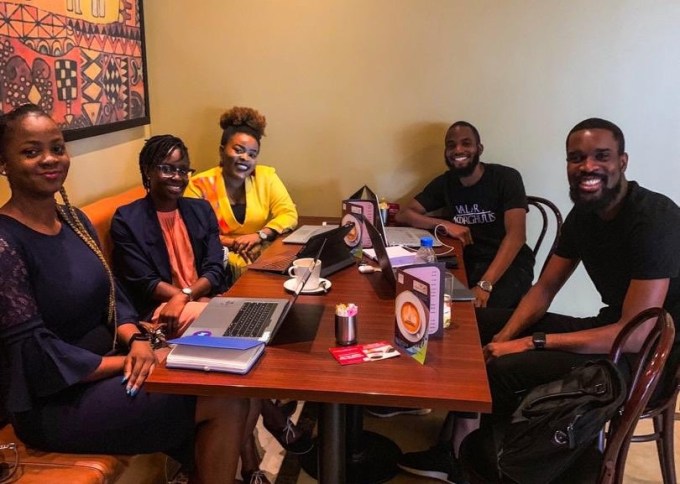
The Microtraction team with founding partner, Yele Badamosi (far right)
Getting into these global accelerators is a surefire way to receive follow-up investment, ranging from $125,000 to $150,000. From the outside in, startups see Microtraction and other early-stage VC firms like Ventures Platform as a means to that end. There have also been arguments that these firms build startups to be “YC or any global accelerator ready.”
However, Dayo Koleowo, a partner at Microtraction alongside Chidinma Iwueke, debunks it saying there’s no formula behind the numbers we see. He believes YC and other accelerators share the same fundamentals with Microtraction which revolves around the team, the market, and traction.
“We love super technical teams, understand the industry they are in and are likely to succeed without us. We are always looking for companies that are solving huge problems that a lot of people face,” he told TechCrunch. “Also, the tech and startup world moves fast, so we like teams that understand that and can show in real-time that they can execute. I believe that these global accelerators look for these same things.”
Typically, YC and other accelerators may perform extended due diligence and risk assessments before cutting cheques for any African startup without a local backer. Koleowo points out that this might be why Microtraction portfolio companies get accepted quicker. “The icing on the cake is that there is a level of de-risking that has been done by Microtraction and other local investors on the ground before these global accelerators step in,” he added.
That said, there’s no denying the significance of Microtraction’s advisory board in playing a part as to why half the firm’s portfolio are in global accelerators. Besides the names mentioned earlier, Lexi Novitske, PIO at Singularity Investments and Dotun Olowoporoku, managing partner at Starta act as regional advisors, and Monique Woodward, a venture partner at 500 Startups is a global advisor.
And with the growing trends of globalization, plus the acceptance of a more decentralised approach to building and operations in the tech industry because of COVID-19, it’s a trend that might continue for a while.
Here’s a bit of a curve ball from Apple. A month-and-a-half or so after launching the Fitness+ app premium workout service, the company’s offering up an add-on intended to offer an exercise dimension beyond the confines of iOS (and your living room). Arriving today for Fitness+ subscribers, Time to Walk is a new, guided walking tour hosted by a rotating cast of celebrity guests.
It’s a pretty diverse cast, as evidenced by the first round of names, which are dropping via a software update today. Included in the first five are Dolly Parton – who is probably about as universally beloved a celebrity as exists in 2021 – and Warriors power forward Draymond Green, who is no doubt a less universal, because, well, sports. Also included in the first round are musician Shawn Mendes and Orange is the New Black star Uzo Aduba.
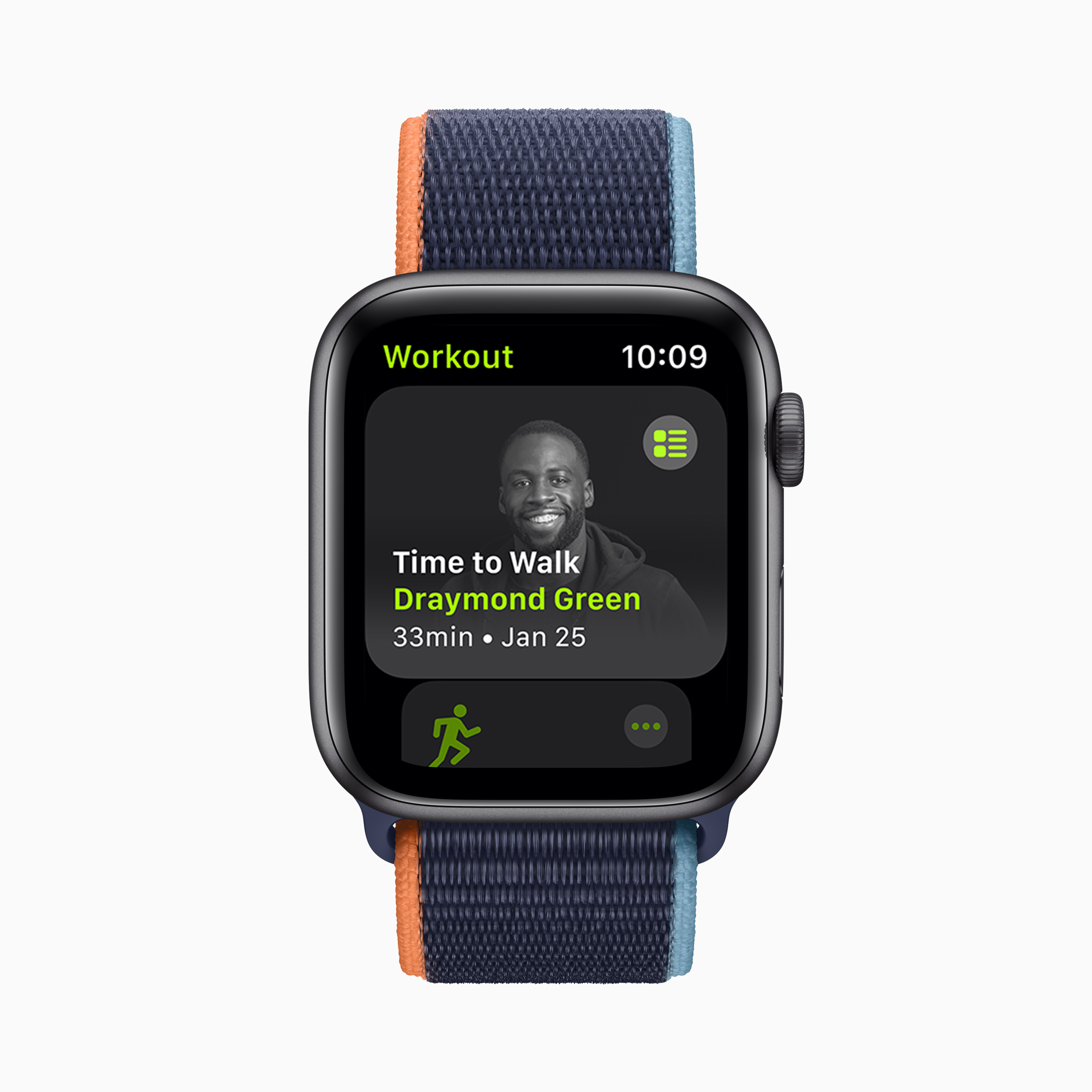
Image Credits: Apple
There are five episodes up front, which will be available as activity cards on the Apple Watch Workout app. In fact, they should start showing as cards in the app’s feed shortly. Going forward, they’ll be updated at a pace of one a week.
The experience is straightforward on the face of it. Essentially, Apple asks guests to record themselves on a walk, telling stories and sharing three songs. Music is played through the app and images are delivered to the small screen in an effort to build a semi-immersive (but not distracting) accompaniment for your own walk. You can save the songs on an Apple Music playlist or save the episode for later, if you want to listen again. For those who utilize wheelchairs for mobility, the feature will appear as “Time to Push,” which builds on top of the wheelchair-based fitness tracking Apple introduced several year back.
An Apple Fitness+ subscription is required to follow along. That’s due, in part, to a deeper integration with the premium fitness service. Both are also tied directly into other Apple services, like Music, which the company has made a kind of foundational element of its workouts.
I’ve always been a big walker — trying to avoid driving or public transit when time and distance allow. But the past year has really prioritized the activity for me as both an excuse to leave my one-bedroom apartment and way to get a workout in with all of the gyms closed for months on end. It is, frankly, a pretty big factor in keeping me going throughout the pandemic.
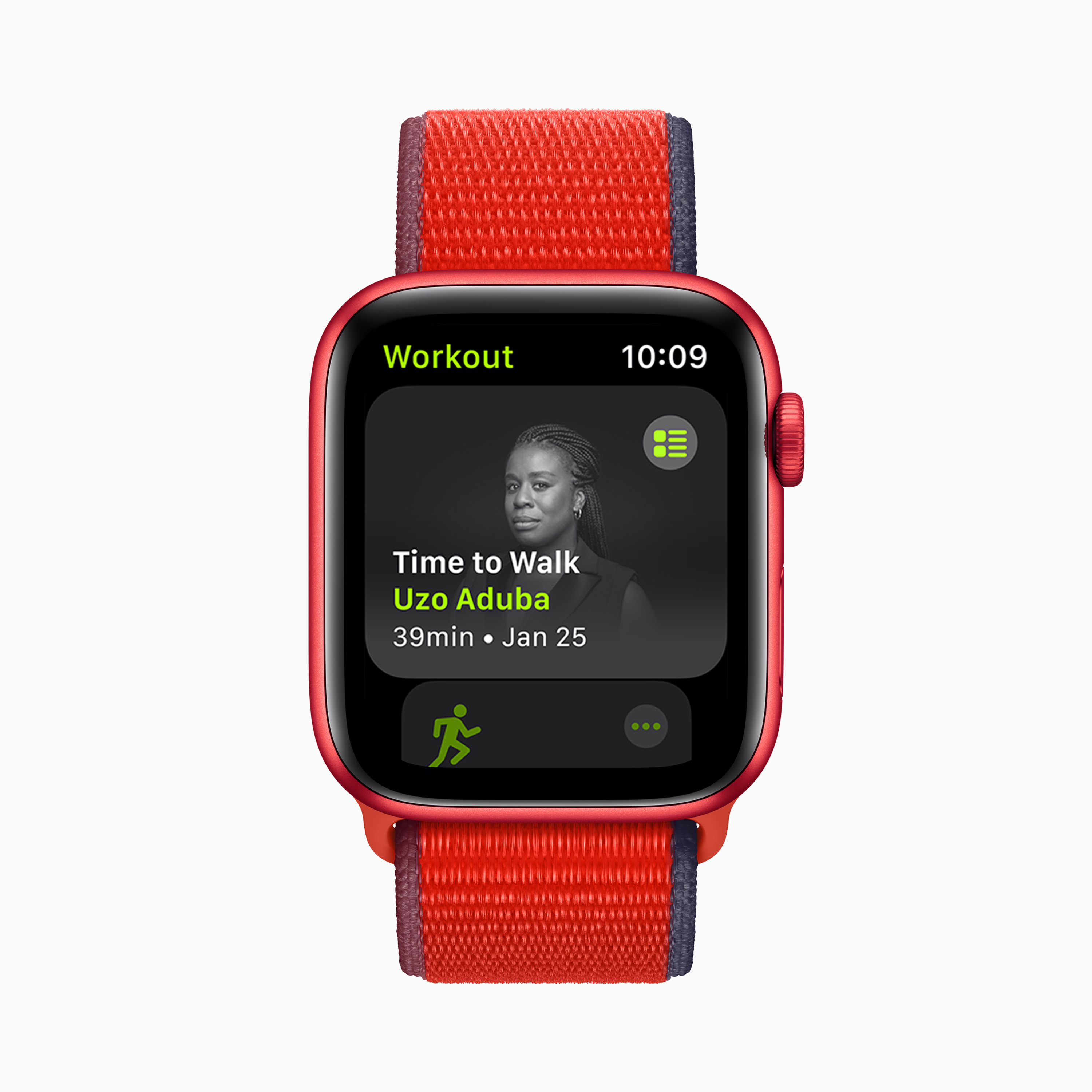
Image Credits: Apple
When I walk, I do so with music or podcasts. I’ve tried some “walking meditations” in the past, but found that the experiences have revolved around notions of “quiet reflection,” which doesn’t quit do the trick when you’re walking over the 59th street bridge into midtown Manhattan. Time to Walk turns the idea on its head a bit, by approximating the experience of walking along with someone. As they walk, they relate a kind of stream-of-consciousness, relating often personal stories in the process. The idea of course, being that walking is a head-clearing tool for many — creatives especially.
“Walking is the most popular physical activity in the world, and one of the healthiest things we can do for our bodies. A walk can often be more than just exercise: It can help clear the mind, solve a problem, or welcome a new perspective,” Apple’s Jay Blahnik said in a release. “Even throughout this challenging period of time, one activity that has remained available to many is walking. With Time to Walk, we’re bringing weekly original content to Apple Watch in Fitness+ that includes some of the most diverse, fascinating, and celebrated guests offering inspiration and entertainment to help our users keep moving through the power of walking.”
Like Fitness+ before it, the new feature is well-timed, as many parts of the world (the U.S. in particular) are still very much in the throes of pandemic-fueled shutdowns. It seems there’s a new story about a new potential mutation warning us off the sorts of things we used to do every day. Time to Walk is an effort to give you some interesting company for those walks.
Moderna has detailed some of the steps it’s taking to ensure that its vaccine remains effective in the face of emerging strains of the SARS-CoV-2 virus that leads to COVID-19. These include testing how adding a second booster, for a total of three shots, works with its existing COVID-19 vaccine, and also developing a strain-specific variant designed to target spike proteins on the new variants of the virus that were first identified in the UK and in South Africa.
The company is pursuing these measures “out of an abundance of caution,” the biotech firm said in a press release, since early studies show that the existing vaccine continues to prove effective against these new strains, albeit with some loss of efficacy specifically with the B.1.351 variant which was first identified in patients in South Africa. Even so, it’s heartening to see the company moving quickly to address the virus’ mutation, since it’s likely that similar adaptations will be required longer term to keep COVID-19 in control even once the current pandemic is ended.
Further, Moderna says that in fact, it expects both its forthcoming candidate and its existing booster vaccine should be able to provide additional immunity posting capabilities when used in combination with “all of the leading vaccine candidates” on the market. That means the company believes it could be used in combination with the Oxford or Pfizer/BioNTech vaccines to boost immunity, which could be helpful in cases where supplies of one or the other are low and there’s an urgent need to provide a booster in a timely manner.
The best news of all of this is, of course, that Moderna now has evidence that suggests the mRNA-based vaccine it’s already providing to people globally will still provide protection against SARS-CoV-2, and by extension, COVID-19. Specifically for the UK variant in particular, the study data shows no reduction in immune performance in patients who received the vaccine. As for the South African variant, that reduction in efficacy mostly translates to a potential of quicker waning of immunity provided by the jab – which hopefully just means people will need another jab sooner than expected, but shouldn’t lead to any dramatic changes in our combined global approach to providing inoculations, especially initially.
A third class action lawsuit has been filed in Europe against Apple seeking compensation — for what Italy’s Altroconsumo consumer protection agency dubs “planned obsolescence” of a number of iPhone 6 models.
The action relates to performance throttling Apple applied several years ago to affected iPhones when the health of the device’s battery had deteriorated — doing so without clearly informing users. It later apologized.
The class action suit in Italy is seeking €60M in compensation — based on at least €60 in average compensation per iPhone owner. Affected devices named in the suit are the iPhone 6, 6S, 6 Plus and 6S Plus, per a press release put out by the umbrella consumer organization, Euroconsumers, which counts Altroconsumo a a member.
The suit is the third to be filed in the region over the issue — following suits filed in Belgium and Spain last month.
A fourth — in Portugal — is slated to be filed shortly.
The tech giant settled similar charges in the US last year — where it was accused of intentionally slowing down the performance of older iPhones to encourage customers to buy newer models or fresh batteries — shelling out $500M, or around $25 per phone, to settle that case (while denying any wrongdoing).
“When consumers buy Apple iPhones, they expect sustainable quality products. Unfortunately, that is not what happened with the iPhone 6 series. Not only were consumers defrauded, and did they have to face frustration and financial harm, from an environmental point of view it is also utterly irresponsible,” said Els Bruggeman, Euroconsumers’ head of policy and enforcement, in a statement.
“This new lawsuit is the latest front in our fight against planned obsolescence in Europe. Our ask is simple: American consumers received compensation, European consumers want to be treated with the same fairness and respect.”
Euroconsumers has produced a video (embedded below) to drum up wider support for the class actions in which it satirizes Apple’s “genius” in coming up with clever ways to accelerate its products’ end of life…
Apple has been contacted for comment on the European class actions.
Almost a year ago the company was fined €25M by France’s competition watchdog over an iOS update that capped performance of aging devices. It was also made to display a statement regarding the action on its website for a month.
TikTok has until Friday to respond to an order by Italy’s data protection agency to block users whose age it cannot verify, TechCrunch has learned.
The GPDP made an ‘immediate’ order Friday in response to the death of a 10-year-old girl from Palermo who died of asphyxiation after participating in a ‘blackout challenge’ on the social network, according to reports in local media.
The agency said the ban would remain place until February 15 — suggesting it would make another assessment about any additional action at that point.
At the time of writing it does not appear that TikTok has taken action to comply with the GPDP’s order.
A spokeswoman told us it is reviewing the notification. “We have received and are currently reviewing the notification from Garante,” she said. “Privacy and safety are top priorities for TikTok and we are constantly strengthening our policies, processes and technologies to protect all users, and our younger users in particular.”
The GPDP had already raised concerns about children’s privacy on TikTok, warning in December that its age verification checks are easily circumvented and raising objections over default settings that make users’ content public. On December 22 it also announced it had opened a formal procedure — giving TikTok 30 days to respond.
The order to block users whose age it cannot verify is in addition to that action. If TikTok does not comply with the GPDP’s administrative order it could face enforcement from the Italian agency, drawing on penalty powers set out in the GDPR.
TikTok’s spokeswoman declined to answer additional questions about the order — which prohibits it from further processing user data “for whom there is no absolute certainty of age”, per GPDP’s press release Friday.
The company also did not respond when we asked if it had submitted a response to the agency’s formal procedure.
In a statement last week following the girl’s death the company said: “Our deepest sympathies are with the girl’s family and friends. At TikTok, the safety of our community — in particular our younger users — is our priority, and we do not allow content that encourages, promotes, or glorifies dangerous behaviour that might lead to injury. We offer robust safety controls and resources for teens and families on our platform, and we regularly evolve our policies and protections in our ongoing commitment to our community.”
TikTok has said it has found no evidence of any challenge involving asphyxiation on its platform.
Although, in recent years, there have been a number of previous reports of underage users hanging themselves (or attempting to) after trying to copy things they saw on the platform.
Users frequently create and respond to content challenges, as part of TikTok’s viral appeal — such as (recently) a trend for singing sea shanties.
At the time of writing, a search on the platform for ‘#blackoutchallenge’ returns no user content but displays a warning that the phrase “may be associated with behavior or content that violates our guidelines”.
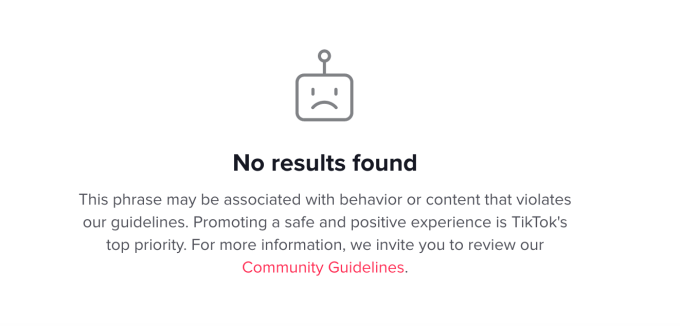
Screengrab of the warning users see if they search for ‘blackout challenge’ (Image credit: TechCrunch)
There have been TikTok challenges related to ‘hanging’ (as in people hanging by parts of their body other than their neck from/off objects) — and a search for #hangingchallenge does still return results (including some users discussing the death of the 10-year-old girl).
Last year a number of users also participated in an event on the platform in which they posted images of black squares — using the hashtag #BlackOutTuesday — which related to Black Lives Matters protests.
So the term ‘blackout’ has similarly been used on TikTok in relation to encouraging others to post content. Though not in that case in relation to asphyxiation.
Ireland’s Data Protection Commission, which has been lined up as TikTok’s lead data supervisor in Europe — following the company’s announcement last year that its Irish entity would take over legal responsibility for processing European users’ data — does not have an open inquiry into the platform “at present”, per a spokesman.
But TikTok is already facing a number of other investigations and legal challenges in Europe, including an investigation into how the app handles users data by France’s watchdog CNIL — announced last summer.
In recent years, France’s CNIL has been responsible for handing out some of the largest penalties for tech giants for infringing EU data protection laws (including fines for Google and Amazon).
In December, it also emerged that a 12-year-old girl in the UK is bringing a legal challenge against TikTok — claiming it uses children’s data unlawfully. A court ruled she can remain anonymous if the case goes ahead.
Last month Ireland’s data protection regulator put out draft guidelines on what it couched as “the Fundamentals for a Child-Oriented Approach to Data Processing” — with the stated aim of driving improvements in standards of data processing related to minors.
While the GDPR typically requires data protection complaints to be funnelled through a lead agency, under the one-stop-shop mechanism, Italy’s GPDP’s order to TikTok to cease processing is possible under powers set out in the regulation (Article 66) that allow for ‘urgency procedures’ to be undertaken by national watchdogs in instances of imperative risk.
Although any such provisional measures can only last for three months — and only apply to the country where the DPA has jurisdiction (Italy in this case). Ireland’s DPC would be the EU agency responsible for leading any resulting investigation.


