& meet dozens of singles today!
User blogs

Tesla is open to licensing its software, including its Autopilot highly-automated driving technology and the neural network training it has built to improve its autonomous driving technology. Tesla CEO Elon Musk revealed those considerations on the company’s Q4 earnings call on Wednesday, adding that the company has in fact already “had some preliminary discussions about licensing Autopilot to other OEMs.”
The company began rolling out its beta version of the so-called ‘full self-driving’ or FSD version of Autopilot late last year. The standard Autopilot features available in general release provide advanced driver assistance (ADAS) which provide essentially advanced cruise control capabilities designed primarily for use in highway commutes. Musk said on the call that he expects the company will seek to prove out its FSD capabilities before entering into any licensing agreements, if it does end up pursuing that path.
Musk noted that Tesla’s “philosophy is definitely not to create walled gardens” overall, and pointed out that the company is planning to allow other automakers to use its Supercharger networks, as well as its autonomy software. He characterized Tesla as “more than happy to license” those autonomous technologies to “other car companies,” in fact.
One key technical hurdle required to get to a point where Tesla’s technology is able to demonstrate true reliability far surpassing that of a standard human driver is transition the neural networks operating in the cars and providing them with the analysis that powers their perception engines is to transition those to video. That’s a full-stack transition across the system away from basing it around neural nets trained on single cameras and single frames.
To this end, the company has developed video-labelling software that has had “a huge effect on the efficiency of labeling,” with the ultimate aim being enabling automatic labeling. Musk (who isn’t known for modesty around his company’s achievements, it should be said) noted that Tesla believes “it may be the best neural net training computer in the world by possibly an order of magnitude,” adding that it’s also “something we can offer potentially as a service.”
Training huge quantities of video data will help Tesla push the reliability of its software from 100% that of a human driver, to 200% and eventually to “2,000% better than the average human,” Musk said, while again suggesting that it won’t be a technological achievement the company is interested into keeping to themselves.
Tesla CEO Elon Musk said on the company’s 2020 Q4 earnings call that all engineering work is now complete on the Tesla Semi, the freight-hauling semi truck that the company is building with an all-electric powertrain. The company expects to begin deliveries of Tesla Semi this year, the company said in its Q4 earnings release, and Musk said the only thing limiting their ability to produce them now is the availability of battery cells.
“The main reason we have not accelerated new products – like for example Tesla Semi – is that we simply don’t have enough cells for it,” Musk said. “If we were to make the Semi right now, and we could easily go into production with the Semi right now, but we would not have enough cells for it.”
Musk added that the company does expect to have sufficient cell volume to meet its needs once it goes into production on its 4680 battery pack, which is a new custom cell design it created with a so-called ‘tables’ design that allows for greater energy density and therefore range.
“A Semi would use typically five times the number of cells that a car would use, but it would not sell for five times what a car would sell for, so it kind of would not make sense for us to do the Semi right now,” Musk said. “But it will absolutely make sense for us to do it as soon as we can address the cell production constraint.”
That constraint points to the same conclusion for the possibility of Tesla developing a van, Musk added, and the lifting of the constraint will likewise make it possible for Tesla to pursue the development of that category of vehicle, he said.
Tesla has big plans for “exponentially” ramping cell production, with a goal of having production capacity infrastructure in place for a Toal of 200 gigawatt hours per year by 2022, and a target of being able to actually produce around 40% of that by that year (with future process improvements generating additional gigawatt hours of cell capacity in gradual improvements thereafter).
The man behind a once-influential pro-Trump account is facing charges of election interference for allegedly disseminating voting disinformation on Twitter in 2016.
Federal prosecutors allege that Douglass Mackey, who used the name “Ricky Vaughn” on Twitter, encouraged people to cast their ballot via text or on social media, effectively tricking others into throwing away those votes.
According to the Justice Department, 4,900 unique phone numbers texted a phone number Mackey promoted in order to “vote by text.” BuzzFeed reported the vote-by-text scam at the time, noting that many of the images were photoshopped to look like official graphics from Hillary Clinton’s presidential campaign.
Twitter just informed me that attempting to disenfranchise voters is not a violation of their Terms of Service. @jack @Support pic.twitter.com/YXVdt8sHwA
— Robert McNees (@mcnees) November 2, 2016
Some of those images appeared to specifically target Black and Spanish-speaking Clinton supporters, a motive that tracks with the account’s track record of white supremacist and anti-Semitic content. The account was suspended in November 2016.
At the time, the mysterious account quickly gained traction in the political disinformation ecosystem. HuffPost revealed that the account was run by Mackey, the son of a lobbyist, two years later.
“… His talent for blending far-right propaganda with conservative messages on Twitter made him a key disseminator of extremist views to Republican voters and a central figure in the alt-right’ white supremacist movement that attached itself to Trump’s coattails,” HuffPost’s Luke O’Brien reported.
Mackey, a West Palm Beach resident, was taken into custody Wednesday in Florida.
“There is no place in public discourse for lies and misinformation to defraud citizens of their right to vote,” Acting U.S. Attorney for the Eastern District of New York Seth D. DuCharme said.
“With Mackey’s arrest, we serve notice that those who would subvert the democratic process in this manner cannot rely on the cloak of Internet anonymity to evade responsibility for their crimes.”
Tesla is open to licensing its software, including its Autopilot highly-automated driving technology, and the neural network training it has built to improve its autonomous driving technology. Tesla CEO Elon Musk revealed those considerations on the company’s Q4 earnings call on Wednesday, adding that the company has in fact already “had some preliminary discussions about licensing Autopilot to other OEMs.”
The company began rolling out its beta version of the so-called ‘full self-driving’ or FSD version of Autopilot late last year. The standard Autopilot features available in general release provide advanced driver assistance (ADAS) which provide essentially advanced cruise control capabilities designed primarily for use in highway commutes. Musk said on the call that he expects the company will seek to prove out its FSD capabilities before entering into any licensing agreements, if it does end up pursuing that path.
Musk noted that Tesla’s “philosophy is definitely not to create walled gardens” overall, and pointed out that the company is planning to allow other automakers to use its Supercharger networks, as well as its autonomy software. He characterized Tesla as “more than happy to license” those autonomous technologies to “other car companies,” in fact.
One key technical hurdle required to get to a point where Tesla’s technology is able to demonstrate true reliability far surpassing that of a standard human driver is transition the neural networks operating in the cars and providing them with the analysis that powers their perception engines is to transition those to video. That’s a full-stack transition across the system away from basing it around neural nets trained on single cameras and single frames.
To this end, the company has developed video labelling software that has had “a huge effect on the efficiency of labeling,” with the ultimate aim being enabling automatic labeling. Musk (who isn’t known for modesty around his company’s achievements, it should be said) noted that Tesla believes “it may be the best neural net training computer in the world by possibly an order of magnitude,” adding that it’s also “something we can offer potentially as a service.”
Training huge quantities of video data will help Tesla push the reliability of its software from 100% that of a human driver, to 200% and eventually to “2,000% better than the average human,” Musk said, while again suggesting that it won’t be a technological achievement the company is interested into keeping to themselves.
Tesla just released its latest earnings report, and the results indicate that Elon Musk’s bets on energy storage and solar are beginning to pay off.
The storage business was the star of the company’s power plays in the fourth quarter, with quarterly year-on-year growth approaching 200%. As the company said in its presentation to shareholders, “[energy] deployments grew substantially from 2019 to 2020. For the first time, our total battery deployments surpassed 3 GWh in a single year, which is an 83% increase compared to the prior year.
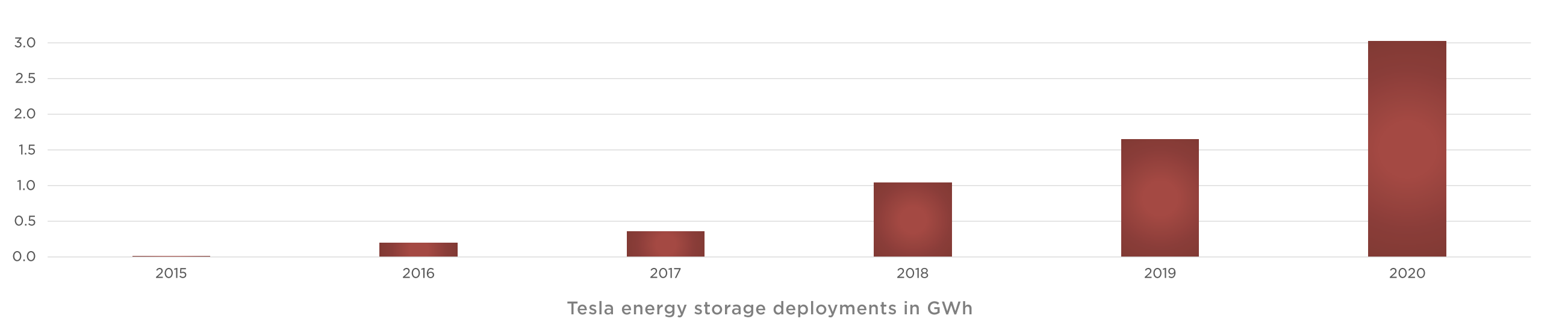
Solar deployments also had their day in the sun. For the year, solar energy installations increased to 205 MW, an 18% increase over the prior year. “This growth is the result of meaningful improvements to our solar retrofit strategy, including product simplification, cost reduction and industry-leading pricing.
Revenue from the energy generation and storage business came in at $752 million for the fourth quarter, up from $436 million in the year-ago period, and up $579 million from the third quarter.
This is likely only the beginning of the surge that’s coming for Tesla’s power business. The company has long stated that it wants to be one of the world’s largest power or utility companies, and global capital is marshaling resources to encourage the shift to renewables.
Tesla could be a huge beneficiary from the Biden administration’s renewable plans through their goals to dramatically boost solar development and buildings. The big infrastructure spend will require big batteries to store renewable power. It will also require massive solar installations.
And even as the federal government makes money moves to renewables, private capital is coming in to boost solar installations and energy storage dramatically.
Over the last week alone, investors have pumped nearly $2 billion into companies that lend money to homeowners for solar installations and energy efficiency upgrades. One company, founded by a former SolarCity executive, announced that it had raised $800 million in capital just today.
At least some of that money will have cash registers ringing for Tesla’s energy storage and solar installation business.
Source: https://techcrunch.com/2021/01/27/teslas-power-businesses-are-beginning-to-take-off/


