& meet dozens of singles today!
User blogs

Hundreds of Android apps, far more than previously disclosed, have sent granular user location data to X-Mode, a data broker known to sell location data to U.S. military contractors.
The apps include messaging apps, a free video and file converter, several dating sites, and religion and prayer apps — each accounting for tens of millions of downloads to date, according to new research.
Sean O’Brien, principal researcher at ExpressVPN Digital Security Lab, and Esther Onfroy, co-founder of the Defensive Lab Agency, found close to 200 Android apps that at some point over the past year contained X-Mode tracking code.
Some of the apps were still sending location data to X-Mode as recently as December when Apple and Google told developers to remove X-Mode from their apps or face a ban from the app stores.
But weeks after the ban took effect, one popular U.S. transit map app that had been installed hundreds of thousands of times was still downloadable from Google Play even though it was still sending location data to X-Mode.
The new research, now published, is believed to be the broadest review to date of apps that collaborate with X-Mode, one of dozens of companies in a multibillion-dollar industry that buys and sells access to the location data collected from ordinary phone apps, often for the purposes of serving targeted advertising.
But X-Mode has faced greater scrutiny for its connections to government work, amid fresh reports that U.S. intelligence bought access to commercial location data to search for Americans’ past movements without first obtaining a warrant.
X-Mode pays app developers to include its tracking code, known as a software development kit, or SDK, in exchange for collecting and handing over the user’s location data. Users opt-in to this tracking by accepting the app’s terms of use and privacy policies. But not all apps that use X-Mode disclose to their users that their location data may end up with the data broker or is sold to military contractors.
X-Mode’s ties to military contractors (and by extension the U.S. military) was first disclosed by Motherboard, which first reported that a popular prayer app with more than 98 million downloads worldwide sent granular movement data to X-Mode.
In November, Motherboard found that another previously unreported Muslim prayer app called Qibla Compass sent data to X-Mode. O’Brien’s findings corroborate that and also point to several more Muslim-focused apps as containing X-Mode. By conducting network traffic analysis, Motherboard verified that at least three of those apps did at some point send location data to X-Mode, although none of the versions currently on Google Play do so. You can read Motherboard’s full story here.
X-Mode’s chief executive Josh Anton told CNN last year that the data broker tracks 25 million devices in the U.S., and told Motherboard its SDK had been used in about 400 apps.
In a statement to TechCrunch, Anton said:
“The ban on X-Mode’s SDK has broader ecosystem implications considering X-Mode collected similar mobile app data as most advertising SDKs. Apple and Google have set the precedent that they can determine private enterprises’ ability to collect and use mobile app data even when a majority of our publishers had secondary consent for the collection and use of location data.
We’ve recently sent a letter to Apple and Google to understand how we can best resolve this issue together so that we can both continue to use location data to save lives and continue to power the tech communities’ ability to build location-based products. We believe it’s important to ensure that Apple and Google hold X-Mode to the same standard they hold upon themselves when it comes to the collection and use of location data.”
The researchers also published new endpoints that apps using X-Mode’s SDK are known to communicate with, which O’Brien said he hoped would help others discover which apps are sending — or have historically sent — users’ location data to X-Mode.
“We hope consumers can identify if they’re the target of one of these location trackers and, more importantly, demand that this spying end. We want researchers to build off of our findings in the public interest, helping to shine light on these threats to privacy, security, and rights,” said O’Brien.
TechCrunch analyzed the network traffic on about two-dozen of the most downloaded Android apps in the researchers’ findings to look for apps that were communicating with any of the known X-Mode endpoints, and confirmed that several of the apps were at some point sending location data to X-Mode.
We also used the endpoints identified by the researchers to look for other popular apps that may have communicated with X-Mode.
At least one app identified by TechCrunch slipped through Google’s app store ban.
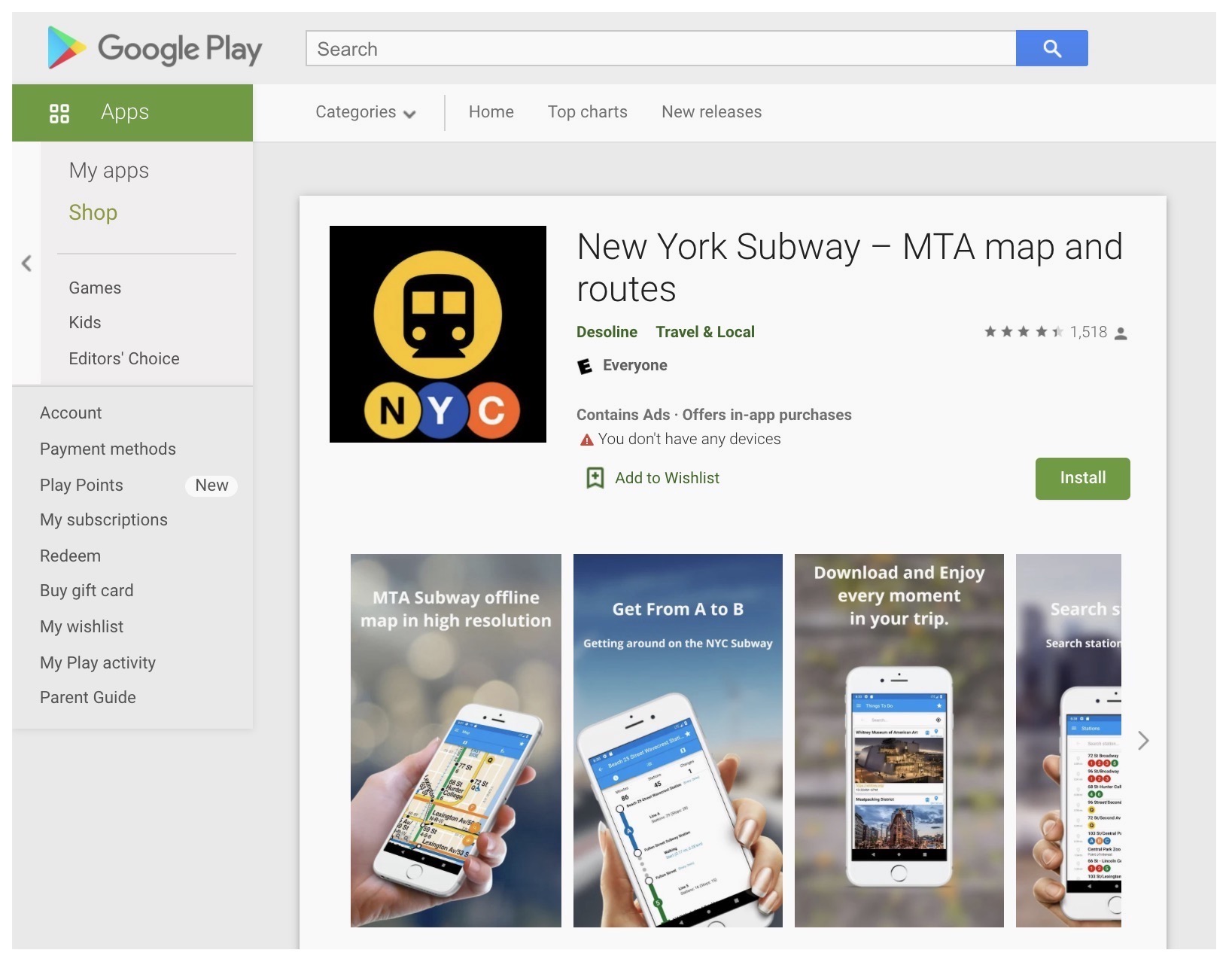
New York Subway in Google Play., until it was removed by Google. (Image: TechCrunch)
New York Subway, a popular app for navigating the New York City subway system that has been downloaded 250,000 times, according to data provided by Sensor Tower, was still listed in Google Play as of this week. But the app, which had not been updated since the app store bans were implemented, was still sending location data to X-Mode.
As soon as the app loads, a splash screen immediately asks for the user’s consent to send data to X-Mode for ads, analytics and market research, but the app did not mention X-Mode’s government work.
Desoline, the Israel-based app maker, did not respond to multiple requests for comment, but removed references to X-Mode from its privacy policy a short while after we reached out. At the time of writing, the app has not returned to Google Play.
A Google spokesperson confirmed the company removed the app from Google Play.
Using the researchers’ list of apps, TechCrunch also found that previous versions of two highly popular apps, Moco and Video MP3 Converter, which account for more than 115 million downloads to date, are still sending user location data to X-Mode. That poses a privacy risk to users who install Android apps from outside Google Play, and those who are running older apps that are still sending data to X-Mode.
Neither app maker responded to a request for comment. Google would not say if it had removed any other apps for similar violations or what measures it would take, if any, to protect users running older app versions that are still sending location data to X-Mode.
None of the corresponding and namesake apps for Apple’s iOS that we tested appeared to communicate with X-Mode’s endpoints. When reached, Apple declined to say if it had blocked any apps after its ban went into effect.
Read more on TechCrunch
“The sensors in smartphones provide rich data that can be exploited to limit our movements, our free expression, and our autonomy,” said O’Brien. “Location spying poses a serious threat to human rights because it peers into the most sensitive aspects of our lives and who we associate with.”
The newly published research is likely to bring fresh scrutiny to how ordinary smartphone apps are harvesting and selling vast amounts of personal data on millions of Americans, often without the user’s explicit consent.
Several federal agencies, including the Internal Revenue Service and Homeland Security, are under investigation by government watchdogs for buying and using location data from various data brokers without first obtaining a warrant. Last week it emerged that intelligence analysts at the Defense Intelligence Agency buy access to commercial databases of Americans’ location data.
Critics say the government is exploiting a loophole in a 2018 Supreme Court ruling, which stopped law enforcement from obtaining cell phone location data directly from the cell carriers without a warrant.
Now the government says it doesn’t believe it needs a warrant for what it can buy directly from brokers.
Sen. Ron Wyden, a vocal privacy critic whose office has been investigating the data broker industry, previously drafted legislation that would grant the Federal Trade Commission new powers to regulate and fine data brokers.
“Americans are sick of learning that their location data is being sold by data brokers to anyone with a credit card. Industry self-regulation clearly isn’t working — Congress needs to pass tough legislation, like my Mind Your Own Business Act, to give consumers effective tools to prevent their data being sold and to give the FTC the power to hold companies accountable when they violate Americans’ privacy,” said Wyden.
Send tips securely over Signal and WhatsApp to +1 646-755-8849. You can also send files or documents with SecureDrop.
Source: https://techcrunch.com/2021/01/28/x-mode-location-google-apple-ban/


As we move deeper into a cloud-centric world, everything was supposed to get easier, but in truth there’s a lot of moving parts, and companies need help getting everything to work. This takes people with a particular set of skills to help clients with tasks like integrations, managing hybrid and multi-cloud environments and getting data where you need it.
Tecera, a new venture capital firm launching today wants to attack this problem by investing in companies that can act as helpers and consultants. In a world where venture capital tends to gravitate mostly towards software and hardware, this is a distinctly different investment thesis.
Chris Barbin, founder and CEO at Tecera knows quite a bit about this. He was one of the founders at Appirio, a consulting firm founded way back in 2006 when cloud computing as we know it today was just getting off the ground. His former company had the vision and the foresight to start a firm to help companies use new tools like Salesforce, Google, Workday and AWS. Wipro bought the company in 2016 for $500 million after it had raised over $117 million, according to Crunchbase data.
Barbin believes that today, the level of complexity has only increased, and there will be a growing need for what he calls this people power to make everything work, and that takes a specialized kind of investor. “There’s been a flurry of investment activity into professional services-based companies over the last couple of years, but there’s never been an investment firm that is exclusively focused on these types of businesses,” Barbin explained.
During the firm’s research phase, the founders identified key platform companies like Salesforce, Twilio, Snowflake, DataDog and Cloudflare, and they estimate that there are between 7500 and 10,000 consulting companies supporting companies like this. “The goal of the firm is to help create a kind of a powerhouse for those emerging [platforms], or a firm or two that actually has the collection of those [SaaS platforms] in their toolkit,” he said.
The company will be targeting established firms with revenue between $5 and $20 million with aspirations to grow into the hundreds of millions, and will be doling out investments of between $5 and 20 million of capital per bet.
The firm is just getting started, but plans to have 8 employees by mid-year. Barbin indicated at least one investment was already in the pipeline, but wasn’t ready to give details just yet.
Source: https://techcrunch.com/2021/01/28/tecera-launches-with-225m-to-fund-cloud-consulting-firms/
New wellness startup Heights is formally launching this week, focusing on a category it describes as ‘braincare’. The startup will market “ultra high quality, sustainable plant-based supplements that feed your brain” based on what it says is scientific data.
It has raised a $2 million Seed funding round (£1.7M) via the Seedrs crowdfunding platform, with the round also including the institutional investor Forward Partners. Angel investors include Tom Singh (founder of New Look), Damian Bradfield (WeTransfer), Dhiraj Mukherjee (Shazam), Renee Elliot (Planet Organic), and celebrity investor Chris Smalling (an England and Manchester United professional footballer).
The funds will be used for customer growth and new product development, including soon-to-launch a ‘psychobiotic‘ probiotic aimed at cognition and mental health.
Customers first take a ‘brain health’ survey, then sign up for a monthly, quarterly, or annual subscription.
Customers need only take two capsules a day, thus hugely decreasing the complexity of juggling regular vitamin taking.
The product fits through a letterbox and the unusual bottle was designed by the well-known product design agency Pentagram. A content and coaching program included in the subscription helps customers, and another brain health survey happens after a month. Heights claims that “93%” improve their brain health score within one month.
Heights is not alone in this new market for what some describe as ‘designer vitamins’ and the arena is already populated by the likes of Hims / Hers, Motion, Vitabiotics and Bulletproof.
These companies broadly fall into the “Nootropics” category — vitamins and minerals designed to improve cognitive function, memory, creativity, or motivation, in healthy individuals. But the market is not small. The ‘self care’, ‘healthcare’, and ‘personal development’ market is worth over $1Trillion but supplements alone is worth at least $100BN+.
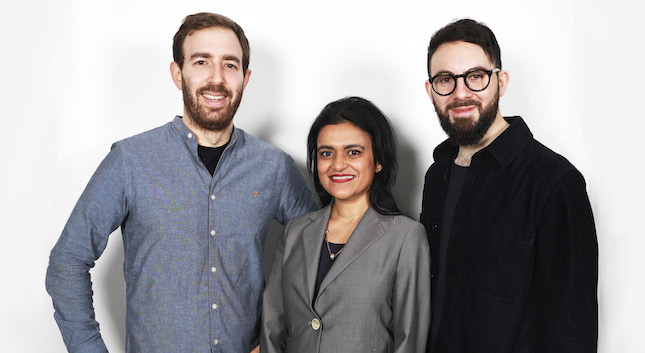
Heights founders Dan Murray-Serter and Joel Freeman, with adviser Dr. Tara Swart.
However, co-founder Dan Murray-Serter says Heights is aiming to do something different to the aforementioned players.
In a text-based interview, he said: “Nootropics as a category really focus on quick fixes, which is why we’re working on the category creation of ‘braincare’ because there are no ‘quick fixes’ in life, and that terminology and category have essentially set people up with the same false hopes as ‘get-rich-quick’ schemes do. We’re set up differently — aka, starting with scientifically researched articles and journal references.”
He said Heights will be positioned more like a skincare or haircare brand, “because people understand that the daily habit/practice is what creates the longevity and impact, not just a one-day miracle.”
Murray-Serter says there are 20 key nutrients science says our brains need to thrive, and these are mostly found in a combination of buying multivitamins, omega 3s, and ‘nootropics’. He says Heights has sourced the “highest quality” ingredients in the most ‘bioavailable form’ in a patented capsule which makes it easier to digest for the body.
“One of the most common reasons the habit of taking vitamins doesn’t stick for people is that the bottle goes into a cupboard and gets ignored. So we started with design alongside quality,” he says. The Heights vitamins come in a distinctive, recyclable bottle which Heights will also aven recycle if you send it back to them.
Murray-Serter, who previously founded the mobile startup Grabble, says he came up with the idea for the startup after a bout of chronic anxiety and a 6 month-long period of insomnia. The problem was solved by high-quality, high-density vitamins and supplements, as opposed to normal supplements which usually only have the lowest recommended daily levels of vitamins inside them.
After starting a newsletter on the subject of optimizing cognitive performance with cofounder Joel Freeman, the pair amassed a following of 60,000 readers www.yourheights.com/sundays
and then came up with the idea of launching the actual product.
The company now has a ‘Braincare‘ podcast that has reached 100,000 downloads, and the founders have also been joined by key team member Chief Science Officer, Dr Tara Swart (pictured).
Two things may help Heights. Firstly, in the era of Covid-19, public health authorities and governments around the world have recommended taking Vitamin D to boost the body’s immune system should someone fall prey to the disease. It’s not insignificant that two Heights capsules contain 400% of the ‘Nutrient Reference Value’ (formerly known as Recommended Daily Allowance) of Vitamin D3, as well as many other supplements. Theoretically, one could take four normal tablets of this, but the customer experience and other added vitamins in Heights will appeal to many. Secondly, the growing awareness of mental health and interest in maintaining good mental health is now a regular subject of public discourse. So Heights appears to be well-positioned to ride both those waves.
While the pandemic has left some startups strapped for cash, the aptly-named Brazilian neobank Nubank is swimming in it. This morning, the company announced that it has raised a $400 million Series G round, putting their total funding to date at $1.2 billion. But even more remarkable, in addition to their new $25 billion valuation (up from $10 billion in 2019), is their customer base of 34 million users, which they’ve built up since the fintech’s launch in 2013.
“We’ve gone from 12 million customers in 2019 to 34 million solely based on word of mouth,” said David Velez, the company’s co-founder and CEO. By September last year, the company was onboarding 41,000 new customers per day. NuBank prides itself on having a $0 customer acquisition cost. Velez said the startup spends what would be marketing money on “great salaries” and superior customer service, which in turn creates “fanatic” customers who share their love for the brand with others.
The new valuation places NuBank as the fourth most valuable financial institution in Latin America and the largest digital bank in the world by the number of customers and app downloads.
The round was led by both private and public investors including Singapore’s GIC, Whale Rock, and Invesco. Current investors Tencent, Dragoneer, Ribbit Capital, and Sequoia also participated in the round. Velez is a former Sequoia partner and is originally from Colombia though he attended Stanford University and worked in the U.S. for many years.
NuBank, based in São Paulo — the financial capital of Latin America and home to 12.8 million people — has expanded to Colombia and Mexico and plans to use the new funding to flesh out its operations in those markets while continuing to build out its product offerings in Brazil.
What started as a credit card company now functions as a full-service bank, minus the cumbersome bank branches, which is one way the company has been able to allocate its funding primarily toward growth.
“People were really done with being mistreated and paying high fees,” said Velez, speaking to Brazil’s notoriously bureaucratic and dreadful banking experience (liken it to going to the DMV, but regularly). Historically, to pay your monthly bills in Brazil, you had to go to a bank branch and wait in line — often outside in the heat — until it was your turn. The lines wrapped around the block like that of an Apple Store upon the release of the latest iPhone.
“It’s like they are doing you a favor by opening an account for you and then charging you 450% interest rate per year,” said Velez. “Our bet was that people would really like to be treated like humans,” he added.
In 1994, when the Brazilian real currency was introduced, it was pegged at 1:1 with the U.S. dollar. However, in recent years, with the country’s largest corruption scandal in history which saw three consecutive presidents jailed, impeached, and incriminated, respectively, the economy has plummeted. And COVID-19 certainly hasn’t helped. The exchange rate is now 1 USD to 5.40 BRL. With low exchange rates in Brazil, Colombia, and Mexico, a $400 million USD investment creates a sizable runway, especially since Nubank’s Brazil operation has been cash-flow positive since 2018.
The company is known for reaching the unbanked population in Brazil, especially those who simply weren’t in the financial position to get a credit card. Traditional banks are present in about 80% of Brazilian municipalities, but considering that Nubank’s app-based product is location-agnostic, it’s able to reach 100% of the municipalities, the company said. In addition, it’s been helping Brazilians build credit. Its Barney-purple credit card starts at a monthly limit of $50 reals per month (roughly $10 USD). If a customer pays on time the first month, their credit continues to increase over the following months.
Amongst its slew of products, Nubank also offers a debit card and savings account, and while it doesn’t have branches of its own, money can be withdrawn from network ATM’s, as is common in the U.S.
“Nubank was born out of the conviction that people deserved better, more transparent and human financial services that would allow them to be in control of their money and their future. We started seven years ago in Brazil, a country with one of the most concentrated banking sectors in the world, and we were able to free millions of people of the bureaucracy and the pain. Through technology and human customer service, we were able to have a positive impact on their daily lives,” said Velez.


