& meet dozens of singles today!
User blogs

Speaking is one of the hardest parts of learning a new language, especially if you don’t have someone to practice with regularly. ELSA is an app that helps by using speech recognition technology to correct pronunciation. Based in San Francisco and Ho Chi Minh City, ELSA announced today it has raised a $15 million Series B, led by VI (Vietnam Investments) Group and SIG. Other participants included returning investors Google’s AI-focused fund Gradient Ventures, SOSV and Monk’s Hill Ventures, along with Endeavor Catalyst and Globant Ventures.
The capital will be used to expand ELSA’s operations in Latin America and build a scalable B2B platform, allowing companies and educational organizations to offers the app’s coaching services to employees or students. Founded in 2015, ELSA, which stands for English Language Speech Assistant, now claims more than 13 million users. Its last round of funding was a $7 million Series A announced in 2019.
In addition to Latin America, ELSA will also focus on expanding in Vietnam, India and Japan, where it saw high demand last year. The company recently formed a partnership with IDP and British Council, which owns the widely-used IELTS English language test and now recommends ELSA to for test preparation. ELSA is also working with language schools in Vietnam like IMAP and Speak Up, online learning platform YOLA and corporate clients including Kimberly Clark, Intel and ATAD.
ELSA co-founder and chief executive officer Vu Van told TechCrunch that many users want to improve their English speaking proficiency for job opportunities and to increase their earning potential. In Vietnam, India and Brazil, people with higher English speaking proficiency can earn about two to three times more than their colleagues, she said.
“This motivation drives a lot of demand for our English learner community in Vietnam, India and Brazil, especially during COVID-19 when we’ve seen enormous interest from the LatAm region as well,” Van added.
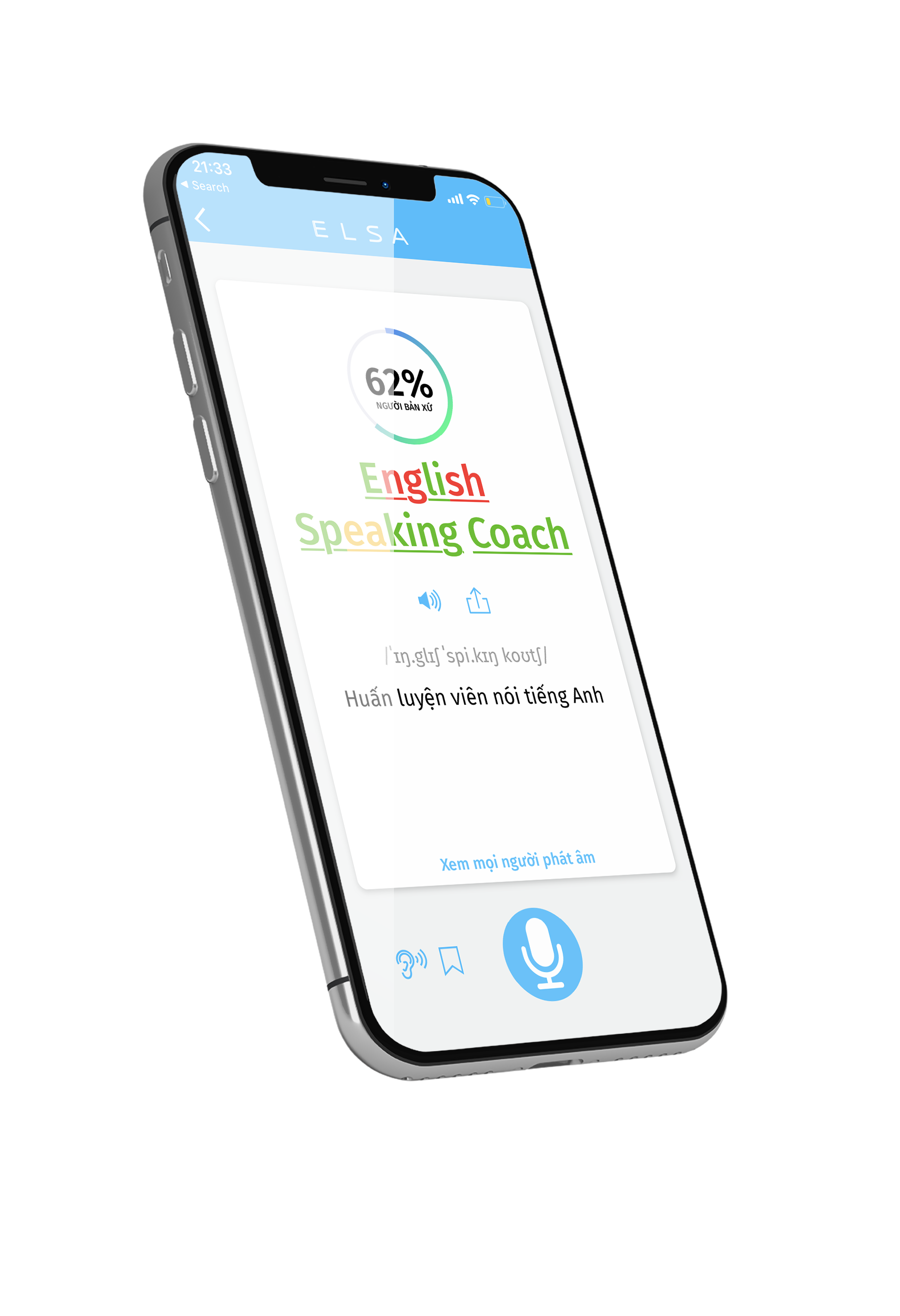
ELSA’s English pronunciation feedback
In Vietnam, where Van is from, English learners spend a lot of their disposable income on online or offline English training. “However, the majority of English learners still struggle to improve their speaking skill because other people don’t understand them or they’re afraid to speak it,” she said. ELSA was designed to give them an accessible resource to help improve their pronunciation and confidence when speaking English.
Other apps focused on English pronunciation include FluentU and Say It. Van said one of ELSA’s main advantages is its proprietary voice recognition AI tech.
“What’s unique about our AI is that we’ve collected the largest amount of accented English voice data from millions of users that we have used to train our AI model over the last few years, which gives us a higher accuracy in recognizing and understanding non-native English speakers around the world,” she said. “The other existing voice recognition technologies available, by comparison, might understand native speakers well but have a hard time understanding non-native accented English learner communities.”
Instead of providing feedback about individual words, ELSA’s app also corrects individual sounds and gives users detailed information on how to improve their pronunciation, including “very advanced prosodic speaking features like intonation, rhythm and fluency to help them speak English more naturally, something that our competitors don’t offer,” Van added.
Ben, a London-based employee benefits and rewards platform, has raised $2.5 million in funding. The seed round is led by Cherry Ventures, and Seedcamp.
A number of angel investors with backgrounds in fintech and HR tech also participated. They include Paul Forster (founder of Indeed), Taavet Hinrikus (founder of TransferWise), Carlos Gonzalez-Cadenas (previously an exec at GoCardless but now a partner at Index Ventures), Philip Reynolds (VP of Engineering at Workday), and Matt Robinson (founder of Nested).
Part fintech, part HR play, Ben has built an employee benefits platform to enable SMEs to offer much more personalised and flexible benefits to employees. The U.K. startup does this via a SaaS for managing benefits, including a benefits marketplace, combined with per-employee debit cards powered by Mastercard.
The idea is to give employees more individual choice around which benefits they choose, while making it easy to on-board additional providers. This can be via the marketplace or through whitelisting merchant or merchant categories via the employer issued Mastercards, such as food and drink or travel and mobility, or a specific co-working space etc.
“While most companies offer benefits in order to attract and engage team members, and ultimately drive productivity, most solutions don’t deliver the desired outcomes,” Ben co-founder and CEO Sebastian Fallert tells me. “To have impact, offerings need to work for the individual employees; after all, a ‘benefit’ that’s relevant for somebody working from home in their mid-40s could be next to useless for a new starter in their 20s”.
Fallert says that providing the required level of personalised benefits has been impossible for most small to medium-sized companies due to the “high cost and complexity” of creating and administering personalised programmes. This has seen only large enterprises able to offer flexible benefit programmes where employees get to pick from a range of options. Ben aims to remedy this.
“The Ben software platform allows companies to load funds and set individual spend rules on how these can be used,” explains Fallert. “Employees are then able to choose from group benefits, such as private medical insurance, mental wellbeing services, or dental plans, while a real per-employee Mastercard opens the door to pretty much any product or service in a tax-efficient and compliant way”.
The result is a “win-win,” says the Ben CEO. “Employees get tailored benefits, and companies only pay for what’s used, take advantage of tax exemptions and preferred pricing, while streamlining the administration”.
The Ben platform is currently used by smaller and mid-market companies, especially those with a distributed team. “It’s these firms in particular that have to deal with the growing complexity of their programmes to keep up with a more diverse and increasingly remote/distributed workforce,” says Fallert.
Meanwhile, Ben has three revenue streams: a SaaS fee; interchange revenue every time its cards get used; and, of course, affiliate revenue from its marketplace.
Adds the Ben CEO: “One of our core hypotheses is that there are so many amazing services out there that simply can’t get through to companies as they’re often not relevant for all employees, such as debt consolidation or fertility treatment. With Ben, they get easy distribution on standard commercial terms while companies get to offer an additional benefit without any additional overhead”.
Despite China’s history of stringent media control, an industry of uninstitutionalized, individual publishers has managed to flourish on social media platforms like Tencent’s WeChat and ByteDance’s Toutiao. These self-publishers are called “We Media” in the Chinese internet lexicon, denoting the independent power of citizen journalists and content creators.
Meanwhile, self-publishers have always had to tread carefully on what they post or risk being targeted by censors who deem them illegal or inappropriate.
The topics they cover are myriad, ranging from fashion and food to politics and current affairs. WeChat, a major destination for self-publishers, hinted last July it had 20 million “public accounts”, platforms for individuals to broadcast content and in businesses’ case, reach customers. In 2020, 360 million users read articles published on WeChat public accounts, WeChat founder Allen Zhang disclosed recently.
Sina Weibo, China’s answer to Twitter, has long attracted citizen journalists. In the early days of COVID-19, millions of Chinese users rushed to Weibo seeking facts from accounts like that of Fang Fang, an author who chronicled what she had witnessed in Wuhan.
Now, a new development in China’s internet regulation is about to further restrict China’s tens of millions of self-publishers.
Public accounts that “provide online news service to the public shall obtain the Internet News Information Permit and other relevant media accreditation,” according to a new regulation (translation here) published January 22 by the Cyberspace Administration of China, the country’s internet watchdog.
In the following days, WeChat, Baidu, Sohu and other online information services began notifying publishers of the new rule. “If your account lacks relevant accreditation, you are advised not to edit, report, publish or comment on news about politics, the economy, military, foreign affairs or other major current events,” according to the notice sent by WeChat.
“The WeChat Public Account Platform always commits to providing a green, healthy online environment to users,” the message adds.
The requirement of news accreditation will likely be a death knell for independent social media publishers that have taken on journalistic roles, particularly those covering politics. “It’s not something you can obtain easily unless you’re an official news outlet or an organization with unmatched resources and background,” a WeChat account publisher told TechCrunch.
China’s control on news reaches into every corner of the internet, and regulations are always playing catchup with the pace at which new media, such as microblogs and live streaming, flourishes.
From 2017 to 2018, the cyberspace authority granted news permits to a total of 761 “internet news services,” which together operated 743 websites, 563 apps, 119 forums, 23 blogs, 3 microblogs, 2285 public accounts, one instant messenger, and 13 live streaming services. In other words, hard news is off limits for internet services of these categories that operate without a news license. It remains to see how platform operators like WeChat and Sina Weibo work to enforce the rules.
Heightening oversight on online information could have merit when it comes to battling misinformation. The new regulation also calls on operators to set up mechanisms like a creator blacklist to root out fake news. But the regulation overall could have an adverse impact on freedom of expression in China, the International Federation of Journalists warned.
“The vaguely defined new rule comes at a time when ‘self-media’ has gained huge popularity in China and journalists have begun using such platforms to publish work which was axed by their organisations,” the IFJ said in a statement published on January 28.
Source: https://techcrunch.com/2021/01/31/china-crack-down-self-publishing/
Access to the internet in Myanmar dropped sharply after the military detained leaders of ruling party National League for Democracy, including Aung San Suu Kyi, and declared a state of emergency. The NLD won a wide majority of parliamentary seats in November’s general election, which the military alleges was the result of election fraud. In a statement on military-owned television, the army said a year-long state of emergency would be declared in Myanmar and power handed to military chief Min Aung Hlaing.
According to NetBlocks, a non-governmental organization that monitors digital rights, cybersecurity and internet governance around the world, internet disruptions began around 3AM Monday morning local time, with national connectivity falling to 75% of ordinary levels, and then reaching about 50% around 8AM. Data shows that the cuts affected several network operators, including the state-owned Myanma Posts and Telecommunications (MPT) and Telenor. NetBlocks said “preliminary findings [indicate] a centrally ordered mechanism of disruption targeting cellular and some fixed-line services, progressing over time as operators comply.”
Update: Internet connectivity in #Myanmar has fallen to 50% of ordinary levels as of 8:00 a.m. local time amid an apparent military coup and the detention of civilian leaders; pattern of disruption indicates centrally issued telecoms blackout order
https://t.co/Jgc20OBk27 pic.twitter.com/71fHI3sRv3
— NetBlocks (@netblocks) February 1, 2021

The United States Embassy’s American Citizen Services said on Twitter that internet and phone connectivity are both limited throughout Yangon and Nay Pyi Taw.
Update: We are aware that internet and phone connectivity is limited throughout Yangon and Nay Pyi Taw.
— American Citizen Services – Burma (Myanmar) (@ACSRangoon) February 1, 2021
Aye Min Thant, a former correspondent for Reuters who is now the Tech for Peace program manager at Phandeeyar, a tech accelerator in Yangon, tweeted that she had been logged out of Signal and Telegram overnight, and can’t log in again because cell service is shut down, preventing her from getting verification codes.
The detainment of Suu Kyi and other National League for Democracy leaders comes days after Myanmar’s military attempted to downplay concerns about a coup by stating it would protect the country’s constitution, despite its allegations of vote fraud in November’s election.
Myanmar came under direct military rule after a 1962 coup replaced the civilian government. In 1990, free elections were held and the NLD won, but the military refused to give up power, placing Suu Kyi under house arrest. After 2011, a transition to democratic rule gradually began, but the military still controlled much of the government.
The NLD has also been accused of being complicit in the military’s ethnic cleansing campaign against Rohingya Muslims and disenfranchising opponents.
While Myanmar’s government does not practice direct censorship of internet content, Freedom House gave the country a score of only 36 out of 100 in 2019, citing manipulation of online content by both the military and NLD, and prosecution that forces individuals to self-censor. In June 2019, the government banned the internet in parts of Rakhine and Chin State, the sites of ongoing fighting between the Myanmar military and Arakan Army. Human rights observers including the Human Rights Watch have said that the internet ban prevents people in those areas from communicating with their families, getting information about COVID-19 or accessing aid.
You’ve just landed on the web version of my weekly newsletter, Human Capital. It’s where we look at the recent events of the week pertaining to diversity, equity, inclusion and labor in tech.
You can sign up here to get Human Capital delivered straight to your inbox every Friday at 1 p.m. PT.
Let’s jump in.
Alpha Global forms to unite Alphabet workers around the world
Alpha Global announced its formation earlier this week to unite Alphabet workers around the world, including those from the Alphabet Workers Union in the United States, The Verge reported. Alpha Global, which is affiliated with the UNI Global Union, aims to create a common worker strategy, support fellow workers and more.
“A just Alphabet has wide-ranging implications for our democracies and societies,” Alpha Global said in a statement. “That is why we are joining together to demand fundamental human rights for all workers in Alphabet operations, including the right to form or join a union and the right to bargain collectively.”
I should mention that you’ll be able to hear more about Alphabet Workers Union at Alpha Global at TC Sessions: Justice directly from Parul Koul, the executive chair of Alphabet Workers Union. You can snag your tickets here for just $5.
Apple Watch launches a Black unity collection

Image Credits: Apple
In celebration of Black History Month, Apple introduced the Black Unity Collection for Apple Watch.
Something feels off about the watch band, but I can’t quite put my finger on it. Perhaps it’s the commoditization of Black culture.
Chan Zuckerberg Initiative launches the Justice Accelerator Fund
The Chan Zuckerberg Initiative has created a new criminal justice reform group, Recode reported this week.
With $350 million put toward the new Justice Accelerator Fund over the next five years, the organization will focus on criminal justice advocacy. JAF will be led by Ana Zamora, CZI’s current director of criminal justice.
NLRB gets a new acting general counsel
Biden named Peter Sung Ohr the new acting general counsel for the National Labor Relations Board. As Vice’s Lauren Kaori Gurley noted, Ohr’s appointment has the potential to be very good for gig workers and workers rights, in general.
Peter Sung Ohr, the new Acting General Counsel of the @NLRB, gave Instacart workers the "ok" on a union election in 2020 and wrote a decision that allowed @uchicagogsu grad students to unionize in 2017, a good sign for gig workers & grad student organizing going forward
— Lauren Kaori Gurley (@LaurenKGurley) January 26, 2021
ServiceNow launches racial equity fund
With $100 million set aside for the fund, the enterprise software company’s racial equity fund aims to “drive more sustainable wealth creation by funding homeownership, entrepreneurship, and neighborhood revitalization within Black communities in 10 regions across the United States,” according to a press release.
Here’s a nugget on how it’ll work:
The ServiceNow Racial Equity Fund will buy smaller community loans to increase the lending capacity for local banks. By increasing access to capital, the investment will facilitate homeownership and entrepreneurship in Black communities, leading to job creation and wider economic growth. The investment, which is the first of its kind for ServiceNow, will initially focus investments in Boston, Chicago, Dallas, Houston, New York, Orlando, San Diego, the San Francisco Bay Area, Seattle, and Washington, D.C. – locations where ServiceNow has significant operations and community presence.


