& meet dozens of singles today!
User blogs

No sooner did we start developing a newsletter, the newsletter industry exploded. Twitter jumped in with a purchase of Revue, Facebook was rumored to be investigating the platform, and each new day brought further experiments. You could blame it on the post-Trump lifting of the fog of despair. The pandemic continued apace, with new variants spurring distribution of vaccines and a transparency in communications with the new president and his team.
After years of social mining of our behavior, interests and transactions, inference has been replaced by direct evidence. The politics of data pressure mandate that we expect free software bundled with increasingly powerful hardware. The core utility of a phone culture shifted as people kept to their homes and mostly used the televisions for entertainment and news, and the phones as notifications consumers. The desktop remained the creation engine for business documents, analytics and information triage.
One year after the pandemic took hold, the outlines of the recovery are becoming visible. Because so much of our transaction history is funneled through the phone, we have left less need or incentive for teasing out indirect data and making inferences on it. Netflix is a honeypot for direct recording of choices, tagged along each customer’s timeline with the minute-by-minute social characteristics of the groups they participate in.
The resulting data type is beyond the bifurcation of product in the Apple hardware sense and the user as product in the Google or Facebook sense, Netflix creates a kind of social signal out of the analytics that is recycled back into the service where it impacts on the user’s behavior organically. We tap into the recommendation flow not just at the Netflix level but also the notification and conversational flows.
Newsletters offer a similar organic resonance, as they combine the author’s analysis of the information flow (in the form of citations) with the actual orbiting references. As with Netflix, the user leaves a breadcrumb trail along with time data as they record their choices and unread items. The maturing newsletter model is one where the authorship more correctly anticipates what has been seen by the target audience, and saves time and insight for rapid return on the investment. Group metrics synthesize this benefit into value on Netflix, where the “ratings” are based on retention and time compression. This is the newsletter opportunity.
If you buy the idea of media consolidation under the newsletter umbrella, how will that manifest itself? Already we’re experiencing a battle similar to the age of blogs, where individual voices built a social engagement cloud that emulated the dynamics of a magazine. Just as Apple inserted itself into the music business with playlists and MTV with top 40 radio, blogs leveraged Twitter and social to create bundles of news, features and commentary. As with playlists, the users were in charge.
Mobile brought notifications to the party, blending blogs with media. Initially podcasts leveraged RSS’s attachment extension to download sound and video files to iPods. But when streaming arrived, the preferred way of consuming the content was by clicking on the notification. This in turn disrupted the cable networks just as the kids went mobile and abandoned TV. During the 2020 campaign, notifications were a great way of routing around insufferable analysis in favor of the actual events.
Meanwhile, Facebook Live, Periscope and YouTube gave virtually everybody a seat at the table. Podcasts democratized media, and streaming democratized distribution. I know many think podcasting is experiencing a renaissance, but personally I think streaming is inventing a new paradigm of the economics of the industry.
Take Clubhouse, for example. It’s distinguished by what it doesn’t do rather than what it does: no recording, therefore no replays. No video, only audio. No lurking, at least surreptitious checking out the scene. If you click on a Clubhouse notification, your name pops up for all to see. And there’s no button to Leave Loudly, just Quietly. Significantly, however, you can operate in a private room, and then go public if you want to. It’s podcasting with an invisibility mode.
Private rooms are just the place to hash things out. Today I had several conversations skirting these issues. One was muted, tentative, doubt mixed with an arrogant optimism. The other was supple, teeming with validation and the presence of humor to leaven the serious nature of the fleeting time we may have. Not recorded, in one case just a regular cell call. But the mulch created informs this post, with its scaffolding of intersecting items lurking in calm support. Podcasting, no.
It reminds me of the Hayden Planetarium, where the planets orbit and the asteroids bisect the swirling cosmos. We’re suspended in the teeming reaches of the near universe, with its fractal efficiency in the representation of the whole. The enterprise moves glacially forward, a breast stroke pace with a small wake. Somehow big things are afoot. At a minimum, they could be.
from the Gillmor Gang Newsletter
__________________
The Gillmor Gang — Frank Radice, Michael Markman, Keith Teare, Denis Pombriant, Brent Leary and Steve Gillmor. Recorded live Friday, January 22, 2021.
Produced and directed by Tina Chase Gillmor @tinagillmor
@fradice, @mickeleh, @denispombriant, @kteare, @brentleary, @stevegillmor, @gillmorgang
Subscribe to the Gillmor Gang Newsletter and join the backchannel here on Telegram.
The Gillmor Gang on Facebook … and here’s our sister show G3 on Facebook.
Source: https://techcrunch.com/2021/02/03/gillmor-gang-in-my-room/
Instagram is developing a new feature that could give its app more of a TikTok-like feel: Vertical Instagram Stories. Today, users browse through Stories through taps and horizontal swipes — a feature Instagram adopted from Snapchat. But now, Stories are passé. Even Snapchat is borrowing ideas from TikTok. Its recent launch of Spotlight, for example, is its own TikTok clone.
In many ways, vertical swiping feels more natural than taps and horizontal flicks. It is, after all, how users navigate much of the mobile web, as well as other key features across a variety of social apps, like Facebook’s News Feed or YouTube’s home page.
That said, turning Instagram Stories into a vertical feed would be a notable change, and one that could potentially set the stage from a shift away from more static content — like the photos and reshared Feed posts that still often fill the Stories section today. In a “Vertical Stories” feed, on the other hand, Instagram would likely prioritize video posts over images to better compete with TikTok, just as it’s currently tweaking its algorithms and overall design to prioritize Reels. (A turn of the dials that has already been leveraged by indie creators to significantly grow their followings, in fact).
The “Vertical Stories” feature was spotted under development by Alessandro Paluzzi who shared the discovery on his Twitter account.
#Instagram is working on Vertical Stories
Swipe up and down to browse stories. pic.twitter.com/LDJje8l137— Alessandro Paluzzi (@alex193a) February 2, 2021

His screenshot shows a simple user interface with text that reads: “Now you can swipe up and down to browse stories” and then a big, blue button labeled “Vertical Stories.”
Paluzzi tells TechCrunch that the feature is not yet live. Instead, he dug it up from Instagram’s code.
Instagram confirmed to TechCrunch the feature is being built but is not out to the public at this time.
“This is an early prototype and is not currently testing on Instagram,” a company spokesperson told us.
A prototype may never actually make it to a public launch, of course, but its existence does say something about what sort of ideas Instagram is considering as a means of offering a better challenge to TikTok.
Today, the company’s TikTok rival, Reels, has been shoehorned into the platform via the Instagram Explore page, where Reels sits in the top position. When you click on the Reels video here, you’re taken to a new user interface where you then vertically swipe through videos, similar to TikTok.
This doesn’t feel right, and the launch of the new format has added to Instagram’s clutter. Today, the app has all sorts of places users can publish their videos, including in the Feed, as Stories, as longer-form IGTV content, and now Reels. It’s too much.
Instagram knows this arrangement isn’t quite working. As Instagram head Adam Mosseri recently told The Verge, most people probably don’t even understand the difference between IGTV content and videos posted to Instagram, for example. He said the company was looking at ways to simplify and consolidate its ideas, too.
While his comments were focused on the confusion between Instagram’s normal video posts and IGTV, there’s also significant overlap between Instagram’s Stories’ vertical video content and Reels. A “Vertical Stories” feed could allow for an eventual combination of those formats — Stories videos and Reels, perhaps.
It’s not clear that’s at all what Instagram has in mind, though. The social network could just be looking to transition another part of its app to the more modern vertical feed, as the demand for the traditional Stories format declines.
Source: https://techcrunch.com/2021/02/03/instagram-confirms-its-working-on-a-vertical-stories-feed/
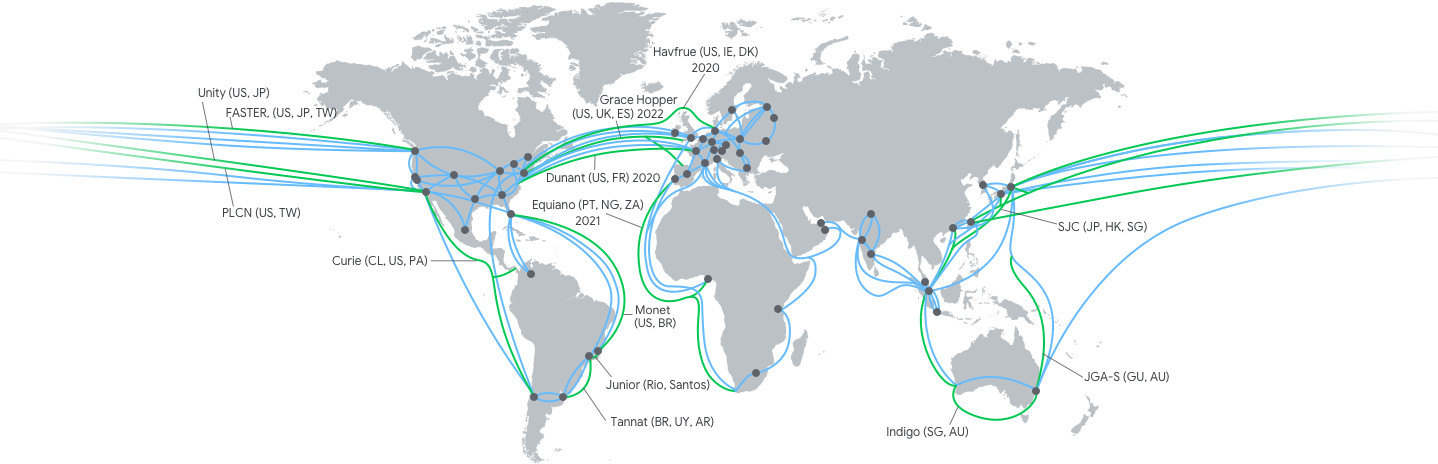
Google, together with its partner SubCom, today announced that the company’s privately owned Dunant subsea cable between Virginia Beach, Virginia and Saint-Hilaire-de-Riez on the French Atlantic coast is now operational.
Google first announced this project, which was named after the first Noble Peach Price winner and founder of the Red Cross, Henry Dunant, back in the middle of 2018. At the time it expected the project to go live in 2020, but besides dealing with the complications of spanning a long cable between continents, the project leaders probably didn’t budget for a global pandemic at the time.
The almost 4,000-mile cable has a total capacity of 250 terabits per second — or enough to transmit the “entire digitized Library of Congress three times every second” (though maybe using Library of Congress data size references is starting to feel a bit antiquated at this point?). Unlike some older cables, Dunant uses 12 fiber pairs, coupled with a number of technical innovations around maximizing its bandwidth, to achieve these numbers.
“Google is dedicated to meeting the exploding demand for cloud services and online content that continues unabated,” said Mark Sokol, senior director of Infrastructure, Google Cloud. “With record-breaking capacity and transmission speeds, Dunant will help users access content wherever they may be and supplement one of the busiest routes on the internet to support the growth of Google Cloud. Dunant is a remarkable achievement that would not have been possible without the dedication of both SubCom and Google’s employees, partners, and suppliers, who overcame multiple challenges this year to make this system a reality.”

Image Credits: Google
With Dunant now being operational, the next Google cable to go live will be the Grace Hopper cable between New York and Europe, with landing sites in Bilbao, Spain and Bude, UK. Google first announced this new cable, which it is also building in partnership with SubCom, last July. It’s expected to go online in 2022 and will feature a total of 16 fiber pairs.
In addition, Google is also building the Equiano cable from South Africa to Portugal. This cable is supposed to go online later this year.
In addition to its privately-owned cables, Google is also a partner in a number of consortiums that band together to build cable systems.
Source: https://techcrunch.com/2021/02/03/googles-new-subsea-cable-between-the-u-s-and-europe-is-now-online/

Several high-level Apple services are experiencing issues and outages on Wednesday morning, Apple has confirmed. These issues are impacting a number of consumer-facing services including Apple Music and Radio, Apple Books, and the App Store platforms across both iOS devices and Mac.
For some users, the services are down. For example, there were reports circulating this morning that users were having problems streaming music through Apple Music or using iTunes. Other have noticed strange problems cropping up on the App Store — like app search results that only returned a small handful of top apps related to the search term.
Even when the services are partially up, they’re sometimes much slower to load than usual — meaning users may see blank pages for several seconds before the page is populated with its usual content.
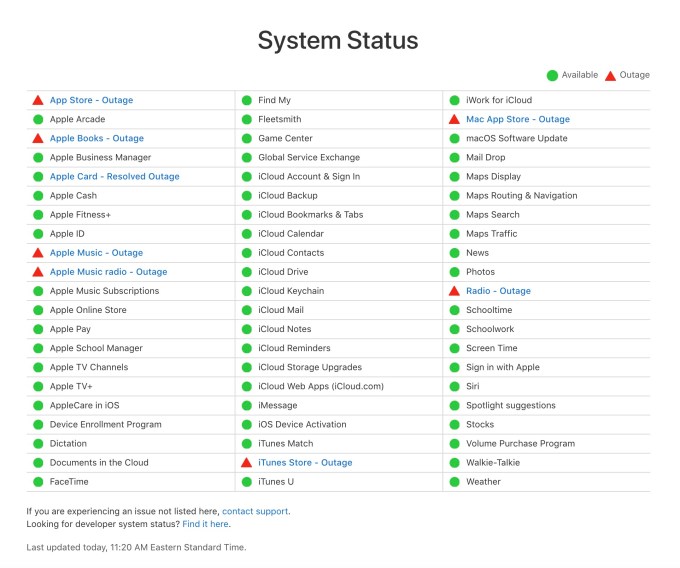
Image Credits: Apple
At the time of the initial reports, Apple’s Status page didn’t reflect these issues, as it showed all services as being available. That has since changed. Now, the page displays outages are occurring across the App Store, Apple Book, Apple Music, Apple Music Radio, iTunes Store, Mac App Store, and Radio.
The Apple Support Twitter account has also posted about the outage, but has yet to provide details about what has happened or when it might be resolved.
What’s concerning is that the account replied to a tweet with a complaint from a user who said they couldn’t reset their password — an indication that the outages could be impacting other types of backend services, as well.
Some services are currently experiencing an outage. Hang tight and keep checking back: https://t.co/waNYZdXpJm If you’d like to connect with us in DM, we can look further. https://t.co/GDrqU22YpT
— Apple Support (@AppleSupport) February 3, 2021
Apple says it’s working to provide us with more information on this, and we’ll update when the company has more to share.


