& meet dozens of singles today!
User blogs

As a deep tech investor, I have often noticed that deep tech startups go through a different evolution cycle than a typical B2B or B2C company.
Accordingly, the challenges they face along the way are different — commercialization tends to be more complex and founders are often required to approach it differently.
Deep tech companies are usually built around a novel technology that offers significant advances over existing solutions in the market; often they create new markets that don’t yet exist. Taking these technologies from “lab to market” requires substantial capital carrying a much higher degree of risk than an average venture investment.
The majority of VCs are often surprised by the amount of complexity involved in building a successful deep tech company.
Typically, the underlying intellectual property (IP) of a deep tech company is unique and hard to recreate, resulting in a significant competitive advantage.
High risk, high reward
Since most deep tech companies are built around a fundamentally new and unproven technology, they carry higher risk. Typically, the tech has been tested in a lab or a research center and the early results are therefore often derived in a controlled environment. As a result, while building a product, founders are likely to encounter technical challenges along the way and won’t be able to eliminate the technology risk until later in the process.
By comparison, if a company is building a marketplace for used cars, for example, the technology risk is almost zero. Deep tech companies have the capability to create new markets with little competition and can replace existing technologies while fundamentally transforming an industry.
Microsoft, Nvidia, ARM, Intel and Google were all deep tech startups in the beginning. These companies will almost always require higher capital, carry higher risk and have longer time to return on investment.
However, if successful, they could deliver outsized returns over an average venture investment.
Technology-first approach
An obvious, but fundamental difference with deep tech companies is their technology-first approach. Typically, the founder has developed a novel technology or IP as part of their Ph.D. thesis or postdoc work and is in search for a real-world problem it can solve. Most startups, in general, pick an existing problem in a market they know well and develop a product that solves for that problem and they have a clear sense of the problem they need to solve.
Deep tech entrepreneurs take the opposite approach and as a result they often suffer from SISP (a solution in search of a problem), as Y Combinator calls it. Founders need to be aware of this and must be willing to pivot and repivot based on market and customer feedback. Investors should be prepared for this before backing the company and support the founders as they navigate through the challenges of building a successful deep tech company.
Toyota Motor North America said Wednesday it will bring three new electrified vehicles to the U.S. market, as the automaker seeks to win over customers by offering a variety of lower emission and zero-emission cars and SUVs.
Two of the new vehicles will be all-electric and one will be a plug-in hybrid, the company said Wednesday. Sales of the vehicles are expected to being in 2022.
The aim, according to Bob Carter TMNA’s executive vice president of sales, is to offer customers multiple choices of powertrain that best suits their needs. The automaker is developing and selling hybrids, plug-in hybrids like the Toyota Prius and Toyota RAV4 and fuel cell vehicles such as the Toyota Mirai.
The company said that by 2025, its Toyota and luxury Lexus models will have an electrified option. The automaker is also developing a dedicated battery electric platform called e-TNGA, that can be configured to meet different needs.
This all-of-the-above approach is aimed at reducing greenhouse gas emissions and capturing more market share, which Toyota believes can only be achieved through variety. Toyota wants to to have 40% of new vehicle sales be electrified models by 2025. By 2030, the company expects that to increase to nearly 70%.
“We believe the fastest way to lower greenhouse gases in the transportation sector is to offer drivers lower carbon choices that meet their needs,” Gill Pratt, chief scientist of Toyota Motor Corporation and CEO of Toyota Research Institute, said in a statement. “At every price point and with multiple powertrains, we can put more people in cleaner automobiles across North America to have the greatest near-term impact on total carbon emissions.”
The company’s internal research, which was built off of a tool that shows the trade-off between GHG Emissions and total cost of ownership, found that emissions of a currently available battery-electric model and a plug-in hybrid model are roughly the same in on-road performance when factoring in pollutants created by electricity production for the average U.S. energy grid used to charge batteries.
Manufacturing is a component of GHG emissions, Toyota noted. Researchers found that the production of a PHEV emits less GHG since it uses a smaller, lighter weight battery. The company also argued that plug-in hybrids are less expensive to buy and own, compared to a BEV.
The company’s argument — that BEVs and PHEVs can provide similar environmental benefits — syncs up with its business plan.
Source: https://techcrunch.com/2021/02/10/toyota-to-bring-three-new-electrified-vehicles-to-u-s-market/
Here’s another edition of “Dear Sophie,” the advice column that answers immigration-related questions about working at technology companies.
“Your questions are vital to the spread of knowledge that allows people all over the world to rise above borders and pursue their dreams,” says Sophie Alcorn, a Silicon Valley immigration attorney. “Whether you’re in people ops, a founder or seeking a job in Silicon Valley, I would love to answer your questions in my next column.”
Extra Crunch members receive access to weekly “Dear Sophie” columns; use promo code ALCORN to purchase a one- or two-year subscription for 50% off.
Dear Sophie:
We’ve been having a tough time filling vacant engineering and other positions at our company and are planning to make a more concerted effort to recruit internationally.
Do you have suggestions for attracting workers from abroad?
— Proactive in Pacifica
Dear Proactive,
Yes, I have many suggestions on what you can do to support international talent interested in moving to the United States. Immigration is a great benefit for attracting the best and the brightest team members from around the globe. And providing immigration security through visa practices and green card programs supports retaining these valued individuals. Consider sponsoring international students and other qualified candidates in the upcoming H-1B lottery in March.
As it now stands, the H-1B lottery will be random this year, not pay-to-play. We anticipate the electronic lottery process will follow these dates:
- March 9 at 9 a.m. PST: H-1B registration process opens.
- March 25 at 9 a.m. PDT: H-1B registration process closes.
- March 31: You’ll know if your H-1B beneficiaries were selected electronically in this initial round of the lottery.
- April 1: First date to file H-1Bs selected in the lottery to request a 10/1/2021 or later start date.
- June 30: Last anticipated day to complete filing of selected H-1B petitions in this initial round of the lottery.
- After June 30: Possibility of a second lottery for registrations submitted in March.

Image Credits: Joanna Buniak / Sophie Alcorn (opens in a new window)
Through the H-1B and other proactive immigration-support measures you can take, your international team members will enjoy a greater sense of immigration security. This allows them to focus on their job rather than worrying about their immigration status. Here are my recommendations for drawing international talent from abroad and fostering productivity and loyalty.
Establish your company’s immigration policy
I recommend working with an experienced immigration attorney who can help your company develop an immigration policy based on your company’s core values, recruiting and immigration budget, and growth plan. Think of immigration as a benefit and a way to differentiate your company from others when recruiting top talent. Providing immigration benefits and immigration security goes a long way toward building team member loyalty and longevity.
For some companies, the best policy may be to have no policy, but it’s important to be deliberate about it and how that will affect your ability to make decisions and budget. For other companies, they implement a limited immigration policy to, for example, hire 40 engineers as soon as possible. Even with a decentralized workforce, a new recruit may be happy to move from Ukraine to Idaho even if your company is not based there.
One of the most difficult tasks in the increasingly high-fidelity world of gaming is making realistic-looking people — especially faces. Epic today showed off a new character creation tool in Unreal Engine that lets you make a near-infinite variety of near-photorealistic digital people with far less effort than it might have taken before.
MetaHuman Creator is an application for designing characters that lets people mix and match presets then dive into the tiniest details. It’s a cloud-hosted service, since the amount of computing power and storage needed to render these characters at this resolution and level of lighting and so on is more than most people will have on hand.
Anyone who’s used a high-quality character creator will recognize the pieces — a few dozen hairstyles, ear types, beards and lip shapes, which can be added, subtracted and adjusted like a digital Mr. Potato Head. Bet you didn’t see that reference coming!

Image Credits: Epic
The difference between MetaHuman and, say, a state of the art consumer-level creator like Cyberpunk 2077’s is fidelity and flexibility. As you can see in the videos, the quality of the hair, skin, eyes, teeth and so on is extremely high — the older fellow on the left has quite realistic wrinkles that shadow and deform properly when he moves his face, and the way the light interacts with the center lady’s light skin is very different from that of the dark-skinned man on the right.
The “center lady” also started as a middle-aged man and was sculpted piece by piece to her current look rather than just switching to a “feminine” preset, demonstrating that the faces don’t “break” if you manipulate them too much — a risk in other creators for sure. You can see the process in fast-forward in the video below:
Naturally it also integrates with the usual creator tools, allowing for animation by various means, fiddling with meshes and exporting for use in other tools.
This level of detail isn’t exactly unprecedented, but the amount of work that goes into rendering a main character good enough for extreme close-ups and microexpressions is huge. Epic’s approach is not just to increase the potential quality of the assets and lighting and so on but to make it easy and efficient to implement. If only AAA studios can muster the resources to make characters like this, it’s not healthy for gaming as a whole.
Epic was humble enough to give credit right off the bat to companies like 3Lateral and Cubic Motion, both specialists in the field it has acquired. The Unreal Engine is presented as a sort of monolithic advance in computer graphics and design, but really it’s a very cleverly assembled amalgamation of dozens of improvements and advances made by individual (now acquired) companies and divisions over the years — more like an operating system with a bunch of integrated applications at this point.
MetaHuman Creator isn’t quite ready for use by just anyone, but Epic is running an early-access program you can sign up for, and they’ve provided a pair of models for you to play with in your existing Unreal Engine environment in the meantime (check the “Learn” tab).
Source: https://techcrunch.com/2021/02/10/epic-shows-off-unreals-nearly-real-metahuman-3d-character-creator/
Mobile analytics and market data company App Annie launched a new app today that CEO Ted Krantz said is built not for the analyst who’s “immersed in the data,” but rather the executive who needs “a much more elevated, top-down view.”
The biggest new piece of the company’s Pulse app is something called the App Annie Performance Score, which Krantz compares to a FICO score for mobile apps. The idea is to take an app’s user acquisition, engagement, monetization and sentiment and boil them down into a single score that benchmarks how the app is performing relative to the competition.
Krantz said that eventually, the performance store could become more customizable for each customer, so that “you can tailor it to the metrics that matter to you.” The app also highlights any shifts in key app metrics and identifies potential causes, and it includes a newsfeed showing what’s happening to the apps and markets that a user follows.
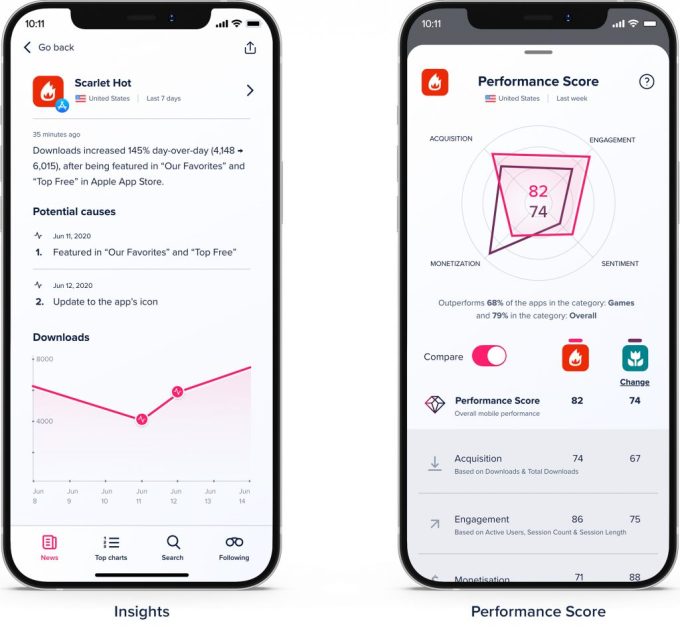
Image Credits: App Annie
The goal, Krantz added, is to provide executives with a quick overview of the data they need without requiring them to dig through it or wait for a report — especially as “mobile is becoming such an imperative.” It’s the team’s “aspiration” to create an app that executives check every day, though he’s not necessarily expecting that to happen initially.
The Pulse app is based on App Annie’s market-level data, so Krantz said it shouldn’t be affected by Apple’s upcoming privacy changes. At the same time, he acknowledged that the company’s broader goals of bringing together first-party and third-party data are starting too look “a little tricky.”
App Annie Pulse is currently available on iOS, with the company planning to launch an Android version in the second quarter of this year. And while Pulse is only available to paying App Annie customers, Krantz said there are also plans for “revamping the free side of the equation and make that a little more meaty.”


