& meet dozens of singles today!
User blogs

Crypto-currency pioneer and early Bitcoin thought-leader Diana Biggs has joined Swiss-based startup Valour, which lets investors easily buy digital assets through their bank or broker. The move is significant with the news that Tesla has bought $1.5 billion worth of Bitcoin, thus massively boosting the mainstream markets for crypto assets. Biggs explored the potential for blockchain technology to help solve humanitarian challenges through her venture, Proof of Purpose, in 2017, and her TEDx speech on Blockchain Technology that year is considered by many in the blockchain space to be one of the best in the genre.
Valour, a Zug, Switzerland-based issuer of investment products, brought in Biggs, the former Private Banking Global Head of Innovation for HSBC, as CEO after recently launching Bitcoin Zero, a fee-free, digital asset ETP product, which trades on the NGM stock exchange.
Biggs, who has been in the Bitcoin space since 2013 told TechCrunch: “I have never seen this much attention to Bitcoin and other crypto-assets… The time for decentralized technologies has arrived, and their potential is increasingly realized by institutional investors.”
Johan Wattenström, the founder of Valour, said: “Diana is the perfect candidate to lead the company through this next phase of growth and expansion. With a wealth of experience in traditional finance, as well as fintech, and her vision for bringing digital assets into the mainstream, we feel very lucky to have her on board.” Wattenström created and listed the digital asset ETP on Nasdaq Nordic, in 2015.
Biggs is an Associate Fellow at the University of Oxford’s Saïd Business School and served as Head Tutor for their Blockchain Strategy Programme from 2018 to 2020. She is on the Board of the World Economic Forum’s Digital Leaders of Europe community and is a member of the Milken Institute’s Young Leaders Circle. Prior to joining Valour, Biggs was Global Head of Innovation for HSBC Private Banking, where she led on fintech partnerships and driving open innovation.
Spacelift, a startup that automates the management of cloud infrastructure, has raised $6 million in a Series A funding round led by London’s Blossom Capital. Polish fund Inovo Venture Partners and Hoxton Ventures are also investing.
The Polish and US-based startup is taking advantage of the opportunity presented by the increasingly complex cloud world, with what it dubs as an ‘infrastructure-as-code (IaC)’ and a ‘policy-as-code’ platform. This allows teams to automate processes, it says, in a more efficient manner without the risk of downtime.
Co-founder Marcin Wyszynski hit upon the idea after working for companies like Deliveroo in the UK and Berlin-based scooter operator TIER Mobility. The company is headquartered in Redwood City, California, US with an additional office in Warsaw, Poland.
Wyszynski said in a statement: “The switch to using cloud servers and infrastructure as code has benefits for businesses but it has created new challenges for teams, particularly when they are distributed. The slightest mistake can cause major outages and downtime which is obviously bad for business. We designed Spacelift to minimize these issues, by providing automation, control, and visibility tools to teams wherever they are.”
Imran Ghory, co-founder and partner at Blossom Capital commented: “Managing infrastructure has been a persistent pain point for fast-growing teams and the need for specialized management tool platforms has been underlined by the fact that so many teams are now working remotely.”
Spacelift’s competitors include HashiCorp (which raised $349.2M) and Scalr (raised $7.5M).
Since M-Pesa’s mobile money infrastructure came into play in 2007, there has been a proliferation of fintech services ranging from wallets to savings and loans. With this mobile money ecosystem growing in double-digits year-on-year, a lot of data is being created in the process. But this has left some fragmentation, where one person’s information is diverse and can be accessed via multiple channels.
For banks and financial institutions, it becomes difficult to understand and provide insights from users’ data. Over the past three years, some platforms have looked to solve this problem. They aggregate users’ financial data and share it with these financial players through APIs driving more data-driven insights and value-added products. One such platform is Pngme.
Today, the Africa-focused but U.S.-based unified financial data platform announced its seed round of $3 million. The investment, led by Radical Ventures, Raptor Group, Lateral Capital and EchoVC was closed in Q3 2020 and came after the fintech startup raised $500,000 in pre-seed two years ago. It further reflects the continued customer growth from banks, fintechs, credit bureaus and microfinance banks in Ghana, Kenya and Nigeria.
Founded by Brendan Playford and Cate Rung, Pngme started primarily as a lending platform in 2018. Playford, who grew up in the U.K., came to East Africa in 2007 to work on philanthropic biofield projects. He ended up writing short-term loans to entrepreneurs, particularly in Kenya and Tanzania, and during this time formed the basis for which he as CEO and Rung as COO founded Pngme.
“That was sort of the impetus we needed and also the experience of being credit invisible in the U.K. led Cate and me to found the company specifically focusing on providing access to finance to Africans,” he said to TechCrunch.
According to Rung, the company’s initial thesis was that entrepreneurs didn’t get enough help, capital-wise. But going into 2019, when the company raised its pre-seed round, the founders realized another problem — the lack of data infrastructure to access risk when giving out loans or capital.
Their stint in an accelerator based in Toronto, Canada helped to better understand the more valuable version of the company — the B2C layer which connects entrepreneurs with finance or the data infrastructure layer to understand risk or a person’s financial identity.
“We were building two different companies at once, so we had to choose one path. We realised that the data infrastructure layer was critical and a massive pain point in most of sub-Saharan Africa,” the COO added.
Pngme had to make a swift pivot to the latter. Building this would have a much more significant impact. Being able to aggregate mobile money transactions, bank transactions, loan data, behavioural data, process all that data into a structured format and make it available as an open API to developers, fintechs or banks across the continent will provide data to power real-time credit and new financial products.
Additionally, the company found out in the course of building that consumers want to understand their finances more. This helps to navigate their way to financial wellness using credit and, later, more sophisticated products. On the other hand, financial institutions need the data to know what customer segments to expand to or increase their bottom line. Therefore, placing emphasis on the customers’ needs is one of the company’s core value propositions.
“We’re hyper-focused on providing the highest real-time data coverage on credit-invisible customers, something that no other API is offering in our markets,” said Playford regarding the company’s consumer-centric play.
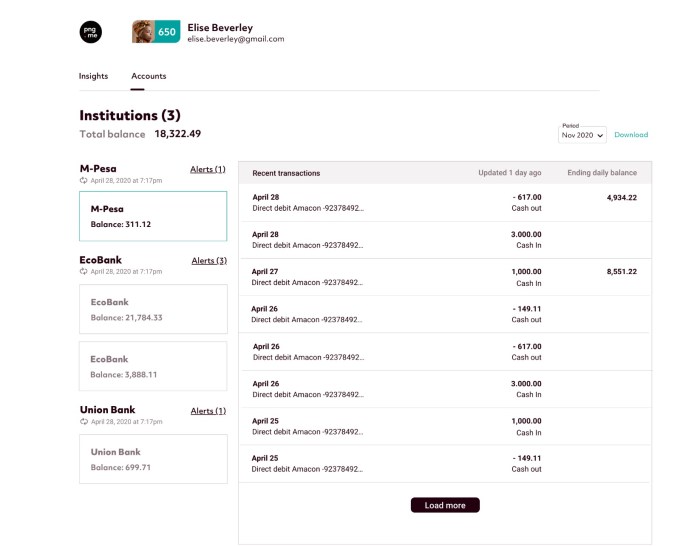
Image Credits: Pngme
Some of Pngme’s customers include SimpleFi, Pavelon, ReadyCash, CashTopUp and Rigo Microfinance. In addition to this, the CEO says the company will integrate with large institutional banks next month.
Despite similarities to other API fintech startups in the region with Plaid-esque functionalities, Playford says Pngme intends to be different from the billion-dollar company.
For one, its focus on traditional channels like USSD data — which has the highest financial coverage on the continent — attests to that. “We’ve gone a step beyond just providing rails to actually building on top of the data. We also provide machine learning insights for our customers,” Rung said.
Also, the platform’s SDK collects user-permissioned data through a partner’s existing app using a one-click data-sharing feature. This data is served up through an easy to integrate API that delivers real-time financial data and alerts. With 300% month-on-month growth in the fourth quarter of 2020, Pngme forecasts the number of user-permissioned data profiles created on its platform to reach hundreds of thousands and millions by 2022.
Pngme’s revenue model is subscription and API-call driven. The platform has different tiers; developers can get a set number of free API calls with no subscription with the free tier. With the enterprise tier for banks and fintech, API calls are charged and can be discounted in some instances. Besides that, the company has a white-glove onboarding process where Playford says developers and startups can reach out to build specific use cases on the platform.
Since raising its pre-seed round, Pngme has been in stealth mode, working with a close group of customers. But with this seed round, the company is going full tilt. According to Pngme, the investment is being used to grow its Lagos and Nairobi teams, particularly the engineers and data scientists, and scaling its product for banks, mobile money operators and fintechs.
Lateral Capital, one of the investors in this round, also backs another API fintech startup in Mono. On the firm’s decision to invest in Pngme, managing partner, Rob Eloff said to TechCrunch that “over the past five years, we have seen a growing appreciation for the continent-wide challenge of providing accurate relational data for financial services customers across Africa. In Pngme, we are fortunate to have met a team with a unique solution to the root cause of financial exclusion in Africa, and a unique culture that spans the best of Africa and the U.S.”
For EchoVC Partners, a Lagos-based early-stage VC, it’s the remarkable job the Pngme team has done in building and delivering a unified financial data API platform for credit identity and access. This is according to Damilola Thompson, the VP and associate general counsel at the firm.
At the moment, Pngme is processing millions in data points per month. With that scale, Rung hopes it will lead to the creation of new technology and more sophisticated financial products.
“What I think is most exciting is the way mobile money leapfrogged any sort of traditional financial infrastructure. Similar to that is how we’re seeing open banking in the U.S. give way to so many new financial products for the end consumer. I hope that by providing forward-thinking open API layers, the same can happen in Africa.”
Northmill Bank, the Sweden-based challenger that has around 200,000 customers across three European countries, has raised around $30 million in new funding.
Leading the round is M2 Asset Management, the Swedish investment company controlled by Rutger Arnhult, and asset management firm Coeli. The injection of cash will be used for continued geographical expansion and to accelerate the development of new products. Notably, this will include plans to launch in 10 new markets as Northmill aims to step on the gas. Next stop, Norway.
As it stands, 2006-founded Northmill is available in Sweden, Norway and Finland, where it competes with incumbent banks with physical branches and the likes of Lunar, Revolut and Klarna (which operates as a bank in its home country of Sweden, and Germany).
More adjacent, another competitor is Anyfin, which is similar to Northmill’s “Reduce” product, which promises to help customers consolidate their existing loans/credit and lower their interest payments. “Our fastest-growing product and main driver today is Reduce, which lowers people’s interest on existing credits, part-payments and credit cards,” explains a Northmill spokesperson.
Founded nearly 15 years ago and originally operating as a credit provider, in 2019 Northmill secured a full banking license, regulated by the Swedish Financial Supervisory Authority. The bank employs 150 people and offers savings, credits, payments and insurances. More generally, it has taken a different and slower path than most of the newer crop of challengers in Europe, relying less on investment to fuel its growth and claims to have been profitable from nearly the get-go.
Cue statement from Rutger Arnhult, chairman of the board of M2 Assets Management: “Northmill Bank is already a profitable company with a proven and sustainable business model, which stands out among today’s tech investments. We have been following their journey for a while and have been impressed by the founders, as well as the company. The banking market is well on its way to change and the winners will be those who best can adapt to the new digital reality. For me, this is an investment in a tech company with long-term owners, who are just at the beginning of their journey. I see great growth potential in the bank.”
Source: https://techcrunch.com/2021/02/10/sweden-based-digital-bank-northmill-raises-30m/
India may soon have another fintech unicorn. BharatPe said on Thursday it has raised $108 million in a financing round that valued the New Delhi-based financial services startup at $900 million.
Coatue Management led the three-year-old startup’s Series D round. Other six existing institutional investors — Ribbit Capital, Insight Partners, Steadview Capital, Beenext, Amplo and Sequoia Capital — also participated in the round, which brings BharatPe’s total to-date raise to $233 million in equity and $35 million in debt.
The startup said as part of the new financing round it returned $17.17 million to its angel investors and employees with stock option.
“With the balance sheet well capitalized (more than US$ 200M in bank), we are now going to keep our heads down and deliver US$30B TPV and build a loan book of US$ 700mn with small merchants by March 2023,” said Ashneer Grover, co-founder and chief executive of BharatPe.
BharatPe operates an eponymous service to help offline merchants accept digital payments and secure working capital. Even as India has already emerged as the second largest internet market, with more than 600 million users, much of the country remains offline.
Among those outside of the reach of the internet are merchants running small businesses, such as roadside tea stalls and neighborhood stores. To make these merchants comfortable with accepting digital payments, BharatPe relies on QR codes and point of sale machines that support government-backed UPI payments infrastructure.
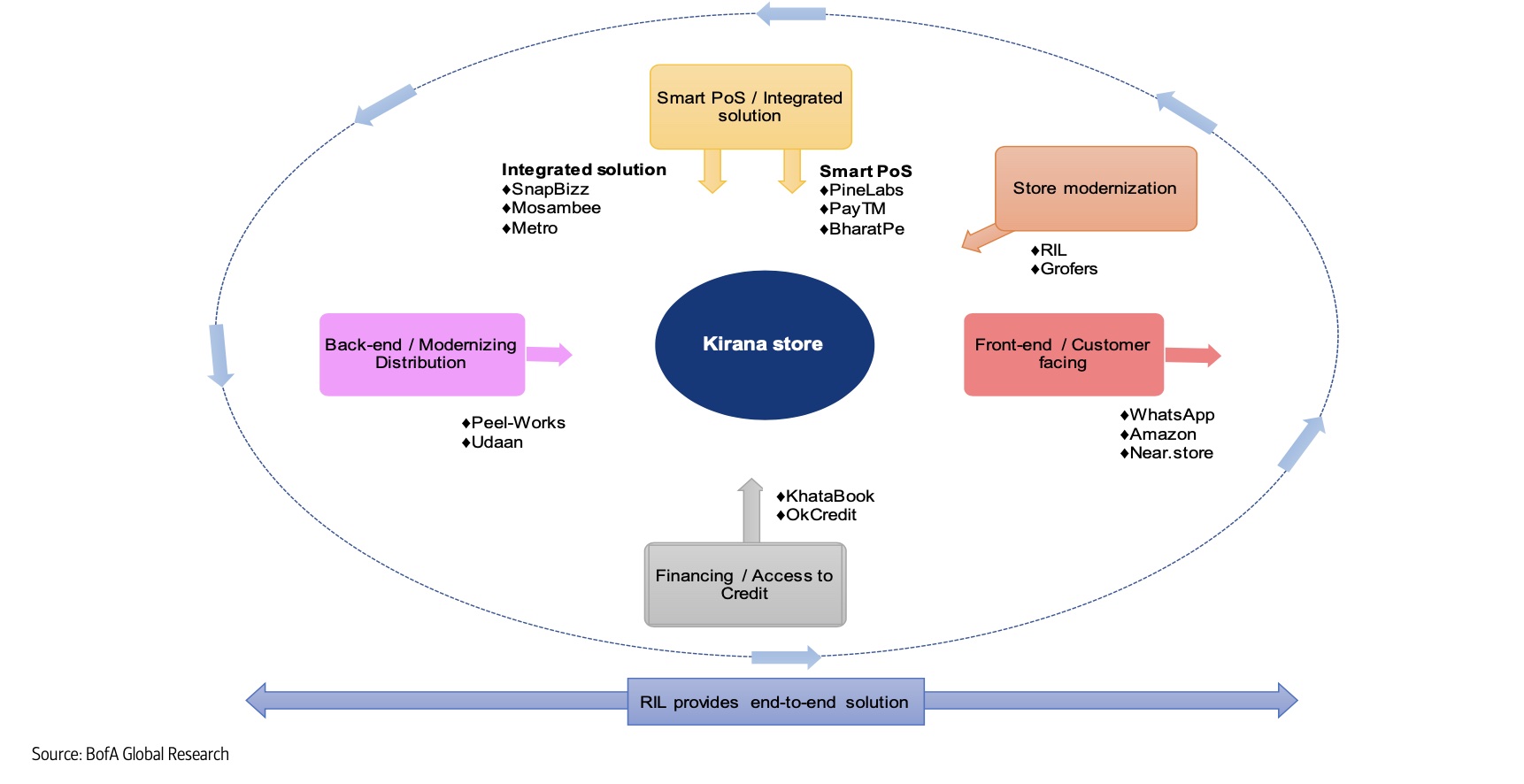
Scores of giants and startups are attempting to serve neighborhood stores in India.
The startup said it had deployed over 50,000 PoS machines by November of last year, and enables monthly transactions worth more than $123 million. It does not charge merchants for universal QR code access, but is looking to make money by lending. Grover said the startup’s lending business grew by 10x in 2020.
“This growth reiterates the trust that the small merchants and kirana store owners have showed in us. This is just the beginning of our journey and we are committed to build India’s largest B2B financial services company that can serve as one-stop destination for small merchants. For BharatPe, merchants will always be at the core of everything we build,” he said.
BharatPe’s growth is impressive especially because it was not the first startup to help merchants. In a recent report to clients, analysts at Bank of America said BharatPe has proven that fintech is not the winner takes all market.
“BharatPe perhaps has the late mover advantages in the space. It was one of the first companies to act as a universal consolidator of QR codes on UPI, giving the merchant the advantage to have one QR code (eventually others like Paytm followed). Unlike its Fintech peers, BharatPe is not educating the merchants but instead following its larger peers who have already educated the merchants,” they wrote in the report, reviewed by TechCrunch.
The startup, which has presence in 75 cities today, plans to further expand its network in the nation with the new fund.


