& meet dozens of singles today!
User blogs

There’s a low energy solution to home heating and cooling sitting right underneath most houses, but until recently no one has been able to tap it.
That solution is geothermal energy, using the earth’s own heat to provide temperature controlled comfort to homeowners is the mission that Kathy Hannun set for herself while working at Google X (the skunkworks division within Google) and it’s been her goal when she spun out her technology as the startup Dandelion Energy.
Her company is now helmed by chief executive Michael Sachse, a former entrepreneur in residence at the venture firm NEA and a longtime executive at the energy management company, Opower, so Hannun can focus on pushing the technology she developed forward.
Helping her advance the geothermal tech is a new $30 million cash infusion from Breakthrough Energy Ventures, the fund backed by Bill Gates and a slew of other billionaires to provide financing that can commercialize the new sustainable technologies needed to help the world respond and adapt to global warming.
In Dandelion’s case that means driving down the cost of installing geothermal systems from over $50,000 to roughly $18,000 to $20,000. The company partnered with Con Edison back in 2019 to offer Westchester homeowners $5,000 off their installations, and that project accounts for some of the 500 homes that are already using Dandelion’s system.
While the number of installations is small Sachse and Hannun have ambitious goals and some other strategic financial backers that may help them meet their targets.
Chiefly, the U.S. homebuilding giant Lennar is an investor in the company’s latest round and their presence on the cap table could mean big things if Dandelion can get its systems installed in any planned new construction.
“Our goal is to be able to do 10,000 homes per year. When we think about getting to 10,000 homes per year what that requires is for us to expand geographically,” Sachse said. “Lennar, which depending on how you measure it either the second largest or the largest homebuilder — they are not just an investor but we are working with them on developing communities.”
For now Dandeliion’s technology is only used by folks in very specific situations who could loosely be described as upper middle class.
“We think of our typical customer as someone who is interested in making a sound economic choice. They’re in their 40s or 50s, with a college degree and good credit,” Sachse said. “Living in a home that is 2000 to 2500 square feet that is by definition a little bit removed from the traditional urban infrastructure. Upper middle class product in the same way that solar has found traction in homes like that.”
Currently, the company focuses on the retrofit market and is confining its operations to the Northeast where there are roughly 5.6 million homes that use fuel oil or propane where installing a Dandelion system can make economic sense given the current costs for the tech.
“The core target customer is someone who is using fuel oil or propane to heat their home. The reason to target them is because we think the payback or them is most attractive,” Sachse said. “Typically the customers who are investing in a Dandelion system and paying cash are going to see a five to seven year payback. Customers who are financing are going to see a lower energy bill from day one.”
Dandelion’s innovations touch on three different aspects of making geothermal systems work, the drill, the heat exchanger, and the monitoring and management system for the heating and cooling system once it’s installed.
First, the company designed a drill that could give installation operations a smaller footprint. Installers need about 7 feet of space to drill down the 300 feet to 500 feet the company needs to access the 55 degree temperatures necessary to create the Dandelion heat loop.
The company then connects that loop to a novel heat exchanger located in a mechanical room of the house. That heat pump is connected to several sensors allowing the company to integrate with things like the Nest Thermostat to enable homeowners to have more control of the temperature n their homes through their smart phones.
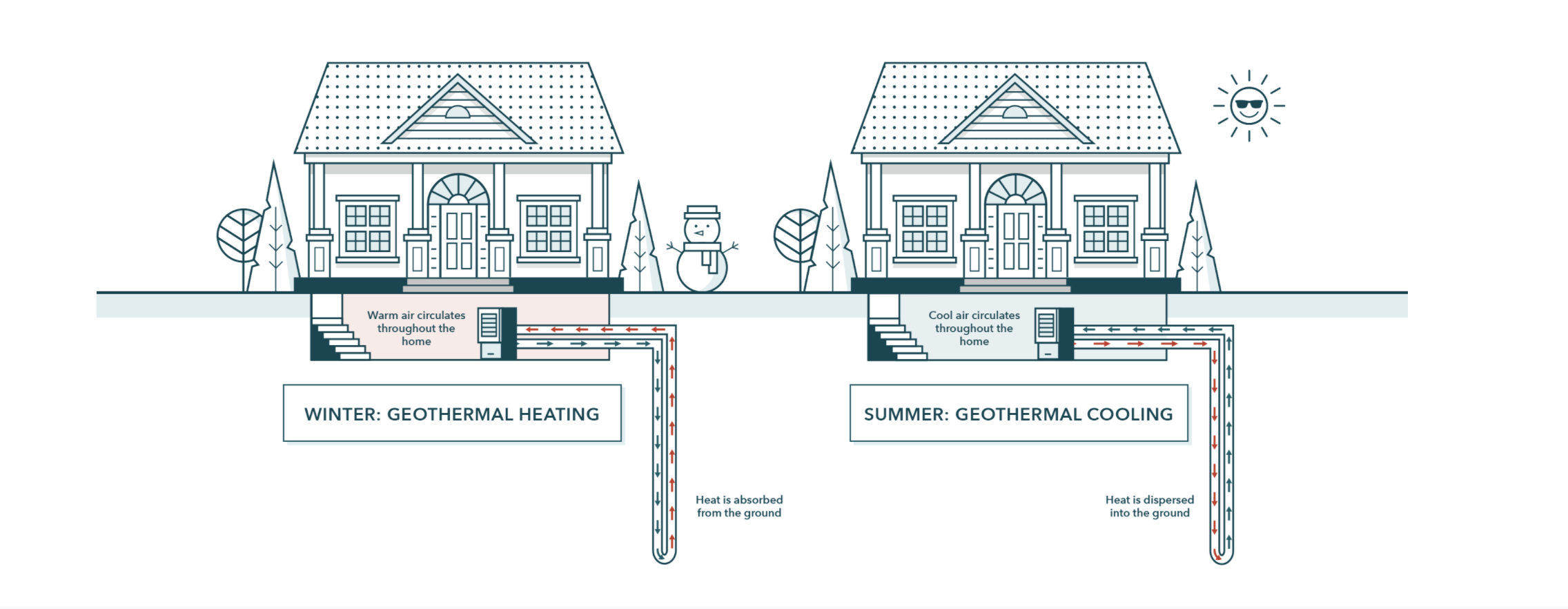
Dandelion Energy heating and cooling system. Image Credit: Dandelion Energy
Dandelion’s system also includes a smart remote monitoring system that collects and stores data. The data is then uploaded about every 10 seconds and is monitored by Dandelion engineers, the company said. This means any potential problems will be caught immediately and a repair man can be sent to the homeowner’s house before the customer is even aware there might be an issue.
The company’s executives argue that massive adoption of their home heating and cooling systems represent a vital part of any energy transition away from fossil fuels, chiefly because electric heating systems are inefficient.
“If we had a grid that was large enough to renewable supply electricity and not worry about the efficiency of the electricity demand we’d be in an amazing spot,” Sachse said. “Realistically to electrify the grid we need to triple our capacity while becoming more efficient. I don’t see how we get there without as part of that journey finding more sustainable ways to heat our homes.”
Geothermal home heating would certainly go a long way toward stabilizing the grid, according to Hannun
“Already air conditioners that are more efficient are putting enormous strain on the grid. Drives fuel use and transition challenges. The benefits of geothermal because of that connection to the ground is really moving out the demand peak,” she said. “The technology has a lot of benefits that it confers to the grid and help it operate much better. Which is one reason why we’ve seen utilities in New York embrace this technology and really become its champion.”
Breakthrough Energy Ventures is wholeheartedly on board with Dandelion’s solution.
“Through a combination of technology, data and operations, Dandelion is making geothermal heating and cooling cost-effective for the residential market, and working to solve a critical need for homeowners and our energy ecosystem,” said Carmichael Roberts, Breakthrough Energy Ventures, in a statement. “Dandelion’s geothermal heat pumps provide an efficient electric heating and cooling system that lowers the cost of heating and cooling for homeowners, no matter their region or climate. We’re looking forward to working with Dandelion as they look to fully displace fossil fuels from the home’s heating and cooling systems.”
TigerGraph, a well-funded enterprise startup that provides a graph database and analytics platform, today announced that it has raised a $105 million Series C funding round. The round was led by Tiger Global and brings the company’s total funding to over $170 million.
“TigerGraph is leading the paradigm shift in connecting and analyzing data via scalable and native graph technology with pre-connected entities versus the traditional way of joining large tables with rows and columns,” said TigerGraph found and CEO, Yu Xu. “This funding will allow us to expand our offering and bring it to many more markets, enabling more customers to realize the benefits of graph analytics and AI.”
Current TigerGraph customers include the likes of Amgen, Citrix, Intuit, Jaguar Land Rover and UnitedHealth Group. Using a SQL-like query language (GSQL), these customers can use the company’s services to store and quickly query their graph databases. At the core of its offerings is the TigerGraphDB database and analytics platform, but the company also offers a hosted service, TigerGraph Cloud, with pay-as-you-go pricing, hosted either on AWS or Azure. With GraphStudio, the company also offers a graphical UI for creating data models and visually analyzing them.
The promise for the company’s database services is that they can scale to tens of terabytes of data with billions of edges. Its customers use the technology for a wide variety of use cases, including fraud detection, customer 360, IoT, AI, and machine learning.
Like so many other companies in this space, TigerGraph is facing some tailwind thanks to the fact that many enterprises have accelerated their digital transformation projects during the pandemic.
“Over the last 12 months with the COVID-19 pandemic, companies have embraced digital transformation at a faster pace driving an urgent need to find new insights about their customers, products, services, and suppliers,” the company explains in today’s announcement. “Graph technology connects these domains from the relational databases, offering the opportunity to shrink development cycles for data preparation, improve data quality, identify new insights such as similarity patterns to deliver the next best action recommendation.”
Source: https://techcrunch.com/2021/02/17/tigergraph-raises-105m-series-c-for-its-enterprise-graph-database/
Hardware may indeed be hard, but a startup that’s built a platform that might help buck that idea by making hardware a little easier to produce has announced some more funding to continue building out its platform.
Fictiv, which positions itself as the “AWS of hardware”, providing a platform for those wanting to design and manufacture items, to easily evaluate and order the manufacturing, and subsequent movement of those goods, has raised $35 million.
It will be using the money to continue building out its platform and the supply chain that underpins Fictiv’s business, which the startup describes as the “Digital Manufacturing Ecosystem.”
David Evans, the CEO and founder, said that the focus of the company has been and will continue to be jobs that are highly specialised, and ultimately not mass-produced items, such as prototypes or objects that are specialised and by their nature not aimed at mass markets, such as particular medical devices.
“We are focused on 1,000 to 10,000,” he said in an interview. “This is the range where most products still die.”
The round — a Series D — is coming from a mix of strategic and financial investors. Led by 40 North Ventures, it also includes Honeywell, Sumitomo Mitsui Banking Corp., Adit Ventures, and M20 (Microsoft’s strategic investment arm), as well as past backers Accel, G2VP, and Bill Gates.
The round brings the total raised by Fictiv to $92 million, and its valuation is not being disclosed
Evans said that the last couple of years since its previous round ($33 million raised in early 2019) have well and truly tested the business concept that he envisioned when first establishing the startup.
Even before the pandemic, “we had no idea what the trade wars between the U.S. and China would do.”
Quite abruptly, the supply chain got completely “crunched, with everything shut down” in China over those disputes, at which point, Fictiv shifted manufacturing to other parts of Asia such as India, and to the U.S. That ended up helping the company when the first wave of Covid-19 hit, initially in China.
Then came the global outbreak, and Fictiv found itself shifting yet again as plants shut down in the countries where it had recently opened. Then, with trade issues cooled down, Fictiv again reignited relationships and operations in China, where Covid had been contained early, to continue working there.
“I guess we were just in the right places at the right time,” he said.
The startup made its name early on with building prototypes for tech companies neighboring it in the Bay Area, startups build VR and other gadgets, with services that included injection molding, CNC machining, 3D printing and urethane casting, with customers using cloud-based software to design and order parts, which then were routed by Fictiv to the plants best suited to make them.
These days, while that business continues, Fictiv is also working with very large global multinationals on their efforts with smaller-scale manufacturing, products that are either new or unable to be tooled as efficiently in their existing factories.
Work that it does for Honeywell, for example, includes mostly hardware for its aerospace division. Medical devices and robotics are two other big areas for the company currently, it said.
But Evans and his investors are careful not to describe what they do as specifically industrial technology.
“Industrial tech is a misnomer. I think of this as digital transformation, cloud-based SaaS and AI,” said Marianne Wu, the MD of 40 North. “The baggage of industrial tech tells you everything about the opportunity.”
Fictiv’s pitch is that by taking on the supply-chain management of producing hardware for a business, it can produce hardware using its platform in a week, a process that might have previously taken 3 months to complete, which can mean lower costs and more efficiency.
“And when you speed up development, you see more products getting introduced,” he said.
There is still a lot of work to be done, however. One of the big sticking points in manufacturing has been the carbon footprint that it creates in production, and also in terms of the resulting goods that are produced.
That will likely become even more of an issue, if the Biden Administration follows through on its own commitments to reduce emissions and to lean more on companies to follow through for those ends.
Evans is all too aware of that issue and accepts that manufacturing may be one of the hardest to shift.
“Sustainability and manufacturing are not synonymous,” he admits. And while materials and manufacturing will take longer to evolve, for now, he said the focus has been on how to implement better private and public and carbon credits programs. He envisions a better market for carbon credits, he said, with Fictiv doing its part with the launch of its own tool for measuring this.
“Sustainability is ripe for disruption, and we hope to have the first carbon-neutral shipping program, giving customers better choice for more sustainability. It’s on the shoulders of companies like us to drive this.”
Source: https://techcrunch.com/2021/02/17/fictiv-nabs-35m-to-build-out-the-aws-of-hardware-manufacturing/
Millions of Americans live paycheck to paycheck, and struggle to get out of a debt cycle.
One startup is developing financial products targeted toward this segment of the population, with the goal of helping them build credit, save money, access funds and plan for the future.
That startup, SeedFi, announced Wednesday it has raised $50 million in debt and $15 million in an equity funding round led by Andreessen Horowitz, also known as a16z. The VC firm also led SeedFi’s $4 million seed funding when it was founded in March of 2019.
Flourish, Core Innovation Capital and Quiet Capital also participated in the latest financing.
SeedFi was founded on the premise that it is difficult for many Americans to get ahead financially. Its founding team has worked at both startups and big banks, such as JPMorgan Chase and Capital One, and operates under the premise that many legacy financial institutions are simply not designed to help Americans who are struggling financially to get ahead.
“We’ve seen firsthand how the system has been designed for underprivileged Americans to fail,” said Jim McGinley, co-founder and CEO of SeedFi. “Our average customer earns $50,000 a year, yet they pay $460 a year in overdraft fees and payday loan companies charge them APRs of 400% or more. They barely make enough to cover their expenses and any misstep can set them back for years.”
In previous roles, McGinley was responsible for payday loans for underserved communities.
“There I got insights to the financial difficulties they had and the need for better products to help them get a step up,” he told TechCrunch.
Co-founder Eric Burton said he can relate because he grew up in Central Texas as part of “a super poor family.”
“I experienced all the struggles of being low income and the necessity of taking on high-priced credit to get through day to day,” he recalled. “I personally was trapped in a debt cycle for a long time.”
In fact, a job offer he got from Capital One was temporarily rescinded because the company said he had “bad credit,” which turned out to be a result of unpaid medical bills he’d incurred at the age of 18.
“I didn’t know about them, but was able to get the job after using my signing bonus to pay off that debt,” he said. “So I can understand how a certain starting point makes it very hard to progress.”
SeedFi’s goal is to tackle the root of the problem. It launched in private beta in 2019, and helped its initial customers build more than $500,000 in savings — even during the COVID-19 pandemic.
Now, it’s launching to the public with two offerings. One is a credit building product that is designed to “create important long-term savings habits.” Customers save as little as $10 from every paycheck, which is reported to the credit bureaus to build their credit history, and are then able to generate $500 in savings in six months’ time.
After six months of on-time payments, SeedFi customers with no credit history were able to establish a credit score of 600, while customers with existing credit scores and less than three credit accounts boosted their scores by 45 points, according to the company.
The concept of enabling consumers to build credit history beyond traditional methods is becoming increasingly more common. Just last week, we wrote about Tomo Credit, which provides customers with a debit card so they can build credit based on their cash flow.
SeedFi’s other offering, the Borrow & Grow Plan, is designed to be a more affordable alternative to installment or payday loans. It provides consumers with “immediate access” to funds while also helping them build savings and credit.
Andreessen Horowitz general partner Angela Strange , who has joined SeedFi’s board with the financing, believes there’s “a massive business opportunity for new financial services entrants to reach historically underserved populations through better product experiences, underwriting and technology.”
In a blog post, she shares an example of how SeedFi works. The company evaluates risk and extends credit to a customer that might be traditionally hard to underwrite. It determines how much to lend, as well as the proportion of dollars to give as money now versus savings.
“For instance, a typical SeedFi plan might be structured as $500 right now and $500 reserved in a savings account. The borrower pays off $1,000 over time, and at the end of the plan, he or she has $500 in a savings account. Not only has the borrower paid a lower interest rate, he or she is in a better financial position after making the decision to borrow money,” Strange writes.
Looking ahead, SeedFi plans to use its new capital to build out its product suite and grow its customer base.
“We will be able to more efficiently fund our growing loan portfolio and serve more customers,” McGinley said.
Certific, a health tech startup co-founded by TransferWise’s Taavet Hinrikus, is breaking cover today with the launch of what it claims is the first “certified” remote COVID-19 testing service.
The British-Estonian company is using techniques borrowed from the worlds of fintech and telemedicine, including asking users to film themselves while taking the at-home test, in a bold attempt to solve remote testing’s adherence and trust problem.
Initially targeting private individuals and businesses in the U.K., with other markets to follow, tests can be ordered online and are carried out remotely with the promise of a certified result the following day for PCR tests and in under 90 minutes for antigen tests.
More broadly, the Certific app and user journey is designed to increase trust in remote testing and ensure that self-performed tests reach the same standard as those carried out in a clinical setting.
“When the pandemic hit, we started toying around with the first finger prick tests to see if you have antibodies, and thinking, ‘hey, is there a way to make use of these to help the world along,’ ” Hinrikus told me during an interview earlier this week. “[But] then it turned out that these kind of antibody tests, and the end immunity, was a very unclear concept. And so we kind of put it on hold, but we kept on thinking about what better things we can do to make testing more trustworthy and easier”.
Then late last year he and Certific’s other co-founders — physician Dr. Jack Kreindler and CEO Liis Narusk — realised that there were things “that we can and should be doing to come up with a more democratised way of medical testing, and apply this to the pandemic”.
Hinrikus doesn’t quite say it, but as the founder of TransferWise and a prolific angel investor, including backing Estonian verification platform Veriff, there’s little doubt that Certific is partly inspired by the authentication techniques that have gained prominence in fintech, such as video selfies used to onboard new customers at digital banks. In addition, medical director Kreindler has experience with anti-doping in close-combat sports.
Coupled with more traditional identity checks, the Certific app asks you to film yourself while you take the test. The recording and test result is securely uploaded to Certific and checked by a qualified physician to ensure you have adhered to the manufacturer’s instructions properly. A medical certification containing the test result is then delivered back to the app. PCR tests cost £64, and the soon to be available rapid antigen tests will be sold in 12-packs for £249 (making the price of a single antigen test £20.75).
But how easy would it be to cheat the test and therefore fake a result? “That’s one thing we definitely are very, very focused on solving,” says Certific CEO Narusk. “Our experience in all the anti-fraud and anti-cheat areas means that we went far and beyond to make sure that you can’t actually tamper with the process. So when you record the video, and after you have recorded the video, it is checked by our test verification officers who make sure that you haven’t moved the tests away from the screen”.
In addition, Certific ensures that the test you have used is actually the test that you ordered and contains the same unique ID, and that you are the person who was supposed to do the test.
That in itself isn’t entirely fraud proof, and Hinrikus clarifies that Certific is initially focusing on ensuring that a test is carried out medically correctly. He says that a higher-priced tier will be offered at a later stage with enhanced video verification, such as a live operator acting as a witness.
This could be particularly useful for businesses, such as live events or travel, where there could be incentives for individuals to cheat and where operators may be required to prove to insurance companies or government authorities that they are COVID-19 safe.
Kreindler, Certific’s medical director, contrasts this with key workers that are currently permitted by U.K. authorities to carry out coronavirus home-testing without any additional verification, but who aren’t nearly as likely to want to fake a result.
“If you think about it, those public servants are not at a great disadvantage if they test positive, because they still get paid. So there’s less of an incentive to cheat. And the challenge comes where you are doing point of care testing in an environment where there actually is some incentive or a big disadvantage [to testing positive]”.
Kreindler also says it’s not just about individuals and that Certific has worked with academics in Estonia, North America and in the U.K. to develop a computational risk model for mass testing for “super spreader” environments, such as large events. People will not only be able to take a test at home before attending, but a risk model that continually learns and takes into account “democratised decentralised testing” and an understanding of vaccination and immunity, could enable further mitigations to be put in place to make sure there’s no net spread of the virus back into the community. “That’s very core to our thinking going forward,” he says. “It’s not just about certifying testing, it’s also about certifying crowds”.
Zooming out even further — and beyond the current coronavirus pandemic — Certific has been built to be entirely test agnostic. Combining speed, convenience, adherence and trust, the company aims to be the rails on which existing and future home tests can run (my words, not theirs). In the future, this could span testing for sexually transmitted diseases (SDIs) to anti-doping tests in sports. And, of course, new types of COVID-19 tests as they come on stream.


