& meet dozens of singles today!
User blogs



Planted, a startup pursuing a unique method of creating a vegetarian chicken alternative, has raised an $18M (CHF 17M) Series A to expand its product offerings and international footprint. With new kebabs and pulled-style faux meats available and steak-like cuts in the (literal) pipeline, Planted has begun to set its sights outside central Europe.
The company was a spinout from ETH Zurich and made its debut in 2019, but has not rested on the success of its plain chicken recipe. Its approach, which relied on using pea protein and pea fiber extruded to recreate the fibrous structure of chicken for nearly 1:1 replacement in recipes, has proven to be adaptable for different styles and ingredients as well.
“We aim to use different proteins, so that there is diversity, both in terms of agriculture and dietary aspects,” said co-founder Christoph Jenny.

Image Credits: Planted
“For example our newly launched planted.pulled consists of sunflower, oat and yellow pea proteins, changing both structure and taste to resemble pulled pork rather than chicken. The great thing about the sunflower proteins, they are upcycled from sunflower oil production. Hence, we are establishing a circular economy approach.”
When I first wrote about Planted, its products were only being distributed through a handful of restaurants and grocery stores. Now the company has a presence in more than 3,000 retail locations across Switzerland, Germany, and Austria, and works with restaurant and food service partners as well. No doubt this strong organic (so to speak) growth, and the growth of the meat alternative market in general, made raising money less of a chore.
The cash will be directed, as you might expect for a company at this stage, towards R&D and further expansion.
“The funding will be used to expand our tech stack, to commercialize our prime cuts that are currently produced at lab scale,” said Jenny. “On the manufacturing side we look to significantly increase our current capacity of half a ton per hour to serve the increasing demand coming from international markets, first in neighboring countries and then further into Europe and overseas.”
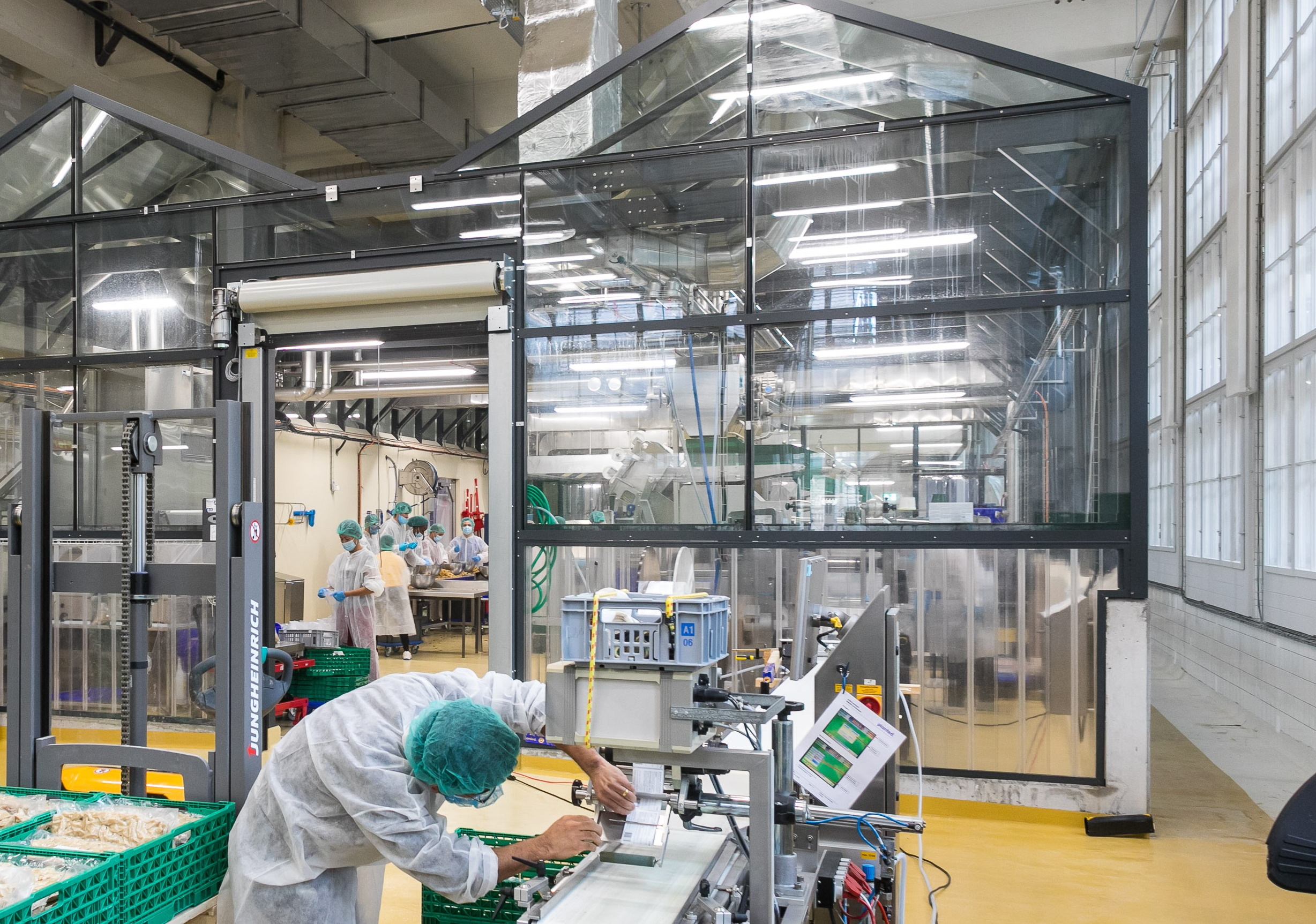
Image Credits: Planted
“We will further invest in our structuring and fermentation platforms. Combining structuring technologies with the biochemical toolboxes of natural microorganisms will allow us to create ultimately new products with transformative character – all clean, natural, healthy and tasty,” said co-founder Lukas Böni in a press release.
No doubt this all will also help lower the price, a goal from the beginning but only possible by scaling up.
As other companies in this space also raise money (incidentally, rather large amounts of it) and expand to other markets, competition will be fierce — but Planted seems to be specializing in a few food types that aren’t as commonly found, at least in the U.S., where sausages, ground “beef,” and “chicken” nuggets have been the leading forms of meat alternatives.
No word on when Planted products will make it to American tables, but Jenny’s “overseas” suggests it is at least a possibility fairly soon.
The funding round was co-led by Vorwerk Ventures and Blue Horizon Ventures, with participation from Swiss football (soccer) player Yann Sommer and several previous investors.
The clock has officially started ticking on Deliveroo’s plans to go public in April. After announcing last week that it planned to list on the London Stock Exchange, today the on-demand food delivery company backed by Amazon and others published selected updated financials for the previous fiscal year, along with its Expected Intention to Float (EITF) — a more formal document that marks the two-week period until the company publishes its prospectus and, at the start of April, embarks on its subsequent IPO.
The bottom line is that Deliveroo is still unprofitable. It posted a 2020 underlying loss of £223.7 million ($309 million), but that figure was down by nearly £100 million from 2019, when it chalked up a loss of £317 million ($438 million). It did not disclose revenues (sometimes called turnover) in today’s statement.
The company said that it now serves some 6 million customers, with its three-sided marketplace also including more than 115,000 restaurants, takeaways and grocery stores, and 100,000 riders in 800 locations among 12 markets.
At the same time, Deliveroo showed some clear momentum in a year where many restaurants had to close their doors and shift operations to take-away models because of Covid-19.
It notes that it has been profitable on an “Adjusted EBITDA basis” over two quarters, with underlying gross profit up by 89.5% to £358 million ($495 million) compared to £189 million in 2019.
Its gross transaction volume (total amount spent by consumers ordering food) grew by 64% to £4.1 billion ($5.67 billion) with the run-rate in Q4 surging to £5 billion. This figure is unsurprising when you consider that Q4 represented the holiday period, and additionally the UK market (Deliveroo’s primary market and its home) went through not one but two different periods of being locked down in that quarter (the second of these is still in place).
It also notes that gross profit margin as a percentage of GTV has grown from 5.8% in 2018 to 8.8% in 2020, with some markets getting to 12%.
“The company remains focused on investing in driving growth in a nascent online food market,” it noted in the EITF, although I’m not sure nascent is exactly the word I’d use. Its drivers are easily the most visible of the many delivery services that exist in London. Deliveroo estimates that the restaurant and grocery sectors represent an addressable market of £1.2 trillion ($1.66 trillion) across the 12 regions where it offers services. In that figure, it says that just 3% of sales are estimated to be online, “equivalent to less than 1 out of the 21 weekly meal occasions being online.”
The company was valued at over $7 billion in it last fundraising, a $180 million round from Durable, Fidelity and others, as recently as January of this year.
It’s a huge leap that is the stuff that tech myths are made of (with untold hours of blood, sweat and tears, and a lot of luck too). I met Will Shu, the CEO and founder, when he was just really getting started at Deliveroo, and he seemed somewhat bewildered by how fast the startup was growing and where it was leading him. It’s interesting that he himself hasn’t forgotten those early days, either, which surely help keep the company focused at a time when there are a lot of opportunities, and therefore a lot of potential for focus unravelling.
“I never set out to be a founder or a CEO. I was never into start-ups, I didn’t read TechCrunch. I’m not one of those Silicon Valley types with a million ideas,” he noted in his letter published in the EITF. “I had one idea. One idea born out of personal frustration. An idea that I was fanatically obsessed with: I wanted to get great food delivered from amazing London restaurants.”
The prospectus will tell us how much the company intends to raise in its IPO so we’ll know those numbers soon. In the meantime, Deliveroo said that it plans to “invest in its long-term proposition by developing its core marketplace, enhancing its superior consumer experience, providing restaurant and grocery partners with unique tools to help them grow their businesses, and providing riders with the flexible work they value alongside security.”
It’s also going to continue building out “dark kitchens” (which it brands Editions); Signature, a white-label service for restaurants to offer delivery via their own online channels; Plus, a Prime-style loyalty subscription service; and on-demand grocery — which is also shaping up to be a huge market in Europe and the rest of the world.
Rimac Automobili, the Croatian company known for its electric hypercars and battery and powertrain development, has gained yet another investment from Porsche AG.
Porsche said Monday it has invested 70 million euros ($83.3 miilion) into Rimac, a move that increases its stake from 15% to 24%.
This is the third time Porsche has invested into Rimac. The German automaker made its first investment into Rimac in 2018. Porsche increased its equity stake into Rimac in September 2019. A few months earlier, Hyundai Motor Company and Kia Motors jointly invested €80 million ($90 million at the time) into Rimac.
Rimac was founded by Mate Rimac in 2009 and is perhaps best known for its electric hypercars, such as the two-seater C Two that it debuted in 2018 at the Geneva International Motor Show. The vehicle produces an eye-popping 1,914 horsepower, has a top speed of 256 miles per hour and can accelerate from 0 to 60 mph in 1.85 seconds. Rimac plans to unveil C Two in its final form in 2021.
However, Rimac does more than produce hypercars. The company, which employs 1,000 people, also focuses on battery technology within the high-voltage segment, engineers and manufactures electric powertrains and develops digital interfaces between humans and machines.
Porsche is most interested in Rimac’s development of components, according to comments made by Lutz Meschke, the deputy chairman of Porsche AG’s executive board. Meschke noted that Rimac is “excellently positioned in prototype solutions and small series” and “is well on its way to becoming a Tier 1 supplier for Porsche and other manufacturers in the high-tech segment.”
Porsche has already placed its first orders with Rimac for the development of highly innovative series components, according to Meschke.
Despite its continued investments, Porsche said it doesn’t have a controlling stake in Rimac.
One of the few industries that have benefited from the COVID-19 crisis is online finance. Around the world, the pandemic has forced consumers to adopt digital banking. Hong Kong’s WeLab, a fintech company founded in 2013, saw users soar by 20% year-over-year in 2020, bringing its accumulative user base to 50 million.
Facing innovative players like WeLab, which aims to bring more convenience, transparency, and affordability to consumers, financial incumbents feel compelled to reinvent themselves. That’s in part why Allianz X, a venture capital arm of the 131-year-old European financial conglomerate Allianz, led WeLab’s latest funding round of $75 million. The Series C1, which involved other investors, followed WeLab’s $156 million Series C round in late 2019.
“Obviously, Allianz is one of the largest asset managers and insurers in the world with a strong presence and solid footprint,” co-founder and CEO Simon Loong told TechCrunch during an interview.
Loong declined to disclose WeLab’s latest valuation but said the number has gone up since the firm last reached the $1 billion unicorn status.
When WeLab set out to build a digital bank, which launched in Hong Kong last year, one of the products it had in mind was “a new generation of wealth advisory on digital banks.”
“Allianz saw what we did over the last couple of years and identified this very interesting opportunity to co-develop a wealth technology for digital banks, so they came to us and said, why don’t they lead the round?” Loong explained.
Through the strategic investment, the partners will jointly develop and distribute investment and insurance solutions across Asia. Those products will diversify Welab’s current offerings, including a virtual bank and a lending product in Hong Kong, as well as several types of lending services in mainland China and Indonesia. Around 47 million of its total users are in mainland China, 2.5 million in Indonesia, and less than one million in Hong Kong, a city with a 7.5 million population.
“It’s an interesting four-way cooperation,” said Loong, referring to the roles of Allianz as an asset management and insurance firm, and WeLab as a bank and fintech solution provider. “I think it will really be an interesting inflection point for the company to scale.”
Working with titans
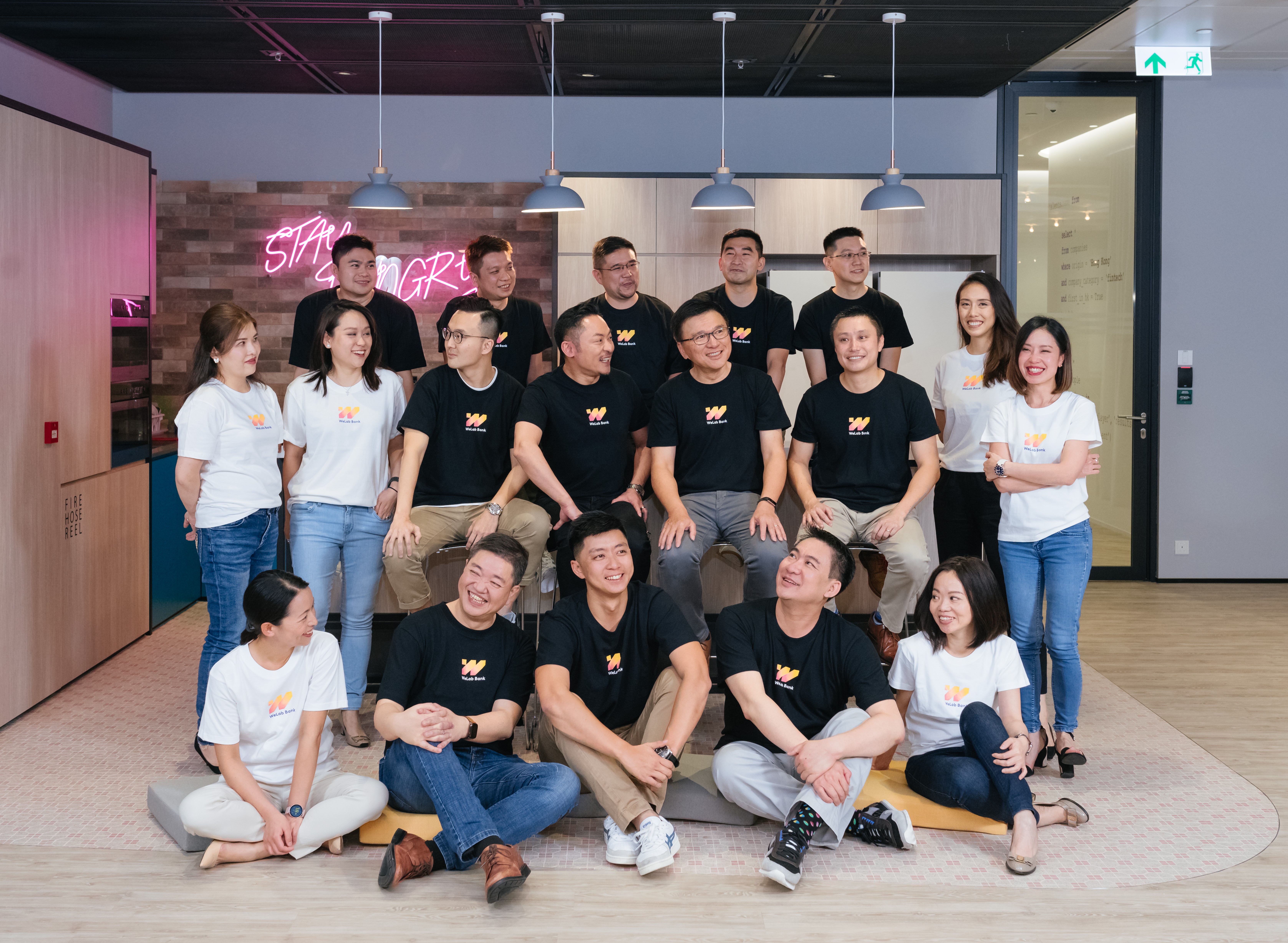
The WeLab team
Equally important to WeLab’s revenue is enterprise services, according to Loong, which are helping conventional banks and financial institutions build up a digital presence. The strategy is not unlike Ant Group’s effort to be an “enabler” for traditional financial players.
In spite of the massive combined market share of Ant and Tencent in China’s fintech market, there remains room for smaller and more specialized players like WeLab. To date, WeLab has attracted about 600 enterprise customers, most of whom are in mainland China.
“[We have] an interesting dynamics with Ant,” said Loong, when asked how WeLab wrestles with a goliath like Ant, whose e-commerce affiliate Alibaba is an investor in WeLab through the Alibaba Hong Kong Entrepreneurs Fund.
“There are businesses where we compete, and there are also areas where we work well together,” he added. For example, WeLab introduced one of the first smartphone leasing services on Alipay, Ant’s flagship app that works as a marketplace for third-party financial products and end consumers. But Ant also has its own in-house financial products, which could clash with outside suppliers peddling on its marketplace.
“In short, I would say that because we are a rather independent company, we work with everyone,” Loong asserted.
Greater Bay links
As a Hong Kong-founded firm, WeLab has actively taken part in the Chinese government’s push to integrate what’s dubbed the Greater Bay Area, which spans the two special administrative regions of China, Hong Kong and Macau, and nine cities in the southern province of Guangdong, including Shenzhen.
An objective of the GBA blueprint is to encourage cross-border talent flow. In a way, the area has all the right conditions to run a fintech startup, which would gain access to technological and banking talents respectively in Shenzhen and Hong Kong, two adjoining cities. WeLab has done exactly that, with a larger base of tech staff in Shenzhen compared to its Hong Kong office which has more finance professionals. It’s planning to add around 100 hires this year to its 800-person headcount.
Aside from shared talent pools, Beijing also wants to encourage more financial integration in the GBA. WeLab has taken notice and plans to roll out its forthcoming wealth management products first in Hong Kong and later into other parts of the GBA through the government-supported scheme called the Wealth Management Connect, which allows residents of Hong Kong and Macau to invest in wealth management products distributed by mainland banks in the GBA. Vice versa, residents in the mainland GBA cities will be able to buy wealth management products in Hong Kong and Macau.
“Hong Kong is a great testbed, but for online business, you need to subject your successful business model to a large population,” said Loong, explaining the company’s expansion plan. “The Greater Bay Area gives us the opportunity to do so. There is a 72 million population with a GDP of $1.7 trillion, which is larger than South Korea… Naturally, it is a good area to scale.”
WeLab was looking to go public back in 2018 but halted the plan because “we didn’t feel that it was the right market window to do this,” Loong recalled. The company was also in the process of securing a banking license, so it decided to work on the critical permit before going public.
“Obviously if you look now, it’s very hot in terms of the equity market,” said Loong. “So we are talking to a lot of people. We keep a close eye on this and we are always open-minded to explore the next right market window for us.”


