& meet dozens of singles today!
User blogs

Remix, the startup that developed mapping software used by cities for transportation planning and street design, was born out of a hackathon during a Code for America fellowship. Nearly seven years later, the San Francisco-based startup is being acquired by Via for $100 million in cash and equity.
Remix will become a subsidiary of Via, an arrangement that will let the startup maintain its independent brand. Remix’s 65 employees and two of its co-founders — CEO Tiffany Chu and CTO Dan Getelman — will stay on.
The acquisition adds yet another service to Via’s ever-expanding business as well as customer base of more than 350 local governments in 22 countries.
Remix’s strength is in planning, while Via brings expertise in software and operations, Chu said in a recent interview.
“By having those two strengths come together, we can be much stronger as an end-to-end solution — from the initial genesis of this idea around transportation planning and carrying that through to operations — in a way that we, individually, would not have been able to achieve otherwise,” Chu said.

Image Credits: Remix
Via started as a on-demand shuttle operator in 2012. The company, which last year hit a $2.25 billion valuation after raising $400 million in a Series E round, has evolved from its initial consumer-facing focus.
Today, Via’s core business is its software and operations platform, which is used by cities and transportation authorities to plan, schedule and deploy their own on-demand and fixed route transit, paratransit and school buses. Via has 200 partners in 24 countries.
Via is backed by Exor, the Agnelli family holding company that owns stakes in PartnerRe, Ferrari and Fiat Chrysler Automobiles as well as Macquarie Capital, Mori Building, Shell 83North, Broadscale Group, Ervington Investments, Hearst Ventures, Planven Ventures, Pitango and RiverPark Ventures.
Accidental founders
Remix’s Silicon Valley-esque origin story was driven by some unlikely entrepreneurs.
Chu had been a user experience designer at Zipcar when she moved to San Francisco to complete a one-year fellowship with Code for America. In the middle of the fellowship, Chu along her eventual co-founders Getelman, Sam Hashemi and Danny Whalen were working on a hackathon project that to help citizens of San Francisco suggest better transit routes to the San Francisco Municipal Transportation Agency.
The transportation planning tool was shared on Twitter and it went viral. Within two weeks, 30,000 maps had been created.
“It became this funny, unexpected armchair transportation planning tool that people explored online,” Chu recalled. But it wasn’t just the local citizenry who took notice. About 200 urban planners reached out, asking the team to build extra features that could be used by agencies for their own transportation planning projects.
“It was kind of a mind blowing moment for us when we realized the project that was supposed to be a grassroots kind of civic project actually had implications around solving real needs and problems in transportation,” Chu said.
Remix was founded shortly after and the company’s founders applied and were accepted into Y Combinator. The company went on to raise a total of $27 million in investments from Y Combinator, Sequoia and Energy Impact Partners.
Apple is beginning to assemble the iPhone 12 in India as it ramps up its production capacity in the world’s second largest smartphone market. Foxconn, a contract manufacturing partner of Apple, is assembling the iPhone 12 model — though currently no other iPhone 12 model — Pro and Pro Max, and Mini — in the country.
The move underscores how India is emerging as a big production hub for global smartphone makers. Samsung, Xiaomi, Oppo, Vivo, and OnePlus have been assembling their smartphone models in India for more than half a decade and have increased their production capacities in recent years.
To attract global giants, New Delhi has been offering tax benefits to firms that locally produce in India and in recent quarters has significantly increased the perks.
“We are optimistic and looking forward to building a strong ecosystem across the value chain and integrating with the global value chains, thereby strengthening electronics manufacturing ecosystem in the country,” said India’s IT Minister Ravi Shankar Prasad last year.
Apple began locally assembling select iPhone models in India in 2017 — beginning with the iPhone SE — though for the initial years the company’s contract partners locally produced only older iPhone models in the country.
Analysts have estimated that Apple, which launched its online store in India last year and is working to set up its first physical retail store in the country this year, plans to move between seven to 10% of its iPhone production to India as it looks to cut reliance on China. TechCrunch understands the figure is “wild speculation.”
The iPhone maker suffered a setback in India late last year after a violent protest broke at a facility in Wistron, one of its key manufacturing partners of Apple, near Bangalore last year. But the Taiwanese firm appears to have resolved the issues. It said last month that it was rehiring workers and will soon be resuming production at its facility.
“Apple is dedicated to making the best products and services in the world to delight our customers. We are proud to be starting production of iPhone 12 in India for our local customers,” said an Apple spokesperson in India in a statement.
Apple assumes just 2% of the Indian smartphone market, but it has grown in recent quarters. Apple shipped more than 1.5 million iPhone units in India in the quarter that ended in December, up 100% year-on-year, making this its best quarter in the world’s largest smartphone market to date, according to research firms Counterpoint and CyberMedia Research.
Unlike several foreign firms that offer their products and services at low prices in India, Apple has focused entirely on a small fraction of the population that can afford to pay big bucks, said Jayanth Kolla, chief analyst at Convergence Catalyst. And while it took several years, Apple has carved out a slice of the market that is growing, he said.
The team behind Songclip thinks that social media could use more music.
Yes, music is a big part of the experience on a handful of apps like TikTok and Triller, but Songclip co-founder and COO John vanSuchtelen told me, “That is not the end of how music is going to be a feature, that is a beginning.”
He added, “In the next nine to 12 months … just like you never have a phone without a camera, you’re not going to have an app without music clips as a feature when you make videos.”
That’s what vanSuchtelen and his co-founder and CEO Andy Blacker are hoping to enable with Songclip, which announced today that it has raised $11 million in new funding.
The startup has created an API that, when integrated with other apps (current integrations include photo- and video-editing app PicsArt), allows users to search for and share music. VanSuchtelen said that like Giphy, Songclip plans to popularize a new media format — the short audio clip — and make it accessible across a wide range of services.
“If I were to say, I’m going to send you a four-minute song,’ it’s just not going to work that way, that’s not how we communicate anymore,” vanSuchtelen said. “How do you take the music and turn it into the bite that you want to use in a social context?”
To do this, Blacker said Songclip doesn’t just license music, it also does its own tagging and clipping, while offering tools for music labels to protect their intellectual property and providing data on how people are interacting with the music. And unlike Giphy, Songclip isn’t looking to build a consumer brand.
All of this involves a combination of human editors and technology. Blacker said the human element is key to understand the nuances of songs and their association, like the fact that Simon & Garfunkel’s “Bridge Over Troubled Water” isn’t really about bridges or water, or that Katrina and the Waves’ “Walking on Sunshine” is a happy song even though it doesn’t have the word “happy” in it.
Songclip has now raised a total of $23 million. The new round was led by Gregg Smith of Evolution VC Partners. The Kraft Group, Michael Rubin, Raised in Space, Gaingels and Forefront Venture Partners also participated, as did industry executives Jason Flom and Steve Greenberg and the band AJR.
Beyond Meat shares soared today on the heels of an announcement that Walmart is beefing up its relationship with the purveyor of meatless protein patties, sausages, and balls.
900 stores will now be stocking Beyond Meat’s hot Italian sausages and its party packs of beefless burgers — those grilling delectations for the omnivores, vegetarians and vegans who no longer want to ask “Where’s the beef?”
Beyond Meat’s increased distribution at Walmart stores is the second jump in production over the past year and part of the company’s efforts to lock down the market for plant-based meat substitutes.
The company’s foods are now sold in over 28,000 stores, and it’s also pulling ahead in the food service industry, where it recently announced deals with Yum Brands and McDonalds.
Shares of the company’s stock ended the day up 3.16% or $4.28 as investors ate up the news.
“We are thrilled by the continued growth with Walmart and the opportunity to offer Walmart customers increased accessibility to a larger selection of our delicious and better-for-you plant-based products,” said Chuck Muth, Chief Growth Officer, Beyond Meat. “As more households continue to buy our products and buy them more frequently, we’re excited to satisfy the growing demand through increased product offerings and distribution.”
The partnership with Walmart, which dates back to 2015 is significant, but not nearly as attention grabbing as the company’s elaboration on recent agreements with McDonalds and Yum! Brands — the brains behind KFC and the two franchises that launched America’s greatest fast food hip hop anthem.
In late February, Beyond Meat opened up about its deals with Yum! Brands and McDonald’s that would see the company work to co-create plant-based protein menu items for KFC, Pizza Hut, and Taco Bell along with the famous golden arches fo McDonald’s.
That details of the agreement withYum! included the expansion of testing the company’s Beyond Fried Chicken in other U.S. cities with KFC. And the launch of the Beyond Italian Sausage Pizza and the Great Beyond Pizza nationwide, becoming the first national pizza chain to introduce a plant-based meat pizza coast-to-coast, the company’s said in a statement at the time.
The McDonald’s announcement fleshed out the meatless details of a partnership that was previously announced when the fast food giant unveiled its McPlant sandwich — a kind of face plant for Beyond given that it couldn’t confirm the details of the agreement at the time.
Now, other plant-based menu items — including options for chicken, pork, and egg products, have been unveiled as part of the broader McPlant platform, the companies said in February.
“Our new McPlant platform is all about giving customers more choices when they visit McDonald’s,” said Francesca DeBiase, McDonald’s Executive Vice President and Chief Supply Chain Officer, said at the time. “We’re excited to work with Beyond Meat to drive innovation in this space, and entering into this strategic agreement is an important step on our journey to bring delicious, high quality, plant-based menu items to our customers.”
It’s been a busy year for the branding geniuses at Beyond Meat, who also inked a deal with Pepsi to develop protein enhanced snacks and beverages under the tragically named PLANeT Partnership.
Along with a more spacious cockpit, more storage and some upgraded cupholders, Audi has packed in some serious new tech into its upcoming all-electric Q4 e-tron compact crossover, including an augmented reality head-up display (HUD) that’s reactive enough to accurately stick to a driver’s real environment.
Audi revealed Tuesday the interior of the Q4 e-tron, the fifth electric vehicle in its lineup and part of the German automaker’s plan to launch more than 30 EVs and plug-in hybrids by 2025. The Q4 e-tron has been expected for some time; it was first revealed as a concept at the 2019 Geneva International Motor Show.
The exterior of the production version of the Q4 is still camouflaged, but we know its dimensions. The takeaway: An electric vehicle that fits in the larger compact SUV segment with a short overhang and wheelbase of 9.1 feet — a combination that gives it a rather stout look. However, that allows for an interior of 6 feet in length, the kind of space found in a large full-size class SUV.
The underlying architecture of the vehicle is based on its parent company VW’s modular electric drive toolkit chassis, or MEB platform. This flexible modular system, first introduced by VW in 2016, was developed to make it more efficient and cost-effective to produce a variety of EVs. It has also given designers more room to play with thanks to the flat floor. And they took advantage of that space, popping in a center console with two cup holders, a 4.4-liter stowage compartment with a cover, two (or four as an option) USB-C sockets and the Audi phone box (which charges wirelessly and boosts your phone’s signal) upon request.
Head-up-Display. Image Credits: Audi
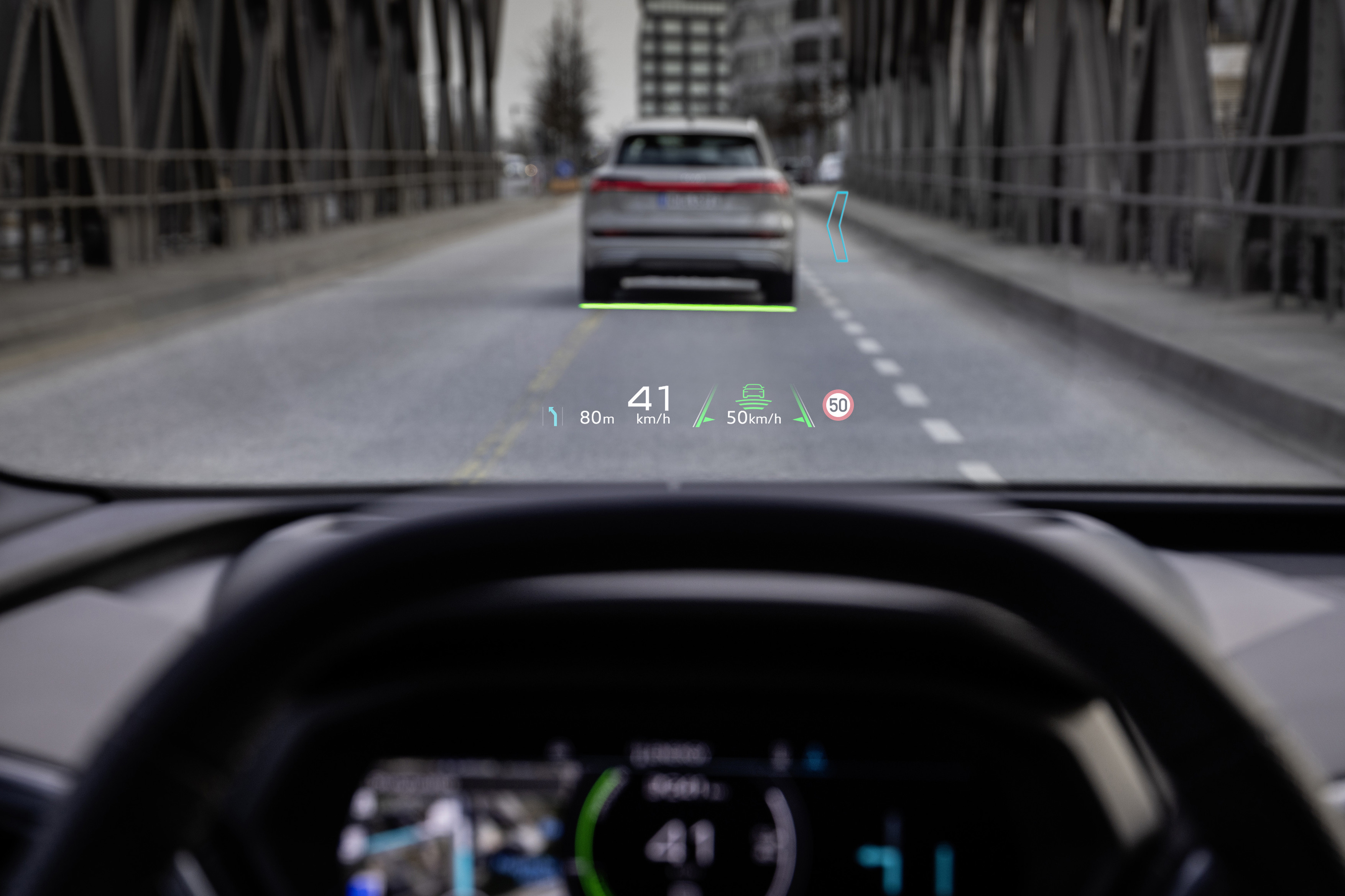
The real story here is the tech — and most notably an option to add an AR-enabled windshield. The AR windshield provides a wider field of view and more accurate and dynamic animations versus a standard windshield HUD. The Q4 e-tron will break down important displayed information via two sections: one for status and one for AR. The former, appearing about 3 meters ahead of the driver, will display the driving speed, traffic signs, the assist system and navigation symbols as static displays.
With the AR section, the driver will perceive the floating symbols to be about 10 meters away. That’ll display information like lane departure warnings that superimpose a red line on the real-life lane marking and a colored stripe over an active car driving in front when in adaptive cruise control.
“Head-up displays aren’t new,” states Audi. “This just takes the field of vision farther out so it enables more active use.”
The AR will also display navigation information. Audi calls the turning arrows “drones,” probably because the arrows fly ahead when driving straight and then disappear, reappearing before the next point of action. When the driver approaches an intersection, the drone announces the turn before steering the driver onto the road with precision.

Head-up-Display. Image Credits: Audi
On the software side of things, the Q4 e-tron’s processing unit, called the AR Creator, picks up raw data from the car’s front camera, radar sensor and GPS navigation to render display symbols at a rate of 60 frames per second and adapt them to the surrounding environment. The quality of these displays, shown via a bit of advanced smoke and mirrors on what Audi calls the EV’s “picture generation unit (PGU)” — basically, a lot of mirrors — will obviously be key to how well it works in real life. With only simulations to show for it currently, it’s not clear how well Audi will pull this off. A wider frame with dynamic symbols must deliver on its promise to show up “just as clearly as their real-life environment” otherwise they’ll become a hindrance to the driver, and if they don’t pull off the depth effect exactly, they could even cause driver discomfort.
The Q4 e-tron also features updated natural-language voice control, activated by saying “Hey Audi.” The new car will also ditch physical buttons on the steering wheel in favor of touch-sensitive ones. But with a haptic feedback loop, it’ll still feel somewhat like you’re pressing a button.
About 3% of the company’s sales in 2020, or 47,000 vehicles, were the electric e-tron SUV and the e-tron Sportback, a number that will surely increase as the company continues to roll out luxury EVs.


