& meet dozens of singles today!
User blogs

For years, there was a debate as to whether WeWork was a tech company or more of a real estate play. At first, most people viewed WeWork as a real estate startup disguised as a tech startup.
And as it kept scooping up more and more property, the lines continued to blur. Then we all watched as the company’s valuation plummeted and its IPO plans went up in smoke. Today, WeWork is rumored to be going public via a SPAC at a $10 valuation, down significantly from the $47 billion it was valued at after raising $1 billion in its SoftBank-led Series H round in January 2019.
Co-founder and then-CEO Adam Neumann notoriously stepped down later that year amid allegations of a toxic combination of arrogance and poor management. WeWork has since been very publicly trying to redeem itself and turn around investor — and public — perception.
Chairman Marcelo Claure kicked off a strategic, five-year turnaround plan in earnest in February 2020. That same month, the beleaguered company named a real estate — not tech — exec as its new CEO, a move that set tongues wagging.
WeWork then also set a target of becoming free cash flow positive by a year to 2022 as part of its plan, which was aimed at both boosting valuation and winning back investor trust.
It likely saw the demise of competitor Knotel, which ended up filing for bankruptcy and selling assets to an investor, and realized it needed to learn from some of that company’s mistakes.
The question now is: Has WeWork legitimately turned a corner?
Since the implementation of its turnaround plan, the company says it has exited out of over 100 pre-open or underperforming locations. (It still has over 800 locations globally, according to its website.) WeWork has also narrowed its net loss to $517 million in Q3 2020 from $1.2 billion in the third quarter of 2019.
Meanwhile, revenue has taken a hit, presumably due to the impact of the coronavirus. Revenue slumped to $811 million the 2020 third quarter, compared with $934 million in Q3 2019.
The pandemic presented WeWork with challenges, but also — some might say — opportunity.
With so many people being forced to work from home and avoiding others during the work day, the office space in general struggled. WeWork either had to adapt, or potentially deal with a bigger blow to its valuation and bottom line.
WeWork’s dilemma is similar to those of real estate companies around the world. With so many companies shifting to remote work not just temporarily, but also permanently, landlords everywhere have had to adjust.
For example, as McKinsey recently pointed out, all landlords have been forced to be more flexible and restructure tenant leases. So in effect, anyone operating commercial real estate space has had to become more flexible, just as WeWork has.
For its part, WeWork has taken a few steps to adapt. For one, it realized its membership-only plan was not going to work anymore, and a dip in membership was evidence of that. So, it worked to open its buildings to more people through new On Demand and All Access options. The goal was to give people who were weary of working out of their own homes a place to go, say one day a week, to work. WeWork also saw an opportunity to work with companies to offer up its office space as a perk via an All Access offering, as well as with universities that wanted to give their students an alternative place to study.
For example, Georgetown did a pretty unique partnership with WeWork to have one of its locations serve as “their replacement library and common space.” And, companies like Brandwatch have recently shifted from leveraging WeWork’s traditional spaces to instead offer employees access to WeWork locations around the globe via All Access passes.
WeWork has also launched new product features. At the beginning of the year, the company launched the ability to book space on the weekend and outside of business hours.
The unbundling of space
I talked with Prabhdeep Singh, WeWork’s global head of marketplace, who is overseeing the new products and also spearheading WeWork’s shift online, to learn more about the company’s new strategy.
“What we’ve essentially done is unbundle our space,” he said. “It used to be that the only way to enjoy our spaces was via a bundled subscription product and monthly memberships. But we realized with COVID, the world was shifting, and to open up our platform to a broader group of people and make it as flexible as humanly possible. So they can now book a room for a half hour or get a day pass, for example. The use cases are so wide.”
Since On Demand launched as a pilot in New York City in August 2020, demand has steadily been climbing, according to Singh. So far, reservations are up by 65% — and revenue up by 70% — over the 2020 fourth quarter. But of course, it’s still early and they were starting from a small base. Nearly two-thirds of On Demand reservations are made by repeat customers, he added.
“Over the last year and a half, we’ve been really figuring out what things we want to focus on what things we don’t,” Singh said. “As a flexible space provider, we are looking at where the world is going. And while we’re a small part of the whole commercial office space industry, we are working to use technology to enable a flexible workspace experience via a great app and the digitization of our spaces.”
For now, things seem to be looking up some. In February, WeWork says it had nearly twice as many active users compared to January. Also, people apparently like having the option to come in at off hours. Weekend bookings now account for an estimated 14.5% of total bookings.
Nearly double as many existing members purchased All Access passes in February 2020 compared to January to complement their existing private office space during COVID, the company said.
In the beginning of the COVID-19, WeWork saw a higher departure of small and medium sized businesses (SMBs) than of its enterprise members, partially due to the nature of their businesses and the need to more immediately manage cash flow, the company said. But in the third quarter of 2020, SMB desk sales were up 50% over the second quarter.
Interestingly, throughout the pandemic, WeWork has seen its enterprise segment grow at nearly double the rate of its SMBs, now making up over half of the company’s total membership base.
While it’s slowing down investing in new real estate assets in certain markets, it is still working to “right-size” its portfolio via exits.
And, when it comes to its finances, as of March 2, WeWork said its bonds were trading at the highest point since the summer of 2019, when the company failed to go public. That’s way up from a 52-week low of about 28%.
“At ~92% for a ~10% yield, the creditor sentiment is clearly positive and a testament to the overall market’s belief that WeWork’s flexible workspace product has a viable future in the future of real estate,” a spokesperson told TechCrunch.
Just last March, WeWork’s bonds were trading at 43 cents on the dollar and S&P Global had lowered WeWork’s credit rating further into junk territory and put the company on watch for further downgrades, reported Forbes.
Still, the company is not done adapting. Singh told TechCrunch that to make WeWork’s value proposition even stronger, it’s working to offer a “business in a box.” Late last year, WeWork partnered with a number of companies to offer SMBs and startups, for example, services such as payroll, healthcare and business insurance.
“A lot of people that come to WeWork are growing businesses,” Singh said. “So while we’ve stuck with our core business services, we’re working to offer more, as in a real suite of HR services that might be complex and expensive for a small business to manage on their own.”
It’s also working to be able to offer its On Demand product globally so that people can opt to work out of a WeWork space from any of its locations around the world.
“Right now, we are in the largest work from home experiment,” Singh said. “I think we’re about to shift to the largest return to work experiment ever. We are just going to be very well positioned.”
The company appears to be trying to become a more sophisticated real estate company that may not be as flashy as the one of the Adam Neumann era, but more stable and more in demand. But is it trying to do too much, too fast?
It will be interesting to see how it all goes.
Early Stage is the premier ‘how-to’ event for startup entrepreneurs and investors. You’ll hear first-hand how some of the most successful founders and VCs build their businesses, raise money and manage their portfolios. We’ll cover every aspect of company-building: Fundraising, recruiting, sales, product market fit, PR, marketing and brand building. Each session also has audience participation built-in – there’s ample time included for audience questions and discussion. Use code “TCARTICLE at checkout to get 20 percent off tickets right here.


Facebook will soon label all posts discussing the coronavirus vaccination with a pointer to official information about COVID-19, it said today.
It also revealed it has implemented some new “temporary” measures aimed at limiting the spread of vaccine misinformation/combating vaccine hesitancy — saying it’s reducing the distribution of content from users that have violated its policies on COVID-19 and vaccine misinformation; or “that have repeatedly shared content debunked as False or Altered by our third-party fact-checking partners”.
It’s also reducing distribution of any COVID-19 or vaccine content that fact-checking partners have rated as “Missing Context”, per the blog post.
While admins for groups with admins or members who have violated its COVID-19 policies will also be required to temporarily approve all posts within their group, it said. (It’s not clear what happens if a group only has one admin and they have violated its policies.)
Facebook will also “further elevate information from authoritative sources when people seek information about COVID-19 or vaccines”, it added.
It’s not clear why users who repeatedly violate Facebook’s COVID-19 policies do not face at least a period of suspension. (We’ve asked the company for clarity on its policies.)
“We’re continuing to expand our efforts to address COVID-19 vaccine misinformation by adding labels to Facebook and Instagram posts that discuss the vaccines,” Facebook said in the Newsroom post today.
“These labels contain credible information about the safety of COVID-19 vaccines from the World Health Organization. For example, we’re adding a label on posts that discuss the safety of COVID-19 vaccines that notes COVID-19 vaccines go through tests for safety and effectiveness before they’re approved.”
The incoming COVID-19 information labels are rolling out globally in English, Spanish, Indonesian, Portuguese, Arabic and French (with additional languages touted “in the coming weeks”), per Facebook.
As well as soon rolling out labels “on all posts generally about COVID-19 vaccines” — pointing users to its COVID-19 Information Center — Facebook said it would add additional “targeted” labels about “COVID-19 vaccine subtopics”. So it sounds like it may respond directly to specific anti-vaxxer misinformation it’s seeing spreading on its platform.
“We will also add an additional screen when someone goes to share a post on Facebook and Instagram with an informational COVID-19 vaccine label. It will provide more information so people have the context they need to make informed decisions about what to share,” Facebook added.
The moves follow revelations that an internal Facebook study of vaccine hesitancy — which was reported on by the Washington Post yesterday after it obtained documents on the large-scale internal research effort — found a small number of US users are responsible for driving most of the content that’s hesitant about getting vaccinated.
“Just 10 out of the 638 population segments [Facebook’s study divided US users into] contained 50 percent of all vaccine hesitancy content on the platform,” the Post reported. “And in the population segment with the most vaccine hesitancy, just 111 users contributed half of all vaccine hesitant content.”
Last week the MIT Technology Review also published a deep-dive article probing Facebook’s approach to interrogating, via an internal ‘Responsible AI’ team, the impacts of AI-fuelled content distribution — which accused the company of prioritizing growth and engagement and neglecting the issue of toxic misinformation (and the individual and societal harms that can flow from algorithmic content choices which amplify lies and hate speech).
In the case of COVID-19, lies being spread about vaccination safety or efficacy present a clear and present danger to public health. And Facebook’s PR machine does appear to have, tardily, recognized the extent of the reputational risk it’s facing if it’s platform is associated with driving vaccine hesitancy.
To wit: Also today it’s announced the launch of a global COVID-19 education drive that it says it hopes will bring 50M people “closer to getting vaccinated”.
“By working closely with national and global health authorities and using our scale to reach people quickly, we’re doing our part to help people get credible information, get vaccinated and come back together safely,” Facebook writes in the Newsroom post that links directly to a Facebook post by founder Mark Zuckerberg also trailing the new measures, including the launch of a tool that will show U.S. Facebook users where they can get vaccinated and provide them with a link to make an appointment.
Facebook said it plans to expand the tool to other countries as global vaccine availability steps up.

Facebook’s vaccine appointment finder tool (Image credits: Facebook)
Facebook has further announced that the COVID-19 information portal it launched in the Facebook app in March last year which points users to “the latest information about the virus from local health ministries and the World Health Organization” is finally being brought to Instagram.
It’s not clear why Facebook hadn’t already launched the portal on Instagram. But it’s decided to double down on fighting bad speech (related to vaccines) with better speech — saying Instagram users will get new stickers they can add to their Instagram Stories “so people can inspire others to get vaccinated when it becomes available to them”.
In other moves being trailed in Facebook’s crisis PR blitz today it has touted “new data and insights” on vaccine attitudes being made available to public officials via COVID-19 dashboards and maps it was already offering (the data is collected by Facebook’s Data for Good partners for the effort at Carnegie Mellon University and University of Maryland as part of the COVID-19 Symptom Survey).
Albeit, it doesn’t specify what new information is being added there (or why now).
Also today it said it’s “making it easy to track how COVID-19 vaccine information is being spread on social media through CrowdTangle’s COVID-19 Live Displays“.
“Publishers, global aid organizations, journalists and others can access real-time, global streams of vaccine-related posts on Facebook, Instagram and Reddit in 34 languages. CrowdTangle also offers Live Displays for 104 countries and all 50 states in the US to help aid organizations and journalists track posts and trends at a regional level as well,” Facebook added, again without offering any context on why it hadn’t made it easier to use this tool to track vaccine information spread before.
Its blog post also touts “new” partnerships with health authorities and governments on vaccine registration — while trumpeting the ~3BN messages it says have already been sent “by governments, nonprofits and international organizations to citizens through official WhatsApp chatbots on COVID-19”. (As WhatsApp is end-to-end encrypted there is no simple way to quantify how many vaccine misinformation messages have been sent via the same platform.)
Per Facebook, it’s now “working directly with health authorities and governments to get people registered for vaccinations” (such as in the city and province of Buenos Aires, Argentina, which is using WhatsApp as the official channel to send notifications to citizens when it’s their turn to receive the vaccine).
“Since the beginning of the COVID-19 pandemic, we have partnered with ministries of health and health-focused organizations in more than 170 countries by providing free ads, enabling partners to share their own public health guidance on COVID-19 and information about the COVID-19 vaccine,” Facebook’s PR adds in a section of the post which it’s titled “amplifying credible health information and resources from experts”.
On the heels of reports that Stripe was raising yet more money, the payments giant has now confirmed the details. The company has closed in on another $600 million, at a valuation of $95 billion.
Stripe said it will use the funding to expand its business in Europe, with a focus on its European HQ, and also to beef up its global payments and treasury network.
“We’re investing a ton more in Europe this year, particularly in Ireland,” said John Collison, President and co-founder of Stripe, in a statement. “Whether in fintech, mobility, retail or SaaS, the growth opportunity for the European digital economy is immense.”
Stripe said the financing included backing from two major insurance players. Allianz, via its Allianz X fund, and Axa are in the round, along with Baillie Gifford, Fidelity Management & Research Company, Sequoia Capital, and an investor from the founders’ home country, Ireland’s National Treasury Management Agency (NTMA).
The insurance angle may point to which direction the company is looking to go next. After all, fintech and insurance are closely aligned.
“Stripe is an accelerator of global economic growth and a leader in sustainable finance. We are convinced that, despite making great progress over the last 10 years, most of Stripe’s success is yet to come” said Conor O’Kelly, CEO of NTMA in a statement. “We’re delighted to back Ireland’s and Europe’s most prominent success story, and, in doing so, to help millions of other ambitious companies become more competitive in the global economy.”
The big round, rising valuation, and growing cap table will inevitably lead to questions around where the company is standing with regards to its next steps, and whether that will include a public listing. Stripe has long kept its cards to its chest when it comes to user numbers, revenues, and profit and those details, once again, are not being disclosed with the news today, and nor has it made any comments on IPO plans.
Notably, the confirmation of the news today is at a lower valuation than the valuation Stripe was reportedly trading at on the secondary market, which was $115 billion; and the round that closed at a $95 billion valuation was also rumored to be coming in at a higher number, over $100 billion.
It’s not clear whether those numbers were never accurate, or if Covid had an impact on pricing, or if European investors simply drove a hard bargain.
The focus on growing in Europe also puts the hiring of Peter Barron — the former EMEA VP of communications for Google and a former journalist — into some context.
Founded in 2010 by John and his brother Patrick Collison (the CEO), Stripe is one of a wave of commerce startups that saw the value of building a simple way for developers to integrate payments into any app or site by way of a few lines of code, at a time when digital and specifically online payments were starting to take off.
Behind that code, the company had done all the hard work of integrating all the different and complex pieces needed to make payments work both in countries and across borders.Over the years, the company has built out a bigger platform around that, a suite of services to position itself as a one-stop shop not just for helping businesses run all of the commercial aspects of their operations, including incorporation, managing fraud, managing cashflow and more.
Within that, Stripe has built out a decent footprint in Europe, with the region accounting for 31 of the 42 countries where it has customers today. While Stripe may have had its start and early traction providing payments infrastructure for startups (and especially small, new startups), today that list includes a lot of big names, too. In Europe, customers include Axel Springer, Jaguar Land Rover, Maersk, Metro, Mountain Warehouse and Waitrose, alongside Deliveroo (UK), Doctolib (France), Glofox (Ireland), Klarna (Sweden), ManoMano (France), N26 (Germany), UiPath (Romania) and Vinted (Lithuania).
Even with heavy competition in payments and adjacent services, there is a huge opportunity for more growth. Stripe says that in the wake of Covid and the rise of people shopping considerably more across the web and apps rather than in person, currently some 14% of commerce happens online, a big shift considering that just a year ago it was about 10%.
Hello friends, and welcome to Week in Review.
Last week, I talked a bit about NFTs and their impact on artists. If you’re inundated with NFT talk just take one quick look at this story I wrote this week about the $69 million sale of Beeple’s photo collage. This hype cycle is probably all the result of crypto folks talking each other up and buying each other’s stuff, but that doesn’t mean there won’t be lasting impacts. That said, I would imagine we’re pretty close to the peak of this wave, with a larger one down the road after things cool off a bit. I’ve been wrong before though…
This week, I’m interested in a quick look at what your kids have been talking about all these years. Yes, Roblox.
If you’re reading this on the TechCrunch site, you can get this in your inbox from the newsletter page, and follow my tweets @lucasmtny.
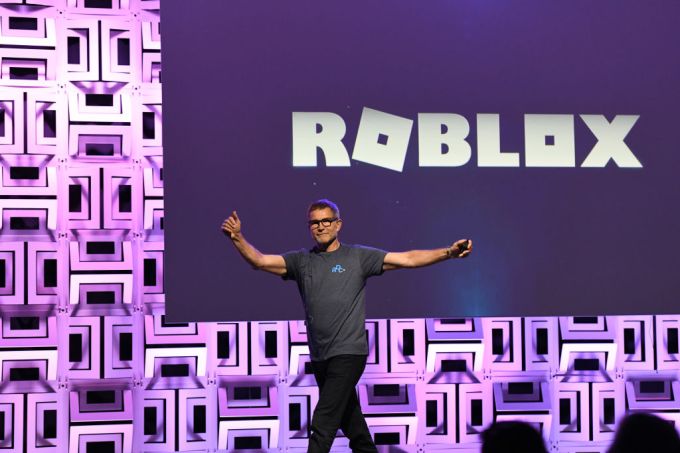
(Photo by Ian Tuttle/Getty Images for Roblox)
The big thing
Roblox went public on the New York Stock Exchange this week, scoring a $38 billion market cap after its first couple days of trading.
Investors rallied around the idea that Roblox is one of the most valuable gaming companies in existence. More than Unity, Zynga, Take-Two, even gaming giant Electronic Arts. It’s still got a ways to go to take down Microsoft, Sony or Apple though… The now-public company is so freaking huge because investors believe the company has tapped into something that none of the others have, a true interconnected creative marketplace where gamers can evolve alongside an evolving library of experiences that all share the same DNA (and in-game currency).
The gaming industry has entered a very democratic stride as cross-play tears down some of the walls of gaming’s platform dynamics. Each hardware platform that operates an app store of their own still has the keys to a kingdom, but it’s a shifting world with uncertainty ahead. While massive publishers have tapped cloud gaming as the trend that will string their blockbuster franchises together, they all wish they were in Roblox’s position. The gaming industry has seen plenty of Goliath’s in its day, but for every major MMO to strike it rich, it’s still just another winner in a field of disparate hits with no connective tissue.
Roblox is different, and while many of us still have the aged vision of the image above: a bunch of rudimentary Minecraft/Playmobile-looking mini-games, Roblox’s game creation tools are advancing quickly and developers are building photorealistic games that are wider in ambition and scope than before. As the company levels-up the age range it appeals to — both by holding its grasp on aging gamers on its platform and using souped-up titles to appeal to a new-generation — there’s a wholly unique platform opportunity here: the chance to have the longevity of an app store but with the social base layer that today’s cacophony of titles have never shared.
Whether or not Roblox is the “metaverse” that folks in the gaming world have been hyping, it certainly looks more like it than any other modern gaming company does.
SHENYANG, CHINA – MARCH 08: Customers try out iPhone 12 smartphones at an Apple store on March 8, 2021 in Shenyang, Liaoning Province of China. (Photo by VCG/VCG via Getty Images)
Other things
Apple releases some important security patches
It was honestly a pretty low-key week of tech news, I’ll admit, but folks in the security world might not totally buy that characterization. This week, Apple released some critical updates for its devices, fixing a Safari vulnerability that could allow attackers to run malicious code on a user’s unpatched devices. Update your stuff, y’all.
TikTok gets proactive on online bullying
New social media platforms have had the benefit of seeing the easy L’s that Facebook teed itself up for. For TikTok, its China connection means that there’s less room for error when it comes to easily avoidable losses. The team announced some new anti-bullying features aimed at cutting down on toxicity in comment feeds.
Dropbox buys DocSend
Cloud storage giants are probably in need of a little reinvention, the enterprise software boom of the pandemic has seemed to create mind-blowing amounts of value for every SaaS company except these players. This week, Dropbox made a relatively big bet on document sharing startup DocSend. It’s seemingly a pretty natural fit for them, but can they turn in into a bigger opportunity?
Epic Games buys photogrammetry studio
As graphics cards and consoles have hit new levels of power, games have had to satisfy desired for more details and complexity. It takes a wild amount of time to create 3D assets with that complexity so plenty of game developers have leaned on photogrammetry which turns a series of photos or scans of a real world object or environment into a 3D model. This week, Epic Games bought one of the better known software makers in this space, called Capturing Reality, with the aim of integrating the tech into future versions of their game engine.
Twitter Spaces launches publicly next month
I’ve spent some more time with Twitter Spaces this week and am growing convinced that it has a substantial chance to kneecap Clubhouse’s growth. Twitter is notoriously slow to roll out products, but it seems they’ve been hitting the gas on Spaces, announcing this week that it will be available widely by next month.
Seth Rogen starts a weed company
There’s a lot of money in startups, there’s really never been a better time to get capital for a project… if you know the right people and have the right kind of expertise. Seth Rogen and weed are a pretty solid mental combo and him starting a weed company shouldn’t be a big shock.

SeongJoon Cho/Bloomberg via Getty Images
Extra things
Some of my favorite reads from our Extra Crunch subscription service this week:
Coupang follows Roblox to a strong first day of trading
“Another day brings another public debut of a multibillion-dollar company that performed well out of the gate.This time it’s Coupang, whose shares are currently up just over 46% to more than $51 after pricing at $35, $1 above the South Korean e-commerce giant’s IPO price range. Raising one’s range and then pricing above it only to see the public markets take the new equity higher is somewhat par for the course when it comes to the most successful recent debuts, to which we can add Coupang.” More
How nontechnical talent can break into deep tech
“Startup hiring processes can be opaque, and breaking into the deep tech world as a nontechnical person seems daunting. As someone with no initial research background wanting to work in biotech, I felt this challenge personally. In the past year, I landed several opportunities working for and with deep tech companies.“ More
Does your VC have an investment thesis or a hypothesis?
“Venture capitalists love to talk investment theses: on Twitter, Medium, Clubhouse, at conferences. And yet, when you take a closer look, theses are often meaningless and/or misleading…” More
Once more, if you liked reading this, you can get it in your inbox from the newsletter page, and follow my tweets @lucasmtny.


