& meet dozens of singles today!
User blogs

Riva, founded by scientist Tuhin Sinha and Siri co-founder Dag Kittlaus, wants to help people measure their blood pressure in a clinically-approved way. Blood pressure can help indicate at-risk patients before they are actually at risk, showing early signs of heart disease. And while other hardware solutions on the market promise the same end-goal, Riva wants to be a purely software solution that integrates with hardware that it thinks its end-user has anyways: their smartphone.
The company, launching out of stealth today, has raised $15.5 million in seed funding in a round led by Menlo Ventures, with participation from True Ventures. UC Health and University of Colorado Innovation Fund accounted for $5 million of the round, with other angels including GoHealth’s Brandon Cruz and Madison Industries Larry Gies. Greg Yap of Menlo, who talked to Sinha for three years before investing, will be joining the board.
Kittlaus, who also founded AI-assistant Viv, says that he began thinking about how to make a difference in digital health after undergoing his own severe health issues. Kittlaus was diagnosed with pancreatic neuroendocrine cancer in 2016, the same type of cancer that late Apple CEO Steve Jobs died from.
“I spend time researching ideas on it, but I was missing the thing that I’ve had in both my previous companies, which was some amazing technical innovation that could form a wedge that you can move the world with,” he said.
Kittlaus mentioned this internal conversation with his friend, who was the first investor in Siri, this past summer. The friend introduced him to Tuhin Sinha, the scientist who spent years developing the technology that is used to power Riva.
To use Riva, all a person needs to do is open the app on their phone and tap ‘Go’, which triggers the camera flash on the back of the phone. The app will then guide the user to place their finger over the right camera, and help them adjust positioning until it locks into place. After that, Riva will use the light to track blood pressure change and create a rendering of it on screen.
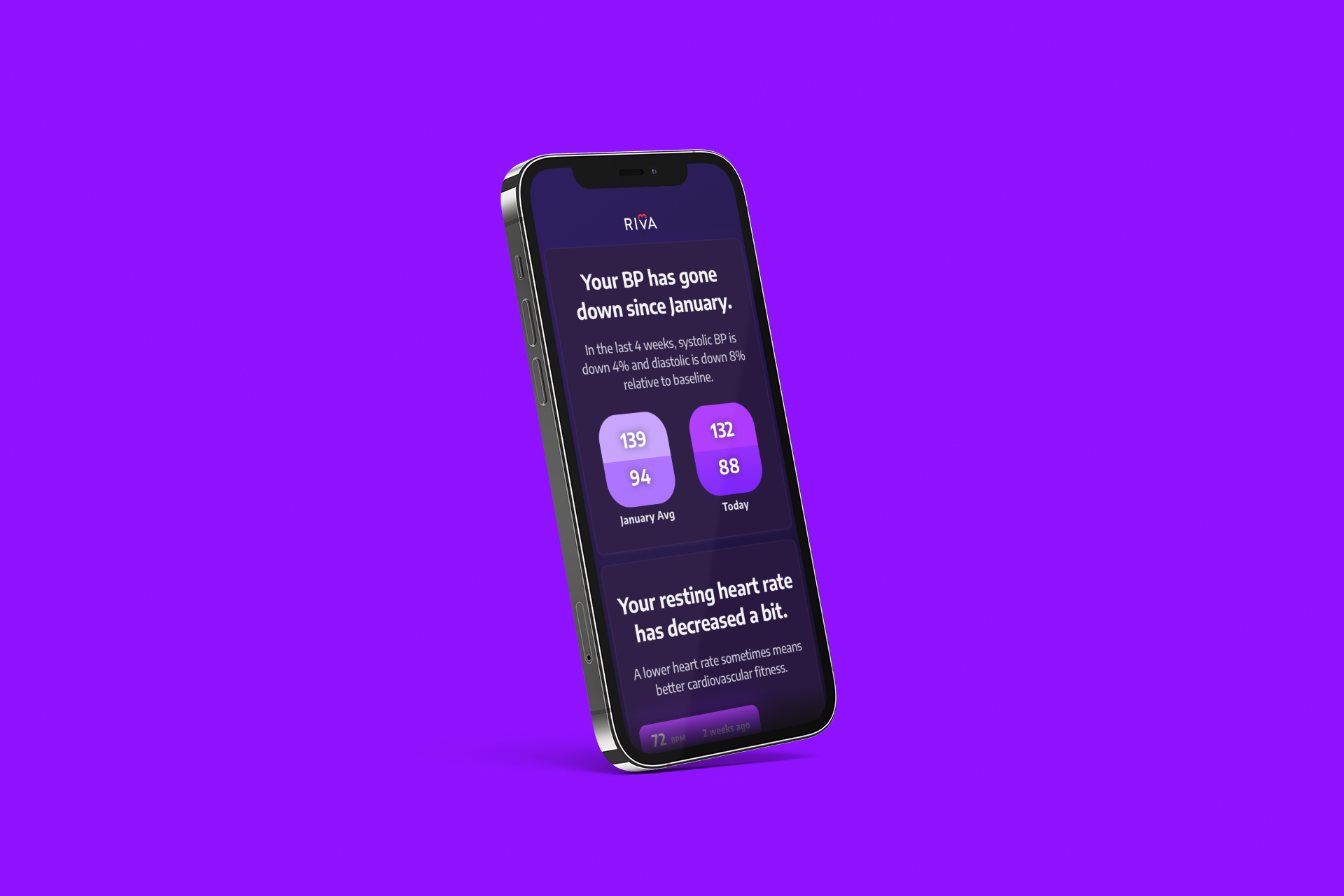
Riva Health planned design, subject to change.
“The well-known part of this technology is shining a light on a blood vessel and getting a wave out of it,” Sinha said. “The novelty is the shape of the wave, how it relates to blood pressure, and our secret sauce is looking at those waveshape changes and validating them in a rigorous and comprehensive way.” Sinha declined to share how they are validating exactly, but said that it is key that a startup has to measure blood pressure in a variety of different scenarios – think standing or sitting – to see if it is effective.
Once Riva tracks five to seven heartbeats worth of data, it has a comprehensive understanding of someone’s blood pressure at that moment.
The data, which is HIPAA compliant, can then be sent to a family physician or doctor’s office to be analyzed if a risk is present, starting with hypertension.
“Moving to a platform like the smartphone is mobilizing the measurement and management of [health and disease management],” Sinha said. Riva Health is a purely software solution.
The company is currently in the process of verifying its software with Android phones, but Kittalus says that “any modern phone should be able to acquire the signal needed” to work.
A big hurdle for any health tech company, and especially Riva, is whether it can get FDA approval for clinical usage. The company is currently engaged in that process with the FDA, and will ask users who pilot its free app, coming out this summer, to participate in the trial and data-gathering to bolster its approval process.
Right now, Riva is using its technology to track the changes in blood pressure in a clinical setting, and the second-half will be in a home setting. By tracking the use of its system in the real world, it can prove that it works in a laboratory and home set-up, helping it prove that its disease management technology is effective.
“There are a lot of gizmos and gadgets that will claim to do blood pressure reading,” Kiittlaus said. “I call it blood pressure as a novelty where it gives you blood pressure reading but not a clinic.” For example, a Fitbit does track blood pressure but consistently underestimates the number, a study says. Other solutions like the Apple Watch or cuffless wearables measure blood pressure for non-clinical usage, which means that it isn’t super accurate and only notifies obvious blood pressure problems.
Riva wants to be daily and precise enough to be relied on by doctors, which is part of its overall route to make money. While the team wouldn’t share any published research or proof about its scientific method, Dr. Richard Zane, the chief innovation officer of UCHealth said that it is “bulletproof” technology. Over 700 companies in the past three years have tried to work with Zane’s team, and Riva is one of the few that met the bar.
“When our team tested it, it actually worked out of the box the first time, which basically never happens,” Zane said. He added that one of the biggest barriers to entry is that people have needed devices in the past, and Riva brings “a novel technology that actually works that will be embedded in something that patients already carry around with them and allow them to manage their heart disease or hypertension.”
“The core product of the company is healthcare outcomes,” Sinha said. The company is part of the wave of startups that believe outcome-based healthcare is the future, a model where doctors are paid for results instead of the number of visits they complete in a day. With this vision, Riva plans to monetize by selling outcomes to hospital systems and providers: if it can provide a tool to help doctors keep people out of surgery and indicate issues earlier than before, it can make a solid argument as to why systems should adopt it.
Only 20% of healthcare works on the value-based model, so this will be a hurdle even with the right sentiment. In the meantime, Kittlaus says that it is working with insurers to pay for its service. Riva would get reimbursed for treating and managing hypertension.
“We want to keep it free for the consumer, free for the doctor, and insurance will cover it,” he said.
If and when the FDA clears this technology, Kittlaus says that doctors and medics “will still be skeptical about it” but will ultimately be convinced of the outcomes being more accurate, and ongoing, than the cuff.
“You’re prescribing an app,” he said. “Instead of medicine.”
The app, pending FDA approval, will be available for public late this year or early next year. The next few months for Riva will be key in determining its success and validity – and Sinha, the chief scientist, say it will be rigorous, but fast. He has a personal tie to the company’s success.
Sinha has lost five brothers, one sister, and his father before the age of 59 to heart disease. Now, his app has the ability to track the condition that made him lose these family members in the first place.
“I feel like I have a ticking time bomb in my chest,” he said. “And if anything, I’m going to do this for myself.”
Copy.ai, a startup building AI-powered copywriting tools for business customers, announced a $2.9 million round this morning. The investment was led by Craft Ventures. Other investors took part in the deal, including smaller checks from Li Jin’s newly-formed Atelier Ventures, and Sequoia.
The startup is notable for a few reasons. First for its model of building in public. I initially heard of the company through its monthly updates that it posts on Twitter. Thanks to that, I can tell you that Copy.ai generated monthly recurring revenue (MRR) of $53,600. That figure, up 46% from January, works out to annual recurring revenue (ARR) of $643,200.
Copy.ai also shares usage numbers, and, humorously, the number of Twitter followers that its founder Paul Yacoubian picked up in the last month.
The startup is also worth watching because it is part of a growing cohort of companies building atop GPT-3, what its progenitor the OpenAI project describes as an “autoregressive language model with 175 billion parameters.” More generally, it’s a piece of AI that can generate words.
Some investors are rather bullish on startups using the technology. Recently on TechCrunch, for example, Madrona’s Matt McIlwain wrote that “the introduction of GPT-3 in 2020 was a tipping point for artificial intelligence” that will lead to “the launch of a thousand new startups and applications.”
So far that’s holding up. Not only has Copy.ai managed to find early in-market traction, TechCrunch has covered a number of other startups busy leveraging GPT-3, including OthersideAi which raised $2.6 million back in November of 2020, and an “AI Dungeon-maker” called Latitude that also employs GPT-3 and raised $3.3 million this February.
But enough about its cohort. Let’s get into how Copy.ai got built.
Origins
Before founding Copy.ai, Yacoubian was an investor and, it seems, a tinkerer. He played with GPT-3 predecessor GPT-2 when it came out, telling TechCrunch in an interview that he discovered that the tool generated lots of “nonsense,” with the occasional “flash of brilliance.” GPT-3 proved even better in his view, providing something akin to a “50x” improvement on the generation that came before it.
Leaning on Twitter as a distribution method — Copy.ai uses Twitter as distribution channel, hence its reporting on social media metrics — Yacoubian and his co-founder Chris Lu launched a few different draft-projects using GPT-3. Simplify.so did text condensing, a slackbot was built but never made it to the outside world, and taglines.ai was put together to help companies come up with slogans.
That last one found early traction, generating around 700 sign-ups in two days. That was enough of a user base, the co-founders decided, to begin monetizing their tool. Then they decided that the initial could be extended to other writing use cases, helping people with myriad distinct writing projects. Copy.ai was formed out of that concept.
The product can now generate text for blogs and products and headlines and the like, based on user-provided word inputs.
What’s odd and nearly antithetical to your humble servant as a writer is that Copy.ai doesn’t want to save you word count, per se. Instead, it generates a number of possible text results that the customer then chooses from. Recall the flashes of brilliance that Yacoubian said GPT-2 could generate? GPT-3 is even better, giving users of Copy.ai even better possible text formulations for their needs. And then the human-in-the-loop plays the editor role, choosing which they want the most and, I presume, tweaking from there.
When it was released back in October of 2020, Copy.ai snagged 2,000 sign-ups in its first two days. Then investors started reaching out.
Quitting their day jobs, Copy.ai became a full-time affair. The unorthodox startup also put together an unorthodox round, raising from what Yacoubian described as “as many people as [they] could.” That wound up being 80 people, give or take.
The round was raised as a capped SAFE, the Y Combinator-favored investing instrument that allows startups to accrete capital from external sources without a formal pricing; instead, SAFEs are often “capped” at a maximum valuation. Copy.ai raised its cap as its fundraising process trundled along.
David Sacks, founder of Craft Ventures, told TechCrunch that he thinks that “natural language generation powered by AI is going to change the way that marketing teams write copy,” adding that amongst startups it is “rare to see such strong bottom-up adoption in so short a time.”
I am honestly a bit excited to see what Copy.ai can do, not because I will use its product — it’s not precisely in my wheelhouse — but because I am rather excited about GPT-3 as a technology. And the startup is an in-market experiment regarding AI and writing. Two things I care quite a lot about.
Stack Overflow is the default Q&A site for programmers (though the overall Stack Exchange network goes well beyond helping you answer your basic PHP questions). But over the course of the last year and a half, with its new CEO Prashanth Chandrasekar coming on board, the company has also kickstarted its SaaS business with a new focus on its StackOverflow for Teams product. Teams offers businesses something akin to a private Stack Overflow for managing and sharing knowledge across a company. Until now, Teams was only available through a paid subscription (or a time-gated trial), but starting today, Stack Overflow will move to a freemium model with a perpetually free plan.
As Chandrasekar told me ahead of today’s announcement, Stack Overflow’s $85 million Series E funding round this summer was all about Teams and accelerating its SaaS growth. “We wanted to double down on eams,” he said. “And that is very much — as we transform into a product-led SaaS company from our foundation of the community and the public platform — that’s a huge, huge focus.”
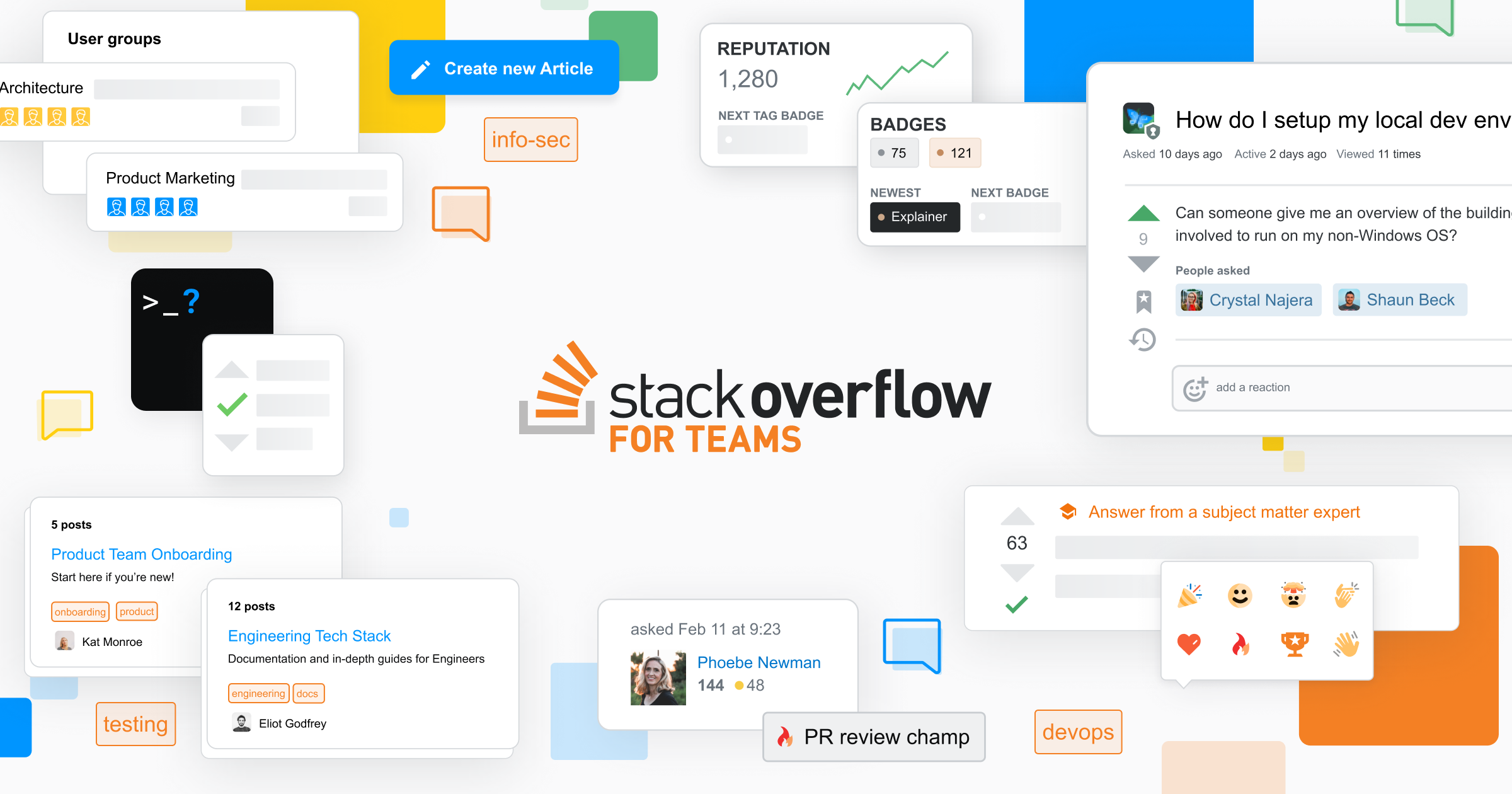
Image Credits: Stack Overflow
Like so many products in this space, Stack Overflow for Teams experienced rapid growth in 2020. Its annual recurring revenue grew 72% last year, the company tells me, and it added over 1,500 Teams customers, including 70 that opted for its high-end Enterprise tier. Teams customers now include the likes of Box, Microsoft, Bloomberg, Instacart and Zapier.
The new freemium offering will be limited to 50 seats, but for the most part, it’s quite a fully-featured solution, with support for all of the core Teams features. It also includes support for the service’s ChatOps integrations with Slack and Microsoft Teams (side note: maybe there are too many products with the name ‘Teams’ right now?). The free service also includes support for single sign-on solutions, which isn’t always a given for a freemium SaaS offering. And while the enterprise tier is SOC II certified and runs on single-tenant instances, that’s not the case for the free, basic and business tiers.
“At Unqork, we use Stack Overflow for Teams and its Slack integration to empower our creators to learn from each other in a productive way and to support our clients building solutions on top of our platform,” said Olga Gomonova, head of enablement at Unqork. “Since implementing Stack Overflow for Teams for internal and external use cases, we’ve been able to reduce the time to respond to client and internal questions from 60 to 30 minutes, and have been able to onboard new hires faster as our company grows.”
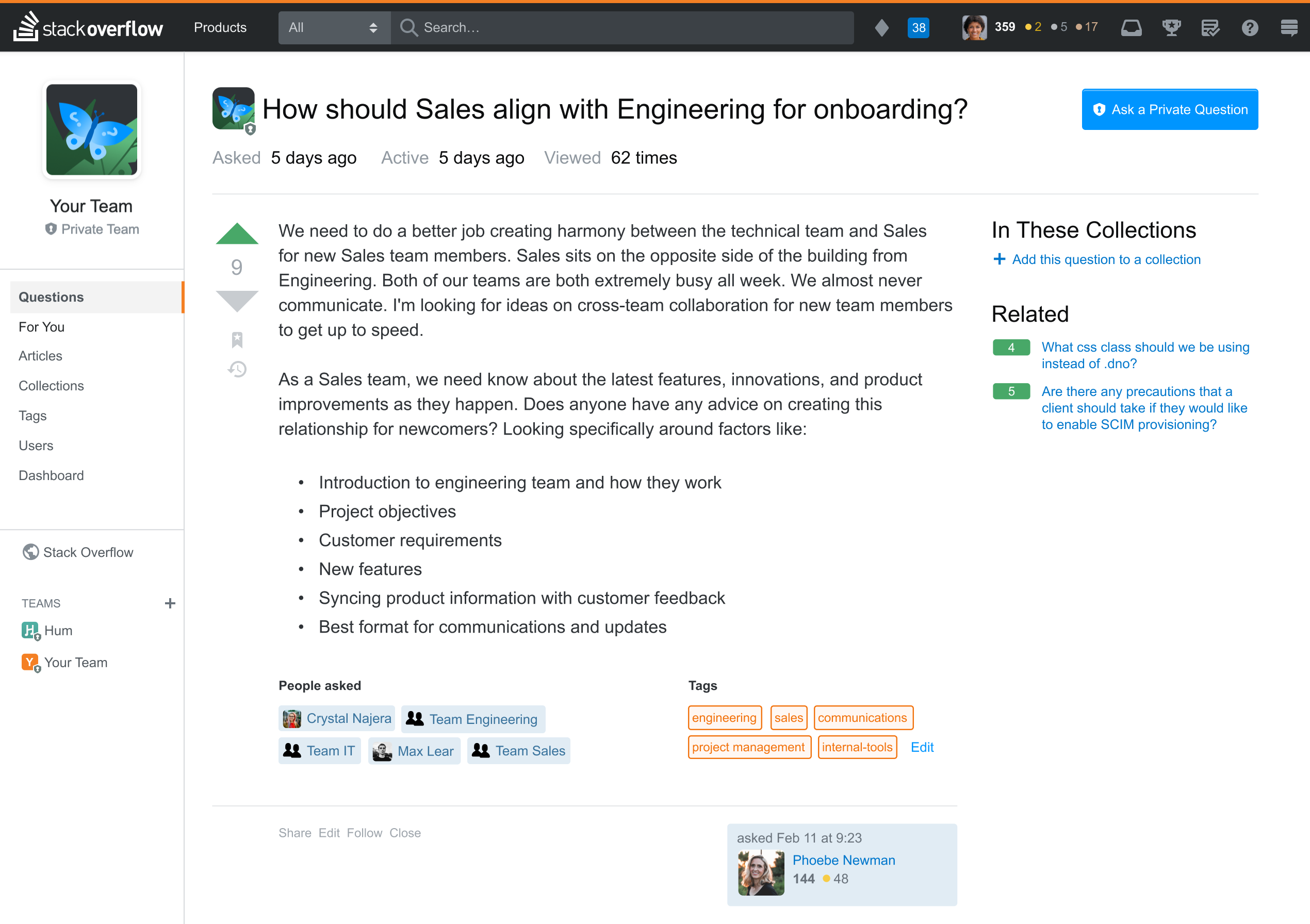
Image Credits: Stack Overflow
Some of the missing features, however, are access to Stack Overflow for Teams’ Articles format for longer-form content and Collections, a feature that allows users to group together sets of similar questions that can be used for an onboarding workflow or in place of a traditional FAQ document, for example. Stack Overflow CPO Teresa Dietrich tells me that the company has seen over 50% adoption of Articles since its launch in August 2020. The company also recently introduced a private feedback option for Teams.
“We found that, unlike on the public Q&A sites, people weren’t comfortable giving downvotes to content on the Teams product until we introduced private feedback,” she said. “So now they give feedback to the content writer in a private way that says it’s incomplete, it’s out of date, or it’s wrong. And then they can put text around that feedback and only the owner of that content sees it.”
The freemium offering has been in the works for a while. As Chandrasekar and Dietrich both noted, the company removed the credit card requirement to get started with the 30-day Teams trial that had been in place before. “We realized through that experience, that it was actually not enough time to allow companies to create a community internally and that’s basically what we’re trying to do,” Chandrasekar said. “So that was a huge learning for us to say it didn’t make a lot of sense for us to keep a free trial that was timeboxed. And that really expanded to just make it free for life.”
Dietrich added that before launching this free offering, the company also wanted to make sure that it had optimized its onboarding flow for these free users as well.
Digitail, a cloud service for veterinary surgeries and customers, has raised $2.5M in a Seed round led by byFounders and Gradient Ventures (Google’s AI fund), joined by Partech and a series of angels including as Dr. Ivan Zakharenkov (Smartflow). The startup was already backed (pre-seed round in 2019) by Fast Track Malmo. Digitail is currently used by 2,000 veterinarians in 16 countries.
Digitail says its “all-in-one” practice management system for animal hospitals and veterinary practices “helps vets simplify their workflow, drive automation, and engage with pet parents, even when they are not at the practice.”
For pet owners Digital had a Health Card for pets, a customer app that is directly connected to the PIMS and acts as a digital ID for the pets. This holds the pet’s medical history, and allows the owner to communicate with the vet through the in-app chat, book their next appointment, and store any other important information about their pet.
The founders are Sebastian Gabor (CEO and co-founder), Ruxandra Pui (CPO and co-founder). They are joined by Alexandru Gheorghita, DVM, in-house veterinarian specialist.
Gabor said in a statement: “Pet care is still being run like in the 90s. Because of the lack of a holistic vision and approach, there is no data unification and no collaboration between the key players of the industry. As a result, vets still need to rely on outdated tools while collaboration and innovation is stopped.”
Competitors include Rhapsody.vet which has raised an $8M Series A, Ezyvet, and Hippo Manager, among others. But Digitail says its all-in-one approach has an edge on the others.
According to some estimates, some 39% of pet owners in the United States are millennials. Digitail is thus finding business among veterinarians surfing a new generation of customers who expect to be able to make bookings and arrangements with their vet via an app. Just as with apps aimed at doctor’s surgeries, Digitail’s platform handles that incoming customer data and also allows the surgery to run. The pet care industry is predicted to reach a value of $200 billion by 2025.
French startup PayFit has raised a $107 million series D funding round (€90 million). Eurazeo Growth and Bpifrance’s Large Venture fund are leading today’s round. Existing investors Accel, Frst and Xavier Niel are participating once again.
PayFit has been building a payroll and HR software-as-a-service platform. It lets you manage your payroll from a web browser and automate as many steps as possible. For instance, you can configure automate payslip generation, export your payroll data to your accounting software and get a list of payments you need to make when it comes to pensions, health insurance, etc.
Given that it’s a software-as-a-service platform, everything remains up to date. For instance, if there are some regulatory changes that require some adjustments, PayFit can update its platform so that you remain compliant from day one without having to think about it.
Over time, the startup has expanded beyond payroll to tackle a bigger chunk of the HR stack. Each employee gets its own PayFit login to access their payslips. But the company doesn’t stop there as you can request time off and enter how much time you’ve worked this week if you’re paid on an hourly basis. PayFit automatically notifies the manager for approval.
PayFit can also become your central repository for expenses and receipts. The company already has everyone’s bank information, which makes it easier to transfer money back to an employee for a cash expense.
Employees can also view the company’s directory and management chain from PayFit. The HR department can set up an onboarding flow in PayFit so that employees can request a computer, a badge, and enter personal information as soon as they join the company.
If you work for a big company that uses something like Workday, all of this probably sounds familiar. But PayFit targets small and medium companies that don’t want to sign expensive contracts with enterprise companies. It has attracted 5,000 clients that employ 100,000 employees overall — that’s an average of 20 employees per company. Some of the biggest clients include Revolut, Starling Bank and Treatwell.
The company is currently live in France, Germany, Spain, Italy and the U.K. It currently has 550 employees and it plans to hire another 250 employees in 2021 to support its growth.


