& meet dozens of singles today!
User blogs

The pandemic’s impact on the business world encouraged adtech startups and digital marketing agencies to collaborate more, helping brands survive the pandemic by bringing businesses closer to consumers.
Although overall spending on advertising slowed in 2020, it is expected to recover in 2021 and reach $630 billion in 2024. According to Statista, North America spends the most on advertising, with second place going to Asia and Western Europe. The rest of Europe, Africa and the Middle East lag behind.
Although overall spending on advertising slowed in 2020, it is expected to recover in 2021 and reach $630 billion in 2024.
However, the Middle East embodies great potential. According to Statista, it boasts the highest growth, with a 600% increase in digital advertising in the MENA region between 2010 and 2015. Although consumers in the region used to prefer traditional advertising channels, the internet took over in 2020, with 44.2% of the total ad expenditures, while TV dropped to 30%.
Here are several essential characteristics of digital advertising in the Middle East region:
- According to a PwC report, 39% of shoppers in the Middle East use social media to find inspiration for purchases, compared to the global average of 29%.
- Due to the existence of a shadow economy, political regulations and unofficial business, the amount of digital ad spending in the MENA region ranged from $1 billion to $1.2 billion in 2020.
- Paid social is the leading category in digital advertising expenditures in the MENA region. Saudi Arabia and Egypt are the largest in terms of active YouTube users.
- There are more than 500 digital agencies listed in the region. UAE is leading in terms of big advertising agencies, while Egypt and Saudi Arabia are famous for small- and medium-size agencies. Most digital marketing talent and creative resources reside in Egypt, Lebanon and Jordan, while most adtech startups are born in Israel, UAE and Qatar, according to digital marketing consultant Yasser Ahmad.
- E-commerce is driving growth, hitting $17 billion in the Middle East in 2020, according to Statista, with many online shoppers increasing the frequency of purchases during the pandemic.
BBG Ventures, a now eight-year-old, New York-based seed- and early-stage venture firm that only backs founding teams which feature at least one woman, just locked down $50 million in capital for its third fund, a major leap over its first two funds, both sized at $10 million.
One determining factor in the bigger fund is that BBGV, formerly backed exclusively by AOL (now Verizon Media), now has a broader pool of institutional and individual investors, including the State of Michigan Retirement Systems, the George Kaiser Family Foundation and Verizon Ventures, along with Poshmark cofounder Tracy Sun, ClassPass cofounder Payal Kadakia, and venture capitalists Aileen Lee, Theresia Gouw, and Jennifer Fonstad.
The young firm also has a track record to which to point. Though an investment in the coworking space The Wing may have taken an unexpected turn, hurt by a national lockdown and internal turmoil, other bets have been growing, including the e-commerce platform Zola; the feminine hygiene brand Lola; and Spring Health, a mental health benefits platform for employers that recently closed on $76 million in Series B funding led by Tiger Global Management.
That’s saying nothing of the vast and underserved opportunity to invest in women-led teams that BBGV’s founders, Susan Lyne and Nisha Dua, believe most venture firms still don’t fully appreciate.
We talked earlier today about why that is with Lyne, who is a former ABC president, former Martha Stewart Living CEO and former CEO of AOL Brand Group; and Dua, who is a former lawyer, management consultant, chief of staff to Lyne, and founder. Our conversation has been edited for length.
TC You’ve raised $50 million. What size checks will you be writing? Are you looking to take bigger positions or do you have a more diverse approach?
ND: We’re looking at writing $500,000 to $1 million checks. We look for 7.5% to 10% ownership, and we’re open to co-leading, but we prefer to lead. We’ve been leading rounds already with this with this fund. We’ll likely do about 30 companies from the fund, backing a mix of pre-seed and seed-stage startups, with reserves for follow-on funding.
SL: We’ve actually done 11 investments; we started investing after the first close.
TC: You’ve invested in nearly 80 startups over the years. What has been your biggest investment to date?
ND: Planet Forward, which was founded by Zume cofounder Julia Collins.
TC: Have you — or would you — ever form a special purpose vehicle to invest more in a startup than your fund enables?
SL: We didn’t do it for our last funds, but we did our first SPV for this fund, in a company called Starface, which is skincare company that takes a very different approach to the acne problem. You’ve probably seen the gold stars [that its customers apply to their pimples] on social media. They’ve been growing very fast and did a Series A recently and we took part of it ourselves but we also opened an SPV for one of our LPs.
TC: What themes interest you right now?
SL: We’ve done a lot of investing thus far in health and well being. That’s our largest category. The second is the future of work and education; the third is climate-friendly commerce; and the fourth is really underestimated, or emerging consumers. In all of those areas, we have actually found there are many, many, many female founders who are active and building great companies
ND: Also, we [have historically] described ourselves as a consumer fund, but we are doing more B2B in this fund, where we think that the B2B approach could solve a bigger consumer problem, including for many millions of consumers.
TC: What’s an example of what you mean?
SL: Grayce, which is doing eldercare and actually selling to employers as an employee benefit. If you look at the cost to companies because of the number of hours and days that many people invest in taking care of an aging parent or trying to figure out what the next step is for them [you appreciate the need for this kind of service]. This platform not only allows you to connect with someone who can help you plan but also points you to the resources you need, including financial resources, legal resources, and living resources.
ND: Another is Full Harvest, a marketplace and logistics platform that takes all the excess food on a farm that doesn’t meet cosmetic standards and resells it to juice and salad makers and other food brands and manufacturers.
TC: You mentioned Julia Collins. Do you know how many first-time founders you’ve backed versus repeat entrepreneurs?
ND: There’s a mix. We don’t have a preference.
TC: Do you have a geographic focus?
SL: I would say, New York City is definitely our primary source for for companies for a lot of reasons, including that there’s a very rich and active female founder community here. This is the headquarters for many different kinds of industries, so you get a range of talent here. But we’ve also invested in San Francisco companies, companies in Los Angeles, in Milwaukee, in San Diego. [We see] opportunity in at least a dozen cities across the country.
TC Have have your syndicate partners changed over time, if at all?
ND: That’s been one of the most exciting things of the past few years. We love to partner with women GPs — folks like Kara Norton of Upfront Ventures and Jess Lee of Sequoia. There is a great spiderweb of women GPs emerging at these top venture funds who can create these strong relationships and are ultimately leads for follow-on rounds.
TC: Do think women-led teams are receiving the valuations they would if they were all-male teams? I was horrified to read earlier today that the wage gap between men and women has improved by 8 cents over the last 25 years.
SL: I can’t speak authoritatively about whether women are getting lower valuations across the board. We certainly know that they are getting a vastly lower percentage of the venture capital investment. If you look at the stats about the amount of funding for women in 2020 versus men, it’s definitely disturbing and shows the vast majority of venture capital is still going to all all male teams. I think some of that is due to the megarounds that we’ve seen, but not enough of it to make a significant difference.
ND: I think it was Harvard Business Review that did some really interesting research at a [2017] TechCrunch Disrupt event that overwhelmingly suggested that men are judged on their potential and women are often judged on their current expertise, and we [might] surmise that [these factors] could have something to do with valuations.
It’s why we’re leading rounds. We see the opportunities that these female-led teams are going after — and we have the opportunity to assess them on their exact merits.
Tech executives face Congress, Spotify gets a redesign and Snapchat is developing a new Remix feature. This is your Daily Crunch for March 25, 2021.
The big story: Zuckerberg defends Facebook over role in Capitol attack
Facebook’s Mark Zuckerberg, Twitter’s Jack Dorsey and Google’s Sundar Pichai appeared at a hearing today with the House Energy and Commerce Committee on the theme of misinformation, particularly the role that their platforms may have played in the Capitol attack by allowing lies and extremism to spread.
In his opening statement, Zuckerberg advocated for reforms to Section 230 and said that Facebook “did our part” to protect last year’s presidential election, putting the blame for the Capitol riots squarely on former President Donald Trump.
Pressed by Rep. Mike Doyle (D-PA) on whether Facebook bears some responsibility, Zuckerberg replied, “I think the responsibility lies with the people who took the actions to break the law and do the insurrection. Secondarily, also with the people who spread that content, including the president but others as well, with repeated rhetoric over time, saying that the election was rigged and encouraging people to organize, I think that those people bear the primary responsibility as well.”
The tech giants
Spotify rolls out redesigned desktop and web apps — Overall, the update gives the Spotify app a more streamlined, less cluttered look and feel.
Snapchat is developing its own take on TikTok Duets with a new ‘Remix’ feature — This feature will allow users to create new content using their friends’ Snaps.
Startups, funding and venture capital
PPRO extends latest round to $270M, adding JPMorgan and Eldridge to grow its localized payments platform — PPRO’s core product is a set of APIs that e-commerce companies can integrate into their check-outs to accept payments in whatever local methods and currencies consumers prefer.
Notarize raises $130M, tripling valuation on the back of 600% YoY revenue growth — When the world shifted toward virtual a year ago, one service in particular saw heated demand: remote online notarization.
Everlywell acquires two healthcare companies and forms parent Everly Health — The new parent entity will now offer services including at-home lab testing kits and education, population-scale testing through a U.S.-wide clinician network, telehealth and a payer-supported/enterprise self-collected lab test.
Advice and analysis from Extra Crunch
Automakers, suppliers and startups see growing market for in-vehicle AR/VR applications — A new battle for market share is emerging inside vehicles.
How VC and private equity funds can launch portfolio-acceleration platforms — Almost every private equity and venture capital investor now advertises that they have a platform to support their portfolio companies.
Will fading YOLO sentiment impact Robinhood, Coinbase and other trading platforms? — What happens to hot fintech startups that have benefited from a rise in consumer trading activity if regular folks lose interest in financial wagers?
(Extra Crunch is our membership program, which helps founders and startup teams get ahead. You can sign up here.)
Everything else
FatFace tells customers to keep its data breach ‘strictly private’ — Clothing giant FatFace had a data breach, but it doesn’t want you to tell anyone about it.
EV makers oppose delay to automotive emissions penalty increase — Electric vehicle manufacturers are pushing back against a decision to delay penalty increases for automakers who fail to meet fuel efficiency standards.
New York moves to legalize recreational marijuana — New York State officials struck a deal with Gov. Andrew Cuomo to allow recreational use of cannabis.
The Daily Crunch is TechCrunch’s roundup of our biggest and most important stories. If you’d like to get this delivered to your inbox every day at around 3pm Pacific, you can subscribe here.

If Congress wants to write laws that effectively regulate companies like Facebook, Google and Twitter, it needs to change the ways it interacts with those companies, because these hearings ain’t it. They’re a waste of everyone’s time, and no one is even pretending otherwise. To truly put Big Tech on the spot, future hearings need to do — at the very least — these three things.
Change the format
Five minutes of free-form questioning by 60 or 70 representatives sequentially is the current format for House hearings, and it’s a disaster — especially on Zoom or Bluejeans or whatever Congress uses.
Over and over again we get representatives who spend three-fourths of their time on de facto opening statements that are as likely as not to be pandering bloviations redundant with what’s already been said. Once that’s finished, the short remaining time forces them to require yes or no answers to poorly posed questions about complex topics.
 Because there’s nothing compelling these CEOs to actually respond with yes or no, they always, always respond with a longer answer. Have done for years, yet representatives still complain about it, even when their questions can’t conceivably be answered with a yes or no without over-committing or self-incrimination.
When you ask, and this was an actual question, “Do you think the law should allow you to be the arbiters of truth, as they have under section 230?” — you cannot seriously expect a yes or no answer. It’s the tech equivalent of “Have you stopped beating your dog?”
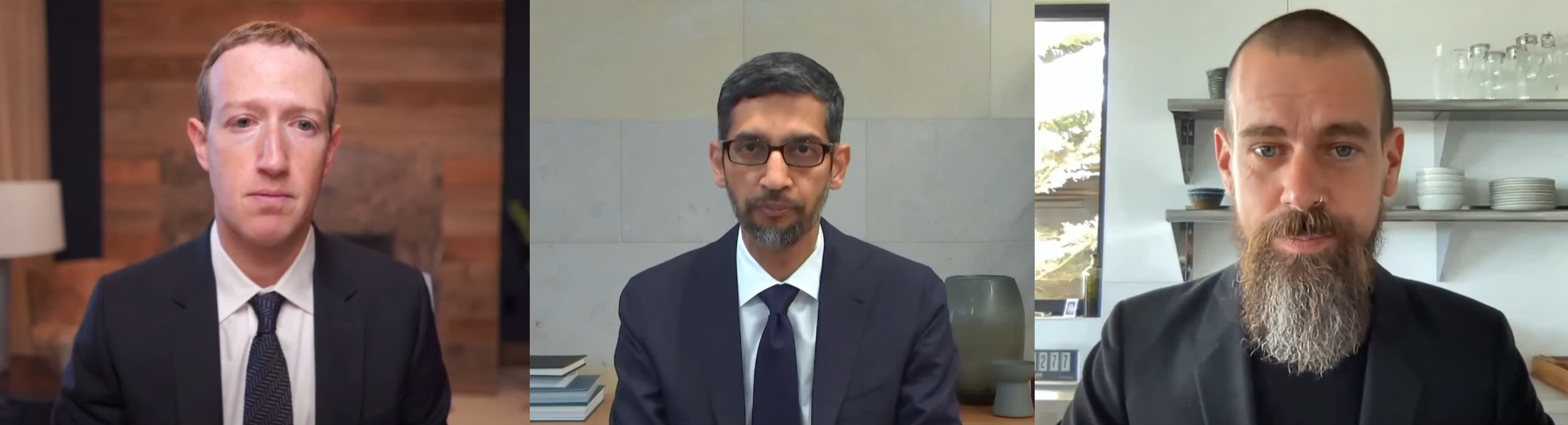
Faced with pointless or impossible questions, Zuckerberg maintained a sort of perpetually aggrieved countenance, looking more like the dog than the beater. Pichai tuned out, missing questions or offering obvious platitudes when called on. Dorsey, plainly bored, tweeted his way through the hearing and answered in monosyllables even when it was not required of him.
 As irritating as this political theater is to watch, it must surely be more so to take part in. Seeing that nothing worthwhile can be said or done in these five-minute abuse sessions, the highly visible chief goal of the CEOs is to run out the clock — safe and incredibly easy to do. Sometimes they appeared to be barely paying attention, secure in the knowledge that they can respond “these are nuanced issues… we take this very seriously, Congresswo—” before being cut off. Begging off based on being “unsure about the exact details” and saying you’ll follow up is another zero-commitment option.
The format needs to be changed to allow for substantive discussion, firstly by extending each member’s questioning time limit to eight or 10 minutes at least; secondly, by providing some kind of guideline for answering, for instance guaranteeing 10 seconds but silencing them after 30. So much is lost to crosstalk in these video hearings that ultimately it’s better to allow a bad answer to go for 20 seconds than to object to it for 25.
It may also pay to limit the participants, allowing the leaders of the Committee to allocate time as they see fit to a smaller number of representatives who have more than boilerplate outrage to put on the record. How exactly this could be accomplished is probably subject to a raft of rules and procedural things, but seriously, there’s no point in having most of these people involved. Keep it fair, keep it bipartisan and let each party either exclude its cranks or own them.
Real consequences or legally extracted promises need to exist as well. One questioner brought up an independent audit Jack Dorsey promised — on the record, to Congress — in 2018. It never took place, with Dorsey saying they decided to do something else instead. So it wasn’t a promise, it wasn’t a requirement and there was no legal compulsion to do anything at all. Why even bother asking if all you’re doing is asking for a favor? Lawmakers need bite to back up their bark, and if that doesn’t exist, they should refrain from barking so much.
Have a real agenda
If the format changes, the agenda needs to as well. Because if we simply allow these clueless lawmakers more time to read their scripts, the scripts will, like legislative goldfish, expand to fill the time allotted to them.
We’ve seen hearings that have made a difference, usually because the people involved have evidence to present and arguments to accompany it. Vice President Kamala Harris was great at this, having a background as a prosecutor — she made it pretty hot for Zuckerberg back in 2018. Reps. Pramila Jayapal (D-WA) and David Cicilline (D-RI) made Jeff Bezos look like he was either ignorant or had something to hide last year by confronting him with incriminating testimony and requiring a real answer.
Unfortunately, we can’t trust our legislators to be informed (or truthful) on these issues or really to even care. Most of the time their questions come off like something anyone could throw together an hour before the hearing with some quick background searches. Some of it (like hammering on the long-settled NY Post/Hunter Biden debacle) is so out of date that it proves beyond a doubt that the questioner had no intention of addressing the issues ostensibly at hand. Why let them waste everyone’s time on irrelevant topics?
Subpoena power comes with its own problems — no one wants to fight a court battle every time they want to ask a few questions — but if Congress is not going to use the tools available to it in the pursuit of legislating these issues, what exactly do they bring to the table?
If hearings don’t have a driving force behind them, such as an event, investigation or document release, they are almost by definition just a way for representatives to generate sound bites and appear concerned to their constituency. Today’s event is very much an example of this.
Bring in principals, not figureheads
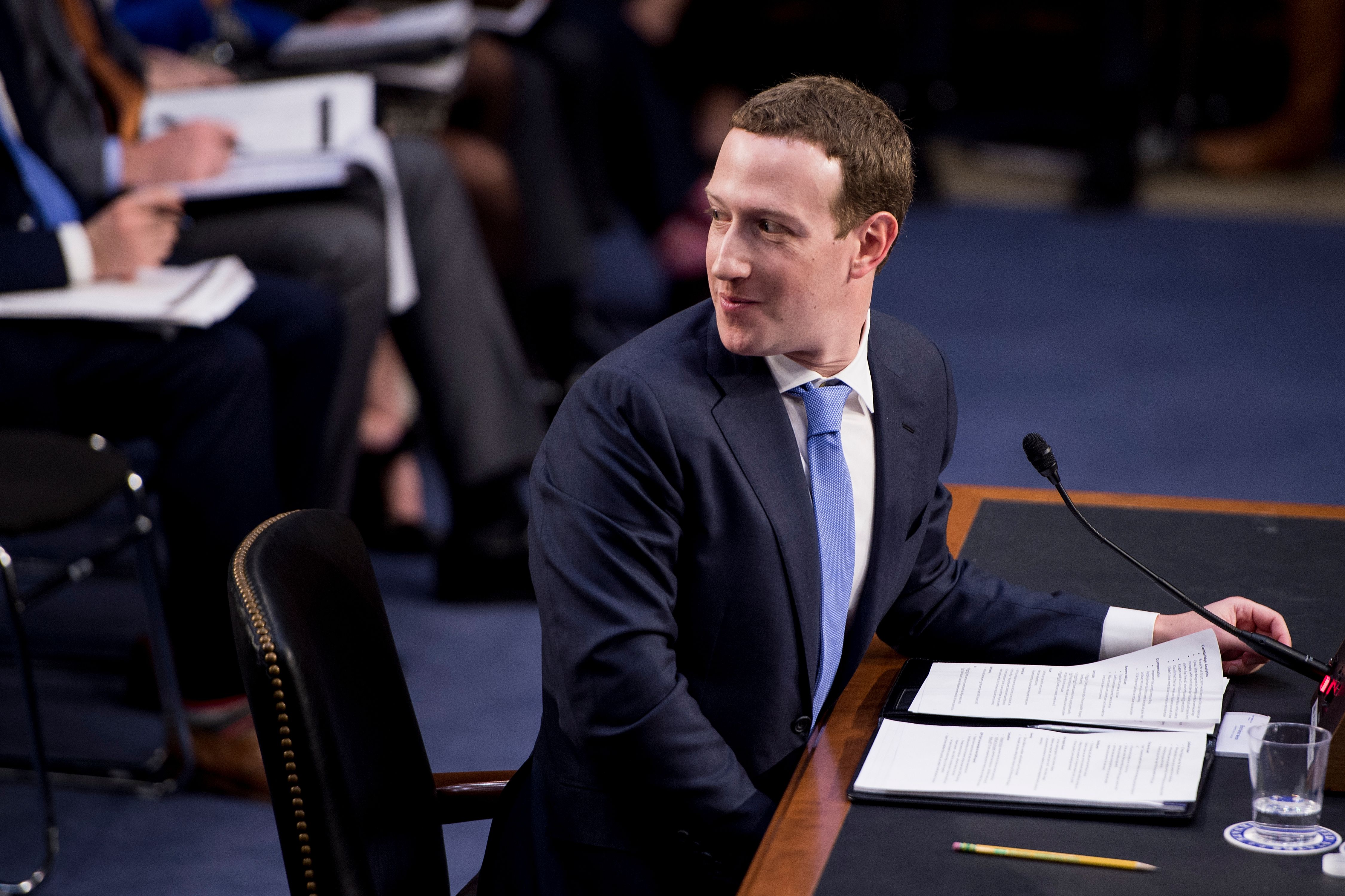
Facebook CEO Mark Zuckerberg listens during a joint hearing of the Senate Commerce, Science and Transportation Committee and Senate Judiciary Committee on Capitol Hill April 10, 2018 in Washington, DC. Facebook chief Mark Zuckerberg took personal responsibility Tuesday for the leak of data on tens of millions of its users, while warning of an “arms race” against Russian disinformation during a high stakes face-to-face with US lawmakers. (Photo: BRENDAN SMIALOWSKI/AFP/Getty Images)
Mark Zuckerberg, Sundar Pichai and Jack Dorsey are very smart. Very well-informed. Very important. But their roles as figureheads as well as decisionmakers in their companies and industries makes it nearly impossible for them to say anything that hasn’t been drafted and cleared ahead of time, and they are also free to not remember or defer to an absent colleague.
There’s no blood to squeeze from these stones, so invite someone else. This was a hearing about disinformation — these companies have people making everyday decisions and directly overseeing projects on that topic. They should be the ones being asked to answer Congress’s questions.
It’s conceivable, if almost certainly untrue, that Zuckerberg “doesn’t recall” conversations about hiding abuse of Facebook data from users. Getting him to take that position is a victory of a sort, but it would be better to have the person whose responsibility this actually was, someone who can’t take refuge in hysterical ignorance.
Certainly these VPs and heads of what have you would also be media trained and prepped with canned statements, but it’s better than the alternative. These CEOs are Teflon-coated and this isn’t their first time in front of the shouting squad. They no longer care about anything but keeping the hearings as boring as possible and avoiding a news cycle. (Dorsey’s weird clock was a great blow-off valve for this. Pichai’s aggressively ordinary background gave you nothing to focus on but his answers — wrong play. And Zuckerberg’s high-quality camera setup only made him look more damp and robotic.)
Every time one of these hearings takes place, the overwhelming impression one gets from them is of a lost opportunity. Here are elected lawmakers given a chance to speak directly to some of the most powerful people in the tech industry, and perhaps nine out of 10 use that time to retread old topics, thrust dubious information into the record, or simply relish their chance to push around someone like Mark Zuckerberg. The temptation is understandable but legislators must put the country first.
Though some representatives raised important issues today, the format prevented them from extracting substantive answers; the lack of a cohesive agenda or central documents meant they had no compelling evidence to put forth; the subjects of their questioning were bored and had no reason to say anything beyond what they put in their carefully prepared opening statements. If future hearings — concerning this or other industries — don’t change things up, no one should be surprised if they, like this one, yield nothing but hot air.

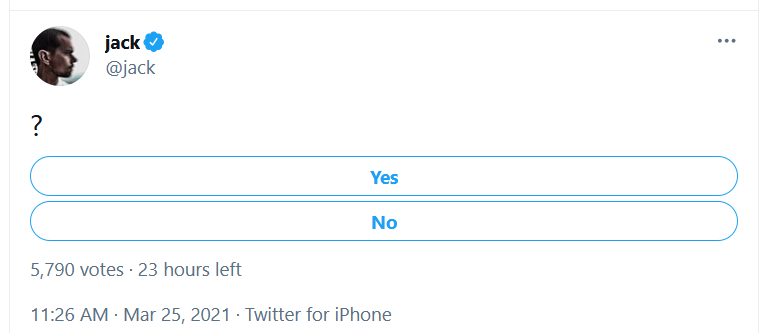
Twitter CEO Jack Dorsey got called out by Rep. Kathleen Rice (D-NY) for tweeting during today’s congressional hearing on disinformation and extremism. The tech exec’s tweet was likely expressing frustration with the format of the hearing, which once again saw the tech CEOs forced to boil down their answers to complicated questions into simple “yes” or “no” answers — or otherwise be cut off from responding. Cryptically, Dorsey this afternoon tweeted out a Twitter poll with just one question: “?” that had only two answers to choose from: either a “Yes” or “No.”
His post — or social commentary, if you will — did not go unnoticed.
Before Rice moved into her line of questioning, which focused on platforms’ ability to radicalize U.S. veterans’ and military service members, she asked the Twitter CEO about his tweet.
“Mr. Dorsey, what is winning — yes or no — on your Twitter account…poll?,” asked Rice, who sat in front of colorful wallpaper covered with flowers, butterflies, bugs and maybe snakes (??), which we agree was one of the better web conferencing backgrounds of the day — perhaps even besting Dorsey’s decision to zoom from his kitchen with a cleverly placed blockchain clock behind him. (Because of course it’s a blockchain clock. Of course.)
“Yes,” Dorsey answered simply, in same monotone he used throughout the hearing, which tends to give the impression of someone who just can’t get worked up over yet another congressional dog-and-pony show.
“Hmmm,” Rice admonished.
“Your multitasking skills are quite impressive,” she snarked, in a tone that did not seem to indicate she was actually impressed.
In case you’re wondering, “Yes” was winning then and continues to win now, with 65.7% of the 65,626 total votes so far, compared with the just 34.3% who voted “No,” as of the time of writing.
?
— jack (@jack) March 25, 2021
Perhaps there’s some optimism left for social media after all?


