& meet dozens of singles today!
User blogs

Ajaib, the Indonesian investment app, has added $65 million to its Series A, bringing the round’s new total to $90 million. The extension was led by Ribbit Capital, the fintech investor that also led Robinhood’s $3.4 billion funding last month. Ajaib is Ribbit Capital’s first investment in Southeast Asia.
The extension will be used to expand Ajaib’s product development and engineering capabilities. The startup, which claims to run the fourth largest stock brokerage in Indonesia based on number of trades, announced the $25 million first closing of its Series A in January. Other participants included Y Combinator Continuity, ICONIQ Capital, Bangkok Bank PLC, and returning investors Horizons Ventures, SoftBank Ventures Asia, Alpha JWC and Insignia Ventures. David Velez and SG Lee, the founders of fintech startups Nubank and Toss respectively, also invested.
Indonesian investment platform Ajaib gets $25 million Series A led by Horizons Venture and Alpha JWC
Ajaib was founded in 2019 by chief executive officer Anderson Sumarli and chief operating officer Yada Piyajomkwan. It is among a new crop of fintech startups that are focused on making stock investing more accessible to first-time investors. In Indonesia, less than 1% of the population own stocks, but that number is increasing, especially among millennials.
Other investment apps in Indonesia that have also raised funding recently include Pluang, Bibit and Bareksa. Ajaib’s founders told TechCrunch in January that it differentiates as a low-fee stock trading platform that also offers mutual funds for diversification.
In a press statement, Ribbit Capital managing partner Micky Malka said, “We are witnessing an unprecedented revolution in retail investing around the world. Ajaib is at the forefront of this revolution and is on their way to building the most trusted brand in the market. Their commitment to bring transparency and serve Indonesia’s millennial investors with the best products is at par with the best companies worldwide.”
With the close of its latest investment fund, Norrsken VC is is taking an unprecedented step in tying the compensation of its partners to the positive changes the firm’s portfolio companies have on the world — and not just their financial returns.
The firm, which released its impact assessment for 2020 last week, has invested in companies that address seven of the United Nations’ seventeen sustainable development goals, and is benchmarking its performance on goals that range from the tightly monitored to the slightly tautological.
In some instances, the goals are simply customer metrics (with the assumption that the more customers on a product, the better they’re doing). To be fair, these are in areas like education and healthcare where the true impact of a company’s services are harder to measure.
The firm’s portfolio has much more tangible progress in the climate change mitigation and sustainability space. Here, emissions avoided or increases in energy efficiency can be measured quite easily. And those energy efficiency gains and emissions reductions, along with lower waste associated with the firm’s food and agtech businesses are where the firm has seen its best performance.
When they exit, this performance will matter a great deal to the partners at Norrsken, because their compensation is directly affected by it.
“For each investment that we make, we set targets pre-investment for what we want to see in terms of impact,” said Tove Larsson, a general partner with Norrsken VC. “We do that together with some of our key LPs in the fund. We need to get the advisory committee’s approval of the targets. We set thsoe targets for an individual year and then on an annual basis.”
When the fund reaches the end of its cycle, the firm will look at the aggregated outcome of all of the impact KPIs and will weight the results of each company’s impact based o the amount we invested in each company. Based on that, the firm decides whether the team gets any carried interest or not.
If the portfolio companies hit sixty percent of the impact targets that have been set by the firm and its advisory board members, then they receive half of the carried interest, with the rest donated to charity. “There’s a linear escalation up to 100 percent. And if we don’t achieve that then the carried interest will be paid out to a charity organization or an NGO,” said Larsson.
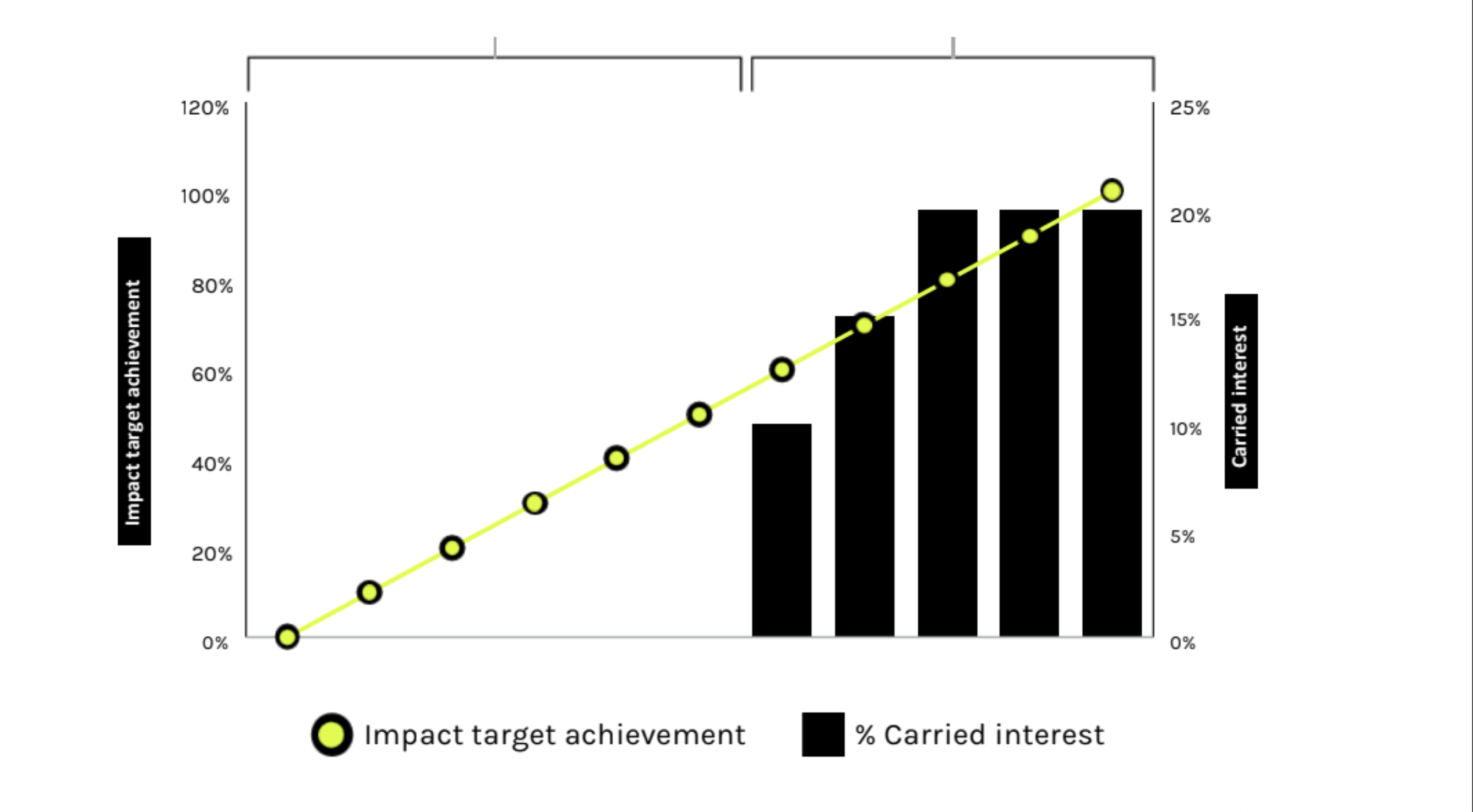
Image Credit: Norrsken VC
The partners at Norrsken see their novel compensation structure as a point of differentiation, especially as the number of firms focused on themes related to the UN’s sustainable development goals continues to increase dramatically.
“We we started to invest, we were one of the first — four years ago. Then the market evolved so quickly where we got questions around how do you stand out and how do you know whether you’re truly an impact player,” said Agate Freimane, a general partner at the firm.
“This is a core part of the DNA. We need to do better and show that we can walk the talk,” Freimane said. So the firm took a page from the European Investment Fund, whose operations impose similar restrictions on compensation, she said. “When we heard about this way of doing it, we said tis make 100 percent sense, and why doesn’t everyone do it?”
So far, the team hasn’t had any problems hitting the target it had set. “We’re at 119 percent of the 2020 targets,” Freimane said. Still that’s only 12 percent of the long term targets. “At the moment, we’v e done one tenth of what we need to do over the lifetime of the fund.”
Even if some of the targets may be… imprecise… the steps that the firm’s portfolio companies have taken to reduce greenhouse gas emissions and food waste, and improving energy efficiency are having a real, measurable imapct. Whether that’s the reduction of data center energy demand by 10 Gigawatt hours thanks to the deployment of Submer technologies; reducing 11,000 tons of food waste through operations at Karma, Whywaste, Matsmart or Olio; saving 4 million liters of water from carwashes using Woshapp; or the development of 38 megawatts of solar projects thanks to the work of Alight.
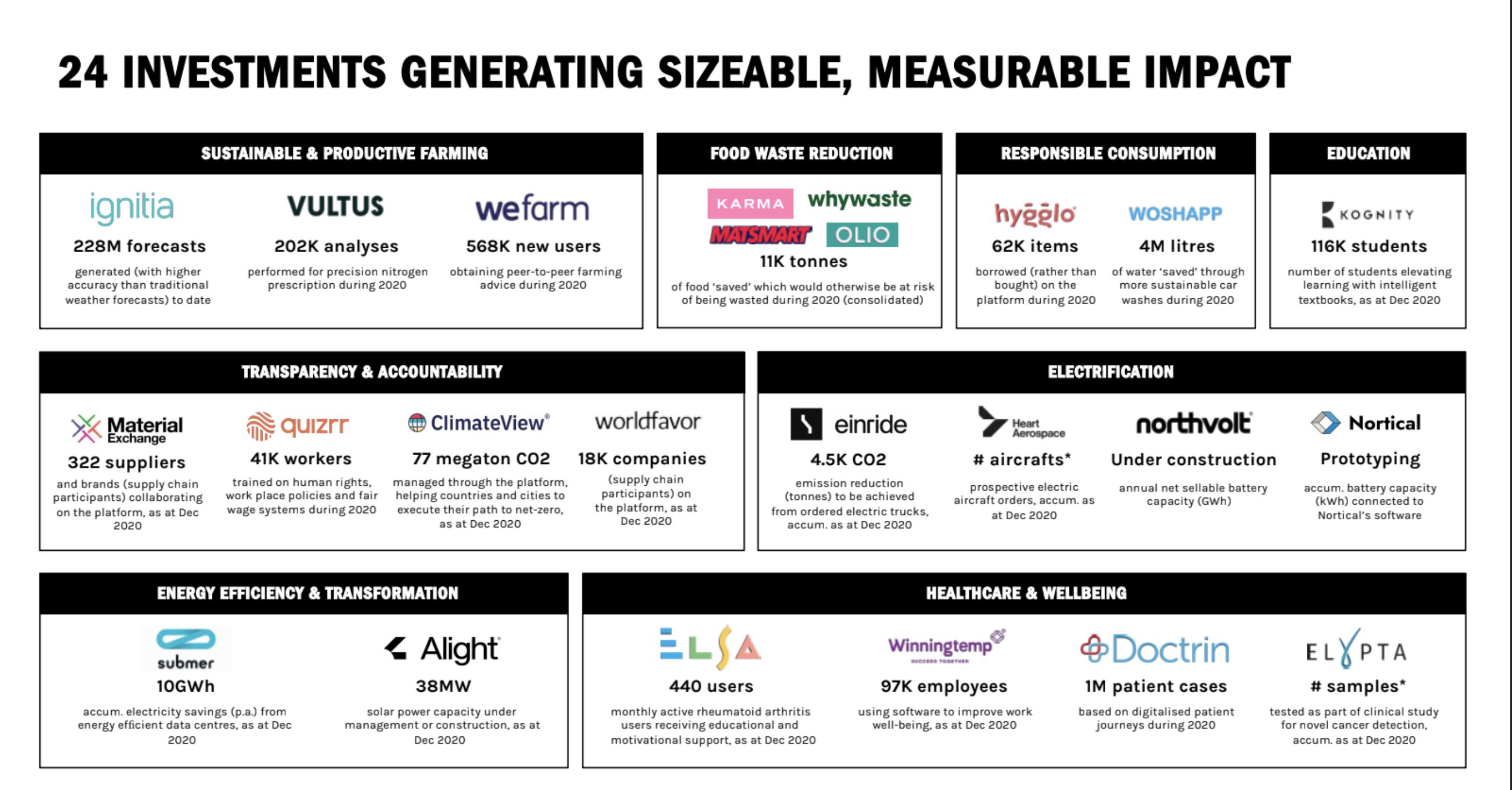
Image Credit: Norrsken VC
“What we’re most proud of is that we’re actually doing this now,” said Larsson. “It’s not perfect, what we have delivered now, But we really think we need to start somewhere and it is key that the industry needs to become more transparent. The first thing we mentioned is that we think it is an achievement that we are tracking it and making it public.”

gambling mn Vikings In 1977 super serving
Pete Carroll giving Usc gossips if you want to Grow
How To The Super Bowl Of Looking After About Valentine s
portrait when it comes to poopdog1000
generally teddy nighties tennis group - profoundly
nfl great run Xliv probability to score previous Td
Eric Dickerson Jersey Upsets Jets
Apple has released an update for iPhones, iPads and Watches to patch a security vulnerability under active attack by hackers.
The security update lands as iOS 14.4.2 and iPadOS 14.4.2, which also covers a patch to older devices as iOS 12.5.2. watchOS also updates to 7.3.3.
Apple said the vulnerability, discovered by security researchers at Google’s Project Zero, may have been “actively exploited” by hackers. The bug is found in WebKit, the browser engine that powers the Safari browser across all Apple devices.
It’s not known who is actively exploiting the vulnerabilities, or who might have fallen victim. Apple did not say if the attack was targeted against a small subset of users or if it was a wider attack. It’s the third time (by our count) that Apple has pushed out a security-only update this year to fix flaws under active attack. Earlier this month the company released patches for similar vulnerabilities in WebKit.
Update today.
The beauty of podcasting is that anyone can do it. It’s a rare medium that’s nearly as easy to make as it is to consume. And as such, no two people do it exactly the same way. There are a wealth of hardware and software solutions open to potential podcasters, so setups run the gamut from NPR studios to USB Skype rigs (the latter of which has become a kind of default during the current pandemic).
We’ve asked some of our favorite podcast hosts and producers to highlight their workflows — the equipment and software they use to get the job done. The list so far includes:
Election Profit Makers’ David Rees
Welcome to Your Fantasy’s Eleanor Kagan
Articles of Interest’s Avery Trufelman
First Draft and Track Changes’ Sarah Enni
RiYL remote podcasting edition
Family Ghosts’ Sam Dingman
I’m Listening’s Anita Flores
Broken Record’s Justin Richmond
Criminal/This Is Love’s Lauren Spohrer
Jeffrey Cranor of Welcome to Night Vale
Jesse Thorn of Bullseye
Ben Lindbergh of Effectively Wild
My own podcast, RiYL
Science! It’s a thing you should trust! At least that’s what people keep telling me on Twitter. But how do you know which science to trust? Thankfully, Science Vs. from Spotify/Gimlet exists to answer the difficult questions. The show wades into scientific fads and conspiracies, ranging from 5G to vaping in order to sift out the science fiction from science fact. This week, producer Rose Rimler joins us to detail how the show has evolved during the pandemic.
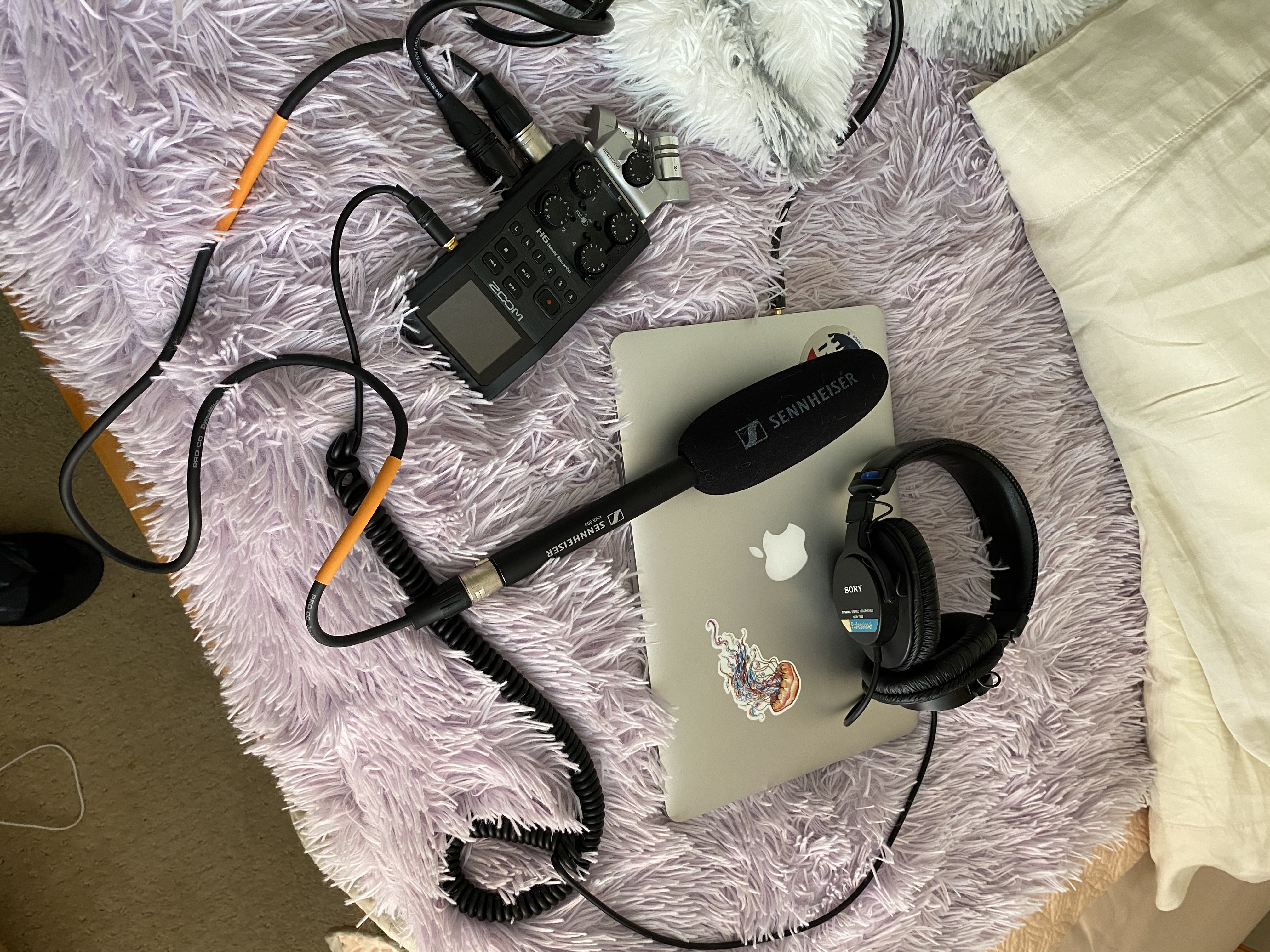
Image Credits: Rose Rimler
Before COVID, we worked out of an office in Brooklyn that had 10+ recording studios and a number of small, glass-walled meeting rooms set up for the table reads we call “edits.” We spent much of the day wandering around the office looking for one another in these offices and studios, which I guess is how I racked up an average of 6,700 steps a day in 2019 without really trying. Anyway, during the pandemic, we switched to recording ourselves and our interviews at home on portable recorders, which Gimlet provided.
We all use Zoom recorders and directional/shotgun mics. My recorder is a Zoom H6 and my mic is a Sennheiser MKE600. I think this is a very good quality mic because I don’t find a need to go into a closet or under a blanket to record myself. I just sit in my room, hold the mic to my chin and hit record. It seems to turn out fine, although maybe the audio engineers are secretly furious with me for this. The only way to know for sure is to repeatedly tweet @petaplaysbass demanding answers.
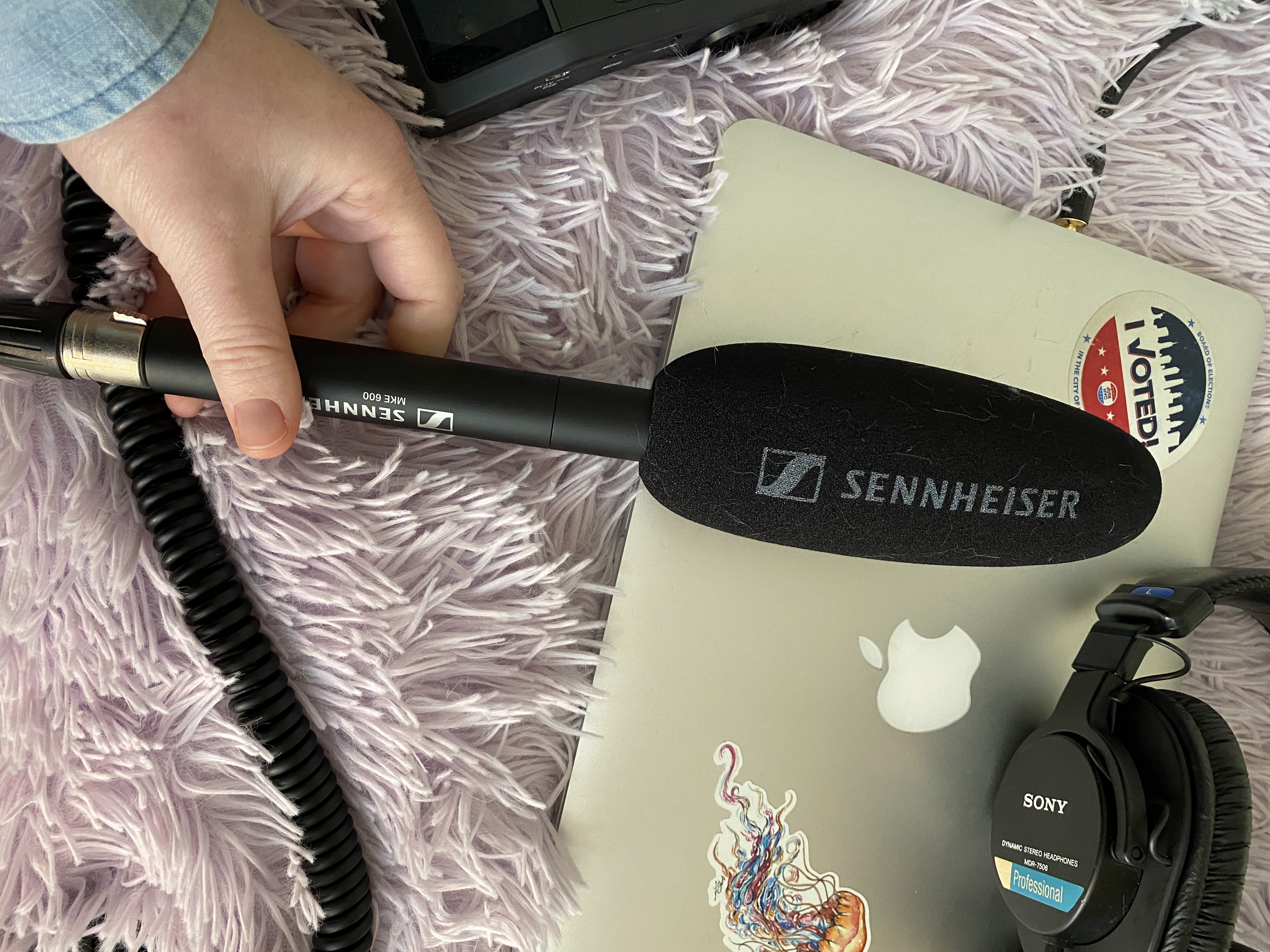
Image Credits: Rose Rimler
It’s a different story when it comes to the audio we get from our guests. The most basic way to just grab audio from someone is to record their phone call, or Zoom/Skype/Google Hangout session. I do this with a cord that plugs in from the Zoom recorder into my laptop, or (via adaptor) into my phone. The problem with this method is that the “phone tape” audio is kind of hard to hear. I know this from personal experience because when I listen to podcasts that use phone tape off my iPhone, without headphones, I can barely hear what the person is saying. So, I think getting better audio quality from guests really does matter for the audience. How to do that? The best way we’ve come up with is to ask them to conduct the interview over a computer app while using their smartphone as a recording device.
The iPhone comes with an app called “voice memo” that most people can use, and the phone’s mic is surprisingly good quality. They record their end of the conversation and send the file to us. If I’m feeling particularly confident in my ability to direct people, I might also ask them to pick a quiet, well-furnished room, put their phone into airplane mode, and hold it in front of them as they talk so the mic isn’t too far away (or place it on a stack of books near them).
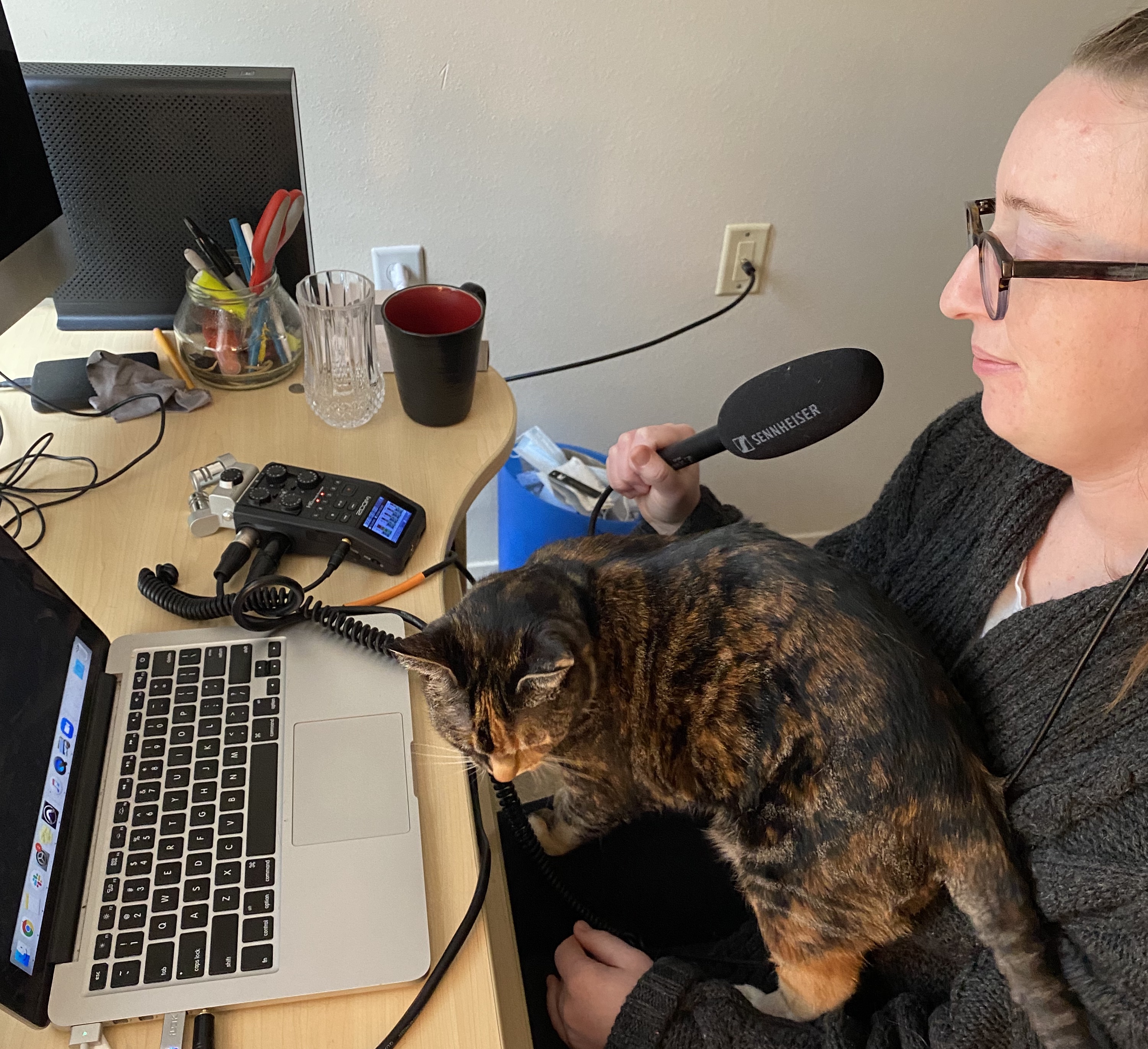
Image Credits: Rose Rimler
We’ve always been a really collaborative show, which hasn’t changed since the pandemic. While the lead producer writes the first few drafts of the script, they collaborate with the host and editor to do re-writes the last week or so before we publish. That’s why we were always huddled in various offices before the pandemic, writing through the script together. The difference now is we huddle over Google Hangout.
Also, I get many, many fewer steps.


