& meet dozens of singles today!
User blogs

Elon Musk’s Neuralink, one of his many companies and the only one currently focused on mind control (that we’re aware of), has released a new blog post and video detailing some of its recent updates — including using its hardware to make it possible for a monkey to play pong with only its brain.
In the video above, Neuralink demonstrates how it used its sensor hardware and brain implant to record a baseline of activity from this macaque (named ‘Pager’) as it played a game on-screen where it had to move a token to different squares using a joystick with its hand. Using that baseline data, Neuralink was able to use machine learning to anticipate where Pager was going to be moving the physical controller, and was eventually able to predict it accurately before the move was actually made. Researchers then removed the paddle entirely, and eventually did the same thing with Pong, ultimately ending up at a place where Pager no longer was even moving its hand on the air on the nonexistent paddle, and was instead controlling the in-game action entirely with its mind via the Link hardware and embedded neural threads.
The last we saw of Neuralink, Musk himself was demonstrating the Link tech live in August 2020, using pigs to show how it was able to read signals from the brain depending on different stimuli. This new demo with Pager more clearly outlines the direction that the tech is headed in terms of human applications, since, as the company shared on its blog, the same technology could be used to help patients with paralysis manipulate a cursor on a computer, for instance. That could be applied to other paradigms as well, including touch controls on an iPhone, and even typing using a virtual keyboard, according to the company.
Musk separately tweeted that in fact, he expects the initial version of Neuralink’s product to be able to allow someone with paralysis that prevents standard modes of phone interaction to use one faster than people using their thumbs for input. He also added that future iterations of the product would be able to enable communication between Neuralinks in different parts of a patient’s body, transmitting between an in-brain node and neural pathways in legs, for instance, making it possible for “paraplegics to walk again.”
These are obviously bold claims, but the company cites a lot of existing research that undergirds its existing demonstrations and near-term goals. Musk’s more ambitious claims, should, like all of his projections, definitely be taken with a healthy dose of skepticism. He did add that he hopes human trials will begin to get underway “hopefully later this year,” for instance – which is already two years later than he was initially anticipating those might start.
It’s been a little over a week since union voting concluded for Amazon warehouse workers in Bessemer, Alabama. Things have been fairly quiet in the eye of the storm for most of it. That changed today, however, as vote counting began in earnest. Thus far, things are breaking pretty dramatically in the company’s favor, following a hard-fought anti-union campaign.
As of the end of the day, no votes have more than doubled the yeses, at 1,100 to 463. With counting resuming — and likely concluding — tomorrow, the Retail, Wholesale and Department Store Union, which would potentially serve as the worker’s union, is decrying the company’s tactics.
“Our system is broken, Amazon took full advantage of that, and we will be calling on the labor board to hold Amazon accountable for its illegal and egregious behavior during the campaign,” RWDSU President Stuart Appelbaum said in a statement provided to TechCrunch. “But make no mistake about it; this still represents an important moment for working people and their voices will be heard.”
The comments appear to be as much about actions the company has taken during the campaign as it is bracing for a likely challenge to the results. The numbers constitute around half of the 3,215 ballots that are being counted. They put Amazon around 500 no votes away from defeating union efforts.
We have reached out to the company for a response to Appelbaum’s comment, but have not heard back. In a comment offered to TechCrunch last month, the company had less than stellar words about Appelbaum, calling the union head the “Chief Disinformation Officer,” adding that “in an attempt to save his long declining union, [he] is taking alternative facts to a whole new level.”
Regardless of the final count, this process is likely to be drawn out. Among the complaints are reports that the company pushed the USPS to install an illegal ballot box, breaking National Labor Relations Board rulings in the process.
Cybercriminals have taken out a number of Facebook ads masquerading as a Clubhouse app for PC users in order to target unsuspecting victims with malware, TechCrunch has learned.
TechCrunch was alerted Wednesday to Facebook ads tied to several Facebook pages impersonating Clubhouse, the drop-in audio chat app only available on iPhones. Clicking on the ad would open a fake Clubhouse website, including a mocked-up screenshot of what the non-existent PC app looks like, with a download link to the malicious app.
When opened, the malicious app tries to communicate with a command and control server to obtain instructions on what to do next. One sandbox analysis of the malware showed the malicious app tried to infect the isolated machine with ransomware.
But overnight, the fake Clubhouse websites — which were hosted in Russia — went offline. In doing so, the malware also stopped working. Guardicore’s Amit Serper, who tested the malware in a sandbox on Thursday, said the malware received an error from the server and did nothing more.
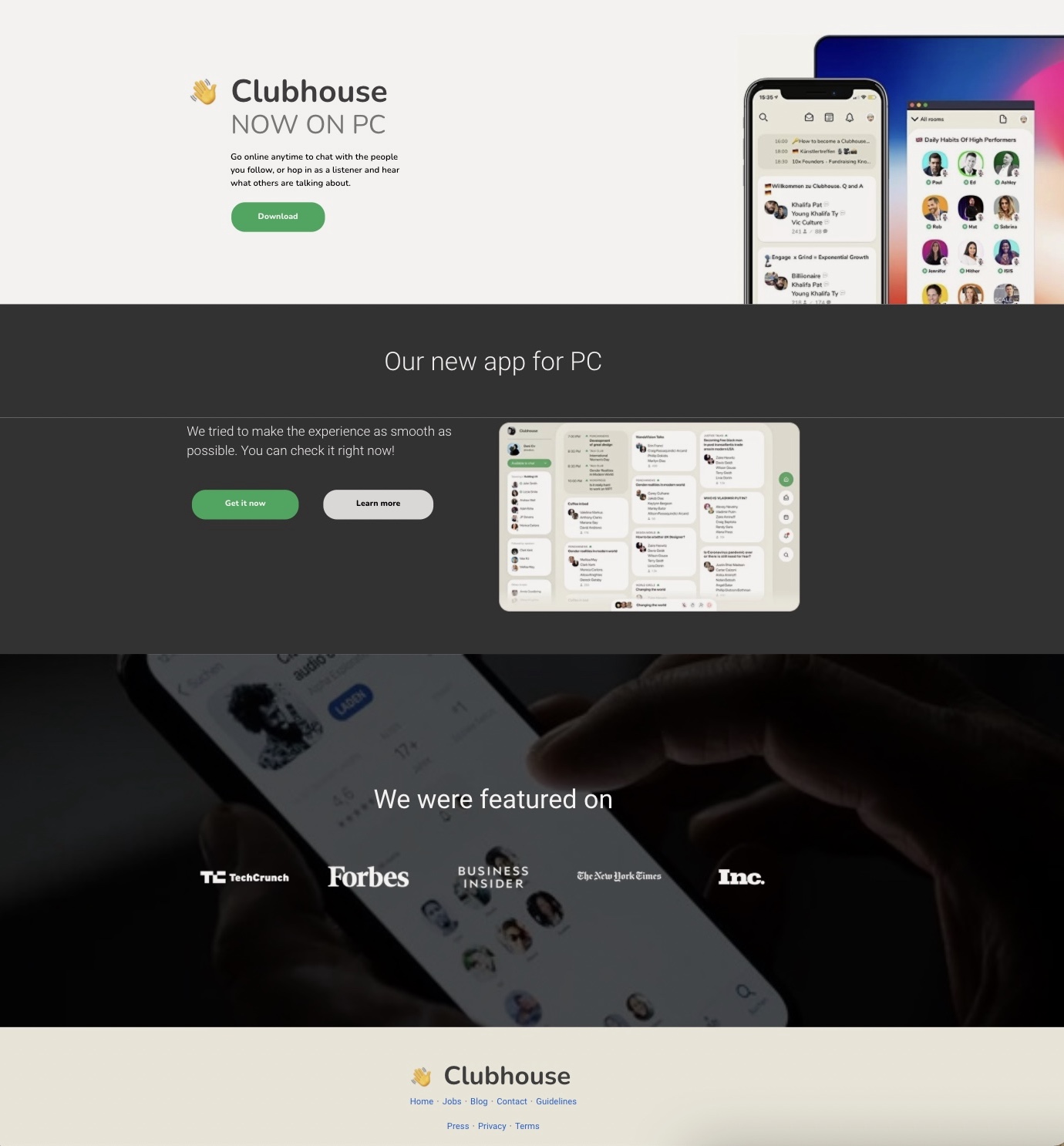
The fake website was set up to look like Clubhouse’s real website, but featuring a malicious PC app. (Image: TechCrunch)
It’s not uncommon for cybercriminals to tailor their malware campaigns to piggyback off the successes of wildly popular apps. Clubhouse reportedly topped more than 8 million global downloads to date despite an invite-only launch. That high demand prompted a scramble to reverse-engineer the app to build bootleg versions of it to evade Clubhouse’s gated walls, but also government censors where the app is blocked.
Each of the Facebook pages impersonating Clubhouse only had a handful of likes, but were still active at the time of publication. When reached, Facebook wouldn’t say how many account owners had clicked on the ads pointing to the fake Clubhouse websites.
At least nine ads were placed this week between Tuesday and Thursday. Several of the ads said Clubhouse “is now available for PC,” while another featured a photo of co-founders Paul Davidson and Rohan Seth. Clubhouse did not return a request for comment.
The ads have been removed from Facebook’s Ad Library, but we have published a copy. It’s also not clear how the ads made it through Facebook’s processes in the first place.
President Biden has announced a new set of initiatives by which he hopes to curb the gun violence he described as “an epidemic” and “an international embarrassment.” Among other things, the ATF will be closing loopholes in unregulated online sales and so-called “ghost guns,” which can be built or printed with no serial numbers or background checks.
Speaking in the White House Rose Garden Thursday afternoon, Biden recounted the many recent mass shootings as horrific tragedies, but pointed out that over a hundred people are shot every day in this country. “This is an epidemic, for God’s sake,” he repeated, “and it has to stop.”
Before outlining his plans for combating the problem, he made sure to address the inevitable Second Amendment objections from people who believe it is a Constitutional right for anyone to own things like assault rifles.
“Nothing I’m about to recommend in any way impinges on the Second Amendment,” Biden said. “From the very beginning, you couldn’t own any weapon you wanted to own. From the very beginning of the Second Amendment existing, certain people weren’t allowed to have weapons.”
Of course federal laws often conflict with state laws on this point, giving rise to surprising sights like heavily armed protestors taking over the Michigan capitol building — quite legally. But the feds do have a few tricks up their sleeves.
Background checks and registration tracking involve federal authorities, and there are loopholes that have appeared or worsened over recent years as online traffic in guns has increased (social networks are notorious for thinly veiled gun trade) and the process of building weapons at home has become easier.
“I have directed ATF to begin work on an updated study of gun trafficking, one that takes into account the fact that modern guns are not simply cast or forged any more, but can be made of plastic, printed on a 3D printer, or sold in self assembly kits,” said U.S. Attorney General Merrick Garland, who took the podium after Biden. “We will ensure that we understand and measure the problem of criminal gun trafficking in a data driven way.”
“Ghost guns” were a hot topic a few years back when several people and organizations, among them Defense Distributed, attempted to popularize 3D-printed pistols and assault rifle components. The high-tech angle made the media bite, though of course traditional gun trafficking in the form of smuggling and in-person sales dwarf the scale of anything these sites and services delivered.
But gun building kits do represent a significant loophole in the ATF’s regulations, which do not require registration or background checks for them. So a person can get 80% of a gun that way, get the other 20% (usually the “receiver,” which component qualifies the assembly as a firearm) by printing or another method, and have a gun with no serial number or registration whatsoever.
Garland has proposed a rule for the ATF to adopt that would change this and a few other things, such as easily purchased modifications for pistols that effectively make them into short-barreled rifles; the new rule would require those conversion kits to be registered. This presumably will follow the confirmation of the ATF’s first director in five years — the position was vacant for the whole last administration — David Chipmen, whom Biden plans to nominate.
Other efforts by the administration include a $5 billion, 8-year investment in community violence intervention programs, a push for “red flag” laws that temporarily bar people in crisis from obtaining guns, and a nudge for Congress to start working on legislation that addresses things the Executive can’t.
The coronavirus pandemic has increased our collective screen time, and that’s particularly true on mobile devices. According to a new report from mobile data and analytics firm App Annie, global consumers are now spending an average of 4.2 hours per day using apps on our smartphones, an increase of 30% from just two years prior. In some markets, the average is even higher — more than five hours.
In the first quarter of 2021, the daily time spent in apps surpassed four hours in the U.S., Turkey, Mexico and India for the first time, the report notes. Of those, India saw the biggest jump as consumers there spent 80% more time in smartphone apps in the Q1 2021 versus the first quarter of 2019.
To put this in perspective in the American market, Nielsen had last year reported consumers were spending around 4 and half hours watching live or time-shifted TV, but only 3 hours, 46 minutes using smartphone apps.
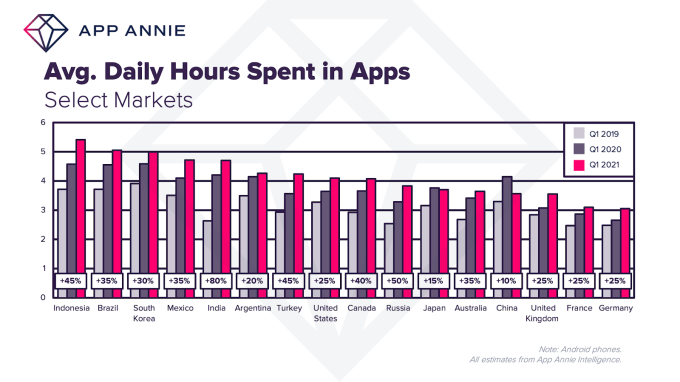
Image Credits: App Annie
However, we should point out that Nielsen and App Annie’s analysis can’t necessarily be compared directly, because App Annie only measured time spent on Android devices — and many Americans use iPhones. Nielsen, meanwhile, relies on panels to achieve a representative sampling. Nevertheless, the broad strokes here are that mobile apps seem to be a more popular means of entertainment than the good ol’ American pastime of watching TV.
The new report also notes that three markets — Brazil, South Korea, and Indonesia — saw the average daily time spent in apps jump to over five hours this past quarter.
It can be difficult to determine which apps are driving these changes as the most downloaded apps tend to remain the same quarter after quarter. The top charts are dominated by the usual names like TikTok, YouTube and Facebook, for example. That’s why App Annie now tracks what it calls “breakout apps,” which are those that saw spikes in quarter-over-quarter downloads across both iOS and Android.
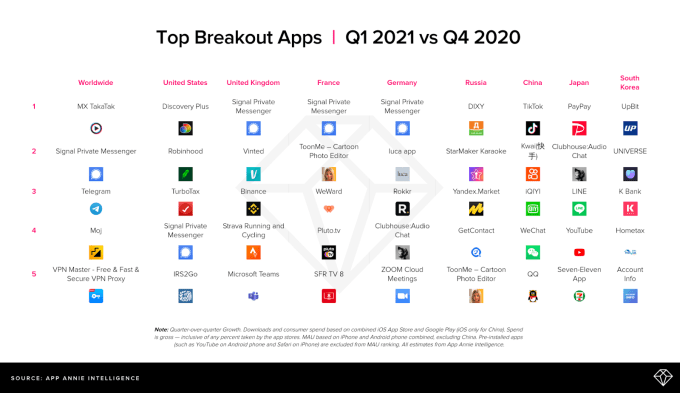
Image Credits: App Annie
In Q1 2021, Western markets saw a sharp rise in secure messaging apps, Signal and Telegram. Signal, for instance, placed first in the U.K., Germany, and France, and fourth in the U.S. as a “breakout app” for the quarter. Telegram was No. 9 in the U.K. No. 5 in France, and No. 7 in the U.S.
Investment and trading apps were also popular in the quarter, with Coinbase’s crypto app at No. 6 in the U.S. and U.K. on this list, while Binance was No. 7 in France. Crypto trading app Upbit, meanwhile, was No. 1 in South Korea. The payment app, PayPay was the No. 1 breakout app in Japan. And Robinhood was No. 2 in the U.S.
Clubhouse also made a showing on the “breakout” charts, as it gained ground in non-U.S. markets like Germany and Japan, where it ranked No. 4 and No. 3, respectively.
China’s breakout chart was different, with a focus on video apps like TikTok, Kwai, CapCut and iQIYI.
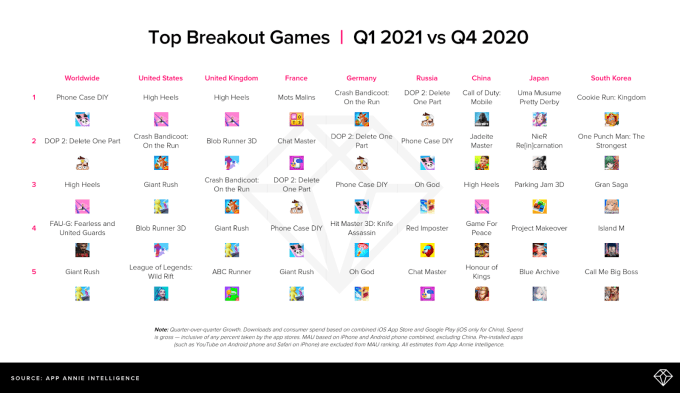
Image Credits: App Annie
TikTok’s influence on games was also apparent in the quarter. The game High Heels from Istanbul-based Rollic (now owned by Zynga), was heavily advertised on TikTok, sending the title to No. 1 in the U.S. and U.K.’s “breakout” games charts, as well as No. 3 in China, No. 7 in Germany, and No. 6 in Russia.
Other hyper-casual games did well, too, including Project Makeover, DOP 2: Delete One Part, and Phone Case DIY.
Crash Bandicoot: On the Run also broke out in the quarter. Despite launching on March 25, the game saw 21 million downloads in four days, becoming the top breakout app in Germany, No. 2 in the U.S., No. 3 in the U.K, and No. 9 in France.


