& meet dozens of singles today!
User blogs

While visual ‘no code‘ tools are helping businesses get more out of computing without the need for armies of in-house techies to configure software on behalf of other staff, access to the most powerful tech tools — at the ‘deep tech’ AI coal face — still requires some expert help (and/or costly in-house expertise).
This is where bootstrapping French startup, NLPCloud.io, is plying a trade in MLOps/AIOps — or ‘compute platform as a service’ (being as it runs the queries on its own servers) — with a focus on natural language processing (NLP), as its name suggests.
Developments in artificial intelligence have, in recent years, led to impressive advances in the field of NLP — a technology that can help businesses scale their capacity to intelligently grapple with all sorts of communications by automating tasks like Named Entity Recognition, sentiment-analysis, text classification, summarization, question answering, and Part-Of-Speech tagging, freeing up (human) staff to focus on more complex/nuanced work. (Although it’s worth emphasizing that the bulk of NLP research has focused on the English language — meaning that’s where this tech is most mature; so associated AI advances are not universally distributed.)
Production ready (pre-trained) NLP models for English are readily available ‘out of the box’. There are also dedicated open source frameworks offering help with training models. But businesses wanting to tap into NLP still need to have the DevOps resource and chops to implement NLP models.
NLPCloud.io is catering to businesses that don’t feel up to the implementation challenge themselves — offering “production-ready NLP API” with the promise of “no DevOps required”.
Its API is based on Hugging Face and spaCy open-source models. Customers can either choose to use ready-to-use pre-trained models (it selects the “best” open source models; it does not build its own); or they can upload custom models developed internally by their own data scientists — which it says is a point of differentiation vs SaaS services such as Google Natural Language (which uses Google’s ML models) or Amazon Comprehend and Monkey Learn.
NLPCloud.io says it wants to democratize NLP by helping developers and data scientists deliver these projects “in no time and at a fair price”. (It has a tiered pricing model based on requests per minute, which starts at $39pm and ranges up to $1,199pm, at the enterprise end, for one custom model running on a GPU. It does also offer a free tier so users can test models at low request velocity without incurring a charge.)
“The idea came from the fact that, as a software engineer, I saw many AI projects fail because of the deployment to production phase,” says sole founder and CTO Julien Salinas. “Companies often focus on building accurate and fast AI models but today more and more excellent open-source models are available and are doing an excellent job… so the toughest challenge now is being able to efficiently use these models in production. It takes AI skills, DevOps skills, programming skill… which is why it’s a challenge for so many companies, and which is why I decided to launch NLPCloud.io.”
The platform launched in January 2021 and now has around 500 users, including 30 who are paying for the service. While the startup, which is based in Grenoble, in the French Alps, is a team of three for now, plus a couple of independent contractors. (Salinas says he plans to hire five people by the end of the year.)
“Most of our users are tech startups but we also start having a couple of bigger companies,” he tells TechCrunch. “The biggest demand I’m seeing is both from software engineers and data scientists. Sometimes it’s from teams who have data science skills but don’t have DevOps skills (or don’t want to spend time on this). Sometimes it’s from tech teams who want to leverage NLP out-of-the-box without hiring a whole data science team.”
“We have very diverse customers, from solo startup founders to bigger companies like BBVA, Mintel, Senuto… in all sorts of sectors (banking, public relations, market research),” he adds.
Use cases of its customers include lead generation from unstructured text (such as web pages), via named entities extraction; and sorting support tickets based on urgency by conducting sentiment analysis.
Content marketers are also using its platform for headline generation (via summarization). While text classification capabilities are being used for economic intelligence and financial data extraction, per Salinas.
He says his own experience as a CTO and software engineer working on NLP projects at a number of tech companies led him to spot an opportunity in the challenge of AI implementation.
“I realized that it was quite easy to build acceptable NLP models thanks to great open-source frameworks like spaCy and Hugging Face Transformers but then I found it quite hard to use these models in production,” he explains. “It takes programming skills in order to develop an API, strong DevOps skills in order to build a robust and fast infrastructure to serve NLP models (AI models in general consume a lot of resources), and also data science skills of course.
“I tried to look for ready-to-use cloud solutions in order to save weeks of work but I couldn’t find anything satisfactory. My intuition was that such a platform would help tech teams save a lot of time, sometimes months of work for the teams who don’t have strong DevOps profiles.”
“NLP has been around for decades but until recently it took whole teams of data scientists to build acceptable NLP models. For a couple of years, we’ve made amazing progress in terms of accuracy and speed of the NLP models. More and more experts who have been working in the NLP field for decades agree that NLP is becoming a ‘commodity’,” he goes on. “Frameworks like spaCy make it extremely simple for developers to leverage NLP models without having advanced data science knowledge. And Hugging Face’s open-source repository for NLP models is also a great step in this direction.
“But having these models run in production is still hard, and maybe even harder than before as these brand new models are very demanding in terms of resources.”
The models NLPCloud.io offers are picked for performance — where “best” means it has “the best compromise between accuracy and speed”. Salinas also says they are paying mind to context, given NLP can be used for diverse user cases — hence proposing number of models so as to be able to adapt to a given use.
“Initially we started with models dedicated to entities extraction only but most of our first customers also asked for other use cases too, so we started adding other models,” he notes, adding that they will continue to add more models from the two chosen frameworks — “in order to cover more use cases, and more languages”.
SpaCy and Hugging Face, meanwhile, were chosen to be the source for the models offered via its API based on their track record as companies, the NLP libraries they offer and their focus on production-ready framework — with the combination allowing NLPCloud.io to offer a selection of models that are fast and accurate, working within the bounds of respective trade-offs, according to Salinas.
“SpaCy is developed by a solid company in Germany called Explosion.ai. This library has become one of the most used NLP libraries among companies who want to leverage NLP in production ‘for real’ (as opposed to academic research only). The reason is that it is very fast, has great accuracy in most scenarios, and is an opinionated” framework which makes it very simple to use by non-data scientists (the tradeoff is that it gives less customization possibilities),” he says.
“Hugging Face is an even more solid company that recently raised $40M for a good reason: They created a disruptive NLP library called ‘transformers’ that improves a lot the accuracy of NLP models (the tradeoff is that it is very resource intensive though). It gives the opportunity to cover more use cases like sentiment analysis, classification, summarization… In addition to that, they created an open-source repository where it is easy to select the best model you need for your use case.”
While AI is advancing at a clip within certain tracks — such as NLP for English — there are still caveats and potential pitfalls attached to automating language processing and analysis, with the risk of getting stuff wrong or worse. AI models trained on human-generated data have, for example, been shown reflecting embedded biases and prejudices of the people who produced the underlying data.
Salinas agrees NLP can sometimes face “concerning bias issues”, such as racism and misogyny. But he expresses confidence in the models they’ve selected.
“Most of the time it seems [bias in NLP] is due to the underlying data used to trained the models. It shows we should be more careful about the origin of this data,” he says. “In my opinion the best solution in order to mitigate this is that the community of NLP users should actively report something inappropriate when using a specific model so that this model can be paused and fixed.”
“Even if we doubt that such a bias exists in the models we’re proposing, we do encourage our users to report such problems to us so we can take measures,” he adds.
French startup Vybe has raised a $2.9 million funding round (€2.4 million) to build a challenger bank for teens. The company is currently testing its product with a soft launch. Users get a Mastercard payment card paired with an e-wallet.
Each Vybe account comes with its own IBAN so that users can send and receive money. If you want to open an account and you are less than 18 years old, you have to go through the KYC process (know your identity) with your parent.
As for parents, they can set up some limits on card payments or even block the card. Parents can also view transactions. The startup plans to generate revenue from interchange fees as well as partnership with brands and a reward system.
While Vybe isn’t technically live, the company has attracted 375,000 downloads. Overall, 260,000 teens have pre-ordered a card already. Thousands of cards have been delivered and the first metrics are encouraging. Early adopters tend to use their card once every two days.
Today’s fund is a round extension from existing investors. Investors include Ronan Le Moal, the former CEO of Crédit Mutuel Arkéa, Kick Club and Manoel Amorim.
Banking products for teenagers are a lucrative segment. In France, there are several companies trying to position themselves on this segment, such as Kard, PixPay and Xaalys. Most of these companies charge a subscription fee to access the service.
Other fintech companies that aren’t specifically targeting young people could also work well with teenagers. For instance, young users can open a Revolut Junior or Lydia account and receive money from their parents.
In the U.S., startups offering debit cards for children are about to reach unicorn status. As The Information’s Kate Clark reported, Greenlight, Current and Step are all raising new funding rounds with a valuation between $1 billion and $2 billion.
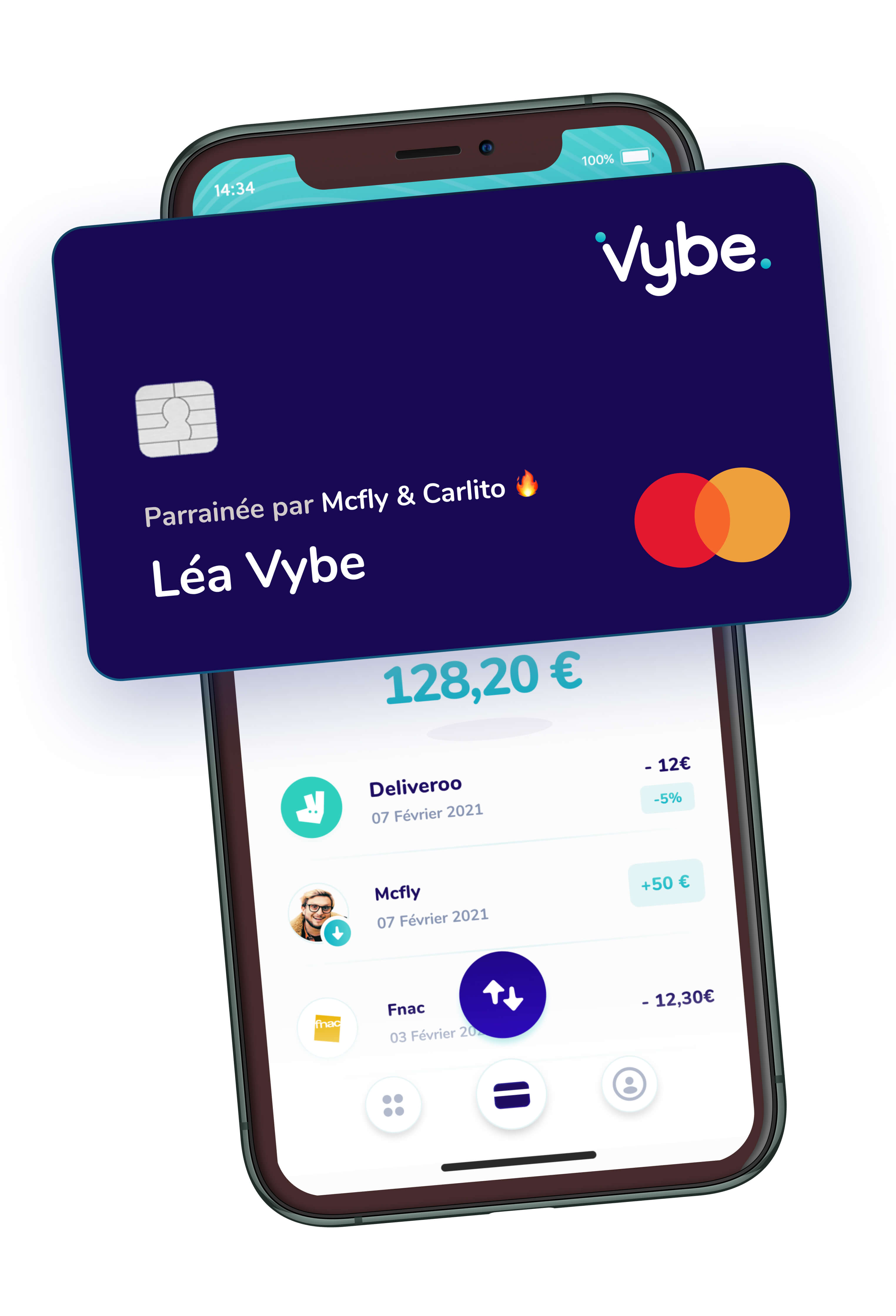
Image Credits: Vybe
Corporate catering company Elior has acquired French startup Nestor for an undisclosed amount. Nestor originally started with a simple idea to differentiate itself from food delivery giants, such as Deliveroo, Uber Eats and others.
Every day, the startup offered a single menu for lunch. If you liked what was on the menu, you could order and get delivered 10 to 20 minutes later. By offering a single menu, a delivery person could deliver several clients in a single ride. Similarly, by managing its own kitchen, Nestor could improve its margins as it didn’t have to pay third-party restaurants.
Since I first covered Nestor in 2016, the company has been capital efficient and mostly focused on this unique product offering. Elior says that Nestor managed to reach 10,000 meals per week.
Over the past few months, Nestor has tried to launch new offers. For instance, companies can switch to Nestor for their canteens. The startup delivers meals in fridges directly. It reminds me of Foodles, another French startup focused on canteen-like services.
Nestor can also deliver individually packed lunches in case you are spending the day with some clients for a big meeting. Popchef has also pivoted to focus more on that segment.
Following the acquisition, Nestor is going to focus more and more on the B2B market. While Elior is working with big companies in glass towers, it has been quite hard to convince small and medium companies to open a canteen in the office.
The sales pitch could be summed up in two sentences. Nestor clients don’t need to have their own kitchen as everything is prepared in advance. And employees don’t have to browse Deliveroo at lunch time to find something that isn’t a burger or a pizza.
Iyuno-SDI Group, a provider of translated subtitles and other media localization services, announced today it has raised $160 million in funding from SoftBank Vision 2. The company said this makes the fund one of its largest shareholders.
Iyuno-SDI Group was formed after Iyuno Media Group completed its acquisition of SDI Media last month. In a recent interview with TechCrunch, Iyuno-SDI Group chief executive officer David Lee, who launched Iyuno in 2002 while he was an undergraduate in Seoul, described how the company’s proprietary cloud-based enterprise resource planning software allows it to perform localization services—including subtitles, dubbing and accessibility features—at scale.
Iyuno also built its own neural machine translation engines, trained on data from specific entertainment genres, to help its human translators work more quickly. The company’s clients have included Netflix, Apple iTunes, DreamWorks, HBO and Entertainment One.
Now that its merger is complete, Iyuno-SDI Group operates a combined 67 offices in 34 countries, and is able to perform localization services in more than 100 languages.
SoftBank Group first invested in Iyuno Media Group through SoftBank Ventures Asia, its venture capital arm, in 2018. SoftBank Vision 2 will join Lee and investors Altor, Shamrock Capital Advisors and SoftBank Ventures Asia Corporation on Iyuno-SDI Group’s board of directors.
China’s tech giants have had a rough time in Western markets over the last few years. Huawei and DJI have been hit by trade restrictions, while TikTok and WeChat are threatened with their apps being banned in the U.S. Overall, Chinese companies with an overseas footprint are increasingly wary of rising geopolitical tensions.
But at an event hosted by California-based crowdfunding platform Indiegogo for Chinese consumer product makers in Shenzhen, businesses from sizes ranging from a startup making portable power stations to 53-year-old home appliances behemoth Midea, listened attentively as Indiegogo’s China managers shed light on how to court Western consumers.
“The first stage is to let ourselves be heard by the world. We have done that,” Li Yongqin, general manager of Indiegogo China, exhorted a room of entrepreneurs. “Next, we will bravely ride the tide and accept the challenge of coming the brands loved by users around the world.”
For Midea, “crowdfunding gives us a very direct way to understand consumers,” said Chen Zhenrui, who oversees the group’s overseas e-commerce initiative. Platforms like Indiegogo and Kickstarter are ways for individuals and organizations to raise capital from a large number of people to fund a project. In most cases, backers get perks or rewards from the project they fund.
Midea raised $1.5 million last year for a new air conditioner unit launched on Indiegogo, an almost negligible amount compared to the 280 billion yuan ($42 billion) annual revenue it generated in 2019. But the support from its 3,600 backers on Indiegogo was more a proof of concept.
Within a few weeks, Midea learned that a compact air conditioner that saddles snugly on the window sill, blocks out noise and saves energy could entice many American consumers. Like other established Chinese home appliances makers, Midea had been exporting for several decades.
But “in the past, much of our overseas business was in the traditional, B2B export realm. I think we are still far from being a world-class brand,” said Chen.
When Midea first launched on Indiegogo, a user left comments on its campaign page calling the project a scam: How could a Fortune Global 500 company be on Indiegogo?
“Through rounds of communication, we got to know each other. That user gave us a big push,” Chen recalled, adding that Midea used a dozen of suggestions from Indiegogo backers to improve its product.

Li Yongqin, general manager of Indiegogo China, exhorted a room of entrepreneurs to develop brands loved by global users. Photo: TechCrunch
More and more traditional manufacturers from China are giving crowdfunding a shot. Padmate, based in the southern coastal city of Xiamen, built a new earbud brand called Pamu from its foundation as a white-label maker of sound systems.
Edison Shen, a director at Padmate, said that traditional export was getting harder as old-school distributors became squeezed by new retail channels like e-commerce. By creating their own brands and reaching consumers directly, factories could also improve profit margins. Padmate went on Indiegogo in 2018 and raised over $6.6 million in one of its wireless headphone campaigns.
Most of the projects on Indiegogo will go beyond the 9-million-backer crowdfunding site onto mainstream platforms, listing on Amazon as well as advertising on Google and Facebook. Though the core services of these American Big Tech firms aren’t available in China, they have all set up some form of operational presence in China, whether it’s stationing staff in the country like Amazon or working through local ad resellers like Facebook.
Indiegogo itself opened its China office in Shenzhen five years ago and has since seen China-based projects raise over $300 million through its platform, according to Lu Li, general manager for Indiegogo’s global strategy. China is now the company’s fastest-growing market and accounted for over 40% of the campaigns that raised over $1 million in 2020.
Kickstarter, a rival to Indiegogo, also saw a surge in projects from China, which reached a record $60.5 million in funding in 2020. The Brooklyn-based company recently began looking for a contractor in Shenzhen or the adjacent city Hong Kong to help it research the Chinese market.
“In recent years, more Chinese companies are getting the hang of crowdfunding and taking their brand global, so ‘blockbuster’ campaigns [from China] are also on the rise,” observed Li.


