& meet dozens of singles today!
User blogs

While many deemed 2020 the year of SPAC, short for special purpose acquisition company, 2021 may well make last year look quaint in comparison.
It’s probably not premature to be asking: is there any company too big to be SPAC’d?
Just today, we saw the trading debut of the most valuable company to date go public through a merger with one of these SPACs: 35-five-year-old, Pontiac, Michigan-based United Wholesale Mortgage, which is among the biggest mortgage companies in the U.S.
Its shares slipped a bit by the end of trading, closing at $11.35 down from their starting price of $11.54, but it’s doubtful anyone involved is crying into their cocktails tonight. The outfit was valued at a whopping $16 billion when its merger with the blank-check outfit Gores Holdings IV was approved earlier this week.
Why is this interesting? Well, first, despite UWM’s size, unlike with a traditional IPO that can require 12 to 18 months of preparation, UWM’s path to going public took less than a year, beginning with Gores Holdings IV completing its IPO in late January 2020 and raising approximately $425 million in cash.
Alec Gores, the billionaire founder of of the private equity firm Gores Group, led the deal. The tie-up was announced back in September and ultimately included an additional $500 million private placement. (It’s typical to tack-on these transactions once a target company has been identified and accepts the terms of the proposed merger. Most targets are many times larger than the blank check companies with which they are joining forces.)
Also notable is that UWM is a mature company, one that says it generated $1.3 billion in revenue in the third quarter of last year alone and whose CEO, whose father started the company in 1986, said last fall that the company is “massively profitable.”
It’s a story unlike that of most outfits to go public recently through the SPAC process. Consider Opendoor, Luminar Technologies, and Virgin Galactic. Each are developing businesses that need capital to keep going and which might not have found much more from private market investors.
SpaceX director Steve Jurvetson underscored the point pretty bluntly last week, saying, for example, that Virgin Galactic has seen “no positive business development” since being taken public. “They announced that they’re going to develop a hypersonic plane, but that has zero synergy with the current business they’re trying to launch, which is suborbital spaceflights, which have yet to happen for customers.”
If more profitable, more mature, more businesses with a very clear path to future revenue begin choosing SPACs over traditional IPOs, it could open up a new world of possibilities.
Either way, UWM isn’t likely to hold the record for ‘biggest SPAC deal ever’ for long. Not only is interest in SPACs as feverish as ever, but one SPAC in particular seems poised to take the title, and that’s the SPAC of billionaire investor William Ackman, whose blank-check company raised $4 billion last summer.
You can bet the deal will be a doozy. Reportedly, Ackerman was at one point looking to take public Airbnb with his SPAC. When Airbnb passed on the proposed merger, he reportedly reached out to the privately held media conglomerate Bloomberg (which Bloomberg has said is untrue).
Because SPACs typically complete a merger with a private company in two years or less, speculation runs rampant about what Ackman — who has said he will kick in an additional $1 billion in cash from his hedge fund — will piece together with all that money.
In the meantime, there have been 59 new SPAC offerings in the last 22 days alone — as many as in all of 2019. They’ve raised $16.8 billion. And there’s seemingly no end in sight.
Just this week, Fifth Wall Ventures, the four-year-old, L.A.-based proptech focused venture firm, registered plans to raise $250 million for a new blank-check company.
Meanwhile, Intel Chairman Omar Ishrak, who previously ran medical device giant Medtronic, is planning to raise between $750 million and $1 billion for a blank-check firm targeting deals in the health tech sector, Bloomberg reported on Sunday.
Gores Group isn’t done, either. On Wednesday, it registered plans to raise $400 million in an IPO for its newest blank check company. It will be the outfit’s seventh to date.
There are now so many companies to go public through a SPAC exchange-traded funds are beginning to appear on the scene to invest in baskets of SPAC deals.
The very newest fund, reported on earlier this week by the WSJ, is being overseen by hedge fund Morgan Creek Capital Management and fintech company Exos Financial. An actively managed fund, the apparent idea is to snap up stakes in firms that recently went public by merging with a SPAC, as well as shell companies that are still on the prowl.
It follows fast on the heels of the world’s first actively managed exchange-traded fund focused on SPACs, the Calgary-based Accelerate Arbitrage Fund, which launched in April of last year.
A second ETF, the Defiance NextGen Derived SPAC ETF, emerged in October.
Source: https://techcrunch.com/2021/01/22/is-anything-too-big-to-be-spacd/
While many deemed 2020 the year of SPAC, short for special purpose acquisition company, 2021 may well make last year look quaint in comparison.
It’s probably not premature to be asking: is anything too big to be SPAC’d?
Just today, we saw the trading debut of the most valuable company to date go public through a merger with one of these SPACs: 35-five-year-old, Pontiac, Michigan-based United Wholesale Mortgage, which is among the biggest mortgage companies in the U.S.
Its shares slipped a bit by the end of trading, closing at $11.35 down from their starting price of $11.54, but it’s doubtful anyone involved is crying into their cocktails tonight. The outfit was valued at a whopping $16 billion when its merger with the blank-check outfit Gores Holdings IV was approved earlier this week.
Why is this interesting? Well, first, despite UWM’s size, unlike with a traditional IPO that can require 12 to 18 months of preparation, UWM’s path to going public took less than a year, beginning with Gores Holdings IV completing its IPO in late January 2020 and raising approximately $425 million in cash.
Alec Gores, the billionaire founder of of the private equity firm Gores Group, led the deal. It isn’t clear when Gores approached UWM, but the tie-up was announced back in September and ultimately included a $500 million private placement. (It’s typical to tack-on these transactions once a target company has been identified and accepts the terms of the proposed merger. Most targets are many times larger than the SPACs. In fact, according to law firm Vinson & Elkins, there’s no maximum size of a target company.)
Also notable is that UWM is a mature company, one that says it generated $1.3 billion in revenue in the third quarter of last year alone. UWM CEO Mat Ishbia, whose father started the company in 1986, said last fall that the company is “massively profitable.”
It’s a story unlike that of many other outfits to go public recently through the SPAC process. Many — Opendoor, Luminar Technologies, Virgin Galactic — are still developing businesses that need capital to keep going and which might not have found much more from private market investors. Indeed, today’s deal would seem to open up a new world of possibilities, and for companies of all sizes.
Either way, it isn’t likely to hold the record for ‘biggest SPAC deal ever’ for long. Not only is interest in SPACs as feverish as ever, billionaire investor William Ackman is still sitting on a $4 billion SPAC to which he has said he’ll throw in an additional $1 billion in cash from his hedge fund, Pershing Square Capital.
You can bet the deal will be a doozy. Reportedly, Ackerman was at one point looking to take public Airbnb with his SPAC, which began trading in July. When Airbnb passed on the proposed merger, he reportedly reached out to the privately held media conglomerate Bloomberg (which Bloomberg has said is untrue).
Because SPACs typically complete a merger with a private company in two years or less, speculation continues to run rampant about what Ackman will put together. In the meantime, there have already been 59 new SPAC offerings this year — as many as in all of 2019 — that have raised $16.8 billion, and there’s seemingly no end in sight.
Just this week, Fifth Wall Ventures, the four-year-old, L.A.-based proptech focused venture firm, registered plans to raise $250 million for a new blank-check company.
Intel Chairman Omar Ishrak, who previously ran medical device giant Medtronic, is planning to raise between $750 million and $1 billion for a blank-check firm targeting deals in the health tech sector, Bloomberg reported on Sunday.
Gores Group isn’t done, either. On Wednesday, it registered plans to raise $400 million in an IPO for its newest blank check company. It will be the outfit’s seventh to date.
There are now so many companies to go public through a SPAC exchange-traded funds are beginning to pop up, putting together baskets of SPAC deals for investors who want to hedge their bets.
The very newest fund, reported on earlier this week by the WSJ and overseen by hedge fund Morgan Creek Capital Management and fintech company Exos Financial, will be actively managed and snap up stakes in firms that recently went public by merging with a SPAC, as well as shell companies that are still on the prowl.
It will be joining the world’s first actively managed exchange-traded fund focused on SPACs, the Calgary-based Accelerate Arbitrage Fund, which launched in April of last year.
A second ETF, the Defiance NextGen Derived SPAC ETF, emerged in October.
Source: https://techcrunch.com/2021/01/22/is-anything-too-big-to-be-spacd/
Alphabet pulls the plug on its internet balloon company, Apple is reportedly developing a new MacBook Air and Google threatens to pull out of Australia. This is your Daily Crunch for January 22, 2021.
The big story: Alphabet shuts down Loon
Alphabet announced that it’s shutting down Loon, the project that used balloons to bring high-speed internet to more remote parts of the world.
Loon started out under Alphabet’s experimental projects group X, before spinning out as a separate company in 2018. Despite some successful deployments, it seems that Loon was never able to find a sustainable business model.
“While we’ve found a number of willing partners along the way, we haven’t found a way to get the costs low enough to build a long-term, sustainable business,” Loon CEO Alastair Westgarth wrote in a blog post. “Developing radical new technology is inherently risky, but that doesn’t make breaking this news any easier.”
The tech giants
Apple reportedly planning thinner and lighter MacBook Air with MagSafe charging — The plan is reportedly to release the new MacBook Air as early as late 2021 or 2022.
Google threatens to close its search engine in Australia as it lobbies against digital news code — Google is dialing up its lobbying against draft legislation intended to force it to pay news publishers.
Cloudflare introduces free digital waiting rooms for any organizations distributing COVID-19 vaccines — The goal is to help health agencies and organizations tasked with rolling out COVID-19 vaccines to maintain a fair, equitable and transparent digital queue.
Startups, funding and venture capital
‘Slow dating’ app Once is acquired by Dating Group for $18M as it seeks to expand its portfolio — Once has 9 million users on its platform, with an additional 1 million users from a spin-out app called Pickable.
MotoRefi raises $10M to keep pedal on auto refinancing growth — CEO Kevin Bennett sees the opportunity to service Americans who collectively hold $1.2 trillion in auto loans.
Backed by Vint Cerf, Emortal wants to protect your digital legacy from ‘bit-rot’ — Emortal is a startup that wants to help you organize, protect, preserve and pass on your “digital legacy” and protect it from becoming unreadable.
Advice and analysis from Extra Crunch
How VCs invested in Asia and Europe in 2020 — The unicorns are feasting.
End-to-end operators are the next generation of consumer business — VC firm Battery has tracked seismic shifts in how consumer purchasing behavior has changed over the years.
Drupal’s journey from dorm-room project to billion-dollar exit — Twenty years ago, Drupal and Acquia founder Dries Buytaert was a college student at the University of Antwerp.
(Extra Crunch is our membership program, which helps founders and startup teams get ahead. You can sign up here.)
Everything else
UK resumes privacy oversight of adtech, warns platform audits are coming — The U.K.’s data watchdog has restarted an investigation of adtech practices that, since 2018, have been subject to scores of complaints under GDPR.
Boston Globe will consider people’s requests to have articles about them anonymized — It’s reminiscent of the EU’s “right to be forgotten,” though potentially less controversial.
The Daily Crunch is TechCrunch’s roundup of our biggest and most important stories. If you’d like to get this delivered to your inbox every day at around 3pm Pacific, you can subscribe here.

Source: https://techcrunch.com/2021/01/22/daily-crunch-alphabet-shuts-down-loon/
“The digital divide is now a matter of life and death for people who are unable to access essential healthcare information,” said UN Secretary General António Guterres in June 2020. Almost half the global population currently has no internet access, and many who do cannot freely access all information sources.
Freedom House, which tracks internet restrictions worldwide, says the coronavirus pandemic is accelerating a dramatic decline in global internet freedom. It found that governments in at least 28 countries censored websites and social media posts in 2020 to suppress unfavorable health statistics, corruption allegations and other COVID-19-related content.
Now, U.S. company Toki is building “school-in-a-box” devices to connect up to 1 billion people across Africa and Asia, using technologies that it claims could filter content to avoid some information sources and bypass local censorship. The devices will be Wi-Fi-ready servers that run on electric power or batteries and can handle dozens of concurrent users. If no networks are available, the servers will also come pre-installed with digital libraries curated to provide “locally relevant content.”
One of Toki’s country managers describes on LinkedIn that the devices would also run a decentralized search engine, designed to be anonymous, private and censorship-resistant. They will be donated to communities in the developing world by a U.S. nonprofit* called eRise, which was founded in 2019 to, according to its website, “focus on digital empowerment initiatives that are capital-efficient, and which improve access to content, community and commerce.”
Both Toki and eRise were founded by entrepreneur and free speech advocate Rob Monster. Monster owns domain registration company Epik, which allowed controversial social network Parler to come briefly back online last week after the site was booted from Amazon’s cloud service. Parler is just one of several platforms enabled by Epik, and Monster’s other domain and web hosting companies, that have been home to far-right content. Parler is accused of hosting users that helped to coordinate the attack on the U.S. Capitol on January 6.
The “school-in-a-box” would contain a memory card with educational content, games, books, maps and modules related to prayers, the story of religions and “the art of being grateful.” It says the device is intended for “parents who want their kids to be smarter and curious; schools who can’t afford a computer; [and] religious places who wish to spread awareness about education and empower the society.”
But one researcher says this effort recalls Facebook’s heavily criticized project offering free connectivity in India, which spawned accusations of bias and self-censorship.
“We’ve seen a similar tactic by Facebook, to provide digital access points that can also serve the purpose of delivering favorable content and ensuring that these groups become dependent on your benevolence,” said Dr. Joan Donovan, director of the Technology and Social Change Research Project at the Shorenstein Center. “It becomes that much harder later on to change the power dynamics when the ideology is in the infrastructure.”
Monster has used free speech arguments to defend Epik’s working with platforms that either welcome or tolerate extreme content. The Southern Poverty Law Center, which tracks hate groups, has been reported as saying that Monster “offers services to the most disreputable horrific people on the Internet.”
Epik spokesperson Rob Davis told TechCrunch that Epik actively works with its clients to help them moderate content, and claimed that the company has deplatformed Nazi groups and deleted those promoting genocide.
“Lawful, responsible freedom of speech is an amazing right,” said Davis. “Every [domain registrar] has groups like this but Epik is often held to a higher standard.”
In a series of posts in 2019 on a forum dedicated to domain-name trading, Monster provided more details about the Toki technology. The servers would be powered by cheap Raspberry Pi processors and run a proprietary version of Linux that would enable file sharing, peer-to-peer commerce, a digital wallet and a personalized search engine, with the option of “ignoring certain data sources.”
“Decentralization not only means decentralization of the narrative and talking points of big tech groups like Google, Twitter and Facebook,” said Epik’s Davis. “It also means anti-censorship by empowering people with things that they didn’t know.” The spokesperson gave the example of naturopathic remedies for minor health complaints. Naturopathic remedies have not been proven to be effective against COVID-19.
Eventually, each device might come pre-loaded with a “snapshot” of the internet, said Davis, although he did not describe how the internet might be reduced to fit on a single, small physical device. The eRise website notes that content would be curated by local digital librarians that it would recruit. Davis told TechCrunch that Toki has working models of its server, is already conducting field trials and hopes to start deploying the devices to 6,000 villages in Africa in 2022 or 2023, perhaps in collaboration with an unnamed Asian telecoms company.
The Toki devices’ selectivity, if practical, could raise its own content and censorship concerns; for example, if eRise allowed extreme content similar to that seen on Epik’s clients like Gab and Parler, or ignored scientific advice on COVID-19 or other health issues.
Donovan said she is wary of any one-box solution. “We have to focus on decoupling information companies from service providers,” she said. “That much control can be used for political gain. Technology is politics by other means.”
*Although eRise also claims on its website to be a 501(c)(3) nonprofit, which would exempt it from some taxes and allow tax-free donations, TechCrunch could not locate it on the IRS’s database of nonprofits. Monster later admitted eRise was not a registered 501(c)(3)).
At Battery, a central part of our consumer investing practice involves tracking the evolution of where and how consumers find and purchase goods and services. From our annual Battery Marketplace Index, we’ve seen seismic shifts in how consumer purchasing behavior has changed over the years, starting with the move to the web and, more recently, to mobile and on-demand via smartphones.
The evolution looks like this in a nutshell: In the early days, listing sites like Craigslist, Angie’s List* and Yelp effectively put the Yellow Pages online — you could find a new restaurant or plumber on the web, but the process of contacting them was largely still offline. As consumers grew more comfortable with the web, marketplaces like eBay, Etsy, Expedia and Wayfair* emerged, enabling historically offline transactions to occur online.
More recently, and spurred in large part by mobile, on-demand use cases, managed marketplaces like Uber, DoorDash, Instacart and StockX* have taken online consumer purchasing a step further. They play a greater role in the operations of the marketplace, from automatically matching demand with supply, to verifying the supply side for quality, to dynamic pricing.
The key purpose of being end-to-end is to deliver an even better value proposition to consumers relative to incumbent alternatives.
Each stage of this evolution unlocked billions of dollars in value, and many of the names listed above remain the largest consumer internet companies today.
At their core, these companies are facilitators, matching consumer demand with existing supply of a product or service. While there is no doubt these companies play a hugely valuable role in our lives, we increasingly believe that simply facilitating a transaction or service isn’t enough. Particularly in industries where supply is scarce, or in old-guard industries where innovation in the underlying product or service is slow, a digitized marketplace — even when managed — can produce underwhelming experiences for consumers.
In these instances, starting from the ground up is what is really required to deliver an optimal consumer experience. Back in 2014, Chris Dixon wrote a bit about this phenomenon in his post on “Full stack startups.” Fast forward several years, and more startups than ever are “full stack” or as we call it, “end-to-end operators.”
These businesses are fundamentally reimagining their product experience by owning the entire value chain, from end to end, thereby creating a step-functionally better experience for consumers. Owning more in the stack of operations gives these companies better control over quality, customer service, delivery, pricing and more — which gives consumers a better, faster and cheaper experience.
It’s worth noting that these end-to-end models typically require more capital to reach scale, as greater upfront investment is necessary to get them off the ground than other, more narrowly focused marketplaces. But in our experience, the additional capital required is often outweighed by the value captured from owning the entire experience.
End-to-end operators span many verticals
Many of these businesses have reached meaningful scale across industries:
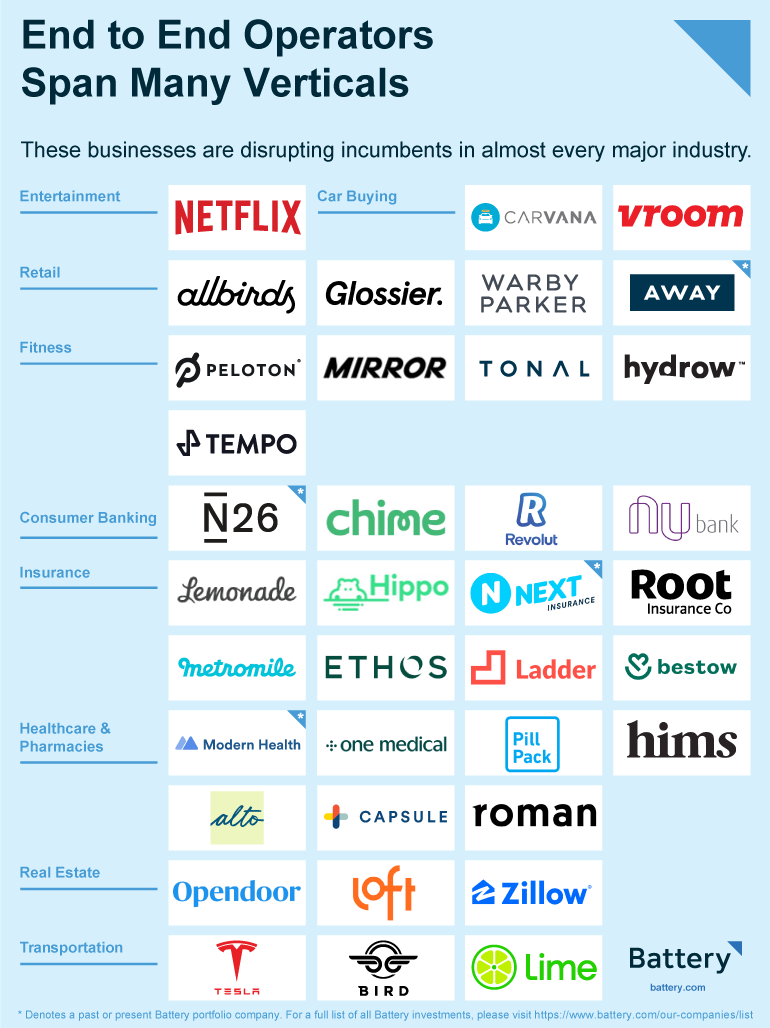
Image Credits: Battery Ventures (opens in a new window)
All of these companies have recognized they can deliver more value to consumers by “owning” every aspect of the underlying product or service — from the bike to the workout content in Peloton’s case, or the bank account to the credit card in Chime’s case. They have reinvented and reimagined the entire consumer experience, from end to end.
What does success for end-to-end operator businesses look like?
As investors, we’ve had the privilege of meeting with many of these next-generation end-to-end operators over the years and found that those with the greatest success tend to exhibit the five key elements below:
1. Going after very large markets
The end-to-end approach makes the most sense when disrupting very large markets. In the graphic above, notice that most of these companies play in the largest, but notoriously archaic industries like banking, insurance, real estate, healthcare, etc. Incumbents in these industries are very large and entrenched, but they are legacy players, making them slow to adopt new technology. For the most part, they have failed to meet the needs of our digital-native, mobile-savvy generation and their experiences lag behind consumer expectations of today (evidenced by low, or sometimes even negative, NPS scores). Rebuilding the experience from the ground up is sometimes the only way to satisfy today’s consumers in these massive markets.
2. Step-functionally better consumer experience versus the status quo
Source: https://techcrunch.com/2021/01/22/end-to-end-operators-are-the-next-generation-of-consumer-business/


