& meet dozens of singles today!
User blogs

Twitter is launching what it calls “a community-based approach to misinformation.”
The Birdwatch project first came to light last fall thanks to product sleuth Jane Manchun Wong. Now Twitter has launched a pilot version via the Birdwatch website.
The goal, as explained in a blog post by Twitter’s Vice President of Product Keith Coleman, is to expand beyond the labels that the company already applies to controversial or potentially misleading tweets, which he suggested are limited to “circumstances where something breaks our rules or receives widespread public attention.”
Coleman wrote that the Birdwatch approach will “broaden the range of voices that are part of tackling this problem.” That has brings a broader range of perspectives to these issues and goes beyond the simple question of, “Is this tweet true or not?” It may also take some of the heat off Twitter for individual content moderation decisions.
Users can sign up on the Birdwatch site to flag tweets that they find misleading, add context via notes and rate the notes written by other contributors, based on whether they’re helpful or not. These notes will only be visible on the Birdwatch site for now, but it sounds like the company’s goal is to incorporate them to the main Twitter experience.
“We believe this approach has the potential to respond quickly when misleading information spreads, adding context that people trust and find valuable,” Coleman said. “Eventually we aim to make notes visible directly on Tweets for the global Twitter audience, when there is consensus from a broad and diverse set of contributors.”
Given the potential for plenty of argument and back-and-froth on contentious tweets, it remains to be seen how Twitter will present these notes in a way that isn’t confusing or overwhelming, or how it can avoid weighing in on some of these arguments. The company said Birdwatch will use rank content based on algorithmic “reputation and consensus systems,” with the code shared publicly. (All notes contributed to Birdwatch will also be available for download.) You read more about the initial ranking system here.
“We know there are a number of challenges toward building a community-driven system like this — from making it resistant to manipulation attempts to ensuring it isn’t dominated by a simple majority or biased based on its distribution of contributors,” Coleman said. “We’ll be focused on these things throughout the pilot.”
Source: https://techcrunch.com/2021/01/25/twitters-birdwatch-fights-misinformation-with-community-notes/
TechCrunch is embarking on a major project to survey the venture capital investors of Europe, and their cities.
Our survey of VCs in Stockholm, and Sweden generally, will capture how the country is faring, and what changes are being wrought amongst investors by the coronavirus pandemic.
The deadline is the end of this week.
We’d like to know how Sweden’s startup scene is evolving, how the tech sector is being impacted by COVID-19, and, generally, how your thinking will evolve from here.
Our survey will only be about investors, and only the contributions of VC investors will be included. More than one partner is welcome to fill out the survey. (Please note, if you have filled the survey out already, there is no need to do it again).
The shortlist of questions will require only brief responses, but the more you can add, the better.
You can fill out the survey here.
Obviously, investors who contribute will be featured in the final surveys, with links to their companies and profiles.
What kinds of things do we want to know? Questions include: Which trends are you most excited by? What startup do you wish someone would create? Where are the overlooked opportunities? What are you looking for in your next investment, in general? How is your local ecosystem going? And how has COVID-19 impacted your investment strategy?
This survey is part of a broader series of surveys we’re doing to help founders find the right investors.
https://techcrunch.com/extra-crunch/investor-surveys/
For example, here is the recent survey of London.
You are not in Sweden, but would like to take part? That’s fine! Any European VC investor can STILL fill out the survey, as we probably will be putting a call out to your country next anyway! And we will use the data for future surveys on vertical topics.
The survey is covering almost every country on in the Union for the Mediterranean, so just look for your country and city on the survey and please participate (if you’re a venture capital investor).
Thank you for participating. If you have questions you can email mike@techcrunch.com
(Please note: Filling out the survey is not a guarantee of inclusion in the final published piece).
This morning, investor and SPAC raconteur Chamath Palihapitiya announced two new blank-check deals involving Latch and Sunlight Financial.
Latch, an enterprise SaaS company that makes keyless entry systems, has raised $152 million in private capital, according to Crunchbase. Sunlight Financial, which offers point of sale financing for residential solar systems, has raised north of $700 million in venture capital, private equity and debt.
We’re going to chat about the two transactions.
There’s no escaping SPACs for a bit, so if you are tired of watching blind pools rip private companies into the public markets, you are not going to have a very good next few months. Why? There are nearly 300 SPACs in the market today looking for deals, and many will find one.
The Exchange explores startups, markets and money. Read it every morning on Extra Crunch, or get The Exchange newsletter every Saturday.
Think of SPACs are increasingly hungry sharks. As a shark get hungrier while the clock winds down on its deal-making window, it may get less choosy about what it eats (take public). There are enough SPACs on the hunt today that they would be noisy even if they were not time-constrained investment vehicles. But as their timers tick, expect their dealmaking to get all the more creative.
This brings us back to Chamath’s two deals. Are they more like the Bakkt SPAC, which led us to raise a few questions? Or more akin to the Talkspace SPAC, which we found pretty reasonable? Let’s find out.
Keyless locks = Peloton for real estate
Let’s start with the Latch deal.
New York-based Latch sells “LatchOS,” a hardware and software system that works in buildings where access and amenities matter. Latch’s hardware works with doors, sensors and internet connectivity.
The company has raised a number of private rounds, including a $126 million deal in August of 2019 which valued the company at $454.3 million on a post-money basis, according to PitchBook data. The company raised another $30 million in October of 2020, though its final private valuation is not known.
As Chamath tweeted this morning, Latch is merging with TS Innovation Acquisitions Corp, or $TSIA. The SPAC is associated with Tishman Speyer, a commercial real estate investor. You can see the synergies, as Latch’s products fit into the commercial real estate space.
Up front, Latch is not a company that is only reporting future revenues. It has a history as an operating entity. Indeed, here’s its financial data per its investor presentation:
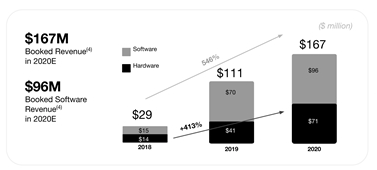
Doing some quick match, Latch grew booked revenues 50.5% from 2019 to 2020. Its booked software revenues grew 37.1%, while its booked hardware top line expanded over 70% during the same period.
That could be due to strong hardware installation fees, which could later result in software revenues; the company claims an average of a six-year software deal, so hardware revenues that are attached to new software incomes could lowkey declaim long-term SaaS revenues.
Update: Adding some clarity here, the above are “booked” revenues, which I’ve made more clear, not actual revenues. Its net revenues, better known as actual revenues, were $18 million, with $14 million of that coming from hardware. So, today, the company is certainly more hardware-heavy than I first thought. Damn non-S-1 filings!
While some were quick to note that the company is far from pure-SaaS — correct — I suspect that the model that could get some traction amongst investors is that this feels a bit like Peloton for real estate. How so? Peloton has large hardware incomes up-front from new users, which convert to long-term subscription revenues. Latch may prove similar, albeit for a different customer base and market.
Per the deal’s reported terms, Latch will be worth $1.56 billion after the transaction. And the combined entity will have $510 million in cash, including $190 million from a PIPE — a method of putting private money into a public entity — from “BlackRock, D1 Capital Partners, Durable Capital Partners LP, Fidelity Management & Research Company LLC, Chamath Palihapitiya, The Spruce House Partnership, Wellington Management, ArrowMark Partners, Avenir and Lux Capital.”
Goalsetter, a platform that helps parents teach their kids financial literacy, announced the raise of a $3.9 million seed round this morning, led by Astia.
PNC Bank, Mastercard, US. Bank, Northwestern Mutual Future Ventures, Elevate Capital, Portfolia’s First Step and Rising America Fund and Pipeline Angels also participated in the round. The round also saw participation from a handful of individual investors including Robert F Smith, Kevin Durant, Chris Paul, Baron Davis, Sterling K. Brown, Ryan Bathe, CC Sabathia and Amber Sabathia.
Goalsetter launched in 2019 out of the Entrepreneurs Roundtable Accelerator. Founded by Tanya Court, who lost over $1 million in the 2001 bubble burst, the platform teaches financial literacy to children of all ages, helping them learn economic concepts, lingo and the principles of financial health.
After long stints at Nickelodeon and ESPN, Court understands deeply how kids learn and what keeps their attention. She vowed to make sure that her children were never ignorant of what it takes to protect their wealth and create more.
The app also allows parents to give allowance through the app, and even pay out their own specified amount for every quiz question the kid gets right in the app. Plus, family and friends can give ‘goal cards’ instead of gift cards, helping kids save for the things they really want in the future.
The company recently launched a debit card for kids, as well, letting parents control the way the card is used and even lock it until their kids have passed the week’s financial literacy quiz.
Families save an average of $120 a month on the platform, and Court says that two families saved over $10,000 in the last year.
The company is also launching a massive campaign next week for Black History Month with the goal of closing the wealth gap among Black children and kids of color through financial education.
“It’s one thing to put a debit card into your teenager’s hands,” said Court. “That’s great. That teaches them how to spend money. It’s another thing to teach kids the core concepts about how to build wealth, or to know the difference between putting your money into an investment account, or putting your money into a CD versus a mutual fund versus a savings account. We teach what interest rates are, and what compound interest means. Our focus is on is financial education because it’s not enough to teach kids how to spend.”
Goalsetter raised $2.1 million in 2019 and now adds this latest round to that for a total of $6 million raised. This latest round was oversubscribed, giving Court the opportunity to be super selective about her investors.
“Every single one of these investors has a demonstrated commitment prior to people marching in the streets in April, to social justice and to investing in diversity and inclusion initiatives and people,” said Court. “Every single one of them. That was really important because we were oversubscribed and we had the luxury of being able to pick who our investors were. Every one of the investors that we invited to our table were investors who we knew invited folks who look like us in 2019 and 2018 and 2017 to their table.”
Source: https://techcrunch.com/2021/01/25/goalsetter-raises-3-9-million-to-teach-financial-literacy-to-kids/
Liz Meyerdirk made a name for herself at Uber as the Senior Director & Global Head of Business Development for the company’s Uber Eats business and she’s now turning her attention to women’s health as the new chief executive of The Pill Club.
The move comes at a perilous time for the remote delivery of women’s healthcare as the Supreme Court has taken steps to limit the provision of sexual healthcare to women in recent months.
“Women’s health care has never been more tested than right now,” Meyerdirk noted in a blog post announcing her new role. “COVID-19 has upended access to care; dozens of states have—and continue—to try and limit women’s choice; and last year, the Supreme Court voted to uphold the rollback of the ACA contraceptive mandate decision, a stunning move that could end up impacting as many as 126,000 women who previously received covered contraception through employer-based health insurance.”
A seasoned corporate executive, Meyerdirk is hoping to navigate The Pill Club through these treacherous times. “These events have shown that reliable, safe, and affordable access to women’s health and birth control is
just one more vulnerability in our health care system,” Meyerdirk wrote.

Liz Meyerdirk, chief executive of The Pill Club: Image Credit: The Pill Club
As it faces an uncertain legal environment on some fronts, the company couldn’t be in a better position financially.
The Pill Club, which is profitable and now has a $100 million run rate, is now ready for its closeup with Meyerdirk at the helm.
The company has managed to make its mark in the crowded world of online prescriptions and refill fulfillment by focusing specifically on women’s health and ensuring that those services are available to as many potential patients as possible.
“We’re now serving hundreds of thousands of women nationwide with 20% on Medicaid,” says Meyerdirk. “We prescribe in 43 states and the District of Columbia.”
For Meyerdirk, the background she had in logistics and fulfillment from her time at Uber Eats made the transition to the pill prescription and delivery service natural.
“There is a heavy logistics element to it,” said Meyerdirk.
As Meyerdirk takes the reins of the company, she said there’s a few areas that The Pill Club will expand into beyond its focus on birth control and contraception. “There are areas that our customers are asking for,” Meyerdirk said.
These areas include, initially, dermatology. Last year the company launched a delivery service for contraceptives and women’s hygiene products like pads and tampons.
As it continues to expand its product suite, it’s also growing its executive staff. The company not only added Meyerdirk, but also David Hsu as chief financial officer and Jeremy Downs as senior vice president of growth. Hsu joins the company from Honey, where led the $4 billion acquisition negotiations with PayPal, and Downs comes from Uber Eats, where he spent five years leading growth.
“We need sustained, long-term access to women’s health care, not just a bridge while the pandemic persists; and we need coverage for essential health services like birth control and prenatal care, regardless of whether or not you’re insured,” Meyerdirk wrote. “Reproductive care has and continues to be an essential part of our business, but there are countless opportunities to serve women in all of their life stages from puberty to menopause.”


