& meet dozens of singles today!
User blogs

Twitter pilots a new tool to fight disinformation, Apple brings celebrity-guided walks to the Apple Watch and Clubhouses raises funding. This is your Daily Crunch for January 25, 2021.
The big story: Twitter unveils Birdwatch
Twitter launched a new product today that it says will offer “a community-based approach to misinformation.”
With Birdwatch, users will be able to flag tweets that they find misleading, write notes to add context to those tweets and rate the notes written by others. This is supposed to be a complement to the existing system where Twitter removes or labels particularly problematic tweets, rather than a replacement.
What remains to be seen: How Twitter will handle it when two or more people get locked into a battle and post a flurry of conflicting notes about whether a tweet is misleading or not.
The tech giants
Walking with Dolly — Apple discusses how and why it brought Time to Walk to the Watch.
Google pledges grants and facilities for COVID-19 vaccine programs — The tech giant is one of several large corporations that have pledged support to local government agencies and medical providers to help increase vaccinations.
Facebook will give academic researchers access to 2020 election ad targeting data — Starting next month, Facebook will open up academic access to a data set of 1.3 million political and social issue ads.
Startups, funding and venture capital
Clubhouse announces plans for creator payments and raises new funding led by Andreessen Horowitz — While we try to track down the actual value of this round, Clubhouse has confirmed it will be introducing products to help creators on the platform get paid.
Taboola is going public via SPAC — The transaction is expected to close in the second quarter, and the combined company will trade on the New York Stock Exchange under the ticker symbol TBLA.
Wolt closes $530M round to continue expanding beyond restaurant delivery — The Helsinki-based online ordering and delivery company initially focused on restaurants but has since expanded to other verticals.
Advice and analysis from Extra Crunch
Qualtrics raises IPO pricing ahead of debut — After being acquired by SAP, Qualtrics announced it would spin out as its own public company.
Fintechs could see $100 billion of liquidity in 2021 — The Matrix Fintech Index weighs public markets, liquidity and a new e-commerce trend.
Unpacking Chamath Palihapitiya’s SPAC deals for Latch and Sunlight Financial — There’s no escaping SPACs, at least for a little while.
(Extra Crunch is our membership program, which helps founders and startup teams get ahead. You can sign up here.)
Everything else
Moderna says it’s making variant-specific COVID-19 vaccines, but its existing vaccine should still work — Moderna has detailed some of the steps it’s taking to ensure that its vaccine remains effective in the face of emerging strains of the SARS-CoV-2 virus that leads to COVID-19.
Original Content podcast: ‘Bridgerton’ is an addictive reimagining of Jane Austen-style romance — Did I mention that the cast is insanely good-looking?
The Daily Crunch is TechCrunch’s roundup of our biggest and most important stories. If you’d like to get this delivered to your inbox every day at around 3pm Pacific, you can subscribe here.

Source: https://techcrunch.com/2021/01/25/daily-crunch-twitter-unveils-birdwatch/
This week, Latch becomes the latest company to join the SPAC parade. Founded in 2014, the New York-based company came out of stealth two years later, launching a smart lock system. Though, like many companies primarily known for hardware solutions, Latch says it’s more, offering a connected security software platform for owners of apartment buildings.
The company is set to go public courtesy of a merger with blank check company TS Innovation Acquisitions Corp. As far as partners go, Tishman Speyer Properties makes strategic sense here. The New York-based commercial real estate firm is a logical partner for a company whose technology is currently deployed exclusively in residential apartment buildings.
“With a standard IPO, you have all of the banks take you out to all of the big investors,” Latch founder and CEO Luke Schoenfelder tells TechCrunch. “We felt like there was an opportunity here to have an extra level of strategic partnership and an extra level of product expansion that came as part of the process. Our ability to go into Europe and commercial offices is now accelerated meaningfully because of this partnership.
The number of SPAC deals has increased substantially over the past several months, including recent examples like Taboola. According to Crunchbase, Latch has raised $152 million, to date. And the company has seen solid growth over the past year — not something every hardware or hardware adjacent company can say about the pandemic.
As my colleague Alex noted on Extra Crunch today, “Doing some quick match, Latch grew booked revenues 50.5% from 2019 to 2020. Its booked software revenues grew 37.1%, while its booked hardware top line expanded over 70% during the same period.”
“We’ve been a customer and investor in Latch for years,” Tishman Speyer President and CEO Rob Speyer tells TechCrunch. “Our customers — the people who live in our buildings — love the Latch product. So we’ve rolled it out across our residential portfolio […] I hope we can act as both a thought partner and product incubator for them.”
While the company plans to expand to commercial offices, apartment buildings have been a nice vertical thus far — meaning the company doesn’t have to compete as directly in the crowded smart home lock category. Among other things, it’s probably a net positive if you’re going head to head against, say Amazon. That the company has built in partners in real estate firms like Tishman Speyer is also a net positive.
Schoenfelder says the company is looking toward such partnerships as test beds for its technology. “Our products have been in the field for many years in multifamily. The usage patterns are going to be slightly different in commercial offices. We think we know how they’re going to be different, but being able to get them up and running and observe the interaction with products in the wild is going to be really important.”
The deal values Latch at $1.56 billion and is expected to close in Q2.
Three years ago, we released the first edition of the Matrix Fintech Index. We believed then, as we do now, that fintech represents one of the most exciting major innovation cycles of this decade. In 2020, all the long-term trends forcing change in this sector continued and even accelerated.
The broad movement away from credit toward debit, particularly among younger consumers, represents one such macro shift. However, the pandemic also created new, unforeseen drivers. Among them, millennials decamped from their rentals in crowded cities to accelerate their first home purchases to the benefit of proptech companies and challenger mortgage players alike.
E-commerce saw an enormous acceleration in growth rates, furthering adoption of online payments platforms. Lastly, low interest rates and looming inflation helped pave the way for the price of Bitcoin to charge toward $30,000. In short, multiple tailwinds combined to produce a blockbuster year for the category.
In this year’s refresh of the Matrix Fintech Index, we’ll divide our attention into three parts. First, a look at the public stocks’ performance. Second, liquidity. Third, we highlight one major trend in the sector: Buy Now Pay Later, or BNPL.
Public fintech stocks rose 97% in 2020
For the fourth straight year, the publicly traded fintechs massively outperformed the incumbent financial services providers as well as every mainstream stock index. While the underlying performance of these companies was strong, the pandemic further bolstered results as consumers avoided appearing in-person for both shopping and banking. Instead, they sought — and found — digital alternatives.
For the fourth straight year, the publicly traded fintechs massively outperformed the incumbent financial services providers as well as every mainstream stock index.
Our own representation of the public fintechs’ performance is the Matrix Fintech Index — a market cap-weighted index that tracks the progress of a portfolio of 25 leading public fintech companies. The Matrix fintech Index rose 97% in 2020, compared to a 14% rise in the S&P 500 and a 10% drop for the incumbent financial service companies over the same time period.
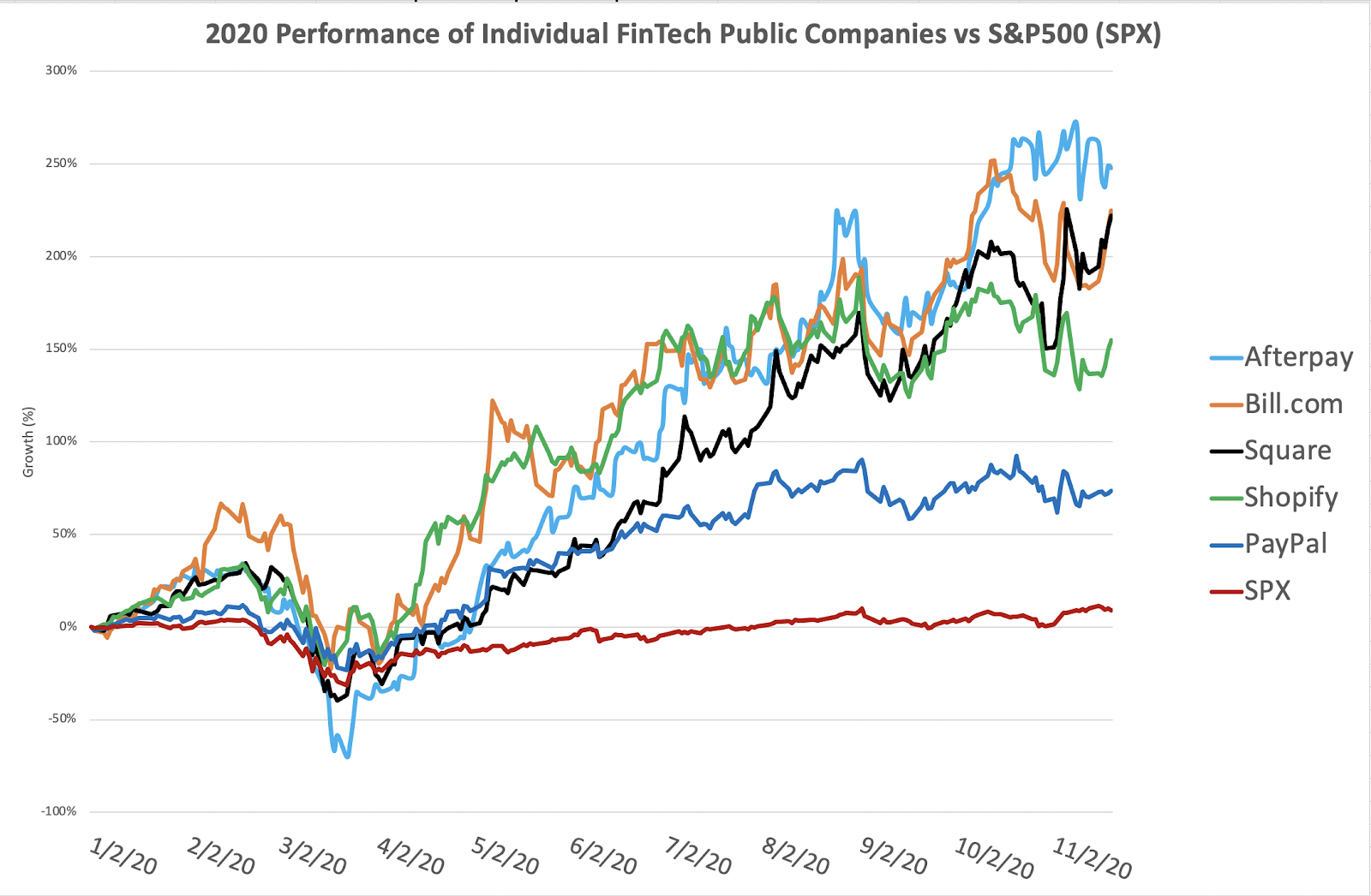
2020 performance of individual fintech companies versus S&P 500. Image Credits: PitchBook
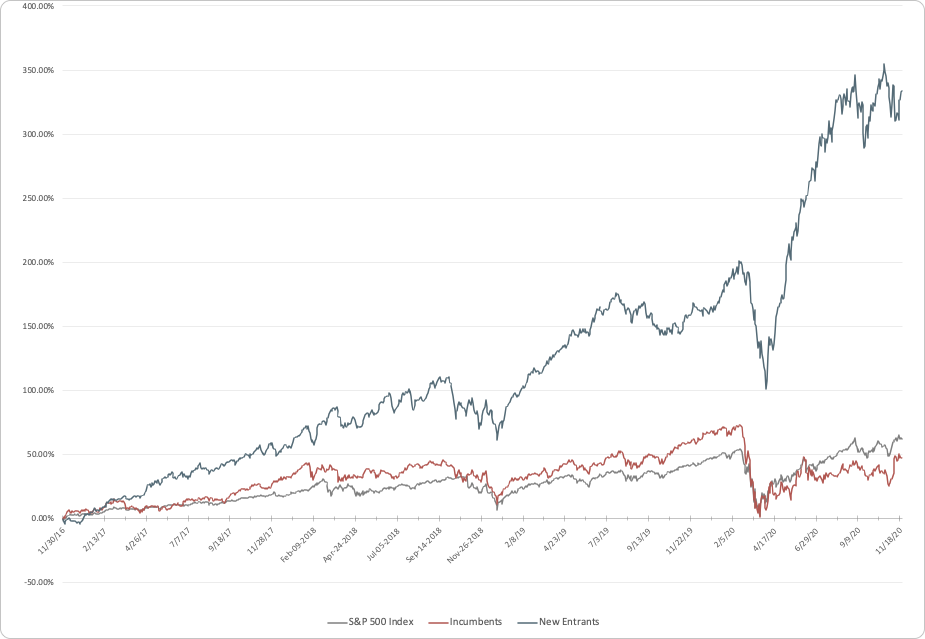
Fintech incumbents and new entrants versus the S&P 500. Image Credits: PitchBook
E-commerce undoubtedly stood out as a major driver. As a category, retail e-commerce grew 35% YoY as of Q3, propelling PayPal and Shopify to add over $160 billion of market capitalization over the year. For its part, PayPal in the third quarter signed up 15 million net new active accounts (its highest ever).
Source: https://techcrunch.com/2021/01/25/fintechs-could-see-100-billion-of-liquidity-in-2021/
Three years ago, we released the first edition of the Matrix Fintech Index. We believed then, as we do now, that fintech represents one of the most exciting major innovation cycles of this decade. In 2020, all the long-term trends forcing change in this sector continued and even accelerated.
The broad movement away from credit toward debit, particularly among younger consumers, represents one such macro shift. However, the pandemic also created new, unforeseen drivers. Among them, millennials decamped from their rentals in crowded cities to accelerate their first home purchase, to the benefit of proptech companies and challenger mortgage players alike.
E-commerce saw an enormous acceleration in growth rates, furthering adoption of online payments platforms. Lastly, low interest rates and looming inflation helped pave the way for the price of Bitcoin to charge toward $30,000. In short, multiple tailwinds combined to produce a blockbuster year for the category.
In this year’s refresh of the Matrix Fintech Index, we’ll divide our attention into three parts. First, a look at the public stocks’ performance. Second, liquidity. Third, we highlight one major trend in the sector: Buy Now Pay Later, or BNPL.
Public fintech stocks rose 97% in 2020
For the fourth straight year, the publicly traded fintechs massively outperformed the incumbent financial services providers as well as every mainstream stock index. While the underlying performance of these companies was strong, the pandemic further bolstered results as consumers avoided appearing in-person for both shopping and banking. Instead, they sought — and found — digital alternatives.
For the fourth straight year, the publicly traded fintechs massively outperformed the incumbent financial services providers as well as every mainstream stock index.
Our own representation of the public fintechs’ performance is the Matrix Fintech Index — a market cap-weighted index that tracks the progress of a portfolio of 25 leading public fintech companies. The Matrix fintech Index rose 97% in 2020, compared to a 14% rise in the S&P 500 and a 10% drop for the incumbent financial service companies over the same time period.
2020 performance of individual fintech companies versus S&P 500. Image Credits: PitchBook
Fintech incumbents and new entrants versus the S&P 500. Image Credits: PitchBook
E-commerce undoubtedly stood out as a major driver. As a category, retail e-commerce grew 35% YoY as of Q3, propelling PayPal and Shopify to add over $160 billion of market capitalization over the year. For its part, PayPal in the third quarter signed up 15 million net new active accounts (its highest ever).
Source: https://techcrunch.com/2021/01/25/fintechs-could-see-100-billion-of-liquidity-in-2021/
A walk is, more often than not, a solitary experience. As far as the age of COVID-19 is concerned, that’s probably more bug than feature. It’s a way to escape the confines of a shutdown for a few glorious moments, to get some air and, for better or worse, reflect on the day that’s passed or the one to come.
It can, like many things these days, however, be isolating.
For me, long weekend walks have been a sort of lifesaver throughout this bizarre year. Following two months of being completely sidelined over (non-COVID) health issues, I began walking more per week than I ever have. It was a slow process at first — frankly, never leaving my one-bedroom apartment for April and May made it so it was physically painful to walk around the block when I finally felt comfortable going outside.
These days, I walk every morning, regularly crossing the bridge into Brooklyn and Manhattan. Until I started using Apple’s new Fitness+ service a few times a day, it was easily my main source of exercise. In November, however, my Apple Watch Activity bars swapped the more generic gray for the Fitness+ yellow. But even as I’ve made a point to do a couple of indoor exercises a day, I still start each day with a walk. Rain, snow, this weekend’s sub-freezing weather — skipping a day would feel like breaking a promise to myself.
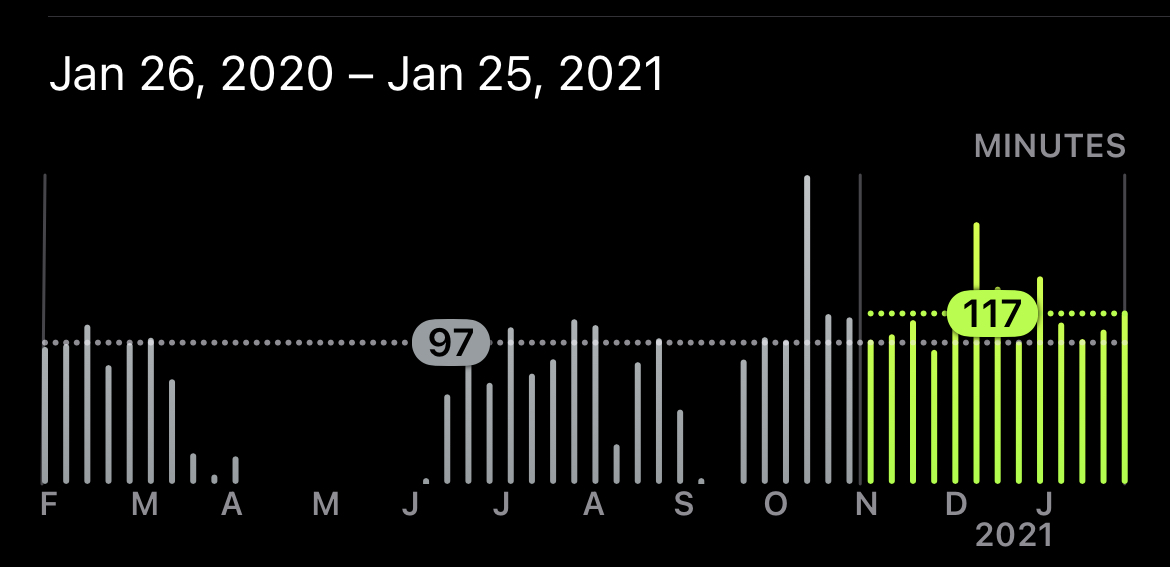
My actual bars (not sure what happened in September — maybe testing a competitor’s device)
This morning Apple dropped the first five installments (episodes?) of Time to Walk. The feature is an attempt to expand the Fitness+ experience beyond the confines of its titular iOS app. A largely Watch-based experience, the feature leverages much of the wearable’s existing features (and Apple’s growing software ecosystem) to offer a more tailored and multimedia experience than you would get listening to a podcast or music alone.
As with the canny arrival of Fitness+ (December) and handwashing for watchOS (September), Apple says the timing was something of a happy coincidence. The company had been working on the feature well before COVID-19 entered the picture.
“Everything from Time to Walk and our launch of Fitness+ was something we had been working on well before COVID,” the company’s senior director of Fitness Technologies Jay Blahnik tells TechCrunch. “From the very beginning, we thought of Fitness+ as a place where everyone was welcome. We wanted it to feel like a place where, whether you’re new to fitness or very fit, there was something for everyone.”
For many, a walk (or push, in the case of those who use a wheelchair for mobility) is square one when it comes to daily workouts. For my part, I was certainly far more comfortable taking quick strolls around the neighborhood. With limits on space and no real exercise equipment to speak of beyond a kettlebell and yoga mat, attempting to approximate the gym experience at home has seemed a fool’s errand.
April found me trying some YouTube yoga classes with limited efficacy. Like most attempts to exercise, it didn’t stick. Walking every day was the only thing that did. And for the first time in my life, COVID-19 found me walking without any particular destination in mind. That old cliché about it being about the journey not the destination is fine when you don’t mind constantly being late to meetings. Walking for the sake of itself, however, changes the dynamic significantly. I speak to artists, writers and musicians on a regular basis for my podcast. The common sentiment is a familiar one: You simply can’t force creativity. But for those who make a point to regularly walk and run, it’s perhaps the most surefire way to kickstart the process.
Time to Walk is Apple’s attempt to capture some of that lightning in a bottle — to follow a rotating cast of big names as they walk through locations that mean something to them. The company says it’s been making an effort to meet guests where they are and essentially coach them through the process. The ability to do so is, of course, depends on their given location — especially with all of the sorts of travel restrictions that have been in place since early last year.
Ultimately, Apple says, the decisions of where to record are made by the guests. “Some guests said, ‘this is where I want to go,’ ” says Blahnik. “And some guests were like, ‘no, I want to to do the walk I normally do.’ For us, it’s not about Shawn Mendes in the Grand Canyon, it’s about where they want to go. Sometimes that’s limited by COVID, but what we found delightful was for many people, they loved to take the walk they loved to take.”
The first four guests — Mendes, Dolly Parton, Draymond Green and Uzo Aduba — run the gamut on approaches. “We think about the stories, we think about the diverse guest,” says Blahnik. We think about all of the ways you’d like the conversations to go. But what was important to us was that the idea resonated with them. The idea of going out for a walk, having a lovely conversation and hearing stories that could give you a different perspective.”
Parton, who turned 75 earlier this month, recorded her session in a studio — in contrast to the other three names. She relates a handful of stories largely revolving around her upbringing in Sevier County (pronounced “severe”), Tennessee. There’s a story about a Christmas tree and one about opening a literacy center with the help of her father (who struggled with his own ability to read and write).
She somewhat self-effacingly relates a story about the time her hometown erected a statue of her. “So I went home, and I said, ‘Daddy, did you know they’re putting a statue of me? Do you know about the statue down at the courthouse?’ ” Parton explains. “And Daddy said, ‘Well, yeah, I heard about that.’ He said, ‘Now, to your fans out there, you might be some sort of an idol. But to them pigeons, you ain’t nothing but another outhouse.’ ”
According to Parton, her father would visit the statue at night with a bucket of soap and water to clean the pigeons’ mess off his daughter’s likeness. Her segment culminates with something approaching a behind the music-style segment, describing stories behind three of her own songs: “Coat of Many Colors,” “Circle of Love” and “9 to 5.” The latter is the real gem of the bunch, contrasting her morning routines to costars Jane Fonda and Lily Tomlin, while describing the role her acrylic nails played in the songwriting and recording process.
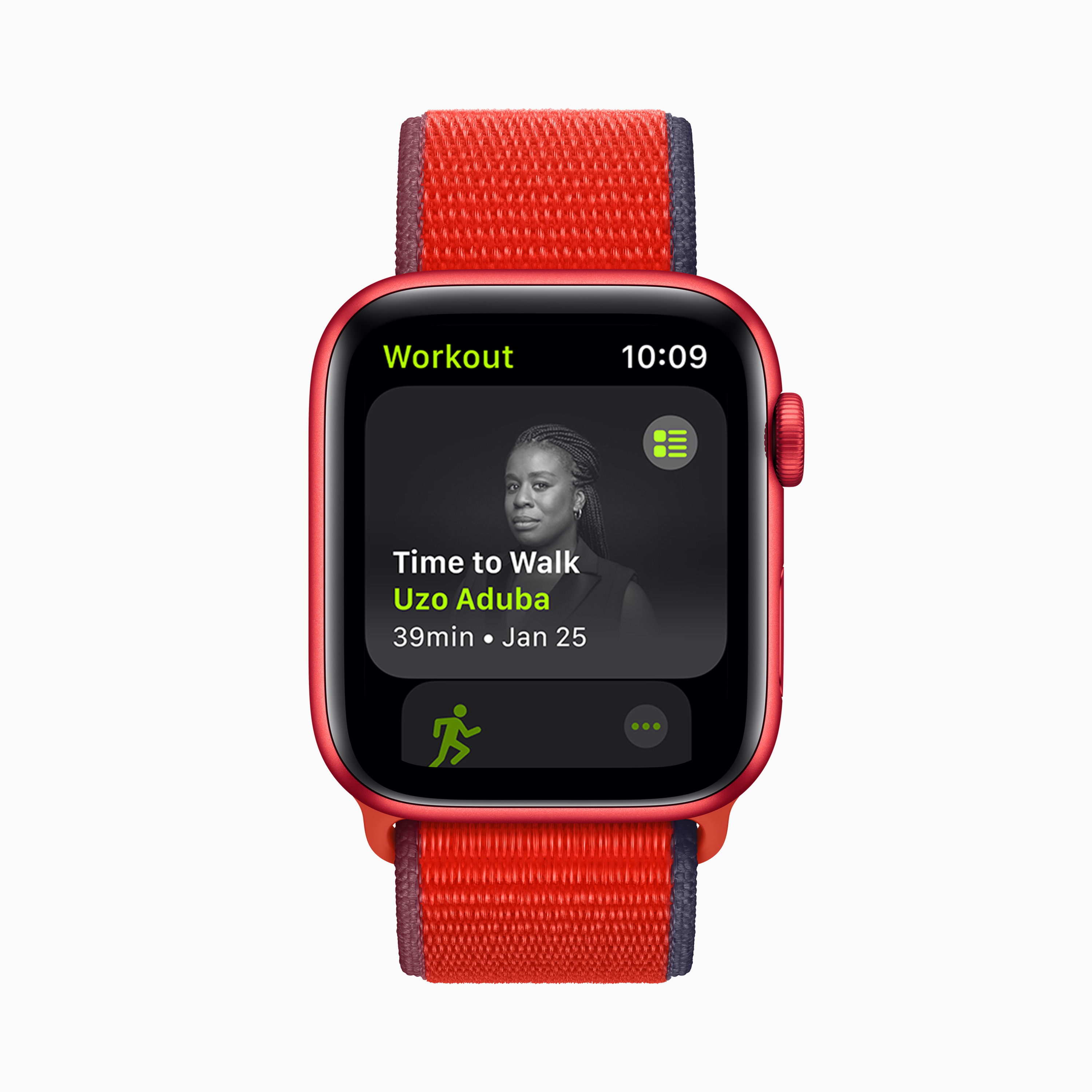
Image Credits: Apple
Green’s stories are more emblematic of the rest. On a walk around Malibu, the Warriors power forward discusses some inspiration stories on and off the court, from being told he would never be a star to a time he tried and failed to cheat on a test in school. The stories are purposefully personal. Aduba relates some of her own struggles to break into acting, as she walks her amusingly named dog Fenway Bark through Fort Green Park in Brooklyn.
The guests share images relating to their stories or snapshots of where they go on their walks, which are delivered to the wrist with a haptic buzz. At they end of the journey, they share three handpicked songs that can be saved to a playlist on Apple Music, similar to what the company has done for its Fitness+ workouts.
Write-ups of the Time to Walk have thus far compared it to podcasting — understandably so, given that it’s an on-demand, audio-first experience. Though the feature, which downloads directly onto the Watch when the new installment drops once a week, has its own flavor, according to Apple.
“Often podcasts are hosted,” Blahnik says, by way of distinction. “In our journey to build out this experience, we certainly considered if there should be a host walking with this person. What we realized is that, for what we were trying to create, the intimacy of having the singular guest talk to you felt a lot more like you were on a walk with them. The notion that it’s not happening in a studio (in almost all cases), that they’re walking someplace that inspires them. You’ll hear that with Draymond and Shawn — with Shawn he’s huffing and puffing up that hill and it’s kind of nice because you’re in that moment together.”
Time to Walk isn’t raw, exactly. It is an Apple production, after all. The company’s certainly not tossing out found audio here. But the content does seem more off-the-cuff than many of its productions, even as it’s packaged together with a slick intro and a trio of songs at the end. But it’s a nice change of pace for those looking for something that feels a little more personal than we’re accustom to from some of the names involved.
Your own mileage will vary, depending on, among other things, your interest in the guest. Though, there’s always a chance someone you’ve never been particularly interested in — or even heard of — will offer some unique tidbit or interesting way of looking at things. That’s one of the potential upsides of having Apple doing the curating here — there’s some interesting potential for discovery. And even in the case of artists you’re familiar with, there’s good potential to discover something new.
The weekly 20 to 45-minute audio supplement won’t make the actual act of walking any less solitary — but for a little while, at least, it’s nice to feel like someone’s along for the ride.
Source: https://techcrunch.com/2021/01/25/walking-with-dolly/


