& meet dozens of singles today!
User blogs

Beauty and wellness appointment booking apps have proliferated of the last few years, but it appears the race is still on as today one of the leaders, Booksy, raises $70 million in a Series C round led by Cat Rock Capital, with participation from Sprints Capital.
The round was also joined by OpenOcean, Piton Capital, VNV Global, Enern, Kai Hansen, Zach Coelius and Manta Ray Ventures, and takes the total raised by the firm to $119 million. The funding will be used for expansion plans across North America, expanding to new verticals, and acquiring complementary businesses.
The Booksy app is used by customers to book and pay for beauty appointments with local businesses. Salons, nail bars and barbershops can manage the bookings, payments, and customer base via the accompanying Booksy Biz app. The platform also allows salons to sell other products via Booksy E-Commerce, which acts as a marketplace allowing customers to discover and book other local stylists, nail technicians etc.
Booksy was founded by Polish entrepreneurs Stefan Batory (CEO) and Konrad Howard. Allowing customers to schedule their best appointment time means that 38% of customers end up booking after-hours and increasing their appointment frequency by 20%, says the company. The startup launched in 2014 but is now in the US (its largest market), UK, Poland, Spain, Brazil, and South Africa. It claims to be the number-one beauty booking app in each country, with “13 million” consumers on the app.
Batory said in a statement: “Like with many sectors negatively hit by the pandemic, it’s been a turbulent time for the beauty and wellness industry but we’re confident in its ability to come back from this, so it’s fantastic to see our latest group of investors share our optimism and vision. This latest round of funding enables us to reach even more salons and service providers across the US, and in all the regions we operate, which in turn helps them reach more customers.”
Alex Captain, founder and managing partner at Cat Rock Capital, said: “We are incredibly excited to invest in Booksy as it builds the leading global software platform for digitizing the beauty and wellness industry around the world.”
Booksy certainly seems to have cracked the international expansion game ahead of most competitors, which tend to stay more local to their countries of origin such as Treatwell, Styleseat, Vagaro and Mindbody. The opportunity for Booksy is to now use its war cast to roll-up other local players.
It has already acquired rival Lavito in 2018 and, more recently, merged with Versum in December 2020 allowing it to enter Mexico.


Lime is adding electric mopeds — painted in the company’s signature green — to its micromobility platform as the startup aims to own the spectrum of inner city travel from jaunts to the corner store to longer distance trips up to five miles.
Lime said Wednesday it plans to launch as many as 600 electric mopeds on its platform this spring in Washington D.C. The company is also working with officials to pilot the mopeds in Paris. Eventually, the mopeds will be offered in a “handful of cities” over the next several months.
The mopeds, supplied by manufacturer Niu, are designed for two people and outfitted with tech like infrared-cameras in the helmet compartment that can detect if they’re in use during a trip, an effort aimed at rooting out misuse and increasing safety. Repeat offenders of Lime’s policies, which includes wearing a helmet at all times, will be kicked off the platform. Customers will also be required to take a selfie wearing the helmet at the start of a ride.
The helmets will be supplied by Moon for U.S. customers and Nikko for the European deployments.
The mopeds will have a top speed of 28 miles an hour and be able to travel up to 87 miles on a single charge. Unlike Lime scooters, in which gig economy workers can earn money by collecting, charging and bringing back to city streets, the mopeds will have swappable batteries and be maintained by full-time employees.
While it’s unclear if mopeds have always been part of Lime’s long-term plans, the company’s head of new mobility told TechCrunch that they’ve been thinking about what the future of electrified urban transportation might include.
“As we’ve grown as a company, we understood that we just needed to follow what our riders were demanding which is further distances,” said Sean Arroyo, head of new mobility at Lime. “The ability to meet any trip, at anytime, anywhere, is something that’s at the foundation for us and so our riders really are the ones that pointed us in this direction.”
Lime CEO Wayne Ting first hinted late last year that a “third mode” of transport beyond scooters and bikes was in the works for the first quarter of 2021 as well as the addition of third-party companies to its platform. Last year, Lime also started to include on its app Wheels-branded electric bikes in certain cities. Ting said, at the time, that users should expect more partnerships like these.
The expansion into mopeds is the latest sign that Lime has managed to put some of its darker Covid-19-tainted times behind it. Lime underwent a round of layoffs in April, taking on capital from Uber the next month in a down-round that brought its valuation under the $1 billion mark. Lime paused most of its operations for a month during the early COVID-19 days.
But it has since rebounded. Ting said in November that the company is both operating cash flow positive and free cash flow positive in the third quarter and was on pace to be full-year profitable, excluding certain costs (EBIT), in 2021. It also had enough cash — or access to it — to expand into mopeds.
The question is, ‘whether more modes are on the way?’
Arroyo didn’t give specifics, but it does appear more is coming.
“I think throughout this year you’re gonna see us really expand, not just with modes, but optionality,” Arroyo said. ” For us it’s really about having a platform that’s available for all these trips, and then we want to be able to provide optionality that makes sense for the riders. Shared is a huge component, but there’s a lot of different levels of what shared looks like; and throughout 2021, I think you’re gonna see us offer quite a few different options as our modes expand.”
Source: https://techcrunch.com/2021/01/27/lime-adds-shared-electric-mopeds-to-the-mix/
Gardin, a ‘deep tech’ hardware and software startup developing optical phenotyping technology and analytics to optimise food production, has raised $1.2 million in pre-seed funding.
Leading the round is LDV Capital, with participation from Seedcamp, and MMC Ventures. A number of angel investors are also investing, including Pratima Aiyagari, Gilad Engel, and Abdulaziz Alrashed.
Founded in late 2019, Gardin’s mission, in the U.K. company’s own words, is to help everyone access high quality, nutritious food that is “good for you and for our planet”.
Specifically, the startup is developing tech for farms based on its own “optical phenotyping” hardware and accompanying analytics software. The idea is to enable food producers to measure and monitor the nutritional value of food, from “seed to plate in a real world environment,” rather than a lab.
“With deployment of Gardin’s OS, insight from our analytics will be delivered to help food producers optimise production, grow nutritious food, lower carbon footprint and reduce waste,” says founder and CEO Sumanta Talukdar. “At Gardin, we want to empower food producers to feed the world consciously, sustainably and nutritionally, as it should be”.
Talukdar says he started the company after learning that the traditional food industry currently “does not, or cannot, quantifiably measure food nutrition and quality”. This has seen Gardin partner with some of the leading crop and plant physiologists, phenotyping experts and plant scientists to identify the key biochemical mechanisms in various crops related to plant physiology.
“By designing hardware to specifically measure the signatures of these mechanisms, Gardin is able to quantify plant physiology and key compounds density with high fidelity (i.e. signal/noise ratio) at a cost similar to consumer electronics goods,” he explained. To achieve this, Gardin is employing a multispectral data fusion approach, using a suite of remote sensing and computer vision techniques to capture very specific data which is then “fused” to drive the analytics.
To that end, Gardin has been designed to assist both traditional and CEA (controlled environment agriculture), with the ambitious aim to become the new “food production gold standard”.
“Our full stack product is designed to run and optimise the entire growing environment running silently in the background like an OS i.e we are solving their problems, helping food producers grow higher quality food and reducing their operating costs and carbon footprint,” adds Talukdar.
“We have also designed our platform so we can integrate with their existing architectures. To us, asking a producer in what is already an asset heavy industry to change or add to their system to make us fit, was folly”.
In terms of traction, Talukdar says Gardin has already secured pilot trials that are ready to go live early this year with “key go-to-market clients. They include supermarket chains, food producers and vertical farms.
French startup Mooncard is partnering with Flying Blue to offer Air France miles to its customers. This is the first time you can earn miles with a payment card in France that isn’t an American Express card.
Mooncard provides corporate payment cards to streamline your expenses. Most companies in France don’t use corporate cards. But fintech startups have created corporate cards that can help you streamline expenses.
In addition to Visa cards, Mooncard lets you easily take a photo of your receipts, add details and submit expenses to your accounting team. You can set up different limits and validation processes.
Today’s news is interesting as American Express has been in a monopolistic position for decades with its partnership with Flying Blue. In France, companies had to choose American Express if they wanted miles as perks.
When it comes to pricing, it looks pretty similar to what American Express offers:
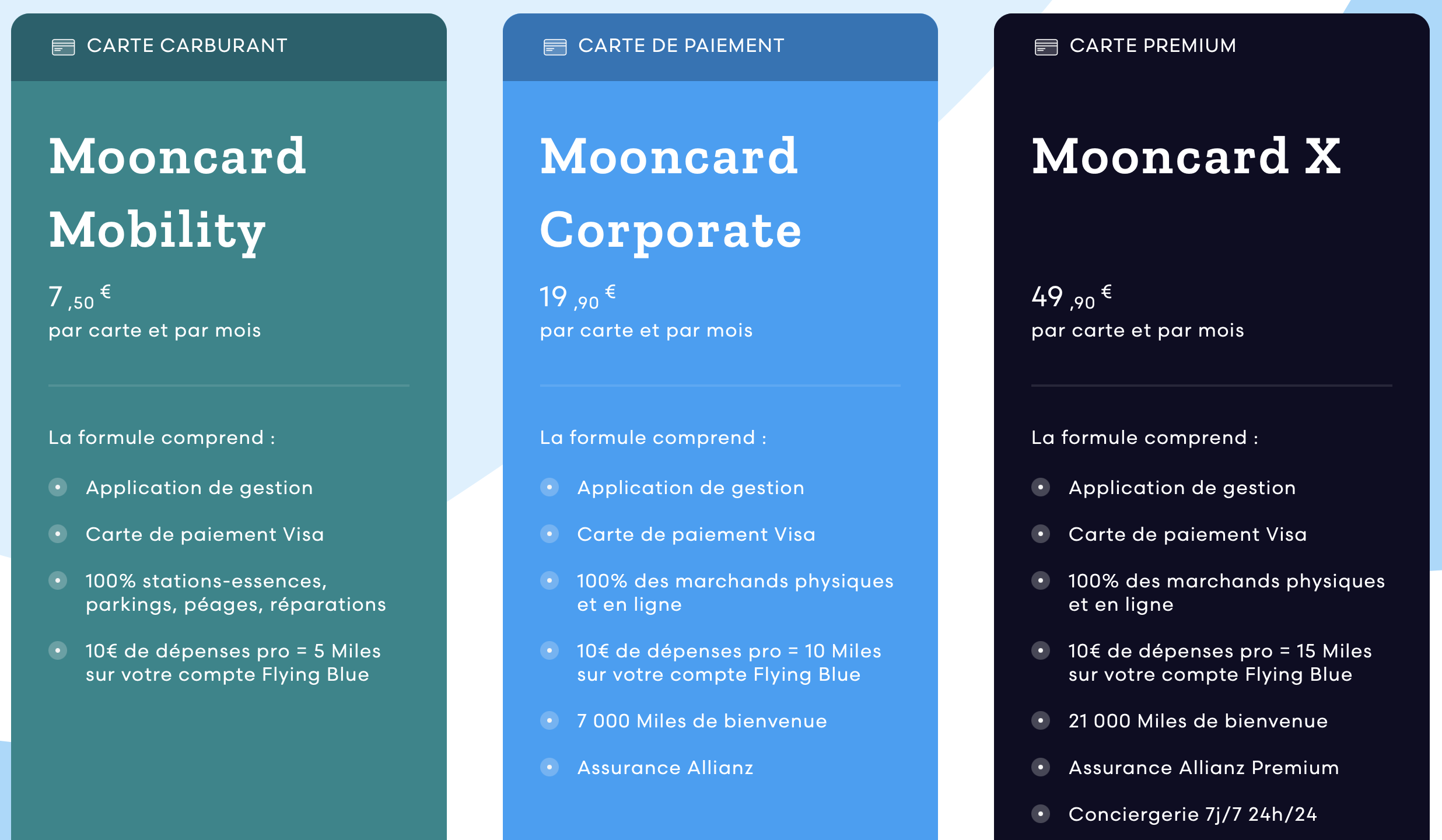
There’s one big difference — Mooncard relies on the Visa network. As many restaurants and shops don’t support American Express, it could be enough to lure customers away from American Express. Employees can use their miles for personal trips.
There are 3,000 companies using Mooncard as well as many public institutions.


