& meet dozens of singles today!
User blogs

Charlie, a personal finance app that began as a chatbot, is relaunching today with a revamped experience focused on the larger goal of helping everyday Americans get out of debt. To do so, Charlie presents users with a full picture of their current debt and how long it will take them to pay it off. Users then connect their bank account to Charlie for personalized assistance in reducing their bills. It also “gamifies” saving money to make the process of setting money aside for paying down debt more fun.
According to Charlie CEO Ilian Georgiev, the idea to turn saving into more of game arose from his prior experience in the mobile gaming industry. At a company called Pocket Gems, he helped scale apps that generated millions of dollars in revenue growth from across millions of users.

Image Credits: Charlie; CEO and co-founder Ilian Georgiev
“A really well-designed mobile game gets people to obsessively manage a virtual economy,” he explains. “And what I was curious about was how do we get people to do better in the real-world economy by using the same kind of tools?”
To help on that front, Charlie’s team includes people with backgrounds in not only computer science and engineering, but also in psychology. Using similar psychological tricks as found in gaming — rules, progress bars and reward mechanisms — the app helps nudge its users towards saving.
The original version of the Charlie app, launched in 2016, worked a little differently, however. It would analyze transaction data to look for areas where the user could improve their finances. It also worked over texting and through Facebook Messenger — platforms Charlie adopted with the idea that users needed a simpler way to connect with their finances.
“But the thing that we kept hearing over and over again, both qualitatively and quantitatively, is that the biggest concern that our users had is ‘how do I get out of debt? So then we said, instead of casting this really wide net…let’s laser focus on this one particular problem,” says Georgiev.
Today, the chatbot still lives on as a feature inside the new Charlie app, but it’s not the core experience.

Image Credits: Charlie
Instead, users begin by providing the app with information about their debt. Georgiev stresses that many Americans often know their debt down to the penny — whether that’s how much they have left on student loans, how much left on their car, how much credit card debt they have, and so on.
The app then calculates how long it would take to pay off this debt if you only made minimum payments. This number helps shock people into action, as they’ll often discover they’re going to be in debt for another 40 or 50 years.
“For most users, that’s an epiphany because they’ve never seen these numbers before, and the math required — even if you do it in Excel — the math required to figure that out is beyond most people,” Georgiev says.
The app then encourages users to learn how they can reduce the time it would take them to get out of debt by paying more than the minimums. By clicking a button, they can visualize the what happens if you pay, for example, $20 or $50 more per month.
The final step is to help users find that extra cash. In part, this may come from savings the app locates on users’ behalf. But it also comes from the money-saving “game.”
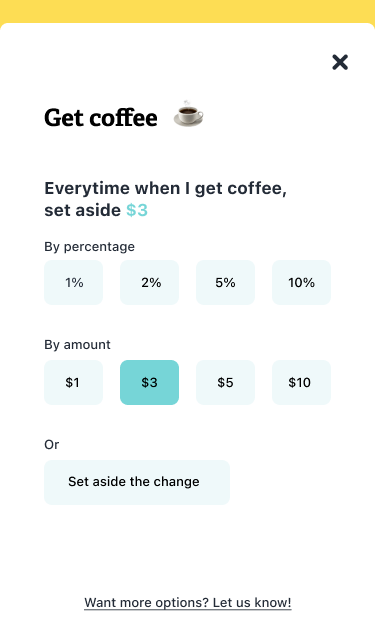
Charlie helps users create autosave rules which, when applied, auto-transfer money from the user’s connected bank account to Charlie’s digital wallet (an account held at partner bank, Evolve). These can be fun rules or even sort of ridiculous ones. For example, you could create “Guilty Pleasures” rules where Charlie will put away 10% every time you eat McDonalds, or it could save $1 for you every time a contestant on “The Bachelor” says they’re “here for the right reasons.”

Image Credits: Charlie
As those rules apply, money is saved and a little progress bar fills. The app rewards you with rainbow confetti as you achieve, also similar to some mobile gaming experiences.
At the end of the month, the user can take that saved money to make a larger payment towards their debt. Currently, Charlie doesn’t manage the bill pay aspects itself — which is a limitation. You have to transfer the funds back to your bank. But a bill pay feature is due to arrive in a couple’ months time, we’re told.
Later this year, Charlie plans to offer debt refinancing services to users. In this case, the team believes they can give the users lower interest rates because Charlie users will have proven, through their use of the app, that they’re lower risk.

Further down the road, Charlie aims to move more into neobank territory by issuing a debit card to users that works with users’ Charlie account. To differentiate from the growing number of neobanks, Charlie will continue to focus on paying down debt and savings.
Georgiev notes that the app’s business model is not built around user data collection, however. Data that’s ingested is sanitized and encrypted, and the app has a strict privacy policy. Plus, Charlie mainly helps people save money, but those funds are actually stored with a partner bank, not in Charlie itself. And because it’s involved in the act of moving money, it has to adhere to regulations around security and fraud prevention.
Today, Charlie charges a $4.99 per month subscription, which the company aims to make up for by helping people reduce their larger debt loads more quickly. However, even that small amount could give money-sensitive users pause, despite Charlie’s perks and successes.
To date, Charlie has registered a half million users for its older chatbot experience. It hopes to now grow that figure with its new tools.
The app is available on iOS and Android.
Source: https://techcrunch.com/2021/01/27/charlie-launches-a-mobile-app-that-gamifies-getting-out-of-debt/
Finesse, a startup promising to take the guesswork and waste out of fashion, is announcing that it has raised $4.5 million in seed and pre-seed funding.
Founder and CEO Ramin Ahmari said the tremendous waste in the fashion industry has become a badly-kept secret, with Burberry recently facing a backlash over its practice of burning unwanted products, and the industry as a whole producing an estimated 13 million tons of textile waste each year.
Finesse is looking to change that, Ahmari said, in part by taking advantage of the fact that that fashion trends are moving out of the “hermetically sealed” world of catwalks and onto social media, where new products take off “on the backs and bodies and posts” of influencers like Kylie Jenner.
“This is data we have access to,” he said. Noting that he previously worked in finance, Ahmari added that the stock market is “much more unpredictable” than the fashion industry — there just hasn’t been a tech startup applying tools like natural language processing and deep learning to fashion.
“In the simplest terms, you can think of what we do as seeing when Kylie posts a picture on Instagram and people go crazy about it … and then you see that happen not just on Kylie’s post but across Instagram, TikTok, Google Trends,” he said. “We predict the establishing of a trend before it goes super viral.”

Image Credits: Finesse
Finesse then uses this data to design new products. Ahmari said that by taking advantage of a “very fast supply chain,” along with tools like CLO 3D modeling software, Finesse can go from identifying a trend to having a product available for purchase in less than 25 days.
While the startup is officially launching today, it’s already been selling products through “drops,” where customers vote for and pre-order products that will only be available in limited quantities. Ahmari said Finesse focuses on selling unique pieces rather than staples, but because it’s confident about consumer demand, it can keep things much more affordable — the products currently for sale range from $8 to $116.
And unlike most fashion companies, Ahmari said that Finesse does not need to employ a giant design department, although he suggested that team members like Vice President of Product Andrea Knopf and Head of Product Development Brittany Fleck — who work in tandem with the startup’s algorithms —are “artists in their own right.”
“Unless we have true AI — which we’re very far from — you are never going to have a machine that’s purely creative,” he said. “You have to have feedback cycles … What we are eliminating is the job where it’s just an intern doing grunt work, all of these people just going through Instagram to find new fashion trends.”
Ahmari also said that with its emphasis on sustainability and connecting with the LGBTQ community (Ahmari identifies as queer and non-binary, and all of the startup’s products are designed for any gender), Finesse is aimed squarely at Gen Z consumers who are tired of fashion dictated by “white, older, cisgender men.”
The startup’s investors include former Twitter head of engineering Alex Roetter, Collective Health CEO Ali Diab, Hoxton Ventures, MaC Venture Capital, Mango Capital and Fab Fit Fun co-founder Sam Teller.
“We believe that FINESSE is truly the future of fashion, from its trend prediction to sustainable supply-chain and manufacturing,” said MaC Managing Partner Marlon Nichols in a statement. “We hope other fashion brands can learn from FINESSE’s disruption in the space and we’re eager to see what’s next.”
Source: https://techcrunch.com/2021/01/27/finesse-launch-seed-funding/
The top-line feature for Ring’s latest is no doubt its price. No way around that. At $60, it’s $40 cheaper than the standard Video Doorbell – and prices from there go up significantly, with the “Elite” running $350.
Perhaps the company is feeling some pressure from the race the bottom for smart home hardware pricing. Wyze, notably, has done the Wyze thing, launching a $30 doorbell along with a slew of other products in September. Though as of this writing, that device is still listed as a “pre-order.”
The Wyze device was expected to be available this month, but has since been pushed back to February. The Ring Video Doorbell Wired is also currently slated for next month, with a shipping date of the 24th. As the name suggests, the new product is only available in a hardwired option – which could be a deal breaker for some. Other standard features here include 1080p video with night vision, motion zones that trigger notifications and two-way audio with noise cancelation built-in. It’s also the company’s smallest doorbell to date.
The Amazon-owned company is, of course, not without its share of controversy. Earlier this month, we noted a security flaw that exposed the locations and home addresses of people using its Neighbors app. There has also been plenty of concern around the brand’s willingness to partner with the law enforcement. A number of civil rights penned an open letter in 2019. Earlier this year, Ring finally enabled end-to-end encryption that requires user opt-in.
The new doorbell will be available through Amazon (naturally) and will be a Home Depot in-store exclusively through late-March.
Source: https://techcrunch.com/2021/01/27/rings-new-doorbell-is-60/
Pinecone, a new startup from the folks who helped launch Amazon SageMaker, has built a vector database that generates data in a specialized format to help build machine learning applications faster, something that was previously only accessible to the largest organizations. Today the company came out of stealth with a new product and announced a $10 million seed investment led by Wing Venture Capital.
Company co-founder Edo Liberty says that he started the company because of this fundamental belief that the industry was being held back by the lack of wider access to this type of database. “The data that a machine learning model expects isn’t a JSON record, it’s a high dimensional vector that is either a list of features or what’s called an embedding that’s a numerical representation of the items or the objects in the world. This [format] is much more semantically rich and actionable for machine learning,” he explained.
He says that this is a concept that is widely understood by data scientists, and supported by research, but up until now only the biggest and technically superior companies like Google or Pinterest could take advantage of this difference. Liberty and his team created Pinecone to put that kind of technology in reach of any company.
The startup spent the last couple of years building the solution, which consists of three main components. The main piece is a vector engine to convert the data into this machine-learning ingestible format. Liberty says that this is the piece of technology that contains all the data structures and algorithms that allow them to index very large amounts of high dimensional vector data, and search through it in an efficient and accurate way.
The second is a cloud hosted system to apply all of that converted data to the machine learning model, while handling things like index lookups along with the pre- and post-processing — everything a data science team needs to run a machine learning project at scale with very large workloads and throughputs. Finally, there is a management layer to track all of this and manage data transfer between source locations.
One classic example Liberty uses is an eCommerce recommendation engine. While this has been a standard part of online selling for years, he believes using a vectorized data approach will result in much more accurate recommendations and he says the data science research data bears him out.
“It used to be that deploying [something like a recommendation engine] was actually incredibly complex, and […] if you have access to a production grade database, 90% of the difficulty and heavy lifting in creating those solutions goes away, and that’s why we’re building this. We believe it’s the new standard,” he said.
The company currently has 10 people including the founders, but the plan is to double or even triple that number, depending on how the year goes. As he builds his company as an immigrant founder — Liberty is from Israel — he says that diversity is top of mind. He adds that it’s something he worked hard on at his previous positions at Yahoo and Amazon as he was building his teams at those two organizations. One way he is doing that is in the recruitment process. “We have instructed our recruiters to be proactive [in finding more diverse applicants], making sure they don’t miss out on great candidates, and that they bring us a diverse set of candidates,” he said.
Looking ahead to post-pandemic, Liberty says he is a bit more traditional in terms of office versus home, and that he hopes to have more in-person interactions. “Maybe I’m old fashioned but I like offices and I like people and I like to see who I work with and hang out with them and laugh and enjoy each other’s company, and so I’m not jumping on the bandwagon of ‘let’s all be remote and work from home’.”
SAP today announced a new offering it calls ‘RISE with SAP,’ a solution that is meant to help the company’s customers go through their respective digital transformations and become what SAP calls ‘intelligent enterprises.’ RISE is a subscription service that combines a set of services and product offerings.
SAP’s head of product success Sven Denecken (and its COO for S/4Hana) described it as “the best concierge service you can get for your digital transformation” when I talked to him earlier this week. “We need to help our clients to embrace that change that they see currently,” he said. “Transformation is a journey. Every client wants to become that smarter, faster and that nimbler business, but they, of course, also see that they are faced with challenges today and in the future. This continuous transformation is what is happening to businesses. And we do know from working together with them, that actually they agree with those fundamentals. They want to be an intelligent enterprise. They want to adapt and change. But the key question is how to get there? And the key question they ask us is, please help us to get there.”
With RISE for SAP, businesses will get a single contact at SAP to help guide them through their journey, but also access to the SAP partner ecosystem.
The first step in this process, Denecken stressed, isn’t necessarily to bring in new technology, though that is also part of it, but to help businesses redesign and optimize their business processes and implement the best practices in their verticals — and then measure the outcome. “Business process redesign means that you analyze how your business processes perform. How can you get tailored recommendations? How can you benchmark against industry standards? And this helps you to set the tone and also to motivate your people — your IT, your business people — to adapt,” Denecken described. He also noted that in order for a digital transformation project to succeed, IT and business leaders and employees have to work together.
In part, that includes technology offerings and adopting robotic process automation (RPA), for example. As Denecken stressed, all of this builds on top of the work SAP has done with its customers over the years to define business processes and KPIs.
On the technical side, SAP is obviously offering its own services, including its Business Technology Platform, and cloud infrastructure, but it will also support customers on all of the large cloud providers. Also included in RISE is support for more than 2,200 APIs to integrate various on-premises, cloud and non-SAP systems, access to SAP’s low-code and no-code capabilities and, of course, its database and analytics offerings.
“Geopolitical tensions, environmental challenges and the ongoing pandemic are forcing businesses to deal with change faster than ever before,” said Christian Klein, SAP’s CEO, in today’s announcement. “Companies that can adapt their business processes quickly will thrive – and SAP can help them achieve this. This is what RISE with SAP is all about: It helps customers continuously unlock new ways of running businesses in the cloud to stay ahead of their industry.”
With this new offering, SAP is now providing its customers with a number of solutions that were previously available through its partner ecosystem. Denecken doesn’t see this as SAP competing with its own partners, though. Instead, he argues that this is very much a partner play and that this new solution will likely only bring more customers to its partners as well.
“Needless to say, this has been a negotiation with those partners,” he said. “Because yes, it’s sometimes topics that we now take over they [previously] did. But we are looking for scale here. The need in the market for digital transformation has just started. And this is where we see that this is definitely a big offering, together with partners. “


