& meet dozens of singles today!
User blogs

There are over 1.7 billion underbanked people globally, the majority of which are from emerging markets. For them, accessing loans can be difficult, which is a problem fintechs try to solve. One way they do this is by promoting financial inclusion by underwriting credit via a proprietary algorithm.
One such company is FairMoney, which describes itself as “the mobile banking revolution for emerging markets.” FairMoney, founded by Laurin Hainy, Matthieu Gendreau and Nicolas Berthozat, is a licensed online lender that provides instant loans and bill payments to underserved consumers in emerging markets.
Three years after launching its mobile lending service in Nigeria, the company set up shop in India, Asia’s second-most populous country in August 2020.
Before expanding, FairMoney experienced exponential growth in Nigeria in terms of loans disbursement. Last year, it disbursed a total loan volume of $93 million, representing a 128% increase from 2019 and a staggering 3,189% growth rate from its first year of operation in 2018. As it stands, the company is projecting a $140 million loan disbursement volume by the end of 2021.
“I think we’ve been able to disburse 25-30% more than some of our competitors and I think we’re a market leader,” Hainy, the company’s CEO told TechCrunch. But compared with traditional banks, it was the seventh-largest digital financial services provider in that area.
FairMoney has come a long way since its Nigeria launch in 2017. In its first year of operation, the company had little over 100,000 users. Now, it claims to have 1.3 million unique users who have made over 6.5 million loan applications. FairMoney offers loans from ₦1,500 ($3.30) to ₦500,000 ($1,110.00) with its longest loan facility standing at 12 months. Annual percentage rates fall within 30% to 260% — the high APR, Hainy says, is due to higher default rates in Nigeria. That said, FairMoney also claims to have an NPL ratio lower than 10%.
According to the CEO, data-driven insights was behind the choice to expand to India. The Indian market is quite similar to Nigeria’s. In the Asian country, only 36% of adults have access to credit, leaving an untapped market of about 141 million people microfinance banks do not serve. But unlike Nigeria, India has better unit economics for the lending business and a more friendly regulatory environment.
“If our ambition is to build the leading mobile bank for emerging markets, we need to start with very large markets,” Hainy said. “We tested our products in 10 different markets checking out for things like what the yield economics is like, NPLs, cost of risk, customer acquisition cost, cost of infrastructure and India stood out to us.”
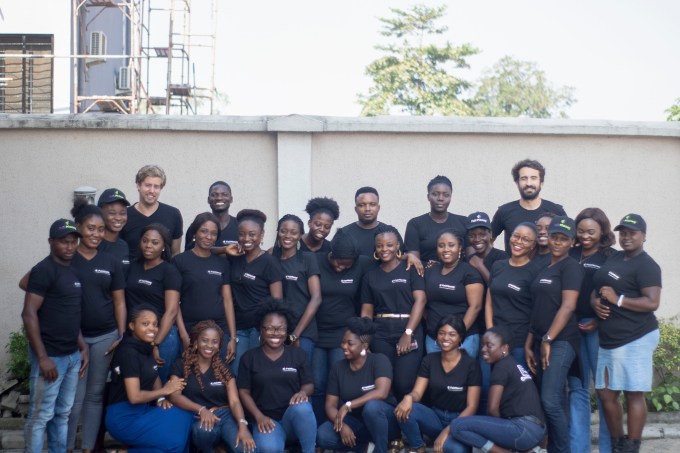
FairMoney Nigeria team
Following its expansion six months ago, FairMoney claims to have processed more than half a million loan applications from over 100,000 unique users. This number trickles down to $5,000 to $6,000 loan applications per day with APR standing at 12-36%. Hainy says the company has achieved this with zero ad spend or marketing.
Due to the daunting logistics behind international expansions, it’s challenging for an African-based startup to expand outside the shores of the continent. Although a rarity, there are a couple of startups to have undertaken such a task. Last year, Nigerian fintech Paga with 15 million users and a network of over 24,000 agents acquired Ethiopian software company Apposit to fast-track its expansion into Ethiopia and Mexico.
FairMoney is on a similar path, as well. And with over 100 staff spread across Nigeria, France, and Latvia, the company hopes to build an engineering and marketing team in India.
Last month, it hired the services of Rohan Khara to become its chief product officer (CPO) and facilitate the expansion. Khara was the former head of product for financial services for Indonesian super app Gojek and held senior roles at Microsoft, Quikr and MobiKwik. Hainy says with Khara’s wealth of experience building consumer products in large emerging markets — India and Indonesia — FairMoney is poised for massive growth in Nigeria and India.
“We both share the vision that financial services in emerging markets need fixing and for us, Rohan brings the expertise to see FairMoney scale from almost a million users to 10 or 20 million users.”
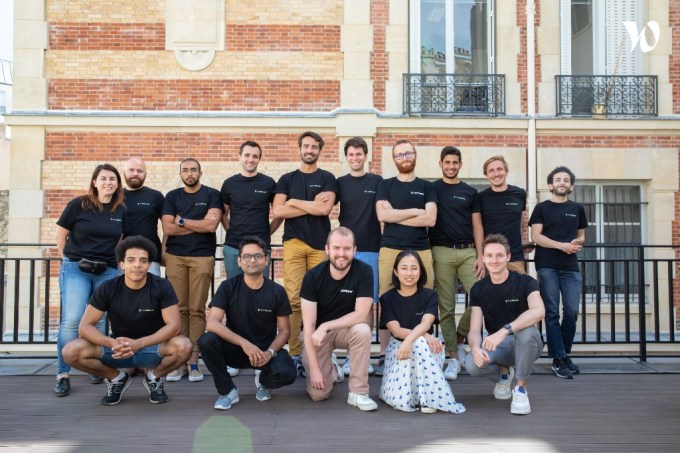
FairMoney French team
Born in Germany to a Nigerian father and German mother, Hainy began his entrepreneurial journey in 2015 by launching a food delivery company in Sweden. Seven months later, he founded Le Studio VC, a Paris-based startup studio and €15 million fund he ran as CEO for three years.
“After those three years, I realised that being an investor wasn’t for me yet. I felt I was too young and I wanted to build something myself,” he said.
Neobanks like Revolut in the UK and N26 in Germany were picking up across Europe. Hainy wanted to create such for Nigeria after noticing how much people lacked access to affordable financial services during a visit.
But despite studying other neobank models, Hainy and his team couldn’t replicate them in a developing market like Nigeria. Credit was still significantly underserved by Nigerian banks because of the strict methodology employed in allocating loans. Sensing an opportunity, they launched FairMoney as a neobank by leveraging a credit-first model. Like Nubank in Brazil, FairMoney started off offering loans to solve the access to credit problem. But its broader vision is not to be just a digital bank but also a commercial bank.
The company is working towards getting a microfinance bank license to operate as the former in Nigeria. However, according to the CEO, the commercial bank license will take longer maybe five to ten years.
“In the next five to ten years, I’d like to think two out of the five largest commercial banks in Nigeria will be neobanks. We want FairMoney to be one of them,” he said.
The Lagos and Paris-based company raised $11 million Series A in 2019. Between now and the time it will get a commercial bank license, Hainy says the company would’ve raised its Series B round to position itself for that task.
After India, which emerging market will FairMoney expand to next? There’s none in sight at the moment, the CEO says. The company plans to move from a credit-led value proposition to a full financial service provider, deepen its verticals, and replicate Nigeria’s growth in India for now.
The advance of short videos is reshaping how information is created, disseminated and consumed online. Snappy 15-second videos aren’t just for entertainment. On Chinese short-video apps Douyin and Kuaishou, people can get their daily dose of news, learn to cook, practice English, hunt for jobs, and seek practically any type of information from the platforms’ quickly expanding content library.
While people are increasingly used to being fed by machine-recommended videos, many users still have the urge and need for active searching. Douyin understood that and incorporated a search function back in mid-2018. More than two years later, the feature reached 550 million monthly active users. There’s still room for Douyin’s search feature to grow, as the app last reported 600 million daily users in September, so its monthly user base should be above that.
Kelly Zhang, the young product manager credited for the rise of Douyin, TikTok’s Chinese version, disclosed Douyin’s search user figure for the first time this week on her microblogging account. Search is a territory that had long been dominated by Baidu in China. As of December, Baidu’s flagship app had 544 million monthly active users, so it’s safe to say as many people are searching on Douyin as on Baidu.
Zhang’s remark is telling of Douyin’s ambition in conquering the online video sector, and eventually how people receive information: “I have said this before: I hope Douyin could become the video encyclopedia for human civilization. Video search is, therefore, the index of the book, the gateway to finding answers and reaping new knowledge.”
She further added that Douyin’s search engine is hiring for research and development, product, and operational roles in the upcoming year (China has just observed the Lunar New Year) as the video app continues to ramp up investment in search capabilities.
Short video platforms are already the second-most popular method for Chinese users to search online, trailing only after general search engines like Baidu and coming ahead of social networks and e-commerce, data analytics firm Jiguang said in a report last December. Baidu’s command of search is increasingly limited by the walled gardens built up by Chinese tech titans who block one another from free access to its sites and data. The status quo harms user experience but bodes well for vertical search engines on apps like Douyin and Alibaba’s Taobao marketplace, and consequently revenues from ad sponsorships.
ByteDance cut its teeth on using machine learning algorithms to recommend content through services like Douyin, TikTok and news aggregator Toutiao. The model proved highly efficient and lucrative, prompting its predecessors from Baidu to Tencent to introduce similarly algorithm-powered content feeds. ByteDance’s move into search, a realm with a longer history, is an intriguing yet natural step. The firm is just completing the puzzle for its digital media empire, giving people another option to find information. Users can receive machine recommendations and subscribe to content creators if they want. They can as well put in a search keyword if they have one in mind, the good old way.
Source: https://techcrunch.com/2021/02/17/short-video-search-douyin-tiktok/
Despite efforts from companies to create equitable environments, it’s clear that employees of a certain demographics, like Black women, sometimes have very different experiences from their counterparts. Glassdoor aims to better surface those experiences through a new feature that allows folks to filter ratings by demographics.
Up until now, Glassdoor only presented an overall ranking for a specific company, so there was no way to easily determine if, for example, Black women feel the same as white men, or if Latino men feel similarly to Asian men. In addition to race, Glassdoor now allows people to filter by gender identity, parental or caregiver status, disability, sexual orientation and veteran status.
Overall, Black employees are less satisfied at work in comparison to all employees, according to new preliminary research from Glassdoor. The research is based on the more than 187,000 employees across more than 3,300 companies who have provided demographic data.
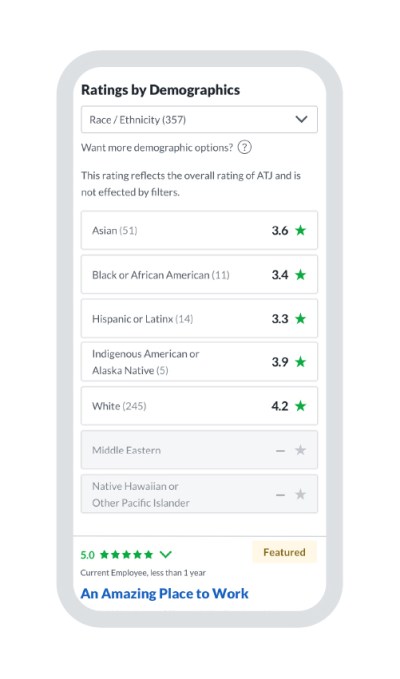
Image Credits: Glassdoor
That same research showed Apple had the highest overall company rating among Black employees, with an average rating of 4.2 out of five. Apple’s overall company rating from that sample size is 3.9.
“Because these data are so new — having been collected within just the last four months — it’s important to resist the urge to make sweeping claims based on early data,” Glassdoor Data Scientist Amanda Stansell and Chief Economist Andrew Chamberlain said in the report. “The averages we’ve reported above are not derived from representative probability samples of company workforces — they represent data shared anonymously by Glassdoor users at this time. Readers should therefore take some caution in making conclusive, company-wide inferences about the state of race and employee satisfaction.”
Source: https://techcrunch.com/2021/02/17/glassdoor-now-lets-you-filter-company-reviews-by-demographics/
Despite efforts from companies to create equitable environments, it’s clear that employees of a certain demographics, like Black women, sometimes have very different experiences from their counterparts. Glassdoor aims to better surface those experiences through a new feature that allows folks to filter ratings by demographics.
Up until now, Glassdoor only presented an overall ranking for a specific company, so there was no way to easily determine if, for example, Black women feel the same as white men, or if Latino men feel similarly to Asian men. In addition to race, Glassdoor now allows people to filter by gender identity, parental or caregiver status, disability, sexual orientation and veteran status.
Overall, Black employees are less satisfied at work in comparison to all employees, according to new preliminary research from Glassdoor. The research is based on the more than 187,000 employees across more than 3,300 companies who have provided demographic data.
Image Credits: Glassdoor
That same research showed Apple had the highest overall company rating among Black employees, with an average rating of 4.2 out of five. Apple’s overall company rating from that sample size is 3.9.
“Because these data are so new — having been collected within just the last four months — it’s important to resist the urge to make sweeping claims based on early data,” Glassdoor Data Scientist Amanda Stansell and Chief Economist Andrew Chamberlain said in the report. “The averages we’ve reported above are not derived from representative probability samples of company workforces — they represent data shared anonymously by Glassdoor users at this time. Readers should therefore take some caution in making conclusive, company-wide inferences about the state of race and employee satisfaction.”
Source: https://techcrunch.com/2021/02/17/glassdoor-now-lets-you-filter-company-reviews-by-demographics/
If you’ve ever tried to hop on the bus in San Francisco and were bummed to find that Apple Pay wasn’t an option: good news! That’s changing. Apple has announced that support for Clipper (the payment system for BART, Muni, Caltrain, AC Transit, and a bunch of other Bay Area transit agencies) is officially on the way. You’ll soon be able to just tap your iPhone or Apple Watch to the card reader and be on your way.
Apple says that Apple Pay will work across all 24 agencies where Clipper is accepted, meaning it should play friendly with:
- AC Transit
- BART
- Caltrain
- City Coach
- County Connection
- Dumbarton Express
- FAST
- Golden Gate Ferry
- Golden Gate Transit
- Marin Transit
- Muni
- Petaluma Transit
- SamTrans
- San Francisco Bay Ferry
- Santa Rosa CityBus
- SMART
- SolTrans
- Sonoma County Transit
- Tri Delta Transit
- Union City Transit
- Vine
- VTA
- WestCAT
- Wheels
Apple does mention that it’ll work with the optional “Express Transit” feature built into Wallet, allowing you to make these relatively small transit transactions without requiring Face ID or Touch ID verification — a nice touch for when there’s 10 people waiting to get on behind you and you’d rather not have to deal with convincing your phone that you are, in fact, you.
So when will it officially roll out? Good question — and one that Apple isn’t answering yet. In an e-mail announcing the coming Clipper support, they say it’s “Coming soon,” but don’t get any more specific than that. A tweet from the @BayAreaClipper account, meanwhile, narrows it down to “this spring” and reiterates that Google Pay support is coming soon, as well.
We’re going mobile! Clipper is coming to Apple Pay and Google Pay this spring. Stay tuned for more details! #clippercard
— Bay Area Clipper (@BayAreaClipper) February 17, 2021
Source: https://techcrunch.com/2021/02/17/apple-pay-will-soon-work-on-bart-and-muni/


