& meet dozens of singles today!
User blogs

Yext Answers allows businesses to provide a better search experience on their own websites — but as the name implies, the goal is really to make sure consumers get the answers they’re looking for.
“If we deliver a link [in response to a search query], we consider it a failure on our side,” Chief Strategy Officer Marc Ferrentino told me.
Ferrentino said the company will be able to do an even better job of that starting on March 17, with the launch of the “Orion” update to its search algorithm.
Yext will then be able to pull answers directly from unstructured pages on a business’ website. The key, he said, is that Yext can “extract structured information” from an unstructured document — whether that’s a webpage, a blog post or a help document — rather than just searching for keywords. So instead simply presenting a link or a “blob of text,” it will offer a “rich snippet” that actually answers your question.
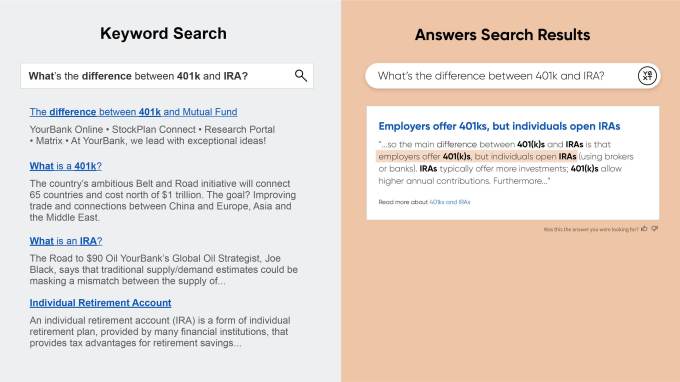
Image Credits: Yext
There’s a good chance that you’re familiar with something similar from Google’s consumer search experience, where the results often include a widget with questions and answers. Ferrentino welcomed the comparison, saying this will allow Yext customers to close the “experience gap” between Google’s search experience and their own.
To demonstrate the technology, Ferrentino showed me how Yext Answers could crawl pages about presidential history and then return the correct answer when asked, “Who was the only U.S. president to be impeached twice?”
Or for a more commercial (albeit slightly meta) example, he showed me how it could answer questions about Yext’s technology. As another example, Yext says it could search a bank’s website to answer a question about the difference between a 401(k) and Roth IRA.
And Yext co-founder and President Jon Brod noted that this change won’t just improve things for business and their customers, but also Yext’s non-profit clients, including the World Health Organization, which is using Yext to provide pandemic-related answers online.
Source: https://techcrunch.com/2021/02/18/yext-answers-orion/
Each year, millions of students in India rush to get an admission in universities abroad. Often they don’t know which program they should focus on, or the college that is right for their skillset and ambition.
Scores of legacy and newfound firms are attempting to offer counselling to these students. But despite India contributing more international students than any other country, most firms aiming to address this challenge are not focused on India, and struggle to understand some unique problems students in the world’s second most populous country face.
An Indian startup that is bridging this gap on Thursday said it has raised $6.5 million in a new financing round as it looks to scale its platform in the world’s second largest internet market.
Leverage Edu said Tomorrow Capital led the Delhi-headquartered startup’s Series A financing round. Existing investors Blume Ventures and DSG Consumer Partners also participated in the round.
Akshay Chaturvedi, founder and chief executive of Leverage Edu, told TechCrunch in an interview that he believes that eventually the firm that is going to serve the students best and emerge most successful will be the one that is physically closer to them, and not to the universities.
Chaturvedi, 30, began exploring this idea for this startup in 2015 and spent a little more than a year experimenting with different models. One of the earliest iterations of Leverage Edu offered mentorship to students and rewarded counselors with points.
Today, the startup offers a broad range of services in addition to offering personalized mentorship. Through its workshops, it helps students find the right college, guides them with complex applications and grade conversions, as well as assists with education loan, VISA, and accommodation. “It’s one digital dashboard. You get everything from flight tickets to local phone numbers, to education loan in one place,” he said.
“We believe it is inevitable that the next stellar brand in the global cross-border education space will be a home-grown one. We have a great belief in Akshay as a founder – he has a fantastic roadmap for scaling the business and the passion to build a truly global Indian edtech brand – and are excited about working with the Leverage Edu team on this journey,” said Rohini Prakash, chief executive of Tomorrow Capital, in a statement.
Leverage Edu helps students land admission in the most prestigious colleges, but also works with those that didn’t score the most marks.
“Students going to the top colleges is just 10% of the potential audience,” explained Chaturvedi, who spent his teen years attending talks from startup founders and also made money by bringing more people to those talks. “There are many universities that don’t have the best branding. To connect them with students, we have our SaaS offering Univalley.com,” he said.
The startup plans to deploy the fresh capital to help students find colleges in more geographies including the UK and Australia, he said.
“We want to focus on a few things and do them really really well. There is also this myth around foreign education being expensive that we’ve been busting for last four years. 18 months from now, we want to be among the top study abroad companies in India, both by number of students and a roof-hitting NPS – because a happy student is why we are all really motivated everyday to do this!”, he added.
Source: https://techcrunch.com/2021/02/18/indias-college-admission-platform-leverage-edu-raises-6-5-million/
Each year, millions of students in India rush to get an admission in universities abroad. Often they don’t know which program they should focus on, or the college that is right for their skillset and ambition.
Scores of legacy and newfound firms are attempting to offer counselling to these students. But despite India accounting for more students than any other country, most firms aiming to address this challenge are not focused on India, and struggle to understand some unique problems students from the world’s second most populous country face.
An Indian startup that is bridging this gap on Thursday said it has raised $6.5 million in a new financing round as it looks to scale its platform in the world’s second largest internet market.
Leverage Edu said Tomorrow Capital led the Gurgaon-headquartered startup’s Series A financing round. Existing investors Blume Ventures and DSG Consumer Partners also participated in the round.
Akshay Chaturvedi, founder and chief executive of Leverage Edu, told TechCrunch in an interview that he believes that eventually the firm that is going to serve the students best and emerge most successful will be the one that is physically closer to them, and not to the universities.
Chaturvedi, 30, has been experimenting with the right model for his startup for over five years. One of the earliest iterations of Leverage Edu offered mentorship to students and rewarded counselors with points.
Today, the startup offers a broad range of services in addition to offering personalized mentorship. Through its workshops, it helps students find the right college, guides them with complex applications and grade conversions, as well as assists with education loan, VISA, and accommodation. “It’s one digital dashboard. You get everything from flight ticket to local phone number, to education loan in one place,” he said.
“We believe it is inevitable that the next stellar brand in the global cross-border education space will be a home-grown one. We have a great belief in Akshay as a founder – he has a fantastic roadmap for scaling the business and the passion to build a truly global Indian edtech brand – and are excited about working with the Leverage Edu team on this journey,” said Rohini Prakash, chief executive of Tomorrow Capital, in a statement.
Leverage Edu helps students land admission in the most prestigious colleges, but also works with those that didn’t score the most marks and find high-profile colleges.
“Students going to the top colleges is just 10% of the potential audience,” explained Chaturvedi, who spent his teen years attending talks from startup founders and also made money by bringing more people to those talks. “There are many universities that don’t have the best branding. To connect them with students, we have Univalley.com,” he said.
The startup plans to deploy the fresh capital to help students find colleges in more geographies including UK and Australia, he said.
“We want to focus on a few things and do them really really well. There is also this myth around foreign education being expensive that we’ve been busting for last four years. 18 months from now, we want to be among the top study abroad companies in India, both by number of students and a roof-hitting NPS – because a happy student is why we are all really motivated everyday to do this!”, he added.
Source: https://techcrunch.com/2021/02/18/indias-college-admission-platform-leverage-edu-raises-6-5-million/
With offline events now firmly moved to online for the foreseeable future, startups in the networking space had to pivot fast in the face of the pandemic. One of those was Grip, previously better known as a networking app for physical conferences (including TechCrunch Disrupt, at one point). Since last year, Grip moved into an ‘omnichannel’ experience, combining various event types across virtual, hybrid, and live. That strategy appears to have paid off as it has now raised a $13 million Series A funding round, taking its total amount raised to $14.5 million.
The round was led by London-based growth equity fund Kennet Partners. The raise is reflective of the boom in online events, which saw London-based startup Hopin raise a $40m Series A last year. Founded in 2016, Grip counts some large event organizers as clients including Reed Exhibitions and Messe Frankfurt.
In a statement Tim Groot, CEO and founder of Grip, said: “Our mission is to empower organizers to bring professionals together to advance industries. This funding round is going to enable us to take the experience to a new level, leveraging our extensive industry-leading platform, offering unique value for Virtual, Hybrid and In-Person events.”
He said they would now be investing heavily in the product and looking to global expansion.
Other competitors to Grip have, in the past, included Brella which raised $1.5m, and Swapcard which raised $6m to date.
So why is it that Grip seems to have pulled away from pack in this way?
Groot told me: “We took a slightly different approach in that we managed to work in a plug-and-play method alongside other platforms. So grip gets used as a standalone virtual event platform by lots of these organizers. So they might use Hopin for the conference but Grip for the networking. So maybe we managed to get more traction that way, over the course of 2020.”
In 2020, following the pivot to virtual events, Grip hosted over 100 events a month and was used by 1.5m people. As a result, the company says revenue grew almost 4x in 2020, and this year it expects to do over 10,000 events on its platform with over 5 million participants.
Grips AI-powered algorithms mean attendees get more personalized matchmaking recommendations based on their interests, including pre-event meeting scheduling. For exhibitors, the software captures business leads and provides post-event analytics.
People can be added to meetings to have group conversations and the startup is also working on a topic-based “speed networking” functionality to hold instant 3 minute conversations.
Grip integrates with various streaming platforms such as Vimeo, Youtube, Zoom, BlueJeans and others, unlike “full-service” platforms such as Hopin or Bizzabo.
Hillel Zidel, Partner at Kennet and Grip board member, added: “Grip’s ability to organize virtual events with a key focus on networking has meant that the company has seen tremendous growth over the last year. Event organizers and their clients have been able to remain connected with their customers despite the constraints on in-person events. As live events resume in the future, Grip is extremely well-positioned to continue to assist event organizers through the provision of software solutions supporting live, virtual and hybrid events.”
Brent Hoberman, co-founder of Founders Factory and a previous investor, said: “Grip was born out of a need we saw in running events at Founders Forum – how do you use smart technology to catalyze the most relevant and valuable connections between your guests?”
Earlybird Digital East Fund — a fund associated with Germany’s Earlybird VC, but operating separately — has launched a €200m ($242m) successor fund. The fund’s focus will remain the same as before: a Seed and Series-A fund focusing on what’s known as ‘Emerging Europe’, in other words, countries stretching from the Baltics to Central and Eastern Europe, and Turkey. The firm has also promoted Mehmet Atici, who’s been with the firm for eight years, to Partner. The new fund has made four investments so far: FintechOS, Payhawk, Picus, and Binalyze.
The back-story to DEF is a fascinating tale of what happened to Europe in the last 15 years, as tech took off and Europeans returned from Silicon Valley.
Following his exit from SelectMinds (where he was the Founder & CEO) in 2005, Cem Sertoglu moved back to Turkey. Although he says he “accidentally became the first angel investor” there, he was clearly the right man, in the right place, at the right time. He told me: “I was very lucky and ended up writing the first checks in some of the first large outcomes in Turkey.”
In 2013, Sertoglu partnered with Evren Ucok (the first angel in Peak Games and Trendyol), and Roland Manger (Earlybird). Dan Lupu, a Romanian investor who had covered the region for Intel Capital, joined them, and together they raised the ‘Earlybird Digital East Fund I’ set at $150m fund in 2014, focusing on CEE and Turkey. This was and is an area where there can be high-quality ventures to be found, but very little in the way of VC.
Thereafter, between 2014 and 2019, the fund invested in UiPath, Hazelcast, and Obilet. UiPath has become a global leader in the area known as ‘Robotic Process Automation (RPA). Hazelcast is a low latency data processing platform startup with Turkish roots. Obilet is a marketplace focused for the massive Turkish intercity bus travel market. DEF has also exited Vivense, Dolap, and EMbonds and in more recent times the fund has exited Vivense, the “Wayfair of Turkey” to Actera, the top local PE fund.
The team had spectacular early success. Peak Games, Trendyol, YemekSepeti and GittiGidiyor are the four largest Turkish tech exits to date. Digital East Fund was an investor in all of them. Peak games exited for $1.8 billion in cash to Zynga only last year.
As of Q4 2020, the fund’s metrics are:
Investment Multiple: 24.9x
Gross IRR: 104.4%
Net IRR: 84.1%
So in VC terms, they have done pretty well.
I interviewed Sertoglu to unpack the story of Earlybird Digital East Fund.
He told me DEF has achieved a 17 times investment multiple on a $150 million fund. He thinks “this might be the biggest European VC fund performance in history, and it’s not coming from Berlin, it’s not coming from London, but it’s coming from Eastern Europe. We have been told by some of our LPs that they think we’re the top 2014 vintage VC fund in the world, nobody’s seen stronger numbers than this.”
“Peak Games turned out to be a phenomenal story. When you look at how tough it’s been for Turkey, macroeconomically. The fact that a single company with 100 people essentially sold for $1.8 billion in cash, was just… it was staggering for the local market here.”
DEF’s emergence from Turkey, together with its relationship with a fund in Berlin, was not the most obvious path for the VC fund.
“One thing we realized early one was that we could invest with our own capital and syndicating to our friends, but for follow-on funding, we’d always have to go global. And that made us feel vulnerable. It made us feel we were always dependent on others’ comprehension of the opportunity that we were facing. So that’s when the first fund idea came out this was,” said Sertoglu.
“We felt that there was this unusual dislocation between opportunity and capital in Eastern Europe. Our first fund was $150 million funds – I mean, a very quaint size compared to Western markets. But we became the largest fund in the region, and decided to focus on this series A gap where we felt that there was this big opportunity, because of the way we think series A is still very much a local play.”
“Being a local player that understands the region would be an advantage, so this was proven to be true. We could essentially see pretty much everything in Eastern Europe for the last eight years. And we caught the biggest one, fortunately, which was UiPath. I think very few funds around the world can say that they see the majority if not all of the opportunities that fall into their mandate,” he said.
“We have this dual strategy of backing local champions as well as contenders for global markets as well. 20 years ago you had to be in Silicon Valley. Now, Transferwise comes out of Estonia, UiPath comes out of Romania. And that was even before the pandemic.”
Sertoglu concluded: “So we now have fresh capital, coming on the heels of a very successful first fund, which we’re keen to deploy. We’re calling all the opportunities, seeing very ambitious, strong teams coming out of the region. And we have 200 million euros to focus on these types of opportunities in the region.”


